
The Ultimate Xamarin Job Hunt: Where to Find the Best Remote Roles
The Real State of Remote Xamarin Jobs in 2026
If you’re hunting for remote Xamarin jobs, here’s the fast answer:
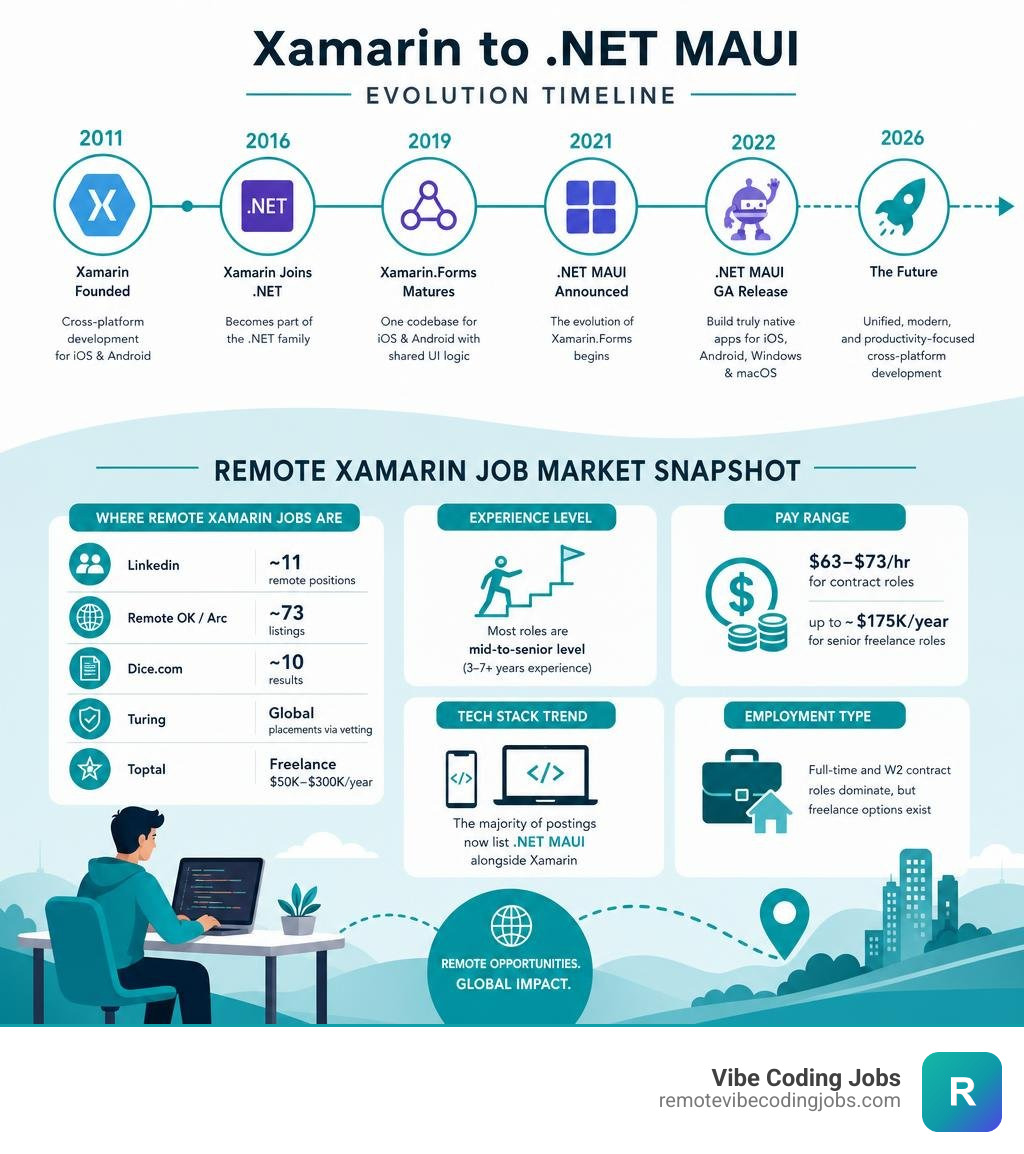
Where to find remote Xamarin jobs right now:
| Platform | Remote Xamarin Listings |
|---|---|
| ~11 remote positions | |
| Dice.com | ~10 results |
| Major Job Boards | ~70+ listings |
| Global Talent Networks | Vetted placements & freelance |
What to expect:
- Most roles are mid-to-senior level (3–7+ years experience)
- Pay ranges from $63–$73/hr for contract roles up to ~$175K/year for senior freelance positions
- The majority of postings now list .NET MAUI alongside Xamarin
- Full-time and W2 contract roles dominate, but freelance options exist
The Xamarin job market is smaller than it used to be — but it’s far from dead. With only around 86 total U.S. listings and roughly 11 fully remote positions on LinkedIn alone, competition is real. The good news? Most developers have already moved on, which means staying sharp in Xamarin — especially with MAUI migration skills — makes you a rare and valuable hire.
Here at RVCJ Editorial, we cover remote developer hiring trends and AI-assisted workflows, including tracking niche markets like remote Xamarin jobs where the right skills still command strong rates. Let’s break down exactly where to look and how to land these roles.
Remote xamarin jobs word list:
Navigating the Market for Remote Xamarin Jobs

Finding a remote position in a specialized ecosystem requires knowing exactly where the demand lies. While generalist job boards may only yield a handful of active listings, understanding the broader shift in how companies hire for the .NET mobile ecosystem makes all the difference.
Currently, the market is divided into two main camps: enterprise organizations maintaining massive legacy codebases, and businesses actively migrating their infrastructure to modern frameworks.
To successfully navigate this landscape, you need to look where the volume is. Standard platforms like the 72 Xamarin jobs in United States – LinkedIn list and xamarin jobs | Dice.com provide a strong baseline for traditional, corporate roles. For developers seeking global flexibility or high-end freelance contracts, specialized networks offer a more direct route to vetted clients.
Below is a breakdown of how demand currently shapes up across different framework versions and job requirements:
| Metric / Feature | Legacy Xamarin (.Forms / Native) | Modern .NET MAUI |
|---|---|---|
| Primary Focus | Maintenance, bug fixing, legacy API support | Greenfield development, active migration |
| Market Demand | Low to moderate (mostly enterprise) | High and rising across all sectors |
| Average Experience Required | 5+ years (Senior heavy) | 3+ years (with C#/.NET background) |
| Typical Remote Flexibility | Highly remote (due to talent scarcity) | Hybrid to fully remote |
| Common Tooling | Visual Studio 2022, Mono, older NuGet packages | Visual Studio 2022, .NET 8+, modern CI/CD |
Current Job Titles and Salary Ranges
When searching for remote Xamarin jobs, you will encounter several distinct titles. Each carries different expectations regarding architecture, backend integration, and migration planning:
- Software Engineer / Mobile Developer: These generalist roles often require a mix of frontend mobile skills and backend C# knowledge.
- Senior Xamarin Developer / Architect: Highly specialized roles focused on app performance, complex integrations, and codebase modernization.
- Full-Stack Mobile Software Engineer: Positions that bridge mobile client development with cloud-based services and APIs.
Compensation remains highly competitive due to the scarcity of experienced .NET mobile developers. For instance, senior roles in elite freelance networks value this skillset up to $175,000 per year globally.
On the contract side, hourly rates are equally robust. Postings like the Remote Xamarin/Android Engineer at ntt data north america |… offer rates ranging from $63/hr to $73/hr, depending on your experience with C# and Web APIs.
Contract vs. Full-Time Remote Xamarin Jobs
As a remote developer, you have to decide between the stability of full-time employment and the flexibility of contract work. Both models are highly active in the Xamarin space, but they serve different business needs:
- W2 Contract Roles: Often utilized by large consulting firms or enterprises that need immediate help with a specific project or migration phase. An example is the hybrid/remote Mobile App Developer (Xamarin iOS, MAUI, Azure PaaS, SQL) | Hourspent | Hirebase, which demands deep expertise in both mobile clients and Azure backend services.
- Full-Time Remote Roles: Preferred by companies that view their mobile app as a core, long-term product. These positions, such as the Mobile Application Developer III (.NET MAUI) | Hireza, prioritize long-term architectural stability, continuous testing, and gradual system upgrades.
- Freelance / Gig Networks: Specialized global platforms connect developers with clients who need highly specialized troubleshooting or short-term architectural guidance without the overhead of a full-time hire.
Technical Requirements and Skills in Demand

To land a high-paying remote role, you must demonstrate a comprehensive understanding of the Microsoft development ecosystem. Modern mobile development is rarely just about the client-side UI; it requires a deep integration with cloud services, local databases, and robust architectural patterns.
Core Tech Stack and Tools
If you are applying for remote Xamarin jobs, your resume should highlight proficiency in the following core technologies:
- Languages & Frameworks: Strong mastery of C# and the .NET framework is mandatory. You should be comfortable writing clean, asynchronous code and utilizing modern C# features.
- Architectural Patterns: MVVM (Model-View-ViewModel) is the industry standard for cross-platform applications. You must know how to implement clean data binding, commands, and dependency injection.
- Local & Cloud Data: Experience with SQLite for local data caching and SQL Server for relational databases is highly sought after. On the backend, familiarity with Azure PaaS (Platform as a Service) is a massive differentiator.
- Development Tools: Daily usage of MS Visual Studio, Git, GitLab, and Jira for project management is standard across remote teams.
These core skills are consistently highlighted in competitive listings, such as the Senior Xamarin Developer at Jobs via Dice – United State | Visa Sponsorship Jobs, which emphasizes the balance between mobile-specific UI development and solid backend integration.
The Transition to .NET MAUI
As Microsoft continues to push its unified .NET ecosystem, the transition from Xamarin.Forms to .NET MAUI (.NET Multi-platform App UI) has become a primary focus for engineering teams.
Many companies are actively seeking developers who can audit legacy Xamarin codebases, resolve deprecated dependencies, and port the application over to .NET MAUI. If you have hands-on experience with the .NET Upgrade Assistant or manual migration of custom renderers to MAUI handlers, make sure to put that at the top of your resume.
This trend is highly visible in modern job specifications like the Full-Stack Mobile Software Engineer | Wfhverse, where MAUI is treated as a core requirement for new development cycles.
Challenges and Opportunities in Remote Xamarin Hiring
The market for remote Xamarin talent presents unique dynamics for both employers and job seekers. Because the framework is in a transitional phase, finding the right match requires navigating specific challenges.
Why Companies Struggle to Hire Xamarin Talent
Many organizations face a severe talent shortage when it comes to maintaining or upgrading their Xamarin apps. Because newer developers often flock to React Native or Flutter, the pool of skilled .NET mobile engineers has shrunk.
Furthermore, companies struggle to find developers who possess both the legacy knowledge required to debug older Xamarin.Android or Xamarin.iOS apps and the modern skills needed to migrate those systems to .NET MAUI. This skill gap often leads to prolonged hiring cycles and premium compensation for those who actually possess this dual expertise.
How to Stand Out When Applying for Remote Xamarin Jobs
If you want to secure the best remote offers, you need to present yourself as a highly independent, communicative professional. Here is how to stand out:
- Build a Targeted Portfolio: Show off real-world projects that demonstrate clean MVVM architecture, offline data synchronization, and integration with third-party APIs.
- Demonstrate Async Communication Skills: Remote teams rely heavily on written communication. Emphasize your ability to document code, write clear pull requests, and collaborate across time zones.
- Highlight Vetting and Language Proficiency: Many global platforms emphasize that a strong command of English (minimum B1 level) and passing technical screening tests are vital for securing placements with premium clients.
- Position Yourself as a Migration Expert: Frame your Xamarin experience not just as a maintenance skill, but as a bridge to modern .NET MAUI development.
Frequently Asked Questions about Xamarin Careers
Is Xamarin still relevant in 2026?
Yes, but its relevance has shifted. While Microsoft has officially transitioned its focus to .NET MAUI, thousands of enterprise applications still rely on legacy Xamarin codebases. Developers who can maintain these systems and guide companies through the migration process are in incredibly high demand.
What is the average salary for a remote Xamarin developer?
For mid-to-senior level roles, salaries typically range from $100,000 to $150,000+ per year for full-time positions. Elite freelance roles can scale up to ~$175,000/year, while contract positions frequently offer hourly rates between $60 and $80 per hour.
Can I transition from Xamarin to .NET MAUI easily?
Yes. Because .NET MAUI is the evolutionary successor to Xamarin.Forms, much of your C# and XAML knowledge carries over directly. The primary differences lie in the single-project architecture, updated hosting models, and the replacement of custom renderers with modern handlers.
Conclusion
The market for remote Xamarin jobs in 2026 is highly specialized, rewarding developers who bring deep .NET expertise and migration capabilities to the table. Whether you are aiming for high-paying freelance contracts or stable full-time roles, having the right technical foundation is key.
If you are ready to take your career to the next level and embrace the future of software development, consider exploring “vibe coding”—the art of building software rapidly using advanced AI tools like Claude and Cursor.
At RemoteVibeCodingJobs, we aggregate the best remote opportunities at async-first companies that encourage modern, AI-assisted workflows. Find remote vibe coding jobs today, access our free playbook, and apply to roles that match your modern tech stack!