Why Finding Remote RPA Developer Jobs is Harder Than Coding Them
The Remote RPA Developer Job Market Is Bigger Than You Think – But Harder to Navigate
Finding work as a remote RPA developer is one of those things that sounds simple until you’re actually doing it.
Quick answer for job seekers:
| What you want to know | The short answer |
|---|---|
| How many remote RPA jobs exist right now? | ~252 in the US, with 99% fully remote |
| What tools do you need? | UiPath, Automation Anywhere, Python, SQL, Power Automate |
| What experience level is in demand? | Mostly mid-senior (61% of roles) |
| Where are jobs posted? | Major job boards and company career pages |
| How fast is the market moving? | 70 new jobs posted in the past 24 hours alone |
| What types of roles are available? | 81% full-time, 18% contract |
The demand is real. Jobs are being posted daily. But the search itself is full of friction – mismatched titles, hidden hybrid requirements, and a heavy skew toward experienced candidates that leaves a lot of developers staring at filters wondering why nothing fits.
This guide cuts through that noise.
I’m part of the RVCJ Editorial team at Remote Vibe Coding Jobs, where we track global hiring trends for async-first developer roles – including the growing market for remote RPA developer positions across major hiring platforms. We cover what’s actually changing in the job market so you can spend less time searching and more time shipping.
What a Remote RPA Developer Actually Does
A remote RPA developer builds and maintains software bots that automate repetitive business tasks. In plain English: they teach software to click, type, read data, move files, call APIs, and route work so humans do less copy-paste and more actual thinking.
That sounds simple, but the role is wider than “build a bot.”
Most remote RPA developers spend time on:
- Process analysis
- Workflow mapping
- Bot design and development
- Testing and deployment
- Production monitoring
- Fixing failed automations
- Writing documentation
- Working with business stakeholders
They often sit between business operations and engineering. One minute they are discussing invoice processing with operations teams. The next, they are debugging selectors in UiPath or writing Python to clean messy input data. Glamorous? Sometimes. Useful? Extremely.
Core responsibilities of a remote rpa developer
Across current job listings, the responsibilities are fairly consistent:
- Design automation logic
- Build bots in an RPA platform
- Test workflows before release
- Deploy to production
- Monitor runs and exceptions
- Improve resilience with retry logic and better error handling
- Maintain SOPs, runbooks, and technical docs
Common hands-on tasks include:
- Building UiPath workflows
- Creating Automation Anywhere bots
- Using SQL to query, update, or validate data
- Writing Python or .NET scripts for custom logic
- Connecting bots to APIs and third-party systems
- Optimizing queues, schedules, and orchestration
- Supporting business users when a process changes
Research from live postings also shows that employers increasingly want maintainable automation, not just “something that works on my machine.” That means logging, exception handling, clean naming, modular workflows, and clear documentation matter more than ever.
How remote delivery changes the job
Remote work changes RPA more than many people expect.
In an office, someone can lean over and say, “The claims bot is failing again.” Remotely, that same issue needs:
- A ticket
- A screen recording
- A runbook
- Logs
- Clear ownership
- A timezone-aware handoff
That is why remote RPA teams lean hard on async habits:
- Documented SOPs
- Loom-style walkthroughs
- Written requirements
- Shared dashboards
- Better status updates
- Strong stakeholder communication
Some remote jobs are globally distributed, but many still ask for overlap with EST or CST. We saw examples where the role was fully remote but required sitting in a specific timezone. So “remote” does not always mean “work from a beach while your bot handles everything.” Sometimes it means “be online when finance notices the reconciliation flow exploded.”
Why Remote RPA Developer Jobs Feel Hard to Find in 2026
The hard part is not that jobs do not exist. The hard part is that they are hidden behind messy titles, overloaded filters, and inconsistent requirements.
Here is why the market feels harder than it looks:
- Titles vary wildly: RPA Developer, UiPath Developer, Automation Engineer, Intelligent Automation Developer, Bot Developer, Process Automation Engineer
- Some “remote” roles are actually hybrid or timezone-restricted
- Many jobs require 3 to 6+ years of experience
- Contract roles are common
- Job boards duplicate listings
- Search filters often miss tool-specific titles like “UiPath Developer”
So yes, there are jobs. No, they are not always easy to find with one clean search.
The current remote rpa developer market snapshot
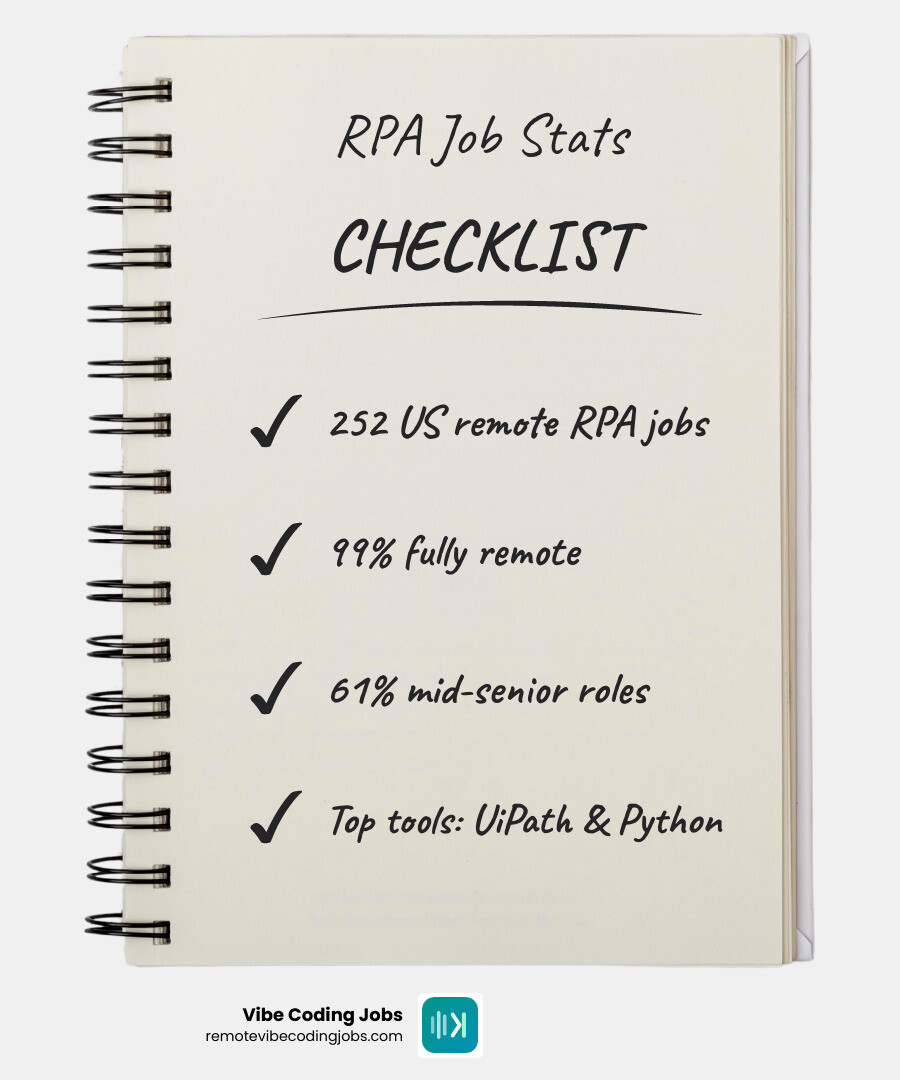
Based on the research snapshot for May 2026, the remote RPA market is active:
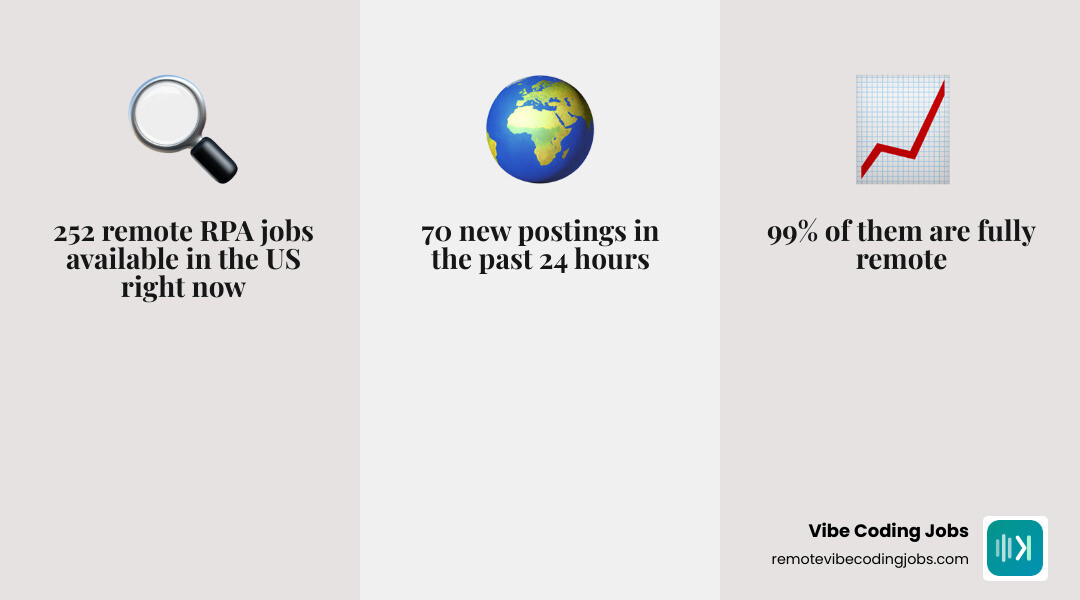
- 252 RPA remote jobs available in the United States
- 250 out of 252 are fully remote, or about 99%
- 70 new jobs were posted in the past 24 hours
- 120 were posted in the past week
- 205 were posted in the past month
- 203 of 252 roles are full-time, about 81%
- 45 of 252 are contract, about 18%
- 155 of 252 are mid-senior level, about 61%
That last number explains a lot. The market is not empty. It is seniority-skewed.
Here is a simple comparison view:
| Platform or source | Snapshot from research | What it suggests |
|---|---|---|
| General remote RPA search results | 252 US jobs | Broad market snapshot for general RPA remote hiring |
| Broader search headline totals | 618 US jobs | Search results can vary by filter, freshness, and keyword scope |
| Tool-specific remote UiPath searches | 324 jobs | Tool-specific searches can surface more specialized demand |
| Easy Apply subset in tool-specific searches | 193 of 324 roles | Lower application friction on a large share of listings |
The mismatch between 252, 324, and 618 is not necessarily a contradiction. It usually means different search terms, different filters, and different inclusion logic. “RPA remote” is broader than “remote RPA developer,” while “UiPath developer remote” is narrower in title but wider in volume on some boards because UiPath dominates many listings.
Where the jobs are posted and how demand differs
Most remote RPA developer jobs show up in a few predictable places:
- Major job boards
- Company career pages
- Remote job communities
- Staffing and contract marketplaces
Each has tradeoffs.
Large job boards give broad market visibility and time-posted filters. Technical hiring marketplaces tend to surface more contractor and tool-specific openings. Company pages are useful for direct applications, but slower to discover. Niche remote boards can have less competition, but lower volume.
The application experience also differs. In some tool-specific searches, 193 out of 324 remote UiPath roles were marked with Easy Apply, which reduces friction. But reduced friction also means more applicants. Convenient for you, convenient for 400 other people too.
Our advice: search by tool and by business outcome, not just by title.
Useful keyword combinations include:
- remote rpa developer
- remote uipath developer
- automation anywhere remote
- intelligent automation developer remote
- process automation engineer remote
- python workflow automation remote
The Skills, Tools, and Certifications Employers Want Most
If we strip away the buzzwords, employers want three things:
- Someone who can build reliable automations
- Someone who understands business processes
- Someone who can work remotely without creating chaos
The most in-demand stack for a remote rpa developer
The most common technical stack in current postings includes:
- UiPath
- Automation Anywhere A360
- Microsoft Power Automate
- Python
- SQL
- .NET
- C#
- VB.NET
- APIs
- Logging and monitoring tools
UiPath appears to be the strongest single platform signal in the research. It showed up repeatedly across senior and mid-level roles. Automation Anywhere is also important, especially in enterprise and healthcare-style postings. Power Automate appears frequently where organizations are heavily tied to Microsoft ecosystems.
Python is increasingly important because modern automation work goes beyond dragging boxes across a canvas. Employers want developers who can:
- Parse and transform data
- Build helper scripts
- Handle edge cases
- Call APIs
- Support AI or LLM integrations
Some newer listings also mention AI-assisted development or LLM integrations. That does not replace traditional RPA skills, but it expands the job into automation engineering. If you can combine RPA platforms with Python, API integrations, and AI tooling, you become much harder to ignore.
For readers who want a neutral background on the category itself, robotic process automation is the broader discipline behind these tools and workflows.
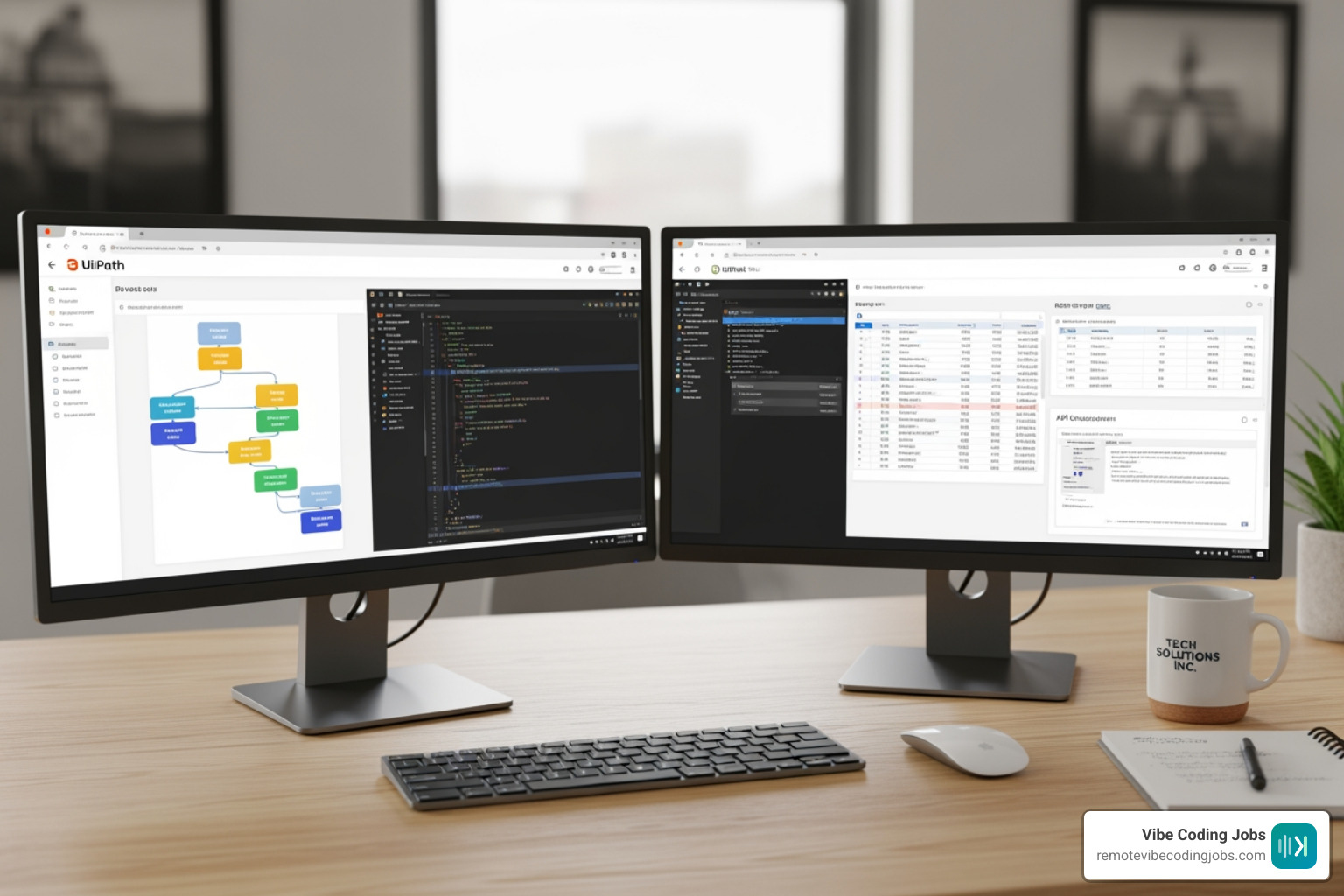
Other commonly requested technical capabilities include:
- SQL queries, joins, inserts, updates, deletes
- Stored procedures
- Unit and integration testing
- Work queues and orchestration
- Exception handling
- Version control
- Process mapping
- API testing with tools like Postman
- Workflow schedulers such as Airflow in engineering-heavy roles
Experience levels and certifications employers prefer
The current market leans toward experienced candidates.
The research snapshot shows:
- Mid-senior roles: 155 of 252, or 61%
- Entry-level roles: much less common, with around 20 cited in the broader research context
Experience requirements in sampled postings commonly fell into these ranges:
- 2+ years for engineering-focused automation roles
- 3+ years for UiPath-centered developer roles
- 6+ years overall in RPA or automation for more advanced contractor positions
Preferred certifications often include:
- UiPath certifications
- Automation Anywhere certifications
- Multi-tool certification as a bonus
- Sometimes domain-specific knowledge, especially healthcare
Project management and business analysis skills also show up more often than many developers expect. Employers do not just want someone to build the bot. They want someone who can assess feasibility, estimate scope, document the process, and communicate risk.
If you are junior, certifications can help compensate for lighter professional experience. They are not magic, but they do send a useful signal: “I know the platform, and I can work within its best practices.”
Salary, Locations, and Industries Hiring Remote RPA Talent
Salary data in the research is lighter than job volume data, but we still have enough signals to set realistic expectations.
Typical compensation for remote rpa developer roles
Here is the honest version: salary varies heavily based on tool specialization, country, seniority, and whether the role is full-time or contract.
From the research:
- Salary filters on one job board showed activity from $40k+ up to $120k+ brackets
- Contract roles make up around 18% of the current US remote market
- Some global remote roles are paid in USD
- One international posting mentioned up to 14 days PTO from day one
A practical market view for May 2026 is:
- Entry-level remote RPA developer: often lower end of listed salary bands, especially if focused on support or maintenance
- Mid-level: stronger pay if you can independently build, test, and deploy automations
- Senior: premium for architecture, orchestration, stakeholder management, and multi-tool expertise
- Contract: potentially higher hourly rates, but less stability and fewer benefits
In remote hiring, Python plus RPA platform experience generally improves pay potential. So does healthcare, consulting, or enterprise automation experience.
Top remote-friendly locations, time zones, and industries
Remote does not always mean location-free.
The research points to several recurring patterns:
- United States roles form a large visible share of current listings
- Some remote jobs require EST or CST overlap
- The Philippines appears in remote RPA hiring examples
- Timezone fit is often listed as a practical requirement even when the role is fully remote

Industry demand is spread across:
- Healthcare
- IT consulting
- BPO and BPM services
- Finance
- Manufacturing
- Retail
- Diagnostics
Why these sectors? Because they have lots of repetitive, rules-based processes. Claims, invoice processing, report generation, onboarding, reconciliations, compliance checks, and document handling are all classic automation targets.
Employer types include:
- Consulting firms
- Outsourcing and BPO organizations
- Enterprise internal automation teams
- Healthcare-adjacent technology groups
- Platform and operations teams expanding into AI-assisted automation
Real examples of active remote openings
The sample postings reveal a few useful patterns.
One role focused heavily on UiPath, process analysis, production support, and scripting in languages like C#, VB.NET, and Python. Another emphasized Automation Anywhere, Python, SQL, and healthcare, while also requiring timezone overlap. A more engineering-leaning role pushed beyond classic RPA into Python, TypeScript, APIs, orchestration, and AI coding tools.
What matters most is not the specific employer. It is the pattern:
- UiPath remains dominant
- Python is rising fast
- SQL is frequently required
- Documentation and support matter
- Remote roles often still want business-hours overlap
- Seniority requirements filter out many applicants before interviews begin
How to Apply Faster and Stand Out in a Competitive Remote RPA Search
If the market feels crowded, speed and clarity matter.
A lot of applicants submit generic resumes that say “worked on automation.” That is not enough. Hiring managers want proof.
A practical application process for remote rpa developer jobs
A strong application process looks like this:
- Create alerts on major job platforms
- Search daily using multiple titles and tools
- Tailor your resume to each role
- Highlight exact platform experience
- Add proof of business impact
- Prepare a short portfolio or demo
- Apply early when possible
- Follow up if the workflow allows it
A realistic remote hiring funnel may include:
- Resume submission
- Pre-screen questions
- Short video introduction or Loom walkthrough
- Technical assessment
- Interview with engineering or automation lead
- Stakeholder or business interview
- Background check
One sample posting specifically asked applicants to submit a short video walkthrough of a past automation project. That tells us something important: employers want evidence that you can explain your work, not just do it.
Helpful resume keywords include:
- UiPath
- Automation Anywhere
- Power Automate
- Python
- SQL
- Process discovery
- Production support
- Exception handling
- Orchestrator
- API integration
- Business process automation
What hiring managers look for beyond technical skill
The strongest candidates show technical ability plus operational maturity.
Hiring managers usually care about:
- Business impact
- Reliability
- Communication
- Ownership
- Documentation quality
- Ability to work asynchronously
- Calm incident response
- Process discovery skill
Portfolio assets that help a lot:
- A short case study explaining a bot you built
- Before-and-after process metrics
- A sanitized workflow diagram
- A screen recording demo
- A sample runbook or SOP
- GitHub scripts for helper tools, if allowed
- Notes on error handling and recovery design
If you have no formal portfolio, build one from past work examples with sensitive details removed. Show what problem existed, how you approached it, what tools you used, and what improved.
That beats a resume bullet saying “Developed automation solutions.” Everyone says that. Almost nobody proves it.
Benefits, Challenges, and Career Growth for Remote RPA Developers
Remote automation work has real advantages, but it also comes with odd frustrations. You get flexibility, but you may also become the person who gets pinged when a bot fails at 6:12 a.m. The machine never sleeps. Very inconsiderate.
The biggest upsides and tradeoffs of remote automation work
Benefits include:
- Flexible work setup
- Access to more opportunities
- More deep-work time
- Less commuting
- Potential to work with global teams
- Strong fit for async documentation-heavy cultures
For many developers, remote RPA work is great because automation development often rewards focused, uninterrupted building time. Process mapping, debugging, and testing all benefit from fewer office interruptions.
Challenges include:
- Incident support outside your preferred hours
- Timezone overlap requirements
- Delays getting answers from business teams
- Higher documentation burden
- Isolation if the team is poorly managed
- Burnout from being both builder and support person
Remote RPA roles also demand clearer writing than many office-based jobs. If your bot fails and your notes are vague, your future self becomes your least favorite coworker.
Where this career can lead next
RPA is not a dead-end niche. It can branch into several strong paths:
- Senior RPA Developer
- Automation Lead
- Solution Architect
- Intelligent Automation Engineer
- Platform Engineer
- Process Improvement Lead
- AI Automation Engineer
- Consulting or freelance automation specialist
The growth path often depends on whether you go deeper into platform expertise or broader into automation systems.
For example:
- Deep specialist path: UiPath architect, Automation Anywhere expert
- Engineering path: Python-heavy automation engineer, platform integration builder
- Leadership path: automation team lead, delivery manager, solution architect
- AI path: intelligent automation, LLM-assisted workflow design, agentic process automation
This is one reason we pay attention to AI-assisted development at Remote Vibe Coding Jobs. The line between RPA developer and automation engineer is getting blurrier. Developers who can combine classic RPA with APIs, Python, and AI tooling are well-positioned for the next wave.
Frequently Asked Questions about Remote RPA Developer Jobs
How many remote RPA Developer jobs are available right now?
From the research snapshot, there are about 252 remote RPA jobs in the US, with 250 of them fully remote. Separate tool-specific searches also found 324 remote UiPath developer roles, and broader search result pages may show even more depending on filters.
So the best answer is: the market is active, but the count changes depending on title, platform, and search scope.
Are most remote RPA Developer roles entry-level or senior?
Most visible roles lean mid-senior. About 61% of the 252-role snapshot were mid-senior level. Entry-level roles exist, but they are much less common. That is why certifications, portfolio proof, and adjacent automation experience matter so much if you are trying to break in.
Is Python becoming as important as traditional RPA platforms?
Python is not replacing UiPath or Automation Anywhere, but it is becoming much more important. Employers increasingly want developers who can combine RPA platforms with scripting, APIs, SQL, and AI-assisted workflows. In practice, that makes Python one of the best companion skills for a modern remote RPA developer.
Conclusion
Finding a remote RPA developer job in 2026 is harder than it should be, not because the work has vanished, but because the market is fragmented.
The jobs are there:
- Around 252 current US remote RPA roles in one market snapshot
- Roughly 99% fully remote in that set
- Strong demand for UiPath, Automation Anywhere, Python, and SQL
- Heavy bias toward mid-senior candidates
- A healthy mix of full-time and contract work
The trick is searching smarter than the average applicant.
Use multiple titles. Filter by tools. Apply early. Show business impact. Prove you can work remotely without hand-holding. And remember that “remote” still often comes with timezone, documentation, and communication expectations.
If you want curated remote developer listings filtered by culture, tech stack, and AI-assisted development tools, explore remote RPA and automation jobs on Vibe Coding Jobs. We built our platform to help developers find better-fit remote roles faster, with daily listings focused on async-first companies and AI-powered development workflows – including the growing overlap between RPA automation and vibe coding.