
Code in Your Pajamas: The Ultimate Guide to Finding Swift Developer Jobs Remote
Remote Swift Developer Jobs Are Booming in 2026 – Here’s What You Need to Know
Swift developer jobs remote are more plentiful right now than at almost any point in iOS history. Here’s a quick snapshot of what the market looks like today:
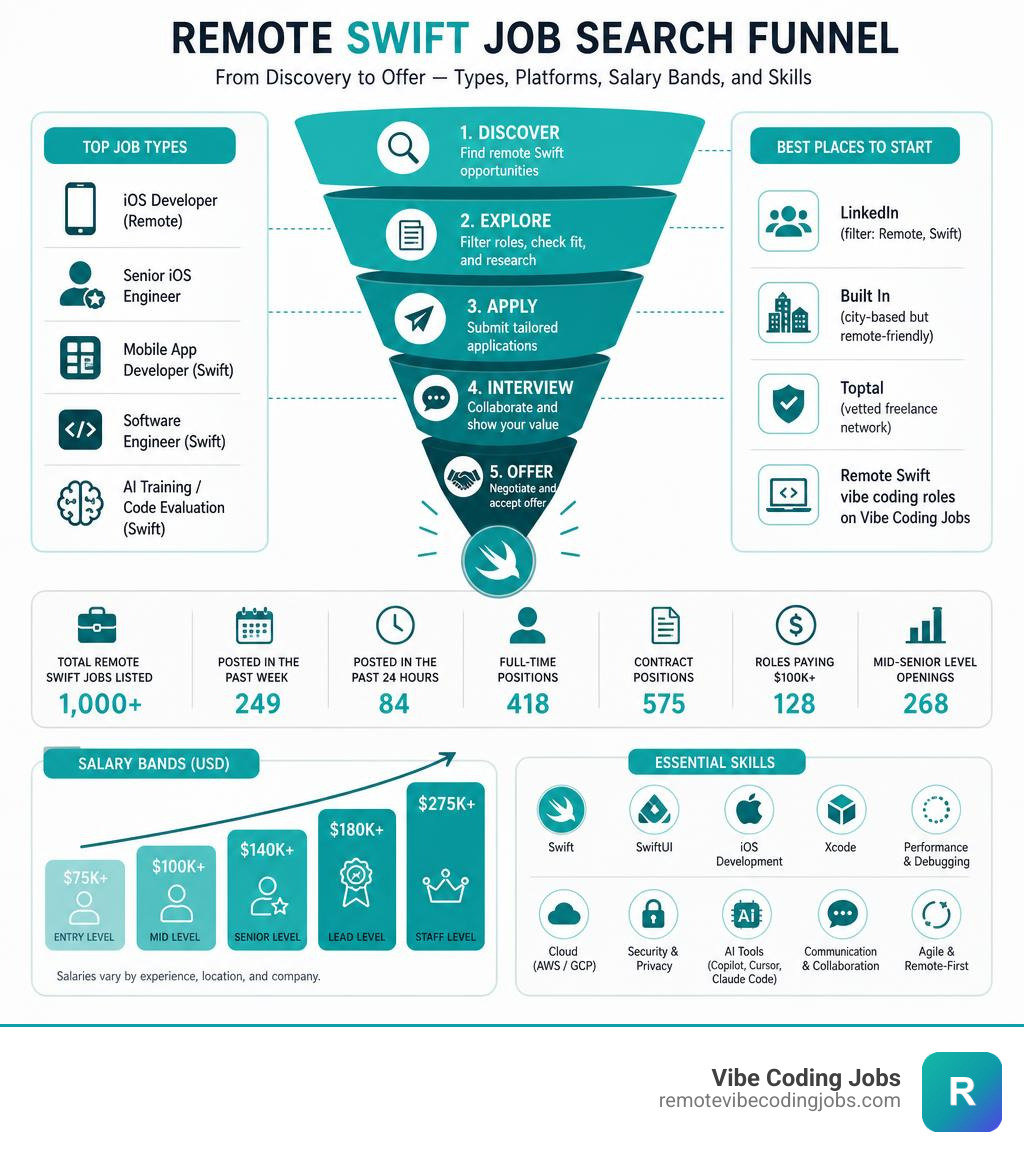
Quick Answer: Remote Swift Developer Jobs at a Glance
| Category | Current Numbers |
|---|---|
| Total remote Swift jobs listed | 1,000+ |
| Posted in the past week | 249 |
| Posted in the past 24 hours | 84 |
| Full-time positions | 418 |
| Contract positions | 575 |
| Roles paying $100K+ | 128 |
| Mid-senior level openings | 268 |
Top job types to search for:
- iOS Developer (Remote)
- Senior iOS Engineer
- Mobile App Developer (Swift)
- Software Engineer (Swift)
- AI Training / Code Evaluation (Swift)
Best places to start looking:
- Curated remote developer listings filtered by tech stack and remote culture
- Company career pages for mobile-first and async-first teams
- Apple developer communities, referral channels, and iOS engineering groups
- Remote Swift vibe coding roles on Vibe Coding Jobs
The remote iOS market has expanded well beyond traditional mobile shops. You’ll find Swift roles inside fintech teams, health platforms, spatial computing startups building for Apple Vision Pro, and AI-training companies that need developers to evaluate and annotate Swift code. Salaries range from $75K at the entry level to $275K+ for Staff iOS Engineers – and contract roles now outnumber full-time postings.
One trend worth noting: employers are increasingly listing AI-tool proficiency – GitHub Copilot, Cursor, Claude Code – as a required skill alongside Swift and SwiftUI. The job is changing fast.
I’m part of the RVCJ Editorial team at Vibe Coding Jobs, where we track remote developer hiring trends, AI-assisted workflows, and curated job listings – including swift developer jobs remote – for async-first engineering teams. Below, we’ll walk you through exactly where to find these roles, what they pay, and how to land one.
Swift developer jobs remote terms to learn:
How to Find swift developer jobs remote in 2026
Finding swift developer jobs remote in 2026 is less about typing one phrase into a search bar and more about building a repeatable search system.
The best remote Swift searches combine:
- Job title variations
- Remote policy filters
- Salary filters
- Time zone requirements
- Tech stack keywords
- AI-assisted development keywords
- Fast daily applications
Start with these search terms:
- Remote Swift Developer
- Remote iOS Developer
- SwiftUI Developer Remote
- Mobile Engineer Swift Remote
- Software Engineer iOS Remote
- iOS Engineer Work From Anywhere
- Swift AI Code Evaluation
- Contract Swift Developer
The market moves quickly. With hundreds of recent postings appearing within a month and dozens appearing within 24 hours, waiting a week to apply can mean showing up after the hiring manager already has a shortlist. We recommend setting alerts, checking curated listings daily, and keeping a reusable application kit ready.
That kit should include:
- A Swift-focused resume
- App Store links or TestFlight demos
- GitHub code samples
- A short remote-work cover note
- A portfolio page with screenshots and architecture notes
- A list of your preferred time zones, rates, and contract terms
Tiny bonus: applying in pajamas is optional. Applying fast is not.
Best filters for swift developer jobs remote
Use filters aggressively. Remote Swift listings often include noise from backend Swift, hybrid mobile jobs, and “remote” roles that secretly mean “come to the office twice a week and pretend it is flexible.”
Best filters to use:
| Filter | Why it matters |
|---|---|
| Remote-only | Removes hybrid and office-first roles |
| Full-time or contract | Separates benefits-heavy roles from flexible gigs |
| Seniority | Helps match junior, mid-level, senior, or staff expectations |
| Salary | Surfaces $100K+ roles and avoids mystery compensation |
| Time zone | Prevents 3 a.m. standups, which should be illegal |
| US-only or global | Clarifies payroll, tax, and legal restrictions |
| Work-from-anywhere | Best for digital nomads and global contractors |
| Async-first | Signals fewer meetings and better deep work |
| SwiftUI/UIKit | Matches modern iOS stack requirements |
| AI tools | Finds AI-assisted Swift and vibe coding roles |
For curated AI-assisted Swift opportunities, start with Swift Vibe Coding Jobs. We filter remote roles by culture, tech stack, and AI tooling so you can spend less time digging and more time applying.
Where remote Swift roles actually appear
Remote Swift roles appear in more places than one generic search feed. The strongest search strategy combines broad discovery with niche filtering and direct company research.
Look in:
- Curated remote developer listings
- Company career pages
- Mobile engineering communities
- Referral channels
- Freelance and contract hiring pipelines
- AI-training and code evaluation platforms
- GitHub and open-source circles
- Swift, iOS, and Apple developer communities
Public listings can be useful for market research too. Compare posting volume across broad job search sources, then narrow your focus by remote policy, salary transparency, time zone expectations, SwiftUI/UIKit requirements, and whether the team uses AI-assisted development tools in a real production workflow.
For role-specific research, review examples of postings such as:
- Senior iOS Developer – remote full-time role using Swift and Objective-C
- iOS Developer – fully remote product engineering role
- iOS Developer – work-from-anywhere mobile app role
- Senior Swift Developer – spatial computing or emerging Apple platform role
- iOS Developer with Swift – contract or consulting role
Then use Remote Swift job listings to focus on roles aligned with remote culture and AI-assisted development.
Cities and regions with the most “remote” Swift postings
Remote does not always mean location-free. Many postings are remote but still tied to payroll rules, time zones, tax compliance, or customer coverage.
Common location patterns include:
- US remote roles requiring US work authorization
- East Coast hours for product and finance teams
- West Coast hours for Apple ecosystem teams and startup schedules
- Europe-friendly schedules for distributed teams
- Global contractor roles paid in USD
- India-based contractor roles supporting global products
City labels can still matter. Some “remote” postings are attached to large tech labor markets because companies use local compensation bands or regional hiring pages. You may see remote Swift postings associated with major US hiring hubs, including California, New York, Texas, Colorado, Denver, and Boulder, even when the day-to-day work is location-independent.
Our advice: read the fine print. “Remote” can mean:
- Remote anywhere
- Remote in one country
- Remote in selected states
- Remote with time zone overlap
- Remote contractor only
- Remote until someone changes their mind, which is less fun
The 7 Most Common Remote Swift Developer Job Types
Remote Swift jobs are not all the same. Some are product engineering roles, some are short-term contracts, and some involve reviewing code for AI model training instead of shipping an app.

Here are the seven most common types we see in 2026.
1. Remote iOS Developer
This is the classic remote Swift role. You build and maintain iPhone and iPad apps, work with product and design teams, fix bugs, ship releases, and keep the App Store pipeline moving.
Typical requirements:
- Swift
- UIKit
- SwiftUI
- App Store deployment
- REST APIs
- Core Data
- Push notifications
- Offline storage
- Threading and performance tuning
- Code reviews
- Distributed team collaboration
Many roles ask for 3-6 years of professional iOS experience, plus proof that you have shipped production apps. Employers often want someone who can own features without needing constant hand-holding across Slack, tickets, and pull requests.
2. Senior iOS Engineer
Senior iOS Engineer roles are where remote Swift compensation starts getting serious. Research-backed listings show senior salary ranges commonly around $135K-$185K, with staff-level roles reaching $185K-$275K depending on scope.
Senior roles usually require:
- 5+ years of iOS experience
- Architecture ownership
- Mentorship
- CI/CD experience
- Unit and UI testing
- Memory management
- Accessibility knowledge
- Performance optimization
- Cross-functional product collaboration
- Release planning
At this level, you are not just writing Swift. You are making technical decisions that affect app scalability, maintainability, hiring, team velocity, and user experience.
3. SwiftUI-Focused Mobile Engineer
SwiftUI-focused roles are growing because many teams are modernizing older UIKit apps or building new interfaces with Apple’s newer frameworks.
Common skills:
- SwiftUI
- Combine
- async/await
- MVVM
- The Composable Architecture
- Modular app architecture
- Widgets
- Live Activities
- iPadOS layouts
- Navigation and state management
These jobs are especially good for developers who enjoy product polish. If you can build smooth interfaces, tame state management, and avoid turning a view file into a 900-line spaghetti monster, you are in demand.
4. Spatial, VisionOS, and Emerging Apple Platform Roles
Some remote Swift jobs now sit at the edge of Apple’s newer platform ecosystem: Apple Vision Pro, spatial computing, RealityKit, ARKit, and iPad companion apps.
These roles may include:
- Building iOS or iPadOS companion apps
- Connecting mobile apps to VisionOS experiences
- Working with RealityKit or ARKit
- Supporting 3D collaboration workflows
- Integrating real-time sync
- Using backends such as Supabase or PostgreSQL
- Prototyping quickly with AI-assisted tools
You do not always need to be a 3D graphics expert. Many teams need strong Swift developers who can build the mobile bridge into spatial experiences. Explore Senior Swift roles in spatial computing if this direction sounds exciting.
5. AI-Assisted Swift Developer Roles
AI-assisted development is now part of the Swift hiring conversation. Some postings explicitly ask for experience with:
- GitHub Copilot
- Cursor
- Claude Code
- Prompt engineering
- AI-assisted debugging
- Generated-code review
- Test generation
- Rapid prototyping
- Security judgment
The key skill is not blindly accepting generated code. It is knowing when AI is right, when it is confidently wrong, and when it has just invented an API that does not exist.
At Vibe Coding Jobs, we focus on roles where AI tools are part of the workflow, not a gimmick. Start with Swift Vibe Coding Jobs if you want Swift roles at AI-forward teams.
6. Remote Freelance or Contract Swift Developer
Freelance and contract Swift roles can pay well and offer more flexibility, but they require more self-management.
Common traits:
- Hourly or project-based pay
- Flexible schedules
- Shorter hiring cycles
- Paid trials or technical screens
- Portfolio-heavy evaluation
- Client communication
- Contractor tax responsibility
- Less predictable benefits
Contract roles currently outnumber full-time postings in many remote Swift searches, with research showing 575 contract positions compared with 418 full-time positions in one market snapshot.
Freelance is best if you like autonomy, rate control, and varied projects. Full-time is usually better if you want benefits, career ladders, and predictable income.
Browse Remote freelance Swift projects if you want flexible Swift work without losing sight of modern AI-assisted workflows.
7. AI Training and Code Evaluation Roles
AI-training roles are one of the fastest-growing remote Swift categories. Instead of building an app, you may evaluate Swift code, identify bugs, write prompts, compare model outputs, or explain why one solution is better than another.
Typical tasks:
- Swift code evaluation
- Bug detection
- Code quality scoring
- Prompt writing
- Technical annotation
- Test-case reasoning
- Explaining Swift concepts clearly
One AI-training employer accounted for 392 Swift remote postings in the research snapshot, showing how large this category has become.
These roles are often contract-based and flexible. They can be a good fit for developers who enjoy code review, teaching, technical writing, or part-time remote work.
Salary, Experience, and Job-Type Benchmarks for Remote Swift Developers

Remote Swift compensation depends on experience, job type, company stage, location policy, and whether you are an employee or contractor.
| Role type | Typical experience | Common pay pattern | Best for | Tradeoff |
|---|---|---|---|---|
| Entry-level iOS Developer | 0-2 years | $75K+ in many remote listings | First remote iOS role | More competition |
| Mid-level Swift Developer | 3-5 years | Often $100K+ | Feature ownership | Must show shipped apps |
| Senior iOS Engineer | 5+ years | $135K-$185K | Architecture and autonomy | Higher interview bar |
| Staff iOS Engineer | 7-10+ years | $185K-$275K | Technical leadership | Broad responsibility |
| Contract Swift Developer | 3+ years | Hourly or project-based | Flexibility | No guaranteed benefits |
| Freelance Swift Developer | 3+ years | Self-set rates | Project choice | Client pipeline required |
| AI-training Swift evaluator | Varies | Contract/task-based | Flexible part-time work | Less product ownership |
Typical salary ranges by level
Remote Swift salary bands in 2026 commonly look like this:
- Entry-level: often starts around $75K+, especially for junior-friendly remote roles
- Mid-level: many roles cross $100K+, particularly with SwiftUI and production app experience
- Senior: commonly $135K-$185K
- Staff: often $185K-$275K
- AI-assisted senior roles: can command stronger offers when paired with architecture skills
- Contract roles: vary widely by rate, workload, and client quality
Remote pay policies differ. Some companies pay national bands. Some adjust by location. Some hire only contractors outside their payroll regions. Always compare total compensation, not just the headline number.
How to compare swift developer jobs remote offers
When comparing swift developer jobs remote, look beyond base pay.
Compare:
- Base salary or hourly rate
- Health benefits
- PTO
- Equity
- Bonus potential
- Device stipend
- Home office budget
- Time zone expectations
- Meeting load
- On-call responsibilities
- App complexity
- Release pressure
- Contractor protections
- Tax impact
- Payment terms
A $150K role with constant meetings and late-night releases may be worse than a $135K async-first role with deep work, sane deadlines, and a manager who understands that humans need lunch.
Full-time vs contract vs freelance Swift work
Full-time remote Swift roles offer stability, benefits, team continuity, and long-term product ownership. They are best for developers who want career growth and predictable income.
Contract roles offer flexibility, faster starts, and sometimes stronger hourly pay. They are best for developers comfortable managing their own taxes, benefits, and pipeline.
Freelance roles offer the most autonomy. You may choose projects, set rates, and work with multiple clients. But you also handle sales, scope, invoicing, and quiet periods.
Quick comparison:
| Factor | Full-time | Contract | Freelance |
|---|---|---|---|
| Stability | High | Medium | Variable |
| Flexibility | Medium | High | Very high |
| Benefits | Usually included | Usually limited | Self-managed |
| Pay upside | Strong | Stronger hourly | Highest if positioned well |
| Admin burden | Low | Medium | High |
| Portfolio importance | High | Very high | Extremely high |
Skills, Frameworks, and Tools Employers Expect
Remote Swift employers want developers who can ship maintainable apps, not just pass syntax quizzes.
Core technologies include:
- Swift
- SwiftUI
- UIKit
- Core Data
- Combine
- async/await
- Xcode
- Instruments
- XCTest
- REST APIs
- GraphQL
- Git
- CI/CD
- SOLID
- MVVM
- VIPER
- The Composable Architecture
- Agile workflows
- App Store deployment
For canonical language and ecosystem guidance, Apple’s official Swift resources are useful references, including the Swift programming language documentation.
Core Swift and iOS skills
You should be comfortable with:
- Optionals
- Protocols
- Generics
- Value vs reference types
- Swift concurrency
- Memory management
- App lifecycle
- Offline storage
- CoreAnimation
- CoreLocation
- Notifications
- Accessibility
- Performance profiling
Employers also expect practical iOS knowledge: how to handle background tasks, how to reduce crashes, how to debug slow screens, and how to keep app state predictable.
Architecture and production engineering
Strong remote Swift candidates understand architecture because remote teams need codebases that are easy to reason about asynchronously.
Important architecture skills:
- SOLID principles
- MVVM
- VIPER
- The Composable Architecture
- Modularization
- Dependency injection
- Clean code
- Refactoring
- Performance optimization
- Crash analytics
- Release pipelines
If your portfolio explains why you chose an architecture, you are already ahead of candidates who only upload code and whisper, “good luck,” to the reviewer.
Testing, DevOps, and collaboration
Remote iOS teams value developers who reduce release risk.
Highlight experience with:
- Unit tests
- UI tests
- Integration tests
- XCTest
- CI/CD
- GitHub Actions
- Fastlane
- TestFlight
- Pull requests
- Code reviews
- Async updates
- Documentation
- Cross-functional collaboration
If you prefer focused work and clear written communication, explore Swift Async First Remote Jobs.
AI-assisted development skills that now matter
AI tools are becoming part of production workflows. Employers increasingly care whether you can use them responsibly.
Useful AI-assisted skills:
- Prompt engineering
- AI pair programming
- Copilot workflows
- Cursor workflows
- Claude Code workflows
- Reviewing generated Swift
- Generating tests
- Debugging with AI support
- Detecting hallucinated APIs
- Security and privacy judgment
- Documenting productivity gains
The best candidates show examples: a refactor accelerated by AI, a test suite generated and reviewed, or a prototype built quickly without sacrificing code quality.
How to Apply and Stand Out for Remote Swift Roles
Remote Swift hiring is portfolio-first. Your application needs to prove three things quickly:
- You can build iOS apps.
- You can communicate remotely.
- You can ship without chaos.
Build a remote-ready Swift portfolio
Your portfolio should include:
- Published apps or TestFlight demos
- SwiftUI examples
- UIKit examples if relevant
- Core Data demos
- API integrations
- Authentication flows
- Testing examples
- Accessibility notes
- Performance improvements
- Screenshots or short videos
- Architecture explanations
- Links to clean GitHub repositories
For each project, explain:
- What you built
- What problem it solved
- What frameworks you used
- What tradeoffs you made
- What you would improve next
Hiring managers love clarity. They do not love mystery repos named final_final_REAL_v3.
Tailor your resume for ATS and hiring managers
Your resume should include the exact keywords that appear in remote Swift postings.
Use terms like:
- Swift
- SwiftUI
- UIKit
- Core Data
- Combine
- async/await
- XCTest
- REST APIs
- GraphQL
- CI/CD
- MVVM
- TCA
- App Store
- TestFlight
- Git
- Remote collaboration
- AI-assisted development
- Cursor
- Claude Code
- GitHub Copilot
Also quantify impact:
- Reduced crash rate by X%
- Improved launch time by X%
- Shipped X App Store releases
- Built features used by X users
- Migrated X screens from UIKit to SwiftUI
- Added X tests to improve release confidence
Prepare for technical interviews and assessments
Remote Swift interviews commonly cover:
- Swift fundamentals
- Optionals, protocols, and generics
- Concurrency and async/await
- Memory management
- App architecture
- SwiftUI state management
- UIKit-to-SwiftUI migration
- Debugging crashes
- API integration
- Offline storage
- Testing strategy
- System design for mobile apps
- Code review exercises
- Take-home projects
- Product thinking
For senior roles, expect architecture discussion. For AI-assisted roles, expect questions about how you validate AI-generated code.
Prove you can thrive remotely
Remote hiring teams want evidence that you can work independently.
Show that you are good at:
- Self-management
- Async writing
- Documentation
- Meeting discipline
- Time zone overlap
- Proactive updates
- Deep work
- Autonomy
- Clear handoffs
- Asking good questions early
If you want roles built around focus time instead of meeting marathons, browse Swift Deep Work Remote Jobs.
Frequently Asked Questions About Remote Swift Developer Jobs
What companies are hiring remote Swift developers in 2026?
In 2026, remote Swift hiring is strongest across:
- Mobile-first startups
- Fintech teams
- Health and wellness apps
- Spatial computing companies
- AI-training platforms
- Consulting firms
- Enterprise product teams
- Consumer app companies
- Contractor-based global teams
Common openings include iOS Developer, Senior iOS Engineer, Mobile App Developer, Staff iOS Engineer, SwiftUI Engineer, and Swift code evaluator roles.
What experience do I need for a remote Swift developer job?
Many remote iOS Developer roles ask for 3-6 years of professional experience. Senior roles often ask for 5+ years. Staff roles typically require deeper architecture, mentorship, and product leadership experience.
That said, junior candidates can still compete with:
- Published apps
- Strong SwiftUI projects
- Clean GitHub repositories
- App Store experience
- Testing examples
- Clear architecture notes
- Excellent async communication
- AI-tool fluency
- A practical portfolio
Remote teams care about proof. If you can show you can ship, your odds improve.
Are freelance Swift jobs better than full-time remote Swift jobs?
Sometimes. It depends on what you want.
Freelance Swift jobs are better if you want:
- More flexibility
- Rate control
- Project variety
- Faster starts
- Global client options
- Portfolio-driven work
Full-time remote Swift jobs are better if you want:
- Stable income
- Benefits
- Equity potential
- Long-term product ownership
- Career growth
- Team mentorship
- Less administrative work
Contract and freelance work can pay well, but you need to manage taxes, invoicing, client expectations, and project gaps. Full-time roles usually offer more stability but less freedom.
Conclusion
Remote Swift hiring in 2026 is strong, varied, and changing fast. The best opportunities are no longer limited to traditional iOS app teams. You can build fintech apps, health platforms, VisionOS companion experiences, AI-assisted tools, or even help train models to understand Swift code.
To land better swift developer jobs remote, focus on the basics:
- Set up daily job alerts
- Use remote-only and salary filters
- Track full-time, contract, and freelance options separately
- Keep your Swift portfolio polished
- Show App Store or demo proof
- Highlight SwiftUI, UIKit, testing, and CI/CD
- Add AI-assisted workflow examples
- Apply quickly when strong roles appear
- Prioritize async-first teams that match how you work best
At Vibe Coding Jobs, we curate remote AI-assisted developer roles for people who want modern tools, thoughtful remote culture, and fewer “quick syncs” that somehow take 47 minutes.
Ready to start? Start with curated Swift vibe coding roles.