The Best Sites for Remote SSIS Jobs
Remote SSIS Jobs Are More Active Than You Think in 2026
Remote SSIS jobs are plentiful right now, and the market moves fast. Here’s a quick snapshot for anyone ready to start applying:
Top sources for remote SSIS jobs (May 2026):
| Source | Listings Available |
|---|---|
| Major US job boards | 750+ remote SSIS roles |
| Curated remote tech job platforms | 100+ open positions across related searches |
| Global developer marketplaces | 50+ remote SSIS developer roles worldwide |
| Niche SQL and contractor boards | Active contractor and full-time postings |
Key facts at a glance:
- 99% of SSIS job listings in the US are tagged as fully remote
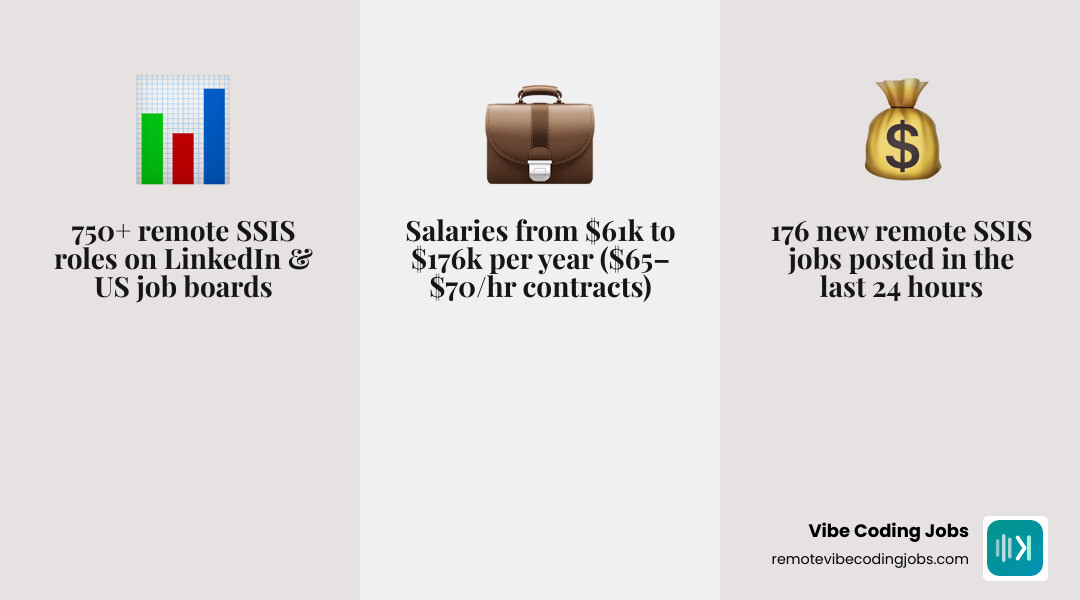
- 176 new remote SSIS jobs posted in the last 24 hours alone
- Salaries range from $61,000 to $176,000 per year ($65-$70/hr for contracts)
- Top roles: SSIS Developer, ETL Developer, SQL DBA, BI Engineer, Data Warehouse Architect
SSIS, or SQL Server Integration Services, is a core Microsoft data tool used to build ETL pipelines, move data between systems, and power enterprise analytics. You can learn more about the platform in the official Microsoft SSIS documentation. Despite being a mature technology, demand for SSIS skills in remote roles remains strong in 2026, driven by healthcare systems, financial services, and large enterprises that still rely heavily on the Microsoft data stack.
Whether you’re a senior ETL engineer or a mid-level SQL developer looking to go remote, this guide covers the best places to search, top job titles, required skills, and salary expectations to help you land your next role faster.
I’m RVCJ Editorial, the team behind Remote Vibe Coding Jobs – we cover remote developer hiring, AI-assisted workflows, and career guidance, including the latest trends in remote SSIS jobs and data engineering roles. Read on for a full breakdown of where to search, what employers want, and how to stand out.
What SSIS Is and Why It Matters for Remote Data Roles
SQL Server Integration Services (SSIS) is the workhorse of the Microsoft data ecosystem. At its core, it is a platform for building enterprise-level data integration and data transformations solutions. We use it to solve complex business problems by copying or downloading files, sending e-mail messages in response to events, updating data warehouses, cleaning and mining data, and managing SQL Server objects and data.
For remote workers, SSIS is particularly valuable because it is a visual, package-based tool. You can design, develop, and deploy these packages from anywhere in the world as long as you have access to the SQL Server environment. It’s the backbone of Business Intelligence (BI) workflows, allowing remote teams to automate the “Extract, Transform, Load” (ETL) process that keeps modern companies running.
Why remote ssis jobs remain relevant in 2026
You might hear people talking about “cloud-native” tools all day, but remote ssis jobs are still thriving in May 2026. Why? Because the world’s most critical data—especially in healthcare and finance—often sits in legacy systems that require sophisticated modernization.
Companies aren’t just deleting their SQL Servers; they are building “hybrid” environments. SSIS is the bridge. It connects on-premise data to the cloud. Whether it’s managing patient records for a massive healthcare provider or processing transactions for a global bank, SSIS remains the reliable, enterprise-standard choice for data movement.
Core responsibilities in remote SSIS developer work
When you land one of these roles, your day-to-day usually involves more than just dragging boxes in a designer. Common responsibilities include:
- Package Design: Creating scalable ETL/ELT pipelines that can handle millions of rows without breaking.
- Data Migration: Moving data from old legacy systems into modern data warehouses.
- Stored Procedures: Writing high-performance SQL to handle complex logic that SSIS components can’t do alone.
- Troubleshooting: Remotely debugging failed jobs and optimizing slow-running packages.
- Documentation: Keeping clear records of data lineage so the rest of the async team knows where the data came from.
Where to Find the Best Remote SSIS Jobs
Finding the right role requires knowing where the high-signal listings are. In 2026, the market is split between massive aggregators, specialized remote job platforms, and employer career pages that cater to remote-first and async teams.
Best places to search for remote ssis jobs in the US and worldwide
If you are looking for remote ssis jobs in the US, start with major professional networks and job boards because they carry the largest share of enterprise listings. For a more curated experience, remote-focused developer job platforms can be useful for filtering by time zone, contract type, and company culture.
We also recommend checking niche SQL and staffing boards, along with the careers pages of healthcare, finance, and consulting companies that regularly hire ETL and SQL Server talent.
How many remote SSIS jobs are available right now?
The numbers for May 2026 are impressive. We are seeing a massive shift toward remote-only work in this sector.
| Metric | Current Count (May 2026) |
|---|---|
| Total SSIS Remote Jobs (US) | 750 |
| Percentage of SSIS jobs that are Remote | 99% |
| New jobs posted in the past 24 hours | 176 |
| Worldwide remote SSIS developer roles | 56 |
This data shows that if you have these skills, you aren’t just looking for a job – you are looking for the right job, because the volume is clearly in your favor.
Regions with the highest concentration of openings
While the jobs are remote, the employers often cluster in specific hubs. In the United States, healthcare and insurance hubs on the Midwest and East Coast remain major hirers. At the same time, global hiring continues to expand.
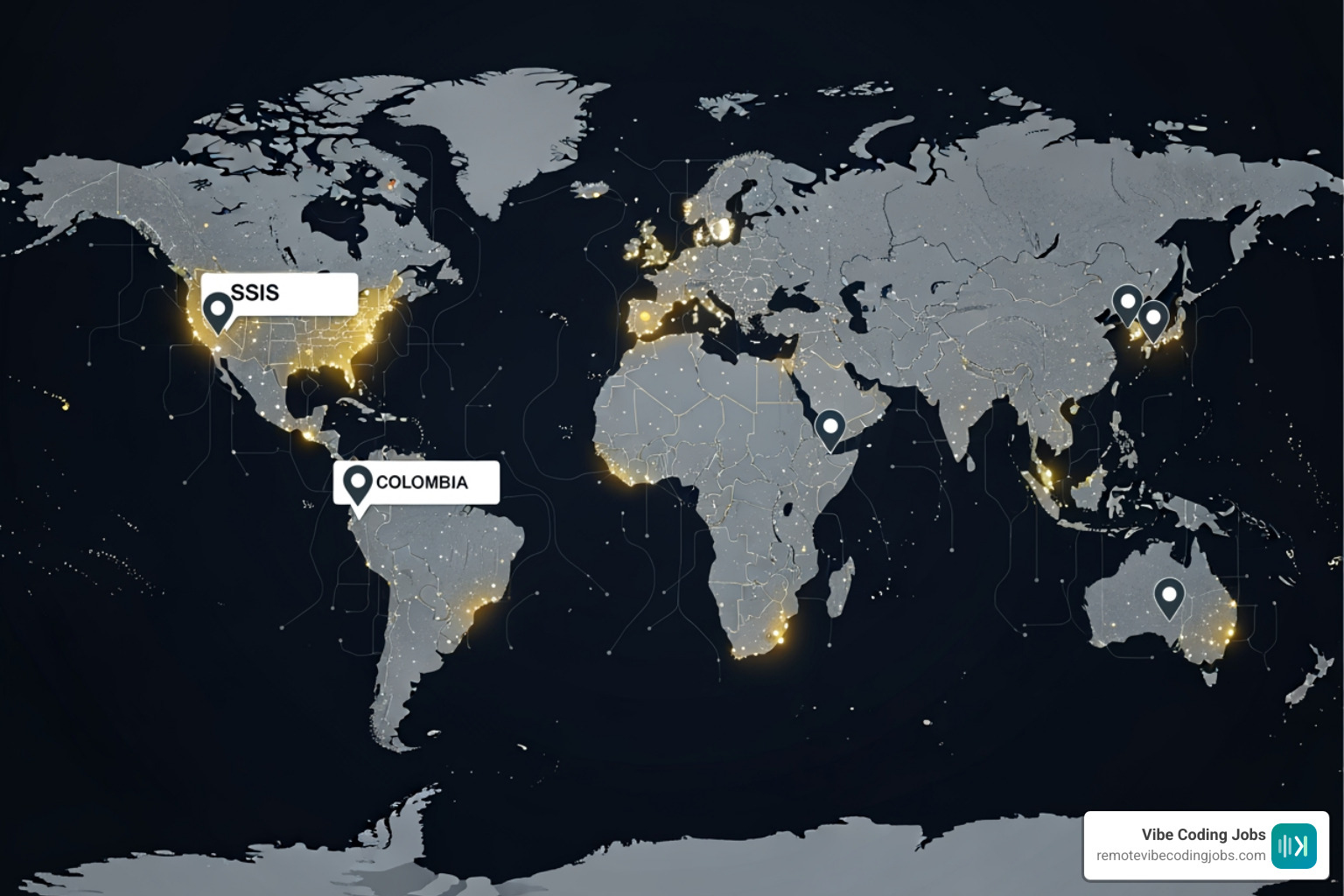
- United States: Leads the way with 750 active roles.
- LATAM (Colombia): A growing hub for US companies looking for time-zone-aligned remote engineers.
- Switzerland: A European stronghold for finance-related SSIS roles.
The Most Common Remote SSIS Job Titles and Skills Employers Want
When searching for remote ssis jobs, don’t limit yourself to just one keyword. Recruiters use a variety of titles to describe roles that are 80% or more SSIS-focused.
Job titles you should search besides “SSIS Developer”
- ETL Developer: The most common alternative; focuses on the data movement lifecycle.
- SQL Server Developer: A broader role where SSIS is a primary tool.
- BI Engineer: Focuses on the “Business Intelligence” output of the data SSIS moves.
- Data Warehouse Architect: A senior role designing the structures SSIS feeds into.
- Data Integration Lead: Often a contract or senior role managing complex migrations.
Skills paired with remote ssis jobs most often
In 2026, knowing only SSIS isn’t enough. Employers want to see a “stack” of related technologies.
- SQL Server & T-SQL: You must be an expert in querying and optimizing databases.
- SSRS & SSAS: The “other two” parts of the MSBI stack (Reporting and Analysis Services).
- Azure Data Factory (ADF): Many companies are moving SSIS packages to the cloud using Azure.
- Kafka/Lambda: For real-time data streaming alongside traditional batch processing.
- Dimensional Modeling: Understanding how to design schemas (Star/Snowflake) for data warehouses.
Experience levels employers ask for most
The market currently leans heavily toward experienced professionals. We’ve found that:
- Mid-Level: Usually requires 5+ years of experience.
- Senior/Architect: Often asks for 8 to 13+ years of experience in SQL Server development.
- Entry-Level: These are rarer in the remote space, as companies prefer “self-starters” who can manage complex data pipelines without in-person supervision.
Salary Ranges, Hiring Companies, and Market Trends
Money talks, and in the SSIS world, the talk is quite good. Because these roles are critical to business operations, the pay reflects the responsibility.
Typical salary ranges for US and international SSIS roles
Based on recent market data from remote job aggregators and employer listings, the salary landscape looks like this:
- Annual Salary: $61,000 on the low end (junior/mid) to $176,000 for Senior Architects.
- Hourly Rates: $65 to $70 per hour is the standard market rate for experienced contractors in the US.
- International Pay: Often location-adjusted, but high-demand regions like Switzerland or remote roles for US companies in Colombia offer very competitive packages.
Types of companies actively hiring for remote SSIS talent
Who is actually signing the paychecks? We see a lot of activity from:
- Healthcare: Large health systems and insurers constantly need to integrate disparate patient data systems.
- Finance/Accounting: Firms in banking, accounting, and compliance hire SSIS experts to manage complex financial data flows.
- Staffing & Tech Consulting: Consulting firms and staffing partners often act as bridges for enterprise-level contract work.
Emerging trends shaping remote SSIS jobs
The biggest trend in 2026 is Cloud Integration. We are seeing a massive shift where SSIS is no longer a standalone tool but part of a hybrid cloud strategy. Many SSIS jobs now require knowledge of Azure Data Factory or AWS Lambda. Companies are modernizing their batch processes into real-time or near-real-time pipelines, meaning AI-assisted development workflows are becoming a standard part of the job to speed up T-SQL, automation, and debugging.
How to Apply and Stand Out in Remote SSIS Jobs
Since 99% of these roles are remote, you aren’t just competing with people in your city – you’re competing with the world. You need to stand out.
Build a resume that matches ATS filters
Applicant Tracking Systems (ATS) look for specific keywords. Ensure your resume includes:
- Measurable Outcomes: “Optimized ETL pipelines to reduce processing time by 40%.”
- Specific Tools: Don’t just say “SSIS.” Say “Designed and deployed SSIS packages for SQL Server 2022 and Azure SQL.”
- Cloud Keywords: Mention Azure, AWS, or Snowflake if you have even basic exposure.
Application tips that improve response rates
- Tailor the Timezone: Many remote employers care about timezone overlap. Mention your availability in your intro.
- Portfolio of Logic: While you can’t always share company data, you can describe the complexity of the logic you’ve built, such as handling fuzzy grouping or complex CDC (Change Data Capture).
- Quick Apply: Use streamlined application workflows when available, but always follow up with a personalized note if a recruiter or hiring contact is provided.
What recruiters look for in remote SSIS candidates
Recruiters want to know you can work independently. They look for:
- Production Support Experience: Can you fix a broken pipeline at 2 AM without someone holding your hand?
- Performance Tuning: Can you make a query run in seconds instead of minutes?
- Communication: Since you are remote, your ability to document your work and explain data lineage to stakeholders is vital.
Frequently Asked Questions About Remote SSIS Jobs
Are remote SSIS jobs mostly mid-level and senior?
Yes. Because SSIS often involves touching “mission-critical” enterprise data, companies are hesitant to hire entry-level developers for fully remote roles. Most listings ask for at least 5-8 years of experience.
Can SSIS professionals transition into cloud data engineering?
Absolutely. In fact, it’s the most common career path. Moving from SSIS to Azure Data Factory (ADF) is a very natural progression, as the concepts of pipelines and data flow are very similar.
Are remote SSIS roles fully remote or hybrid-remote?
In 2026, the data shows that 99% of US-based SSIS roles are listed as fully remote. While some legacy firms might ask for “hybrid,” the vast majority of the market has moved to a remote-first model to attract top talent.
Conclusion
The market for remote ssis jobs is incredibly healthy in May 2026. With over 750 active roles in the US and a high percentage of them being 100% remote, there has never been a better time to leverage your SQL and ETL skills. By focusing on the right platforms and keeping your skills updated with cloud integration, you can secure a high-paying, flexible career.
If you’re looking for the best “vibe” in your next role – where AI tools and async culture are the norm – check out the curated listings at https://remotevibecodingjobs.com. We help developers find the roles that match not just their tech stack, but their lifestyle.