
7 Best Platforms for Remote Node.js Developer Jobs in 2026
The Market for Remote Node.js Developer Jobs in 2026
If you want a quick answer on the best places to look for remote Node.js developer jobs, here are the main channels:
- Professional networks – highest volume and strong filters
- Remote-only job boards – curated remote-first roles
- Developer marketplaces – profile-based matching and vetting
- Company career pages – direct apply and less competition
- Niche aggregators – backend-focused listings with salary insight
- Vibe Coding Jobs – AI-first teams, async culture, vibe coding roles
- Stack-specific boards – TypeScript, Next.js, and full-stack adjacent roles
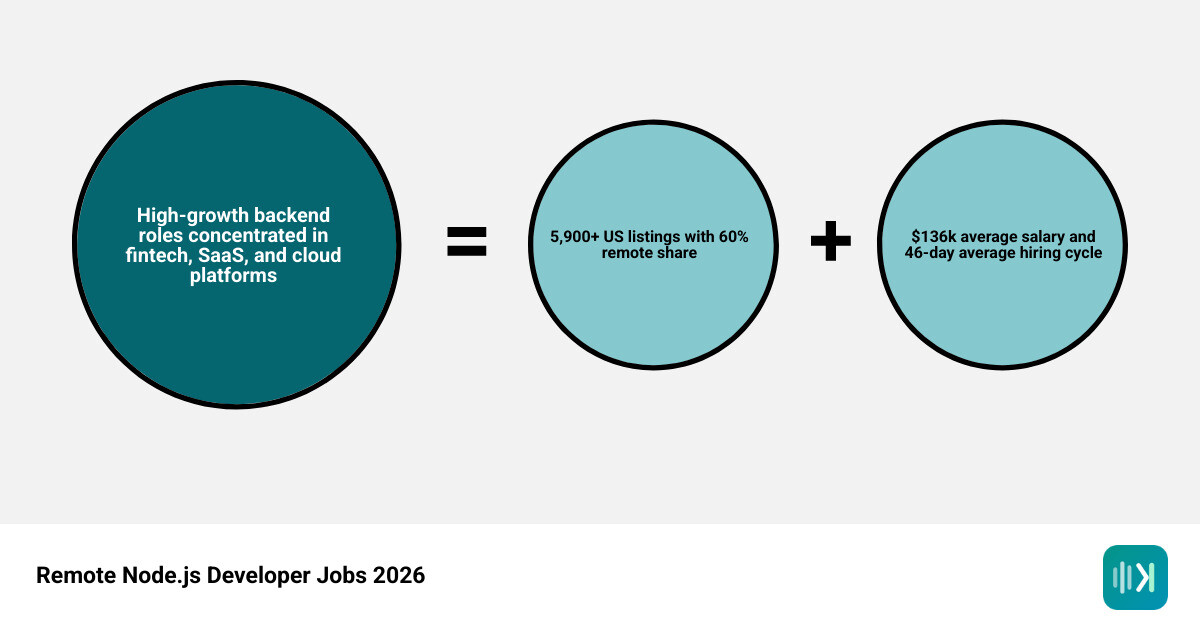
The market for remote Node.js developer jobs has never been stronger. Over 5,900 positions are currently listed in the US alone, with more than 4,400 posted in just the past month. The average salary sits at $136,420 per year, and 60% of all Node.js job postings are remote – making it one of the most remote-friendly backend stacks in the industry today.
Whether you’re a mid-level engineer looking for your next async-first team or a senior developer chasing a lead role with real architectural ownership, the challenge isn’t finding openings. It’s knowing where to look and how to cut through the noise.
We are the RVCJ Editorial team at Vibe Coding Jobs – we cover remote developer hiring, AI-assisted coding trends, and career guidance specifically for engineers working on remote Node.js developer jobs and adjacent backend roles. We’ve analyzed dozens of job sources and hundreds of live listings to bring you this guide.
Remote node js developer jobs vocab explained:
Why Remote Node.js Developer Jobs Are Booming in 2026
Node.js sits in a sweet spot for modern remote engineering teams. It powers APIs, microservices, real-time apps, backend-for-frontend layers, and full-stack JavaScript products. That makes it useful to both startups moving fast and larger companies modernizing older systems.
The hiring data backs that up:
- More than 5,000 remote Node.js openings are available in the United States
- 4,481 were posted in the past month
- 60% of Node.js jobs are remote
- 93% are full-time
- Node.js appears in 59.8% of remote developer job postings analyzed
- The average salary is $136,420
- Employers take about 46 days on average to close a remote Node.js role
In plain English: demand is high, pay is solid, and companies are still hiring even if the process is not exactly Formula 1 fast.
Node.js also keeps benefiting from broader adoption of event-driven systems, API-heavy products, and cloud services. If you want a neutral technical reference on the runtime itself, the Node.js Wikipedia page gives a useful high-level overview.
Current Demand for remote node js developer jobs in the United States
The US market is especially active. One major professional network alone shows 5,937 remote Node.js jobs in the United States, with 4,481 recent postings in the last month. That tells us two important things:
- There is strong overall job volume
- New openings keep appearing, so search freshness matters
A large share of those roles are aimed at experienced engineers. Research shows 3,768 mid-senior level positions, which means companies are not just hiring junior developers to maintain legacy endpoints. They want people who can build services, design systems, and make architecture decisions.
There is also real salary depth in the market. On one large platform, 1,923 jobs listed pay of $100,000+. For backend developers with production experience in APIs, cloud, and TypeScript, that is a strong sign that remote Node.js work remains premium work.

Most Common Titles, Levels, and Pay Bands
The title on the posting is not always “Node.js Developer.” In fact, many of the best roles hide in adjacent naming. The most common titles we see include:
- Node.js Engineer
- Backend Engineer
- Full Stack Developer
- Full Stack JavaScript Developer
- API Developer
- Platform Engineer
- Software Engineer, Backend
- Senior Full Stack Engineer
Experience levels also vary, but the market leans mid-to-senior:
- Entry-level: limited supply
- Junior: available, but much fewer openings
- Mid-level: common
- Senior: very common
- Lead: smaller volume, highest pay
Salary benchmarks from remote Node.js listings break down roughly like this:
- Entry-level: $59,900
- Junior: $117,026
- Mid-level: $111,587
- Senior: $143,316
- Lead: $223,812
Yes, that junior figure looks oddly high compared with mid-level data. That usually happens when the sample size is small and skewed by a handful of better-paid roles. The bigger takeaway is that senior and lead Node.js jobs consistently command strong compensation, especially when they include architecture, security, or cloud ownership.
If you want to browse a focused set of current openings, our Remote Node.js Developer Jobs page is a good place to start.
7 Best Platforms for Remote Node.js Developer Jobs in 2026
Different platforms solve different problems. Some are best for volume. Some are better for signal. Some are where you go when you are tired of seeing the same recycled posting for the 14th time.
| Platform category | Best for | Volume | Salary transparency | Filters | Direct apply |
|---|---|---|---|---|---|
| Professional networks | Broad search and alerts | Very high | Medium | Strong | Often |
| Remote-only boards | Remote-first companies | Medium | Low to medium | Good | Usually |
| Developer marketplaces | Matched opportunities | Medium | Medium | Good | Often |
| Company career pages | Fresh direct listings | Low individually | Medium | Limited | Yes |
| Niche aggregators | Hidden backend roles | Medium | High | Good | Often |
| AI-first boards | Async, AI-native teams | Growing | Medium | Strong by workflow | Often |
| Stack-specific boards | Adjacent JavaScript roles | Medium | Low to medium | Stack-focused | Usually |
1) General professional networks for remote node js developer jobs
General professional networks are still the fastest way to see raw market demand. They are especially useful if you want:
- US-only filters
- salary filters
- experience filters
- “posted in the last 24 hours” sorting
- company and recruiter visibility
- easy-apply options
Large professional networks are useful because volume is the major advantage. If your goal is to understand the market quickly, few places are better.
Best use case:
- High-volume search
- Building alerts
- Tracking title variations like Backend Engineer or Full Stack Developer
Downside:
- High competition
- Lots of duplicate or agency-posted roles
- Some listings stay visible after they are already deep in the funnel
2) Curated remote-only job boards
Curated remote-only boards are ideal when you care more about remote culture than sheer listing count. These platforms usually focus on companies that already know how to hire distributed teams.
Why this category works well:
- Roles are usually truly remote, not “remote-ish”
- Stronger chance of async or distributed workflows
- Less clutter from local hybrid jobs masquerading as remote
- Good fit for startup and growth-stage teams
Best use case:
- Developers who want remote-first companies
- People avoiding office bait-and-switch nonsense
3) Developer-first marketplaces and talent networks
Developer-first platforms are less about endless scrolling and more about matching. They often let you build a detailed profile, show your stack, and get surfaced to companies looking for vetted engineers.
These platforms often help with:
- profile-based discovery
- contract and full-time options
- time zone matching
- developer vetting
- interview support
Best use case:
- Experienced Node.js developers
- Engineers comfortable presenting portfolios, GitHub work, and deep stack knowledge
4) Company career pages with direct applications
This category is underrated.
A lot of quality remote node js developer jobs appear first on company websites before they spread to bigger boards. Applying directly can mean:
- lower competition
- fresher listings
- cleaner job descriptions
- a more tailored application
For example, a company may post a fintech backend role on its own careers page with clear requirements around Node.js, AWS, and data work.
Best use case:
- Targeted applications
- Shortlists of companies in fintech, SaaS, healthtech, or platform tooling
- Candidates willing to customize resumes instead of one-click applying to everything with a pulse
5) Niche remote aggregators for backend and JavaScript roles
Niche aggregators can be incredibly useful because they often pull jobs from company sites and smaller sources that do not always show up elsewhere. They also tend to offer more salary and skills insight than generic boards.
This category is useful for:
- backend-specific searching
- salary benchmarking
- skills filters
- hidden listings
- faster fresh-job discovery
The strongest value here is signal density. If you are a Node.js engineer, you do not want to wade through unrelated design, sales, and marketing posts just to find one API role.
6) AI-first remote job boards for developers
This is where we believe the market is heading fastest.
AI-first teams increasingly expect developers to work with tools like Cursor, Claude, and Copilot as part of normal engineering flow. That does not replace Node.js fundamentals. It just changes how productive teams ship, debug, and prototype.
Our own ecosystem at Vibe Coding Jobs focuses on remote roles filtered by:
- async culture
- AI-assisted development workflows
- stack fit
- product-engineering environments
- faster applications
If you want context on why this matters, see our guide to Remote Developer Jobs: AI Tools, Benefits & ROI.
Best use case:
- Developers who already use AI coding tools daily
- Engineers looking for AI-native or AI-friendly teams
- Product-minded Node.js developers who want to move faster without sacrificing quality
7) Specialized stack-based boards for adjacent JavaScript roles
Not every good Node.js job is tagged “Node.js.” Many appear under TypeScript, Next.js, full-stack JavaScript, or product engineer searches.
That is why stack-adjacent boards matter. They help you find roles where Node.js is core, but not always the headline keyword.
Useful related reads include:
- Remote TypeScript Developer Jobs 2026: Your Ultimate Guide
- Remote Next.js Developer Jobs: Your Ultimate 2024 Guide
Best use case:
- Full-stack engineers
- Backend developers moving into broader product roles
- Candidates with strong TypeScript experience across frontend and backend
What Employers Want in Remote Node.js Developer Jobs
The modern Node.js role is no longer just “can write JavaScript on the server.” Employers expect a full backend skill set plus at least some cloud and systems awareness.
Core Backend Skills Most Frequently Required
Across live listings, the most common technical requirements include:
- Node.js
- JavaScript and ES6+
- TypeScript
- Express
- NestJS
- Fastify
- REST API design
- authentication and authorization
- OAuth, JWT, and session security
- input validation
- testing
- documentation
- Git
- Agile collaboration
React and TypeScript appear frequently too, especially in full-stack roles. In one analyzed set of postings, both React and TypeScript appeared in 32.5% of listings.

If we had to summarize the baseline employer wish list in one sentence, it would be this: build APIs, write maintainable code, communicate clearly, and do not accidentally set production on fire.
Cloud, DevOps, and Architecture Skills That Raise Salaries
The best-paying roles usually add infrastructure and architecture expectations on top of pure coding. Skills that show up repeatedly include:
- AWS
- Docker
- Kubernetes
- CI/CD pipelines
- serverless patterns
- observability and monitoring
- microservices
- API gateway design
- PostgreSQL and relational modeling
- SQL and NoSQL
- scalability and performance tuning
Microservices are especially important in 2026. Several remote Node.js listings now emphasize service boundaries, API gateway patterns, containerized deployment, and cloud-native operations as core rather than optional.
That matters because companies are hiring Node.js developers not just to build endpoints, but to help shape distributed systems.
AI-Assisted Coding Tools Now Showing Up in remote node js developer jobs
A newer trend is explicit demand for AI-assisted development workflows. Some roles now mention familiarity with LLM-based development environments or “vibe coding” as a preferred qualification.
In practice, that can mean using AI for:
- scaffolding services
- generating test cases
- code review support
- debugging
- writing documentation
- exploring architecture options
- rapid prototyping
The key is not blind trust in generated code. Strong teams still expect engineers to verify security, performance, and correctness. AI is an accelerator, not a substitute for judgment.
For more on this shift, we recommend:
- Remote Developer Jobs: AI Tools Workflow
- Remote Developer Jobs: AI Tools Efficiency, Collaboration & Debugging
Who Is Hiring Remote Node.js Developers and How the Process Usually Works
Remote Node.js hiring is active across multiple industries, not just classic startups.
Industries and Companies Actively Hiring
The strongest demand tends to come from:
- fintech
- SaaS
- healthtech
- e-commerce
- data platforms
- cybersecurity
- enterprise software
Why these sectors? Because they need APIs, integrations, account systems, event-driven workflows, and scalable service layers. Node.js fits those use cases well.
Fintech is especially notable. Roles in that space often combine Node.js with AWS, data handling, and secure development practices. SaaS companies also hire heavily for product backends, multi-tenant systems, and internal platform work.
Typical Hiring Timeline and Application Process
On average, employers take 46 days to close a remote Node.js opening. That does not mean every process drags on for a month and a half, but it is a useful benchmark.
A typical hiring flow looks like this:
- Resume or application review
- Recruiter screen
- Hiring manager conversation
- Technical assessment or take-home
- Live coding or pair programming
- System design or architecture round
- Team or culture interview
- References
- Offer
Senior roles often include deeper architecture discussion, mentoring expectations, and security questions. Full-stack positions may test both React and Node.js. API-focused roles often dig into microservices, REST design, auth, and database tradeoffs.
Application tips:
- Apply early when the posting is fresh
- Tailor your resume to the job description
- Include a GitHub or portfolio if you have one
- Mention remote collaboration and time zone overlap
- Show production impact, not just task lists
Benefits and Challenges of Working Remotely as a Node.js Developer
Benefits:
- location flexibility
- more deep work time
- access to a larger job market
- often better work-life design
- fewer commutes, which nobody misses except maybe train snack vendors
Challenges:
- time zone coordination
- async communication demands
- isolation
- harder visibility if you do not document your work
- more responsibility for self-management
The best remote Node.js developers get good at writing updates, documenting decisions, and making progress visible without needing five meetings to say “the API is done.”
How to Stand Out and Get Hired Faster
A lot of applicants say they know Node.js. Fewer can prove they built reliable systems with it.
Build a Stronger Application for remote node js developer jobs
To stand out, we recommend showing evidence in these areas:
- API projects with real endpoints
- TypeScript usage
- cloud deployments
- database design
- testing
- security awareness
- measurable outcomes
Your resume should include keywords employers actually scan for:
- Node.js
- TypeScript
- Express or NestJS
- AWS
- Docker
- PostgreSQL
- CI/CD
- REST APIs
- microservices
- authentication
- testing
Also add quantified impact where possible:
- reduced API latency by 30%
- migrated service to TypeScript
- built CI/CD pipeline that cut deploy time
- handled X requests per day
- improved test coverage from A to B
Direct applications still work very well, especially on company pages and curated platforms. Fast follow-up also helps. A short, thoughtful message beats generic “just checking in” notes.
Position Yourself for 2026 Trends
The strongest candidates in 2026 combine classic backend depth with modern workflow fluency. That means:
- cloud-native thinking
- microservices literacy
- observability awareness
- product mindset
- system design communication
- AI-assisted coding habits
If you want to understand how AI changes hiring without wrecking your job security, these guides are useful:
- Remote Developer Jobs: AI Tools Integration & Job Security
- Remote Developer Jobs: AI Tools Roles & Careers
Frequently Asked Questions About Remote Node.js Developer Jobs
Are remote Node.js jobs mostly full-time or contract?
Mostly full-time. Research shows 93% of Node.js jobs are full-time, while about 6% are contractor roles. That is good news if you want stability, benefits, and a longer runway for career growth.
Is TypeScript becoming mandatory for Node.js roles?
Not universally mandatory, but it is getting very close for many mid-level and senior roles. TypeScript shows up frequently in remote Node.js listings, especially where teams care about scale, maintainability, and full-stack consistency. If you know Node.js but not TypeScript yet, that is one of the highest-ROI skills you can add.
How do remote Node.js roles compare with Python roles?
Both are strong remote backend markets, and both pay well. Node.js roles often lean more toward JavaScript/TypeScript ecosystems, product teams, real-time apps, and full-stack overlap. Python roles often show up more in data, automation, AI, and backend frameworks like Django or FastAPI. If you want a comparison point, read Remote Python Developer Jobs 2026: Your Ultimate Guide.
Conclusion
The market for remote Node.js developer jobs in 2026 is large, active, and increasingly specialized. There are thousands of openings, strong six-figure salary potential, and clear demand for developers who understand APIs, cloud infrastructure, TypeScript, and modern remote collaboration.
The best platform depends on what you need:
- Use broad networks for volume
- Use remote-only boards for remote-first culture
- Use developer marketplaces for matching
- Use company pages for direct applications
- Use niche aggregators for high-signal backend roles
- Use AI-first platforms when you want teams that already work the way modern developers increasingly do
At Vibe Coding Jobs, we focus on curated remote roles, AI-tool filters, async-first culture, and faster applications so you can spend less time scrolling and more time landing interviews.
Ready to start? Find Your Next Remote Node.js Role