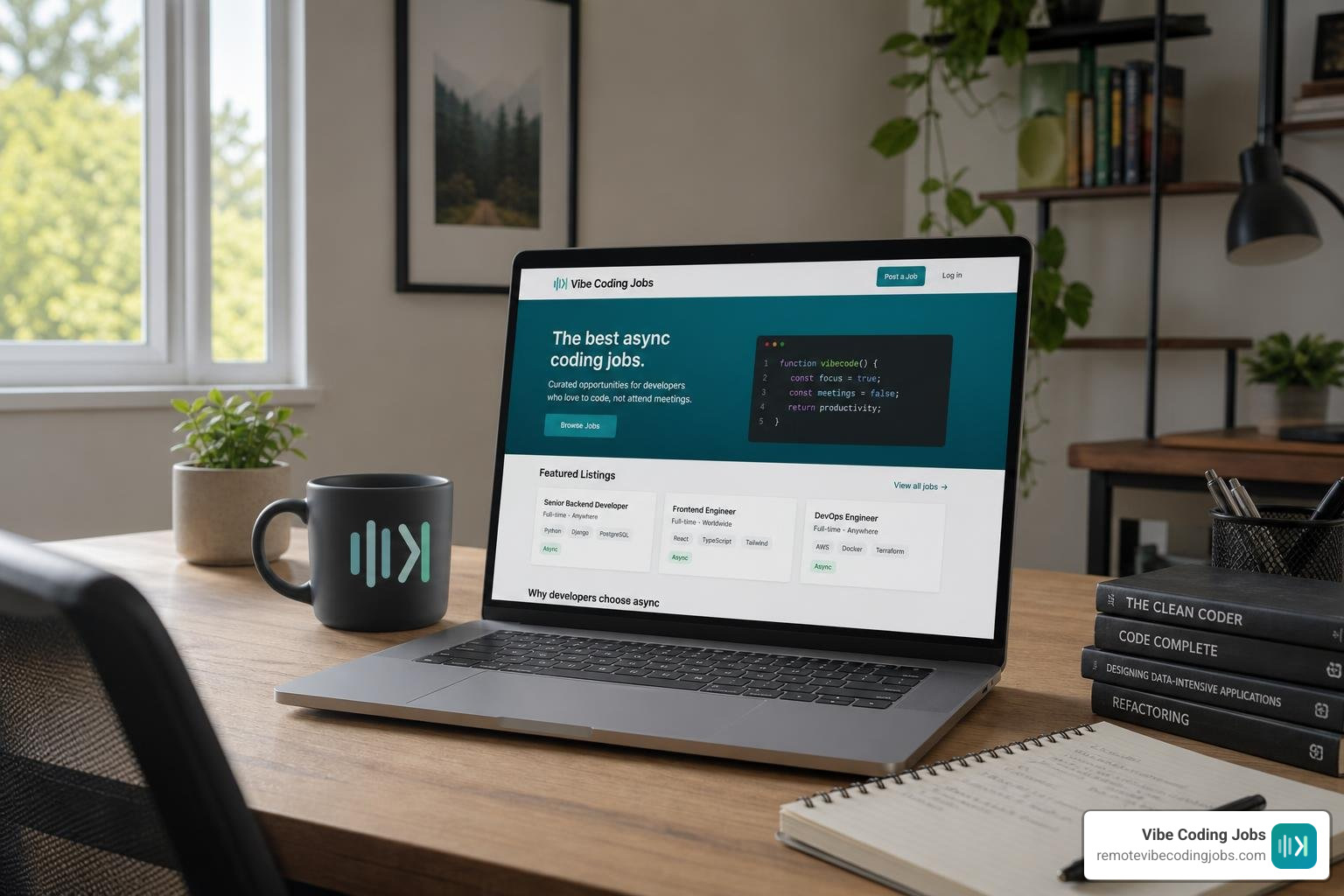
Why curated async coder listings are the future of work
Finding the right remote job in 2026 can feel like searching for a needle in a digital haystack, which is why modern developers rely on curated async coder listings to bypass the noise of meeting-heavy workplaces. Traditional job boards are flooded with roles that claim to be remote but still force you into endless daily standups and rigid timezone constraints.
If you want to skip the generic platforms and find a real async-first coding role, here is a quick summary of where to look:
- Vibe Coding Jobs: The best place for remote, AI-assisted developer roles at fast-moving, no-BS companies.
- GitHub “Awesome” Lists: Open-source, community-led repositories that connect builders with modern AI-native teams.
- Specialized Async Newsletters: Weekly curated digests that deliver flexible, timezone-independent roles straight to your inbox.
- Developer Communities: Slack and Discord groups dedicated to remote work where founders post direct opportunities.
The way we build software has changed. With AI tools now writing nearly half of all production code, the most valuable developers are no longer the ones who type the fastest. Instead, the industry is shifting toward “vibe coding”—where developers act as creative directors of AI agents.
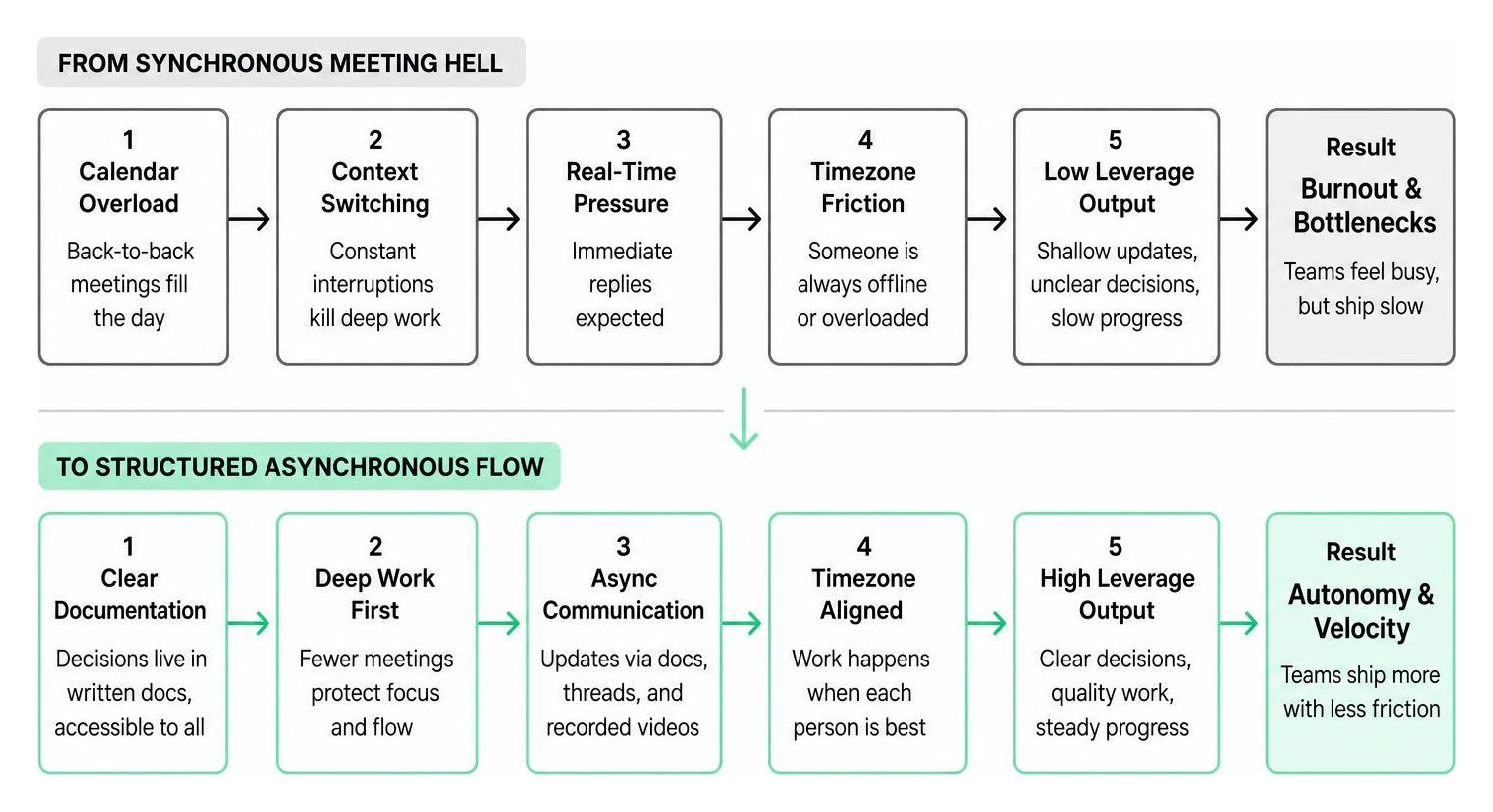
To do this work well, you need long, uninterrupted blocks of time. You cannot get into a flow state when your calendar is packed with status meetings. This is why async-first companies are winning the war for top talent. They replace live meetings with written documents, Loom videos, and clear task boards.
I am Di Su, a software engineer with over 10 years of experience building scalable web solutions and leading growth projects at places like Adaptify SEO and SourceWhale. Over the last decade, I have actively analyzed curated async coder listings to help developers escape meeting fatigue and land high-leverage roles that respect their focus.
Let’s explore the absolute best platforms to find these opportunities in 2026.
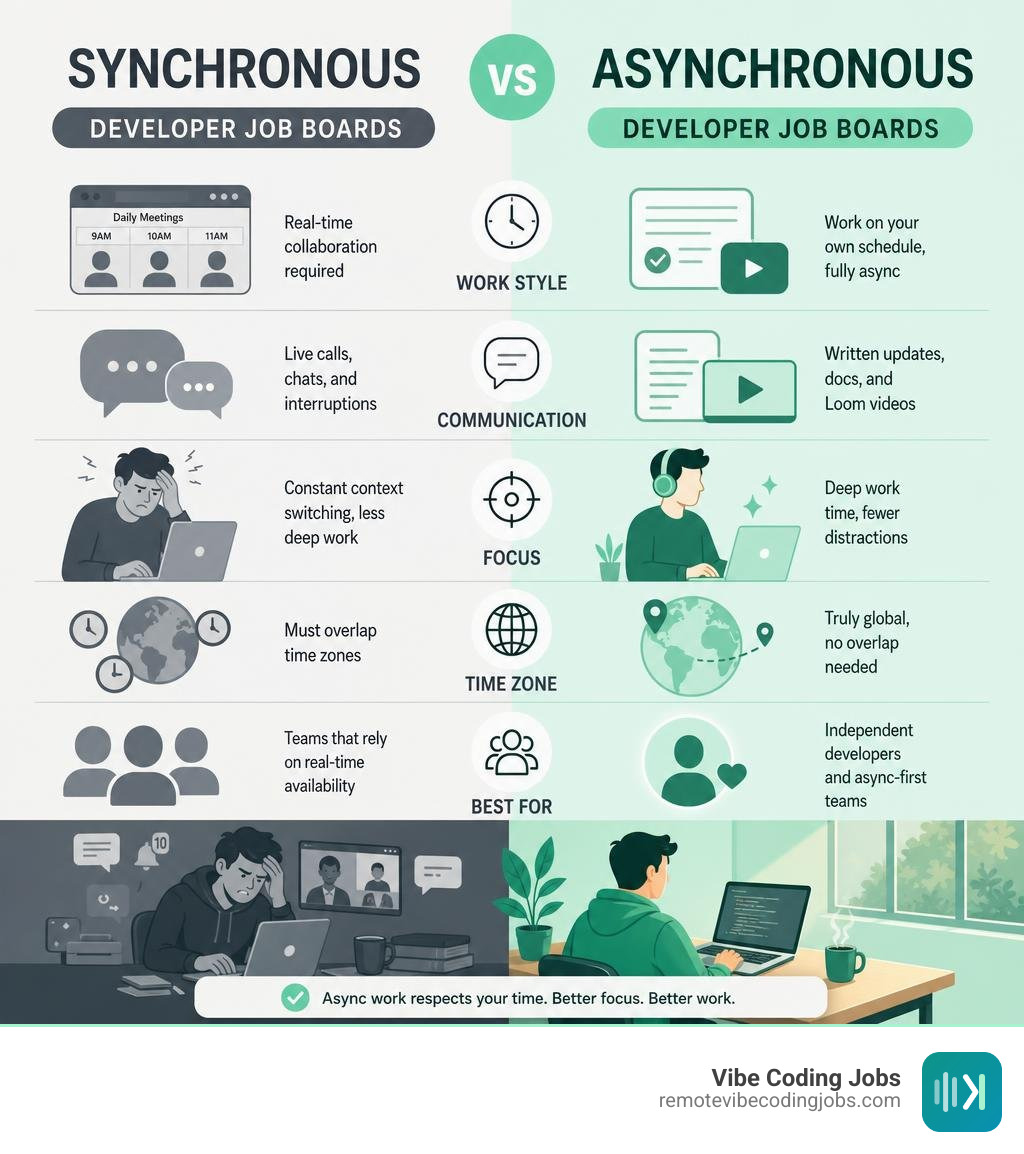
Terms related to curated async coder listings:
What is Async-First Development and Why is it Dominating in 2026?
As we navigate through July 2026, the global software engineering landscape has undergone a profound structural shift. Async-first development is no longer just a perk for digital nomads; it has become the dominant work culture for high-performing, remote-first technology teams.
At its core, async-first development means that synchronous, real-time communication (like live Zoom meetings or immediate Slack expectations) is the exception, not the rule. Instead, teams default to written documentation, recorded video walkthroughs, and highly organized task tracking. This style of work respects timezone differences, eliminates meeting fatigue, and provides developers with the ultimate remote-work luxury: uninterrupted blocks of time for deep work.
The data supports this massive cultural shift. Recent workplace studies show that 98% of remote workers want to continue working remotely at least some of the time. This massive demand has pushed companies to adapt, leading to a 25% year-over-year increase in remote job postings in tech. However, traditional remote setups that try to replicate the 9-to-5 office environment through constant surveillance and back-to-back meetings are failing. Top talent is actively migrating to companies that advertise through specialized, curated async coder listings because they offer true, trust-based autonomy.
To understand how to navigate this cultural landscape, you can check out The Ultimate Async-First Remote Work Guide, which goes deep into how modern teams collaborate across continents.

How Async-First Companies Differ from Traditional Remote Teams
Traditional remote companies are often just “office-first” organizations operating in pajamas. They still expect you to be online from 9 AM to 5 PM, sit through mandatory daily standups, and reply to Slack messages within five minutes.
In contrast, true async-first companies operate under a completely different paradigm:
- Minimal Meetings: Brainstorming sessions are replaced by structured design documents. Status updates are replaced by automated tool integrations or brief, recorded video updates.
- Asynchronous Tooling: Teams coordinate using specialized platforms. Task management happens in Linear, long-form documentation lives in Notion, quick walkthroughs are recorded on Loom, and Slack is used with clear boundaries (e.g., no expectation of an immediate response).
- Results-Oriented Metrics: Managers don’t care when you work or how many hours you sit at your desk. They care about the quality of your output, your ability to unblock yourself, and the clarity of your written communication.
This trust-based autonomy allows engineers to work when they are most creative and productive, whether that is at 5 AM or midnight. For a closer look at the organizations leading this charge, explore our breakdown of Top Companies Hiring for Async-First Remote Developer Jobs.
The Intersection of Vibe Coding and Curated Async Coder Listings
The rise of async-first work has perfectly coincided with the explosion of AI-assisted development, commonly referred to as “vibe coding.” Vibe coding is a development approach where engineers use advanced AI tools—like Cursor, Claude, Windsurf, and GitHub Copilot—to handle the bulk of manual syntax generation. This allows the developer to focus on high-level system architecture, product design, and logic flows.
The metrics show that AI-assisted development is now the industry norm:
- GitHub Copilot writes an average of 46% of code across all programming languages in files where it is enabled.
- Demand for AI-assisted development skills has surged by 300% year-over-year, making it the fastest-growing skill set in software engineering.
- There are currently over 1,725 remote vibe coding jobs live and updated daily on dedicated platforms.
Vibe coding requires intense logical focus and deep context. If a developer is interrupted every 30 minutes by a Slack huddle or a status meeting, the mental model they have built with their AI assistant collapses. Async-first environments provide the long, quiet stretches of time required to direct AI agents effectively. This is why modern builders are constantly searching for curated async coder listings that specifically highlight AI-forward, meeting-light employers. You can find these specialized roles directly through our directory of Async Remote Developer Jobs.
Top Platforms for Curated Async Coder Listings
Finding these highly coveted roles requires stepping away from generic job boards like Indeed or LinkedIn, which are often cluttered with outdated or misleading “remote” listings. Instead, you need to leverage curated directories, open-source repositories, and developer-centric communities.
| Platform / Resource | Primary Focus | Best Feature | Curation Type |
|---|---|---|---|
| Vibe Coding Jobs | AI-assisted & Async-first roles | Curated daily, filters for AI tools | Human-vetted, tech-specific |
| Landed Jobs (GitHub) | Freelance, advisory, & contract AI | Direct-to-developer open listings | Fractional & contract AI roles |
| Awesome Remote Job | Open-source remote opportunities | Community-driven, zero-BS list | GitHub community-curated |
| Company Career Pages | Direct hiring at async-first firms | No middleman, direct application | Employer-curated |
| Tech Newsletters | Curated weekly digests | Delivered straight to your inbox | Editor-curated |
Dedicated Async-First Job Boards
If you want to ensure the company you are applying to actually lives and breathes asynchronous values, start with dedicated async job boards.
A great place to begin is by looking for platforms that focus heavily on roles that respect your timezone and prioritize results over physical presence. These platforms are designed to help you transition to a highly autonomous lifestyle, listing positions at forward-thinking companies that have completely abandoned the traditional 40-hour meeting grind.
To find active developer listings with these exact parameters, check out Async-First Remote Developer Jobs with Flexible Hours. By focusing on platforms that filter specifically for async communication, you can bypass the noise of traditional job boards and connect directly with employers who value deep work.
Open-Source Repositories and Curated Async Coder Listings
For developers, some of the most reliable and high-quality job listings aren’t on commercial websites at all—they are hosted directly on GitHub. Open-source awesome lists have become a primary discovery mechanism for modern developer tools and remote work opportunities.
The classic GitHub – lukasz-madon/awesome-remote-job: A curated list of … is a community-driven repository that has been curated for years. It contains zero-BS links to remote-first companies, specialized job boards, and regional remote communities. Because it is maintained by developers for developers, it completely avoids the spam and fake listings common on commercial platforms.
Using these open-source resources also helps you build a community connection. Many repositories have active Discord or Slack channels where you can get your resume reviewed, share interview debriefs, and get direct referrals to async-first companies.
Specialized AI and Freelance Curated Async Coder Listings
For builders who prefer freelance, fractional, or advisory work over traditional full-time employment, the market has evolved rapidly. Many AI-native startups prefer hiring highly skilled “builders” on a flexible, contract basis to set up their initial LLM pipelines, RAG systems, or agentic workflows.
An incredible resource for this is the landedjobs/ai-freelance-and-advisory-jobs repository. This curated directory currently features 125 live freelance and advisory AI roles, categorized cleanly by seniority (including Senior/Staff, Mid-level, and specialized internships). These listings are refreshed every few days and connect developers directly with AI-forward companies looking for high-leverage, short-term expertise.

Key Skills, Salaries, and Trends for Async Developers
To land a role through these curated async coder listings, you need to possess a unique combination of technical expertise and highly developed soft skills. In an async environment, your code and your writing are your only representatives.
- Exceptional Written Communication: This is the absolute non-negotiable skill. You must be able to write clear, concise, and unambiguous design documents, pull request descriptions, and Slack updates. If you cannot explain your technical decisions clearly in writing, you will struggle in an async team.
- System Design and Architecture: Because you won’t have a senior developer sitting next to you to answer questions in real time, you must have a strong grasp of system design. You need to be able to look at a complex problem, architect a modular solution, and implement it independently.
- Self-Management and Autonomy: You must be a self-starter who can manage their own schedule, prioritize tasks effectively, and proactively unblock themselves when they hit a wall.
- Modern Tech Stacks: While language-agnostic builders are highly valued, async-first companies frequently hire for modern, highly productive ecosystems. For example, you can explore specialized listings like Async-First Ruby Developer Jobs or Async-First MongoDB Developer Jobs to see what stacks are currently in high demand.
Salary Ranges and Compensation Trends in 2026
Compensation in the async-first world is highly dynamic, often reflecting a fascinating mix of global talent arbitrage and premium rates for elite builders. Because async-first companies can hire from anywhere, salary bands can vary widely depending on the company’s funding, location, and compensation philosophy.
On general directories, salary expectations can span extreme ranges—from $4,000/year for entry-level tasks in developing regions to $600,000/year for highly specialized AI architects in major tech hubs. However, for established, mid-to-senior software engineers working at VC-backed startups or profitable remote-first companies, the standard salary ranges in 2026 are highly lucrative:
- Junior / Mid-Level Developer: $70,000 – $150,000 USD
- Senior Software Engineer: $150,000 – $220,000 USD
- Staff / Principal Engineer / AI Architect: $220,000 – $350,000+ USD
Importantly, remote senior engineers at AI-forward, async-first companies frequently earn 15% to 25% above the traditional market median. Furthermore, salary transparency is incredibly common in this niche. Most curated job boards require employers to post transparent salary bands upfront, saving you from wasting time on low-paying roles. To learn more about how benefits, equity, and geographic location impact your take-home pay, read our detailed guide on Async-First Remote Developer Jobs: Culture, Tools, and Salary.
How to Stand Out and Land an Async-First Developer Role
Because remote jobs offer incredible flexibility, they are highly competitive. A single remote job posting can attract up to 10x more applicants than a traditional, in-office role. If you are just submitting a generic PDF resume to flooded application portals, your chances of getting noticed are slim.
To land an async-first role, you must treat your job search like a structured, 90-day project and use strategies that prove you can thrive in a highly autonomous environment:
- Build Public Proof of Work: Async companies value builders. Instead of just listing technologies on your resume, build and ship public projects. Document your building process on GitHub, write technical blog posts, or share your system architectures publicly.
- Use the “Loom Video Trick”: When applying for a role, go beyond the standard application form. Record a short, 2-minute Loom video introducing yourself, explaining why you are a great fit for the company, and briefly walking through a piece of elegant code you wrote. This immediately demonstrates your verbal communication, technical clarity, and proactive nature.
- Customize Every Application: Spend 10 to 15 minutes researching the company’s product, engineering blog, or open-source repositories. Mention a specific technical challenge they are facing or a feature they recently shipped in your cover letter.
- Highlight Async-Essential Soft Skills: Ensure your resume explicitly highlights your experience with independent problem-solving, writing technical documentation, and managing projects across timezones.
Common Mistakes to Avoid When Applying for Async Roles
When searching through curated async coder listings and submitting applications, avoid these common pitfalls that raise immediate red flags for hiring managers:
- Sending Generic, Copy-Pasted Resumes: If your application looks like it was mass-submitted to 100 other companies, it will be instantly rejected.
- Ignoring Timezone Constraints: Even fully remote, async-first companies often have geographic restrictions for legal, tax, or occasional collaboration overlap reasons. Always verify that your location aligns with the job listing’s requirements.
- Providing Zero Written Samples: Since written communication is the lifeblood of async work, failing to link to written documentation, technical blog posts, or detailed pull request descriptions is a missed opportunity to prove your primary skill.
- Demonstrating an Over-Reliance on Real-Time Guidance: If your portfolio or interview answers suggest that you need constant, real-time hand-holding or daily synchronous check-ins to make progress, async-first companies will pass on your application.
Frequently Asked Questions about Curated Async Coder Listings
What does async-first mean for a software engineer?
For a software engineer, async-first means that your day is not structured around live meetings or real-time Slack conversations. Instead, you receive your tasks through project management tools (like Linear), read the corresponding technical specifications in a shared document (like Notion), and write code independently. You communicate your progress through written updates, detailed pull request descriptions, and occasional short, recorded videos. This gives you long, uninterrupted blocks of focus time to write code and solve complex architectural problems.
How do I find high-quality curated async coder listings?
The best way to find high-quality listings is to bypass generic, high-volume job boards and focus on niche, developer-centric platforms. Use dedicated async-first job boards like Vibe Coding Jobs, monitor community-curated GitHub awesome lists, and subscribe to specialized newsletters that deliver hand-vetted, timezone-independent roles directly to your inbox every week.
What tools do async-first development teams use?
Async-first engineering teams rely on a highly integrated stack of tools designed to maintain alignment without real-time meetings. This typically includes:
- Linear or Jira for highly structured, asynchronous task tracking.
- Notion, Slite, or GitHub Wikis for comprehensive, long-form technical documentation and design docs.
- Loom or CleanShotX for sharing quick, asynchronous video walk-throughs of code, bugs, or product features.
- Slack or Discord with established communication boundaries (e.g., notification schedules and no expectation of instant replies).
- GitHub or GitLab for collaborative code reviews, pull requests, and automated CI/CD pipelines.
Conclusion
The era of sitting in an office—or sitting on endless Zoom calls pretending to be in an office—is coming to an end for top-tier software engineers. As we progress through 2026, the combination of async-first work cultures and high-leverage, AI-assisted development is redefining what it means to be a highly productive developer.
By leveraging curated async coder listings, you can bypass the noise of meeting-heavy organizations and connect with forward-thinking companies that respect your focus, value your output, and give you the autonomy to build incredible software on your own schedule.
If you are ready to take control of your career, start using AI tools to supercharge your workflow, and find a remote role that respects your time, we invite you to join us. You can explore our daily, hand-curated listings of AI-forward roles and download our free interview playbook to start your journey. To understand exactly how this technological shift is unfolding, dive into our comprehensive guide and learn more about vibe coding today.