
Remote AI Coding Vacancies Are Booming — Here’s Where to Look in 2026
Remote AI coding vacancies are multiplying fast in 2026, and the best ones get filled quickly. Here’s a snapshot of where to find them right now:
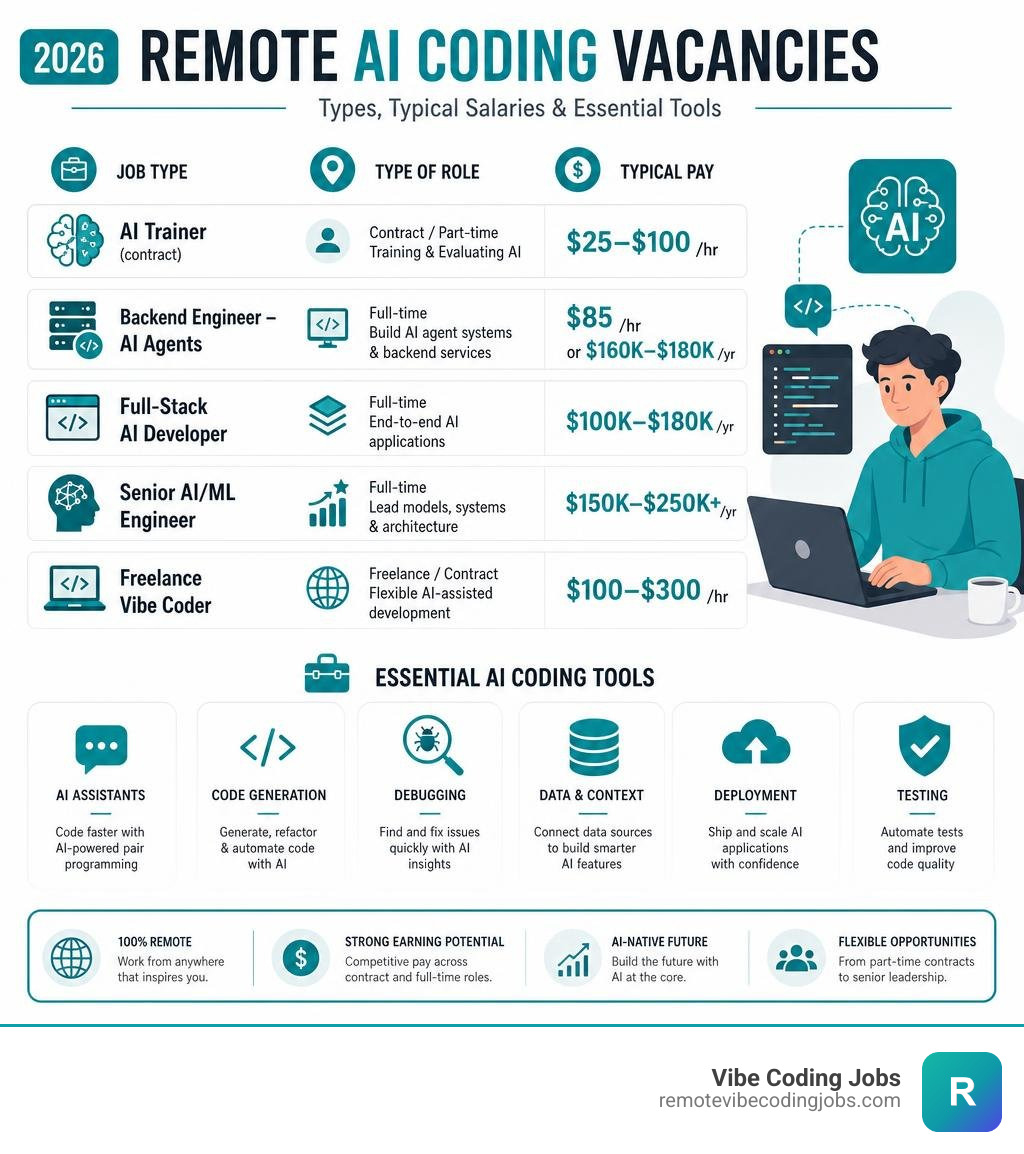
| Job Type | Where to Find It | Typical Pay |
|---|---|---|
| AI Trainer (contract) | Outlier, Stellar AI, G2I | $25–$100/hr |
| Backend Engineer – AI Agents | Mercor, tech startups | $85/hr or $160K–$180K/yr |
| Full-Stack AI Developer | Dev.Pro, MAIA, Coder | $100K–$180K/yr |
| Senior AI/ML Engineer | Snorkel AI, Directio | $150K–$250K+/yr |
| Freelance Vibe Coder | Toptal, Upwork | $100–$300/hr |
The market has shifted decisively. Companies aren’t just looking for developers who occasionally use AI — they’re hiring engineers whose default way of shipping software is AI-native. There are currently over 576 open vibe coding roles across major job boards, with 169 of those fully remote.
The demand is real, the pay is strong, and the roles span everything from flexible part-time contracts to senior full-time positions at well-funded AI companies.
I’m the RVCJ Editorial team at Remote Vibe Coding Jobs — we cover AI-assisted development, remote hiring trends, and practical job-search advice for developers navigating the growing market of remote AI coding vacancies. We curate verified global remote roles daily so you can skip the noise and find positions that actually match your stack and work style.
The Landscape of Remote AI Coding Vacancies in 2026

The engineering landscape in 2026 looks fundamentally different than it did just a few years ago. Hand-coding every line of boilerplate is quickly becoming a relic of the past. Today, the rise of powerful AI coding assistants has birthed a new era of software development: “vibe coding.” This shift has catalyzed an explosion of specialized roles, making the hunt for remote AI coding vacancies one of the most active segments of the tech job market.
According to recent job board data, there are currently 576 active vibe coding positions, with 169 of them offering fully remote setups and 293 operating on-site. This growing volume of remote positions highlights a broader structural change. Companies are no longer viewing remote work as a temporary perk, nor are they viewing AI tools as optional add-ons. Instead, they are actively restructuring their engineering workflows to support asynchronous, globally distributed teams who leverage AI to build software at unprecedented speeds.
To understand where this market is heading, we must look at how these roles are expanding. In our deep dive on AI Coding Jobs: Remote Market Trends, we highlight how companies are securing massive competitive advantages by employing “AI-first” developers. These professionals achieve 2-5x productivity increases within their first month of adopting state-of-the-art tools. Consequently, organizations are moving away from traditional hiring frameworks to find builders who can design, prompt, and orchestrate complex systems rather than just write syntax.
Common Types of Remote AI Coding Vacancies
When browsing modern job listings, you will notice that “Software Engineer” is no longer a catch-all title. The market has bifurcated into highly specialized roles. If you are looking to secure one of these positions, you will likely find yourself applying to one of the following categories:
- AI Trainers and Model Evaluators: These roles focus on human-in-the-loop training for Large Language Models (LLMs). Engineers write high-quality prompts, evaluate model-generated code for correctness, and build expert rubrics. Companies like Stellar AI and Outlier frequently hire for these positions, offering flexible, project-based contracts.
- Backend Engineers for AI Agents: These developers build the infrastructure that allows AI agents to act autonomously. This includes designing APIs, managing real-time data pipelines (using tools like Kafka or RabbitMQ), and implementing hybrid retrieval systems. If you want to build the systems behind agentic workflows, you can check out Remote AI Engineer Jobs to see who is hiring.
- Full-Stack AI Engineers: These developers bridge the gap between user experience and AI intelligence. They build intuitive front-end interfaces while integrating complex backend RAG (Retrieval-Augmented Generation) pipelines.
- AI Data and Platform Engineers: These specialists focus on building the data pipelines and validation frameworks that feed AI models. They ensure data observability, governance, and low-latency access to vector databases. You can find active listings for these infrastructure-heavy roles on our curated feed of AI Engineer Vacancies.
Contract vs. Full-Time Remote AI Coding Vacancies
One of the most important decisions you will make when searching for remote AI coding vacancies is choosing between contract/freelance work and full-time employment. Both paths have evolved significantly to accommodate AI-driven workflows.
| Feature | Contract / Freelance AI Work | Full-Time Remote AI Roles |
|---|---|---|
| Hiring Speed | Extremely fast (often hours or days via skill tests) | Standard multi-stage interview process (2–4 weeks) |
| Compensation Structure | Hourly base rate ($25–$100/hr) or task-based ($400/task) | Annual salary + equity + health benefits + PTO |
| Work Autonomy | Complete control over your hours; work from anywhere | Asynchronous but expected to collaborate during core hours |
| Typical Tasks | RLHF, code ranking, converting PRs to agent challenges | Architecting platforms, deploying RAG pipelines, cloud SRE |
| Job Security | Variable; highly dependent on active project volume | High; integrated into the company’s core product roadmap |
For developers who value ultimate flexibility, contract work is incredibly lucrative. Independent contractors can easily command rates between $100 and $300 per hour due to their ability to deliver functional products in a fraction of the time traditional developers require. Alternatively, platforms like Mercor offer task-based compensation where developers earn a flat rate (e.g., $400 per accepted task) for evaluating frontier AI coding agents.
Conversely, full-time remote roles offer long-term stability, equity refresh grants, unlimited PTO, and comprehensive benefits. Full-time developers are deeply integrated into product strategy, working to build proprietary AI systems, scale cloud infrastructure, and maintain continuous delivery pipelines.
Top Companies Hiring AI Developers Remotely
If you are wondering where to focus your job search, several pioneering companies are consistently listing remote AI coding vacancies. These organizations range from fast-growing startups to established cloud-infrastructure giants. To get a comprehensive view of the landscape, you can explore our guide on the Best Companies Hiring AI Developers Remotely.
Let’s look at how some of these prominent employers structure their remote opportunities:
- Coder: A remote-first organization with a global team spanning from Alaska to Australia. Coder focuses on building secure, scalable cloud development environments. They offer incredible perks, including a $150 monthly learning stipend, a 4-week paid sabbatical every five years, and comprehensive fertility benefits. They use their own experimental agent development engine, Blink, to build internal tools and keep developers in flow state.
- Snorkel AI: Known for building the data and environments behind the world’s most advanced AI systems, Snorkel AI is a powerhouse in the AI space. While they hire for full-time engineering and research roles, they also maintain an active “Expert Community” for specialists who want to contribute on a more flexible basis. You can browse their open positions directly on the Find careers in AI | Snorkel AI Careers portal.
- Stellar AI: This platform focuses on project-based, open-ended contract work. They employ people with diverse technical backgrounds to convert GitHub pull requests into challenges for coding AI agents. Stellar AI is highly accessible, requiring no prior AI experience—only strong coding fundamentals and a reliable internet connection.
- MAIA: A remote-first European startup building specialized AI knowledge management platforms for industrial enterprises. They hire full-stack applied AI engineers to design RAG pipelines and LLM tracing systems, offering competitive salaries and virtual stock option plans (VSOP).
How Industry Leaders Structure AI Roles
Remote-first companies have had to reinvent the traditional software development lifecycle to support AI-native developers. Because AI tools allow developers to build features in hours rather than weeks, the bottleneck is no longer writing code—it is reviewing, testing, and architecting systems.
To handle this, companies are adopting asynchronous, low-oversight work environments. For example, contract platforms like G2I Inc. hire senior Python developers to work in highly independent environments where they evaluate, edit, and rank LLM-generated code. Similarly, companies hiring remote AI talent frequently look for developers who can integrate “agentic” coding practices directly into their daily workflows, using tools like Claude Code or OpenAI Codex to automate routine PR reviews and feature implementations.
Essential Skills and Tools for Remote AI Developers
Securing a remote AI coding job in 2026 requires a different skill set than traditional software engineering. While strong computer science fundamentals remain crucial, employers are placing a premium on “AI fluency”—the ability to seamlessly collaborate with AI models to ship secure, high-quality software.
If you are looking to enter this field, our guide on Entry-Level AI Coding Jobs outlines how you can break into the industry by building a portfolio that highlights your prompt engineering and system design capabilities.
To stand out to hiring managers, you should focus on mastering these core competencies:
- System Architecture and Design: Because AI can generate code blocks instantly, your job shifts from typing syntax to structuring systems. You must understand how microservices, databases, and APIs connect securely.
- Prompt Engineering and Context Window Management: Knowing how to feed the right context to an LLM to get the desired output is an art form. You need to understand how to craft precise instructions and utilize system rubrics.
- Code Quality and Observability: AI-generated code can contain hidden bugs, security vulnerabilities, or performance bottlenecks. Candidates must possess sharp code-review instincts to validate, refactor, and debug AI outputs.
- Data Engineering for AI: Understanding how to manage modern data platforms (like Snowflake, Databricks, or BigQuery) and MLOps tools (such as dbt or Airflow) is highly sought after by employers hiring for Senior AI/Python Developer – Remote Work Type – Directio Sp. z o.o. .
The AI-Native Tech Stack
The modern AI developer’s toolkit extends far beyond standard IDEs and compilers. To remain competitive, you should be comfortable working with the following tools and frameworks:
- AI Coding Environments: Cursor, Windsurf, and Replit Agent are the industry standards for iterative, natural-language development.
- Rapid Prototyping Tools: Bolt.new, Lovable, and v0 allow developers to build full-stack web applications from simple text prompts in minutes.
- AI Orchestration Frameworks: LangGraph, LangChain, and Model Context Protocol (MCP) are essential for building multi-agent systems and managing complex retrieval pipelines.
- Core Languages: Python remains the king of backend AI development, while TypeScript and React dominate the front-end interface layer for AI applications.
Compensation and Market Trends for AI Coders
The financial rewards for AI-fluent developers are exceptionally strong. Because these professionals deliver software much faster than traditional engineers, companies are willing to pay a premium for their efficiency.
To understand the long-term trajectory of these salaries, you can read our comprehensive analysis on The Future of Remote AI Coding Jobs. Here is what the compensation landscape looks like in 2026:
- Entry-Level AI/Vibe Coders: Typically earn between $70,000 and $100,000 annually. These roles often focus on AI training, data labeling, and basic frontend integrations.
- Mid-Level AI Developers: Command salaries ranging from $100,000 to $150,000. These engineers are responsible for building production-grade features and managing RAG pipelines.
- Senior AI Engineers & Architects: Earn anywhere from $150,000 to $250,000+ (with some specialized roles at tech startups scaling up to $400,000+). These professionals architect complex agentic workflows, manage secure cloud deployments, and oversee AI platform strategy.
- Freelance / Contract Rates: Freelance vibe coders charge between $100 and $300 per hour because they can deliver complete MVPs in days instead of months. For entry-level contract AI training, the base rate starts at $25 per hour, while specialized contract roles (like C++ or backend AI training) pay between $50 and $100 per hour.
Frequently Asked Questions about Remote AI Coding Jobs
Navigating remote AI coding vacancies can bring up a lot of questions. If you are looking for active listings and want to explore the best places to apply, check out our resource on Remote AI Developer Job Boards and Openings.
Below, we answer some of the most common queries from developers looking to transition into this space.
What is vibe coding?
“Vibe coding” is a term used to describe a modern software development approach where the developer uses natural language prompts to guide AI tools in generating, refactoring, and deploying code. Instead of manually typing out every line of syntax, a vibe coder acts as a system architect, product manager, and quality assurance lead. You describe the “vibe” and functionality of what you want to build, and the AI handles the heavy lifting of manual implementation.
Do I need a computer science degree to get a remote AI coding job?
No, a formal Computer Science degree is not strictly required for many remote AI coding roles, especially in the contract and startup space. While a degree is beneficial for deep machine learning research, most applied AI and vibe coding roles value practical skills above all else. Employers want to see a strong portfolio of real, functional projects built using AI tools, a proven ability to write precise prompts, and solid problem-solving skills. Completing hands-on projects and passing practical skill-match tests is often the fastest way to get hired.
How much do remote AI coding jobs pay?
Compensation varies based on your experience level and the type of contract. Flexible AI training contracts typically start at a base rate of $25/hr and can scale up to $100/hr for specialized languages. Full-time remote AI engineers earn competitive salaries, with mid-level developers averaging $100K–$150K and senior engineers commanding $150K–$250K+ per year, often accompanied by equity, health benefits, and remote-work stipends.
Conclusion
The era of manual, repetitive coding is giving way to a highly efficient, AI-first future. Whether you want to work as a flexible, part-time AI trainer earning competitive hourly rates, or as a full-time senior engineer architecting agentic backend systems, the market for remote AI coding vacancies is filled with opportunity.
At Remote Vibe Coding Jobs, we make it easy for you to transition into this exciting field. We aggregate the best remote vibe coding and AI-assisted development jobs at async-first companies, filtering them by tech stack, remote culture, and specific AI tools like Cursor and Claude.
Ready to skip the generic job boards and find roles tailored to the future of development? Check out our guide on What is Vibe Coding to learn how to master these tools, browse our daily curated listings, and join our talent network to land your next remote AI role today!