
Why Getting Culture Fit Right for Async Roles Changes Everything
Culture fit in async roles is one of the most misunderstood parts of remote hiring in 2026. Most developers focus on tech stack and salary — but the companies where people actually stay are the ones where the culture matches how you naturally work.
Here’s a quick answer to what strong culture fit looks like for async positions:
- Self-motivation — you do your best work without someone checking in
- Written communication — you default to clear, context-rich writing over quick calls
- Output focus — you measure yourself by results, not hours online
- Documentation discipline — you write things down so teammates in other time zones can act without you
- Autonomy tolerance — you’re comfortable with silence and delayed responses
These traits separate people who thrive in async environments from those who quietly burn out. And that burnout risk is real — 69% of remote workers report experiencing it due to pressure to always be online, even in roles that claim to be flexible.
The difference between a great async role and a miserable one usually comes down to whether the company’s culture is genuinely built around async work — or just remote-washed.
I’m Dominic Zijlstra, co-founder of Adaptify.ai and a former data scientist and DevOps engineer who has worked in distributed, async-first environments across Europe and beyond — experience that taught me exactly how to evaluate culture fit in async roles before signing an offer. In this guide, I’ll show you the practical signals, red flags, and frameworks that tell you whether a company’s async culture is real.
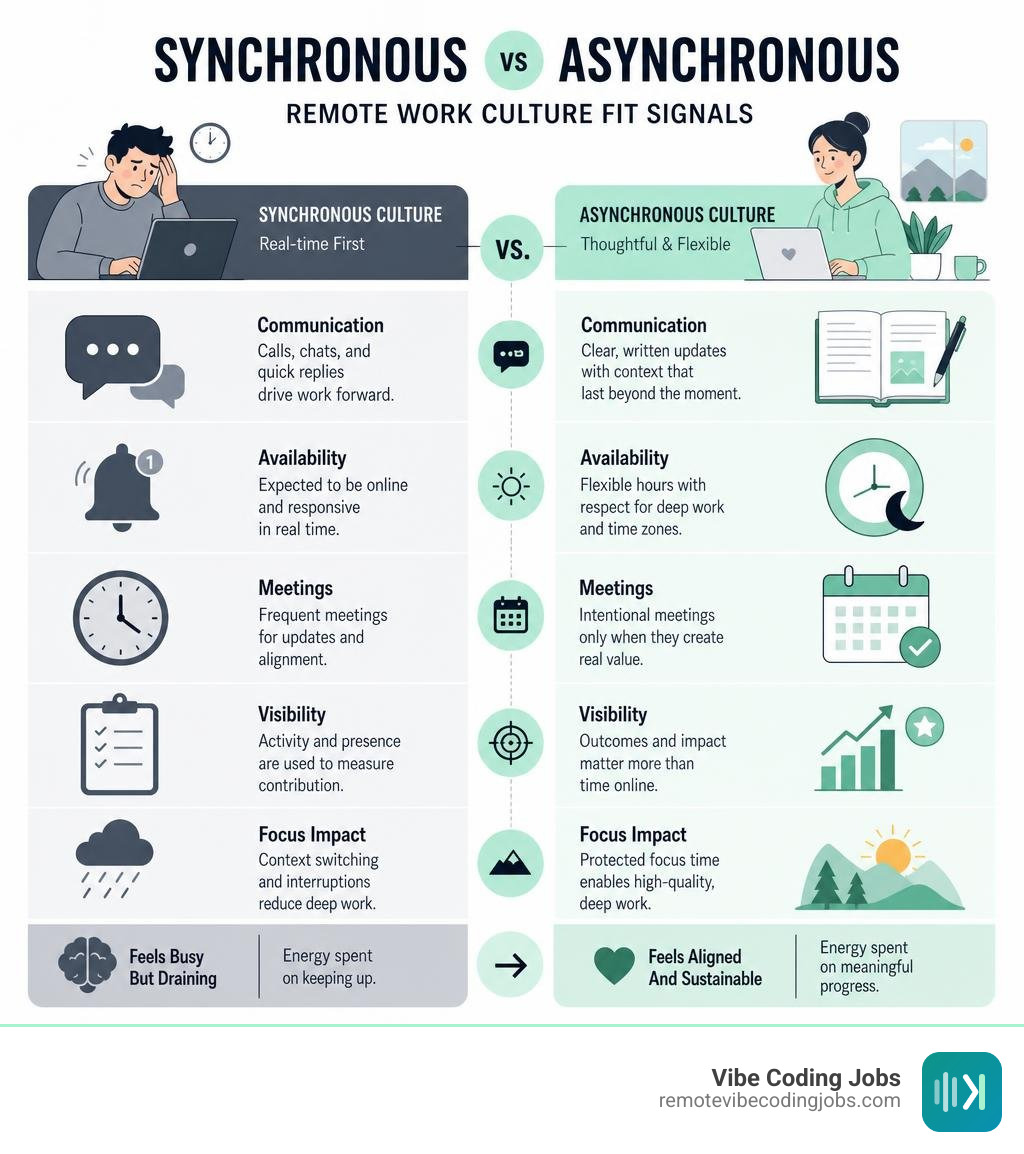
Related content about culture fit async roles:
Defining Culture Fit Async Roles in 2026
In 2026, the competitive edge for global companies has shifted from who has the flashiest office to who has the most efficient asynchronous-first culture. Nearly 60% of professionals work in full-time remote roles, and the top expectation of modern knowledge workers has evolved from simple location flexibility to true, uncompromised workplace autonomy.
But what exactly defines a strong culture fit for these roles?
In an async-first company, culture is not a social perk. It is a quiet operating system running in the background, powering every code commit, pull request, and product launch. A genuine async culture relies on several foundational pillars:
- Output-Based Performance Evaluation: Your value is judged entirely on your deliverables and impact, not on “desk time” or how long your Slack status light remains green. Teams that operate with an async-first mindset report 42% higher productivity compared to those tied to traditional schedules.
- Radical Transparency and Trust: Information is never siloed. Strategic decisions, project roadmaps, and even executive calls are documented and searchable by default. This high trust environment eliminates the need for micromanagement.
- Written Communication as the Default: Instead of dragging five people into a “quick sync” call, team members take the time to write structured, comprehensive updates. This respects everyone’s focus time and creates an automatic paper trail of institutional knowledge.
When we evaluate whether a candidate fits this operational model, we are looking for alignment with these core values. If you are someone who requires real-time verbal validation to move forward on a task, or if you struggle to document your thought process clearly, a highly async environment might feel isolating or frustrating. Conversely, if you value uninterrupted focus blocks and want to design your workday around your peak productivity hours, finding The 2026 Guide to Asynchronous-First Culture for Distributed Teams will feel like discovering the holy grail of career satisfaction.
Key Attributes of Success in Culture Fit Async Roles
Success in an asynchronous environment is predicted by a highly specific set of soft skills and behavioral traits. When we screen developers for our platform, we look for these indicators:
- High Autonomy and Self-Motivation: You don’t wait for a manager to assign your next ticket. You look at the product roadmap, identify high-impact tasks, and pull work from the backlog yourself. You are comfortable making decisions with 80% of the information and iterating based on results.
- Systems Thinking: You understand how your code impacts the broader codebase and how your documentation affects developers working eight time zones away. You write code and documentation with the explicit goal of making yourself obsolete—meaning anyone else can step in and understand your work without needing to jump on a call with you.
- Proactive Decision-Making: In an async setup, waiting for approval can stall a project for a day or more. Successful async developers are comfortable stating their assumptions, making a calculated decision, documenting their reasoning, and moving forward. They ask for forgiveness rather than permission, knowing that a bias for action is highly valued.
If you want to dive deeper into how these communication dynamics play out on modern engineering teams, check out our guide on Async Remote Developer Jobs: Flexible Communication.
The Psychological Realities of Asynchronous Autonomy
While the freedom of async work is incredibly liberating, it introduces unique psychological challenges that require a strong cultural fit to manage. The most prevalent of these is what we call “quiet pressure.”
Because there are no physical office walls or set 9-to-5 hours, many developers experience the “anxiety of silence.” When you post a question or submit a pull request and don’t receive an immediate response, the temptation is to stay online, constantly refreshing your notifications. This behavior leads directly to the 69% burnout statistic we mentioned earlier.
To combat this, healthy async companies establish explicit communication Service Level Agreements (SLAs). For example, they might set expectations like:
- Slack/Teams: Response expected within 4 business hours.
- Email: Response expected within 24 business hours.
- Project Management (Linear/Jira): Update expected within 48 business hours.
Furthermore, they make it clear that no response is ever expected outside of your local working hours. Mastering this environment requires a high degree of self-discipline to close your laptop and trust that your team respects your boundaries. You must also practice “over-clarity” in your writing, anticipating potential follow-up questions and front-loading all necessary context to minimize the back-and-forth delay across time zones.
For a deep dive into mastering these mental models and communication frameworks, read Async Communication: The Complete Guide for Remote Professionals | RemoteResume.ai.
How Top Companies Assess Culture Fit for Async Positions
If a company claims to be async-first but runs a traditional, interview-heavy hiring process consisting of five rounds of rapid-fire live coding and whiteboard sessions, they are showing you a massive mismatch. True async-first companies design their recruitment funnels to actively test the exact skills you will use on the job.
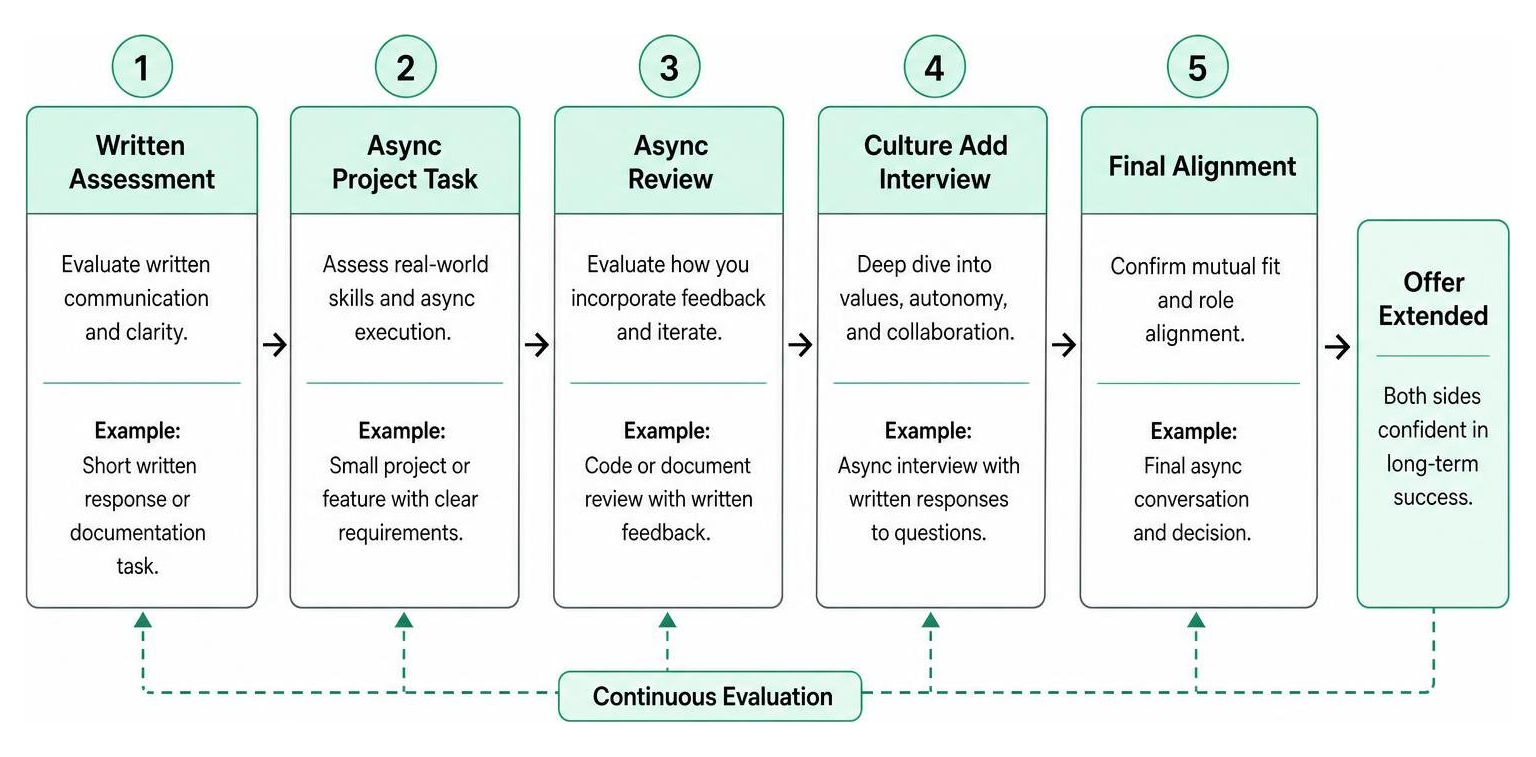
This progressive filter ensures that both the company and the candidate can evaluate mutual fit before making a long-term commitment. By shifting the focus from verbal charisma to written clarity and real-world execution, async hiring processes achieve far better long-term retention. In fact, companies utilizing these practical filters report a first six-month attrition rate of just 8%, compared to the 25% industry average. Learn more about these structures in this guide on Hiring for Async-First: Practical Filters and Interview Structure.
Evaluating Written Communication and Documentation Skills
The first and most critical filter in an async hiring process is the written assessment. Rather than relying solely on a resume, top-tier remote companies will ask you to complete a brief written exercise early in the process.
This is not a trick test; it is an evaluation of your technical writing ability and your capacity to share context. You might be asked to write a 400-to-600-word response explaining how you resolved a complex technical dependency in a past project, or how you would structure a README file for a new open-source library.
Hiring managers score these assessments based on:
- Structure: Are there clear, logical headings and bullet points?
- Detail: Do you name specific tools, metrics, and technical trade-offs?
- Context: Can a non-technical stakeholder or a developer from another team understand the core problem and solution without needing a walkthrough call?
- Tone: Is your explanation collaborative, educational, and constructive?
If you are curious about how these documentation workflows translate into daily developer productivity, read our analysis of Async-First Remote Developer Jobs: Workflow Productivity.
Structuring the Interview Process to Mimic Async Work
The ultimate test of async culture fit is a paid trial week. Instead of relying on artificial coding puzzles, companies will bring you into their actual workspace (using tools like Slack, GitHub, and Notion) to work on a real, low-priority backlog task.
During this trial, the team is not just looking at the quality of your code; they are evaluating your async communication patterns.
- Do you update your progress on GitHub tickets so your work is visible to everyone?
- Do you state your assumptions clearly in your pull requests?
- Do you ask for help when you are stuck, or do you “go dark” for days?
- How do you handle feedback on your code reviews?
This practical approach ensures that both parties have a realistic preview of what day-to-day collaboration will look like. It respects your time by paying you a standard daily rate for your labor, and it protects the company from hiring individuals who interview exceptionally well verbally but struggle to execute independently. For a complete playbook on setting up and navigating these practical remote hiring processes, review Hiring Remote Employees That Fit Your Culture: A Practical Playbook – DEV Community.
Balancing Cultural Alignment with Time Zone Overlap
Hiring globally is one of the greatest advantages of the async model, but it introduces a delicate balancing act: how do you manage cultural alignment when your team is scattered across 15+ different time zones?
The key is to understand that not all remote roles require the same level of real-time collaboration. We can break this down by “collaboration intensity” and “system maturity”:
| Role Type | Collaboration Intensity | Time Zone Overlap Needed | Primary Success Driver |
|---|---|---|---|
| High Intensity (e.g., Product Managers, UX Designers, Sales) | High (Requires frequent brainstorming, rapid feedback loops, and live alignment) | 3–4 hours of daily overlap | Strong real-time communication & rapid iteration |
| High Autonomy (e.g., Software Engineers, Data Analysts, Content Writers) | Low (Focuses on deep work, individual execution, and structured handoffs) | Minimal (1–2 hours of weekly overlap is sufficient) | Mature documentation, clear ticket specifications, and async tools |
To make global collaboration sustainable, successful distributed teams establish a “minimum viable overlap”—often just a single 30-minute window per week where the entire team is online simultaneously for social connection or high-level alignment. The rest of the week runs entirely on async systems, eliminating the “time zone tax” of forcing employees in Berlin, Lagos, and Tokyo to join late-night or early-morning calls.
To explore how top remote companies organize their engineering teams to support this balance, check out our resource on Async-First Remote Developer Jobs: Roles Teams Companies.
Red Flags and Green Flags for Job Seekers
As a job seeker looking for culture fit async roles, you must learn to read between the lines of job postings and interview processes. Many companies use “remote-friendly” as a buzzword to attract talent, but once you join, you discover they have simply copy-pasted their high-stress office habits into Slack and Zoom.

To find legitimate opportunities that offer true schedule flexibility and respect your focus time, you need to know how to spot the difference.
Spotting Genuine Culture Fit Async Roles in Job Descriptions
A company that is genuinely built around async work will showcase this clearly in their job descriptions. Look for these high-signal green flags:
- Explicit Mention of Async Workflows: They use terms like “async-first,” “results-oriented,” “written communication preferred,” or “global team across time zones.”
- Transparent Tool Stacks: They list documentation and project management tools as core parts of their workflow (e.g., Notion, Linear, GitHub Discussions, Loom) rather than just real-time chat apps.
- Flexible Core Hours: If they mention working hours, they define a broad, flexible window (e.g., “core collaboration hours between 10 AM and 2 PM EST”) rather than requiring a strict 9-to-5 presence.
- Focus on Output: The job description emphasizes clear deliverables and key performance indicators (KPIs) rather than daily attendance or availability.
To learn more about how to analyze these cultural signals in developer roles, read our guide on Async-First Remote Developer Jobs: Culture Workflow Communication.
Red Flags: When “Remote” is Just Micromanagement in Disguise
Conversely, you should run—not walk—away from companies that exhibit these remote micromanagement red flags:
- Mandatory Green Status Lights: Any expectation that you must show as “active” on Slack or Teams during specific hours is a sign of low trust.
- Meeting-Heavy Language: Job descriptions that mention “daily standups,” “frequent syncs,” or require you to be available for rapid-fire real-time calls throughout the day.
- Geographic Restrictions (Hidden): Postings that claim to be “global remote” but quietly restrict hiring to a single country or state due to a lack of mature legal and operational infrastructure.
- Notification Fatigue: Interviewers who expect immediate responses to emails or messages sent outside of standard business hours, signaling a culture of “always-on” anxiety.
For a deeper understanding of the benefits of avoiding these traps, read Async-First Remote Developer Jobs: Benefits Communication Teamwork.
Fostering Connection and Professional Growth in Async Teams
One of the most common concerns candidates have about joining an async-first company is: “If I am sitting at home working by myself all day, how will I build relationships, and how will anyone recognize my contributions when it’s time for a promotion?”
This is a valid fear. In traditional companies, career growth is often driven by “proximity bias”—the people who get promoted are the ones who have casual face-to-face chats with the boss or speak up the loudest in meetings.
However, in a mature async culture, this dynamic is completely flipped. Because everything is documented, your work is highly visible to the entire organization. This radical transparency creates a meritocratic environment where your actual contributions speak louder than office politics. Learn more about designing these systems in how to build culture in a 100% remote asynchronous startup 2026.
Building Human Connections Without Real-Time Meetings
Building a strong team culture does not require forcing everyone into awkward virtual happy hours or mandatory Zoom trivia games. Instead, successful async companies foster organic human connection through lightweight, optional rituals:
- Asynchronous Wins Threads: A weekly Slack or Teams thread where everyone shares their personal and professional victories, accompanied by emojis and GIFs.
- Interest-Based Channels: Dedicated spaces for hobbies, pets, music, and parenting where team members can bond over shared passions at their own pace.
- In-Person Offsites: Many async companies host one or two annual in-person retreats. These events are designed entirely for social bonding, strategy discussions, and building deep human rapport—leaving the daily execution to the async tools once everyone returns home.
To explore practical ideas for designing these human connections, read the guide on How to build human connections in an async workplace.
Accelerating Career Growth Through Radical Visibility
Working in an async-first culture can actually accelerate your professional development faster than a traditional office environment. Because all internal memos, strategic decisions, and recorded meetings are stored in an open, searchable directory, you can learn through “osmosis” by reviewing how leadership thinks and operates.
For example, a junior engineer can read the exact documentation and code reviews written by principal architects, or watch a recorded Loom video explaining a major infrastructure redesign. This radical visibility gives you early access to high-level context, allowing you to take on personal responsibility and drive impactful projects far earlier in your career.
To understand how to leverage these documentation-rich environments for your personal career progression, read about Creating a Successful Asynchronous Work Culture.
Frequently Asked Questions about Async Culture Fit
How do async companies evaluate performance without desk time?
Performance is evaluated strictly on output, impact, and communication quality. Instead of tracking the hours you spend sitting in front of your screen, managers look at your actual deliverables—such as the number of resolved GitHub issues, the clarity of your documentation, and your ability to unblock teammates through proactive context sharing.
If you want to see exactly how these communication workflows are structured to measure developer impact, read our deep dive on Async-First Remote Developer Jobs: Communication Workflow.
What are the biggest challenges of transitioning to an async-first role?
The biggest hurdle is breaking the habit of expecting instant gratification. In a synchronous office, if you get stuck, you tap a colleague on the shoulder. In an async role, you must learn to “work in parallel”—meaning if you reach a blocker on one task, you document your questions clearly, submit them to your team, and immediately pivot to another high-priority task while waiting for a response. This requires a high degree of self-discipline, organization, and comfort with silence.
How do async-first teams handle urgent issues or crises?
Async-first does not mean “never synchronous.” Healthy teams establish clear escalation paths and emergency protocols for critical situations (like a production database outage).
They define specific communication channels (such as PagerDuty, a dedicated phone line, or an “urgent” Slack tag) that bypass standard response SLAs. Everyone knows that these synchronous exceptions are reserved strictly for true emergencies, ensuring that daily focus time remains protected.
Conclusion
Finding a company that offers a genuine culture fit in async roles is the key to unlocking a sustainable, high-performing, and deeply satisfying engineering career in 2026. It allows you to reclaim your focus, eliminate meeting fatigue, and design your daily schedule around your life—rather than squeezing your life into the margins of a rigid workday.
If you are a developer who loves using modern AI-assisted workflows—like leveraging Cursor and Claude to accelerate your coding speed—you need an employer who understands and supports this style of development. That is exactly why we built RemoteVibeCodingJobs.
We curate daily listings of remote “vibe coding” roles at verified async-first companies, filtering specifically for teams that value output, respect your autonomy, and encourage the use of cutting-edge AI tools to build amazing software.
Ready to take control of your career and find a team that matches your working style? Learn more about vibe coding and find your next async role on our platform today.