
Why Every Developer Needs an AI Tool Playbook Guide in 2026
An AI tool playbook guide is a structured, repeatable framework that tells your team exactly how to use AI tools — what to build, how to prompt, how to measure results, and how to scale what works.
Here’s the quick version of what a strong AI playbook covers:
- Assess readiness — identify the real problem before picking a tool
- Structure your prompts — reusable, role-specific instructions for repeatable tasks
- Define phases — discovery, build, deploy, and optimize
- Govern outputs — policies, verification standards, and escalation paths
- Measure adoption — track daily usage rates, productivity gains, and workflow changes
- Iterate continuously — treat the playbook as a living system, not a static document
Most developers and teams skip straight to the tools. They buy subscriptions, run one training session, and wait for the productivity gains to appear.
They don’t appear.
Research consistently shows that up to 70% of AI pilot failures come from people and process problems — not the technology itself. At the same time, 75% of companies are now adopting AI, but only 35% of employees have received any real training in the past year.
That gap is expensive. And it’s exactly what a well-built AI playbook is designed to close.
The teams that do get it right see dramatic results: content output up 2-3x on the same headcount, sales prep time cut by 60-70%, and pipeline review time slashed in half — all within a 90-day rollout window. The difference isn’t the tool. It’s the playbook behind it.
I’m Dominic Zijlstra, co-founder of Adaptify.ai and a data scientist and DevOps engineer with over a decade of experience building automated systems — and I’ve put together this AI tool playbook guide drawing on real-world rollout frameworks, governance best practices, and hands-on prompt engineering. Whether you’re a solo developer or scaling a team, what follows will give you a concrete, actionable structure to go from AI-curious to AI-native.
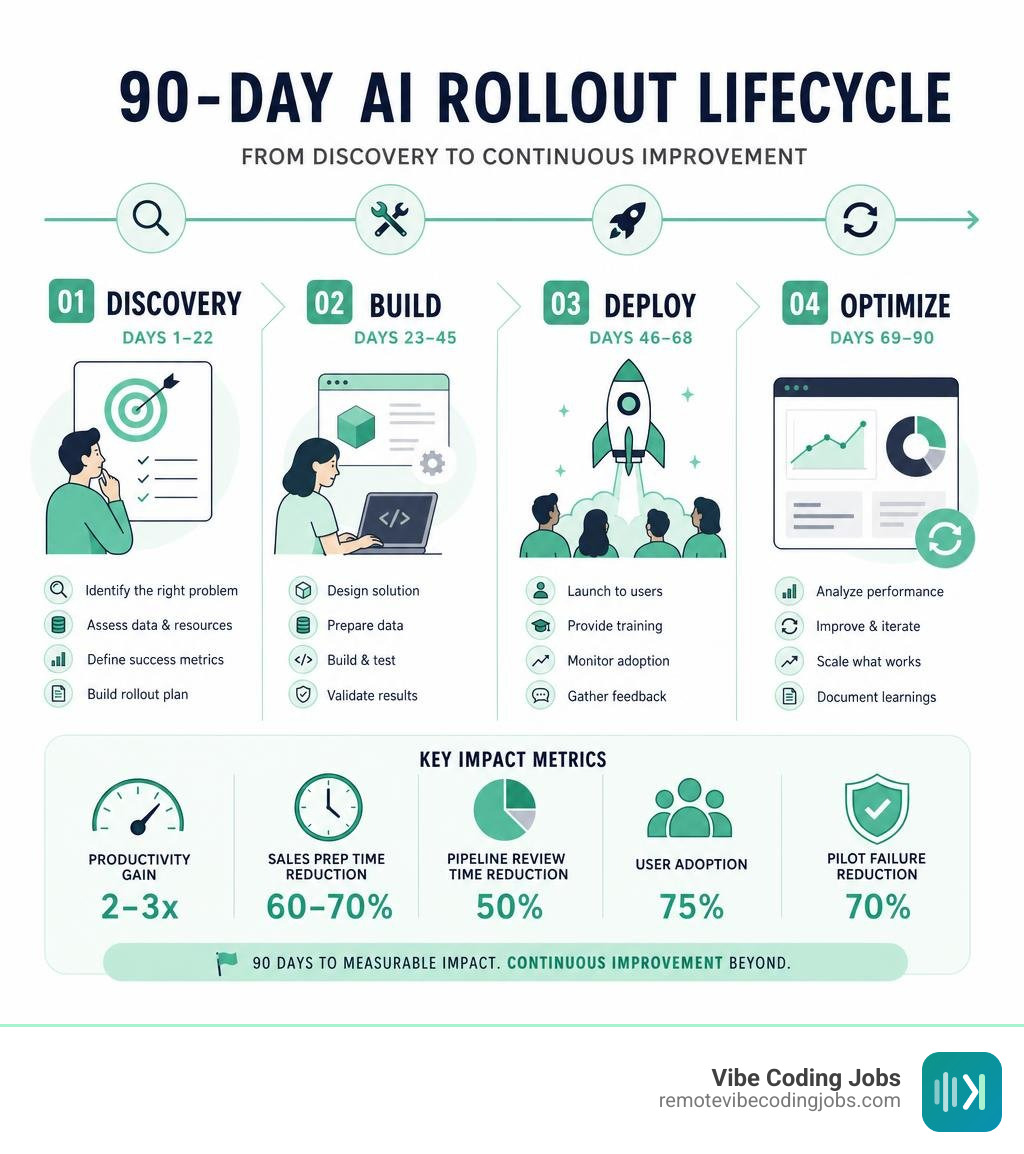
Key terms for AI tool playbook guide:
What is an AI Playbook and Why Your Organization Needs One

An AI playbook is not a static PDF containing a list of software links or basic prompting tips. It is an operational framework that defines how an organization identifies business problems, evaluates potential AI systems, integrates tools into daily workflows, and manages the human change required for true adoption.
Without a playbook, organizations fall into the trap of “tool sprawl”—buying dozens of disjointed software subscriptions that employees either ignore or use in highly inconsistent, unsecure ways. A structured playbook shifts the focus from tool features to business outcomes, serving as a single source of truth for safe, productive AI usage.
To understand why this is essential, we have to look at the root causes of pilot failures. While technology is occasionally the culprit, up to 70% of AI pilot failures stem from people and process issues. Teams often automate broken, manual workflows instead of redesigning them first.
By utilizing a structured framework like The 90-Day AI Rollout Playbook (Week-by-Week) | Treetop , organizations can avoid these common pitfalls. This methodology ensures that before any software is procured, the team undergoes a rigorous readiness assessment and problem identification phase.
We can map this process using a 4-quadrant opportunity matrix, which evaluates candidate use cases based on business impact and implementation complexity. This ensures we prioritize high-value, low-complexity “quick wins” before attempting complex multi-system integrations.
By grounding our strategy in validated organizational needs rather than technological hype, we build a solid foundation for AI Revolution: How AI is Transforming Remote Software Development. This systematic approach bridges the gap between raw technological capability and sustainable, daily operating value.
How to Structure an Effective AI Tool Playbook Guide
A highly functional playbook is organized like a software repository: modular, version-controlled, and highly actionable. Rather than generic advice, it contains specific, reusable prompts designed for repeated tasks.
These prompt playbooks act as custom system instructions that can be loaded into different AI sessions to achieve consistent, high-quality results. To keep these workflows running smoothly, we must design our procedures using Mutually Exclusive and Collectively Exhaustive (MECE) steps. This prevents the AI from skipping crucial actions or becoming confused mid-run.
When structuring your playbook, it is important to distinguish between “playbooks” and “knowledge bases.” Use playbooks for repeatable, step-by-step tasks that require active execution. Use static knowledge bases for style guides, brand guidelines, or project-specific references.
For a complete breakdown of how to build these automated paths, our Vibe Coding Workflow Guide offers a deep dive into structuring AI-assisted development. A great example of this structured execution is the Sales Asset Creator | Claude Code Playbooks , which provides an interactive template to generate tailored client deliverables on demand.
To understand how traditional operating models compare to AI-native systems, let’s look at the operational differences:
| Traditional Static Playbook | Dynamic AI Playbook |
|---|---|
| Created once, sits in a shared drive, and is rarely updated | Treated as a living system, updated via feedback loops |
| Relies on manual execution of every step | Uses automated triggers and agent orchestration |
| Generic advice that doesn’t adapt to specific customer context | Dynamically ingests real-time data to personalize outputs |
| Hard to measure compliance or actual utilization | Tracked via automated usage audits and API telemetry |
Core Phases of the AI Tool Playbook Guide
A successful rollout is structured around four distinct, chronological phases. Skipping any of these steps is the most common reason AI initiatives stall.
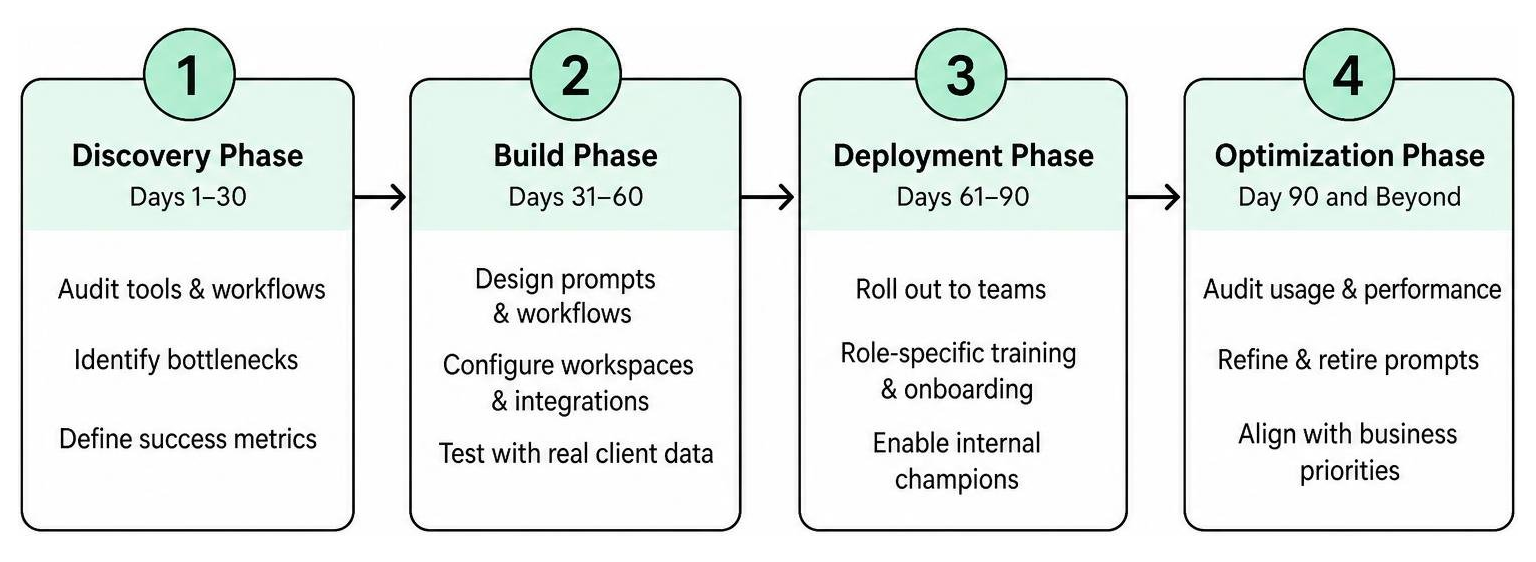
- Discovery Phase (Days 1–30): We begin with a comprehensive audit of existing tools, followed by async workflow interviews with team members to identify operational bottlenecks. The main goal here is to establish a clear business case and define what “working correctly” looks like as a measurable number.
- Build Phase (Days 31–60): During this phase, we design our prompt structures, configure shared workspaces, and build initial integrations. Rather than using synthetic test data, we construct and test these workflows using real, active client accounts to ensure immediate practical relevance.
- Deployment Phase (Days 61–90): Here, we roll out the tools to the wider team using role-specific, cohort-based training rather than a single generic workshop. We also identify and resource internal champions within each department to drive daily adoption.
- Optimization Phase (Day 90 and Beyond): We conduct thorough usage audits to identify which prompts are performing well and which should be retired. This phase ensures the playbook remains highly aligned with changing business priorities.
Best Practices for Writing Reusable Prompts in Your AI Tool Playbook Guide
To make your playbook truly reusable, prompts must be designed with the same rigor as traditional code.
First, establish clear input variables, allowing users to quickly swap out context (such as company name, target audience, and primary pain points) without altering the core instructions.
Second, define exact output specifications. If you need a self-contained HTML file with inline CSS and JS, state that explicitly, detailing the postconditions and formatting rules.
Third, implement robust error handling. Instruct the AI on what to do when it encounters missing data or API failures—for example, establishing a “three attempts before asking a human” rule to encourage autonomous problem-solving.
Domain-Specific Playbooks: Engineering, Sales, Marketing, and Healthcare

AI playbooks are not one-size-fits-all. Different departments require highly specialized approaches to safely maximize productivity.
In Software Engineering, playbooks focus heavily on code quality, security, and developer velocity. Instead of manual refactoring, engineers use structured rules to automate repetitive tasks and manage agentic workflows. To build a robust development environment, teams leverage a curated selection of Vibe Coding Tools: AI-Powered Arsenal to streamline everything from rapid prototyping to automated code reviews.
In Sales, the focus shifts to real-time intelligence and reducing preparation overhead. A prime example is the Account Planning – PG:AI Docs framework, which demonstrates how to build comprehensive, data-driven account plans in under 45 minutes by extracting insights from earnings calls, hiring signals, and technology stacks. This replaces traditional, static CRM fields with live, actionable strategies.
In Marketing, playbooks focus on scaling brand-consistent content and transition from basic prompting to sophisticated agent orchestration. Rather than using AI to write generic blog posts, modern marketing teams deploy autonomous agents to scan for compliance, enforce brand voice, and run multi-channel campaigns. This approach is detailed in The AI Playbook: A modern marketer’s guide to agent … , which outlines how to build a scalable, agentic marketing engine.
In Healthcare, the stakes are incredibly high, meaning playbooks must prioritize clinical relevance, ethical responsibility, and operational viability. These guides focus heavily on integrating clinical decision support tools directly into existing hospital workflows without disrupting medical staff, ensuring strict patient data privacy and transparency at every step.
Governance, Compliance, and Ethical Guardrails
As AI tools become deeply integrated into daily operations, robust governance is no longer optional. It is the very layer that determines whether your AI initiatives can scale safely.
When establishing your compliance framework, align your playbook with international standards such as ISO 42001 (the standard for AI management systems) and the NIST Risk Management Framework (RMF). If you operate in or serve users in the European Union, your playbook must include specific conformity assessments to comply with the EU AI Act.
Data privacy is a cornerstone of responsible AI. Your playbook should clearly state which data can be processed by external LLMs, establish strict rules for data anonymization, and forbid the use of customer data for public model training.
To help navigate these complex system integrations, How to Build Your Agentic AI Roadmap in 2026 provides a comprehensive framework for managing enterprise risk, security, and cost estimation.
Furthermore, as systems transition from basic assistants to autonomous agents that can execute actions independently, understanding the underlying technology is critical. Our deep dive on How Do AI Coding Agents Work? A Deep Dive for 2026 explains the architecture, security boundaries, and validation loops required to prevent unauthorized actions and mitigate prompt injection risks.
Overcoming the Human Bottleneck: Training, Culture, and Change Management
The hardest part of any AI rollout is not configuring the APIs or writing the prompts. It is managing the human transition. With 55% of hiring managers reporting that their organizations lack the resources to help employees use AI effectively, the training gap is a major bottleneck to operational success.
To overcome this, we must shift our company culture from fear to enablement. Employees often worry that AI tools are meant to replace them.
Your playbook should explicitly frame AI as a force multiplier—an assistant that automates repetitive, administrative tasks so team members can focus on higher-level strategy, product design, and creative direction. This transition is reshaping professional growth, as detailed in our guide on From Writing Code to Managing Agents: New Developer Career Path.
To ensure high adoption, avoid passive learning resources. Instead, implement a continuous enablement program characterized by:
- Cohort-Based Learning: Group employees by specific roles and run hands-on, multi-session workshops using real, daily tasks.
- Internal Champions Circles: Identify and resource 1–2 power users per department to provide immediate peer-to-peer support.
- Feedback Loops: Establish clear channels where team members can suggest prompt improvements, report bugs, and share successful use cases.
- Psychological Safety: Reward experimentation and build a culture where employees feel safe reporting when an AI tool makes a mistake, ensuring continuous collective learning.
Frequently Asked Questions about AI Playbooks
How do you measure the success and maturity of an AI implementation?
We measure success across three key pillars: utilization, quality, and cost.
A primary success metric is achieving a daily AI usage rate of over 60% across the deployed team.
On an operational level, we track specific productivity gains, such as cutting sales preparation time by 60–70% or reducing time-to-proposal from days to hours.
Maturity is benchmarked by evaluating the strength of your data foundation, your team’s prompting skills, and how deeply coordinated your AI tools are across your existing systems.
Why do up to 70% of AI pilots fail in organizations?
Most pilots fail because organizations treat AI adoption as a simple procurement event rather than a fundamental operating-model change.
They buy software subscriptions, hold a single kickoff meeting, and expect immediate productivity gains without providing structured, role-specific training.
This leads to tool sprawl, employee frustration, and a lack of clear ownership, causing teams to eventually abandon the tools and return to their traditional, manual workflows.
How can we keep our AI playbooks dynamic and continuously updated?
To prevent your playbook from becoming a static, forgotten document, treat it like an active codebase.
Establish automated feedback loops by feeding anonymized user transcripts, edge-case failures, and successful outcomes back into your prompt optimization loop.
Implement clear version control, designate specific process owners to review and update prompt files regularly, and use automated monitoring systems to track model drift and performance degradation over time.
Conclusion
The transition to an AI-native operating model is not about replacing human talent; it is about amplifying it. By implementing a structured, governed, and continuously updated AI tool playbook guide, organizations can bypass the common human and process bottlenecks that cause most pilots to fail, turning raw technological speed into sustained business value.
At RemoteVibeCodingJobs, we help developers and forward-thinking companies thrive in this new landscape. We curate daily listings of remote “vibe coding” positions at async-first companies, filtered by tech stack and advanced AI tools like Cursor and Claude.
If you’re ready to take the next step in your development career and master the art of AI-assisted engineering, explore our resources and find your next role with us. Start your journey by learning more about the future of software development with our comprehensive guide to vibe coding.