
The Fastest Way to Find Remote Async Engineering Roles in 2026
Remote async engineering roles are fully remote positions where engineers work independently, without scheduled meetings or real-time standups, communicating through written documentation, pull requests, and recorded updates instead.
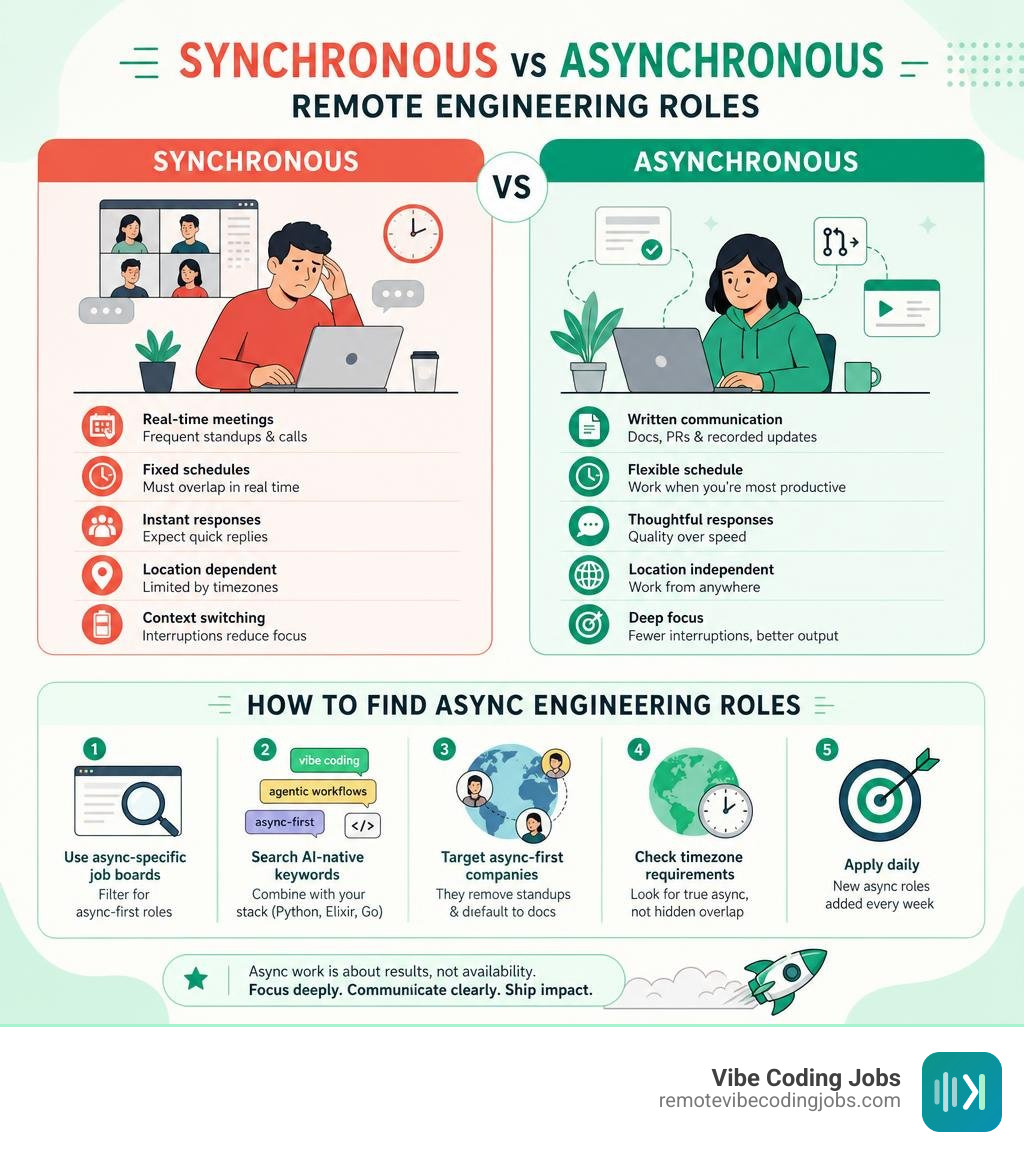
Here are the fastest ways to find them:
- Use async-specific job boards like Vibe Coding Jobs to filter for genuinely async-first roles
- Search for AI-native keywords like “vibe coding,” “agentic workflows,” or “async-first” alongside your stack (Python, Elixir, Go)
- Target async-first companies that explicitly eliminate standups and default to documentation — like fully distributed global HR and SaaS platforms
- Check timezone requirements — many “async” roles still require overlap windows (e.g., UTC-3 to UTC+3 or within 2 hours of CET)
- Apply daily — specialized boards add thousands of new remote listings every week
The demand is real. General job boards show 3,000+ async-tagged roles in the US alone — but most are customer support or operations listings. Engineers need to dig deeper to find the genuine async engineering opportunities, which are increasingly AI-assisted, agentic, and distributed across six continents.
That’s exactly what this guide is for.
I’m Di Su, a software engineer with 10+ years of experience in web development and scalable systems, with hands-on work across the kinds of async, remote-first stacks that define today’s remote async engineering roles. Everything here is built from real research, real job data, and real engineering experience — no fluff.
Remote async engineering roles terms explained:
What Are Remote Async Engineering Roles?
An asynchronous remote engineering role is the ultimate evolution of distributed work. While traditional remote jobs simply swap an office chair for a home office chair while keeping you tied to back-to-back Zoom meetings, true async roles decouple your work from the clock.
In an async-first engineering team, you do not have daily standups, mandatory real-time ceremonies, or constant Slack pings demanding immediate replies. Instead, your primary workspace is the codebase, issue trackers, and written documentation. You are measured by your output, code quality, and the clarity of your written communication. This style is closely related to asynchronous communication, where people exchange information without needing to be present at the same time.
This model is built for deep focus. By giving engineers the freedom to design their schedules, async-first companies unlock massive blocks of uninterrupted time. This is where high-quality system design, clean refactoring, and creative problem-solving actually happen. For a deeper look at how this impacts your daily flow, check out our guide on Deep Work Culture Developer Jobs: Finding Focus & Flow.
Traditional Remote vs. Remote Async Engineering Roles
To understand if this lifestyle is right for you, it is vital to contrast it with standard remote setups. Traditional remote environments often suffer from “presence theater” – the pressure to appear active on Slack or Teams during specific “9-to-5” hours. Async roles throw this out of the window.
| Feature | Traditional Remote Work | Remote Async Engineering Roles |
|---|---|---|
| Primary Communication | Synchronous (Zoom, Slack pings, live calls) | Asynchronous (Notion, GitLab/GitHub PRs, Loom) |
| Daily Meetings | Standups, sprint planning, live syncs | None or highly optional; status updates are written |
| Timezone Dependency | High (must overlap 6-8 hours with the team) | Low (typically requires 0-2 hours of flexible overlap) |
| Trust & Autonomy | Medium (monitored hours, calendar blocks) | High (complete ownership over when and how you work) |
| Documentation | Secondary (often outdated or non-existent) | Primary (the source of truth for all engineering decisions) |
In an async-first company, documentation is not an afterthought; it is the infrastructure. Decisions are made through RFCs (Requests for Comments), design docs, and thoroughly detailed pull requests. If it is not written down, it does not exist. This level of autonomy requires immense self-discipline, but the reward is complete control over your life.
The Rise of Vibe Coding in Remote Async Engineering Roles
The landscape of software development is undergoing a massive shift. The emergence of highly capable LLMs and AI coding assistants has given birth to a phenomenon known as “vibe coding.”
Vibe coding is not about slacking off; it is about raising your level of abstraction. Instead of spending hours writing boilerplate syntax, configuring Webpack, or fighting minor type definitions, engineers act as directors. They use advanced tools like Cursor and Claude to orchestrate code generation, run automated verification loops, and build complex systems using natural language and system design principles.
This fits perfectly into remote async engineering roles. When you do not have to sit in meetings, you can use your deep work blocks to guide AI agents through complex feature implementations. Rather than manually writing every line of code, you focus on system architecture, security guardrails, and robust test suites. To understand how this compares to old-school development, read our analysis on Vibe Coding vs Traditional Coding.
5 Essential Steps to Land Daily Async Coder Jobs
Landing one of these highly coveted roles requires a different approach than traditional job hunting. You cannot rely on a flashy resume alone; you must prove that you can operate independently in a written-first, AI-accelerated environment.

1. Master the Async Tech Stack and AI Tools
To succeed in an async engineering team, you must be highly proficient with the tools that enable rapid, independent execution.
First, let’s talk about the development languages. Modern async-first companies heavily favor highly concurrent, scalable, and robust backend languages. We see a significant density of roles requiring:
- Elixir & Phoenix: Prized for concurrency, fault tolerance, and building real-time, distributed systems asynchronously.
- Go (Golang): The industry standard for high-performance microservices, cloud-native tooling, and Kubernetes-orchestrated environments.
- Python: Widely used across backend systems, data pipelines, and especially within AI/ML engineering teams building agentic workflows.
Second, you must integrate AI-assisted development tools into your daily workflow. Top async employers are no longer just tolerating AI; they are actively mandating it. They expect you to use:
- Cursor: The premier AI-native fork of VS Code that allows you to chat with your codebase, edit multiple files simultaneously, and auto-generate complex features.
- Claude / Claude Code: Highly valued for its exceptional reasoning capabilities, deep understanding of complex code bases, and ability to execute CLI-based agentic tasks.
Mastering these tools shows employers that you have the “AI leverage” required to ship features at three to four times the speed of a traditional developer. For a comprehensive look at setting up your environment, check out our guide on Best Claude Code for Remote Developers in 2026: A Comprehensive Guide.
2. Build a Portfolio That Proves Async Competence
In a synchronous world, you can explain your work during a live interview. In an async world, your portfolio must do the talking for you.
When hiring managers look at candidates for remote async engineering roles, they look for specific signals that prove you can work without a manager looking over your shoulder. Your portfolio and GitHub profile should showcase:
- Exceptional PR Descriptions: Your pull requests should not just say “fixes bug.” They should contain a clear summary of the problem, a detailed explanation of your architectural choices, screenshots or Loom videos of the change in action, and a breakdown of how you verified the changes.
- Written Architectural RFCs: Include markdown documents in your public repositories that show how you plan features before writing code. This demonstrates that you can think deeply and communicate technical trade-offs clearly to a distributed team.
- AI-Assisted Project Case Studies: Document how you leveraged tools like Cursor or Claude to build a project. Show the prompt history, the architectural decisions you made, and how you set up verification loops (tests, evals, guardrails) to ensure the AI-generated code was secure and reliable.
Your writing ability is just as important as your coding ability. If you want to stand out, treat your portfolio as a masterclass in technical documentation. Learn more about crafting this in our guide on Killer Remote Developer Portfolio: How to Land Your Dream Job.
3. Target the Right Companies and Disciplines
Not every company is built for async work, and not every engineering discipline adapts to it equally. To maximize your chances, you should target sectors and roles where async is already the norm.
Key Engineering Disciplines Hiring Async:
- Backend Engineering: Since backend systems rely heavily on clear API boundaries, databases, and microservices, backend developers can easily work independently once the initial architecture is defined.
- DevOps & Site Reliability Engineering (SRE): Infrastructure management is inherently async. Managing CI/CD pipelines, Kubernetes clusters, and cloud infrastructure relies on code (IaC) and automated monitoring rather than live meetings.
- AI / ML & Applied AI Engineering: This is the fastest-growing sector. Companies are hiring engineers to build agentic workflows, RAG (Retrieval-Augmented Generation) patterns, and AI evaluation pipelines. These roles are highly autonomous and naturally fit the async model.
Finding Leading Async Employers
Look for companies that have built their entire operational model around a “handbook-first” culture. These organizations document every process, value, and workflow in public or internal wikis (like Notion), allowing team members across 90+ nationalities to work seamlessly without synchronous bottlenecks. To explore who is hiring right now, check out our curated list of Async-First Remote Developer Jobs: Top Companies.
4. Leverage Specialized Async Job Boards
If you search for “async” on mainstream job boards like LinkedIn, you will likely get thousands of irrelevant results. Most of those listings are for customer support, operations, or administrative roles, or they use “asynchronous” to describe a technical programming concept (like async/await in JavaScript) rather than the workplace culture.
To save time and find high-quality developer roles, you should use specialized platforms:
- Vibe Coding Jobs: We aggregate and curate daily remote “vibe coding” and AI-assisted development roles at async-first companies. We filter listings strictly by culture, tech stack, and the AI tools they use, making it incredibly easy to find your dream role.
Using a dedicated platform ensures you are applying to companies that actually understand, respect, and practice asynchronous work, rather than traditional companies trying to jump on the remote bandwagon.
5. Ace the Asynchronous Interview Process
The interview process for an async role is a direct reflection of how you will work once hired. You won’t find many high-pressure LeetCode style live whiteboarding sessions here. Instead, you will encounter:
- Written Screening: You will be asked to answer technical and cultural questions in writing. This is your first chance to prove your written communication skills.
- Asynchronous Coding Exercises: Instead of live coding, you will be given a realistic, take-home project. You will be expected to build a solution, write comprehensive tests, and document your implementation thoroughly.
- Loom Walkthroughs: Many async companies will ask you to record a short video (using Loom or similar tools) explaining your code, walking through your architectural decisions, and demonstrating the working feature.
- The “Bar Raiser” Written Interview: A deep-dive written discussion about your past experiences, technical philosophy, and how you handle autonomy and conflict asynchronously.
To succeed, treat every interaction as an opportunity to demonstrate your independence, attention to detail, and proactive communication. If you are preparing for this stage, read our complete preparation guide: Ace the Interview: How to Prepare for Remote Developer Interviews.
Compensation and Career Growth in Async Engineering
One of the biggest questions developers have about async roles is how they handle salaries, career progression, and team integration when everyone is working in different corners of the world.

Understanding Async Salary Benchmarks
Compensation in globally distributed, async-first companies is highly sophisticated. Because these organizations hire across multiple continents, they typically use geographic pay ranges (geo-ranges) to calculate salaries.
This philosophy aims to remain highly competitive in local markets while ensuring internal pay equity. Many forward-thinking async companies reject “cheap-labor” practices, choosing to pay well above local market rates in developing regions to bring local wealth to international talent.
- Senior Backend Engineer (Elixir/Go/Python): Typically ranges from $53,300 to $119,850 USD annually, depending on the engineer’s location and local market index.
- Senior Forward Deployed Engineer (AI/Integrations): Can command a wider range from $53,300 to $215,750 USD annually, reflecting the high demand for engineers who can bridge client needs with cutting-edge AI implementations.
- Contract AI Engineering Specialists: On-demand or part-time roles can pay highly competitive hourly rates, sometimes reaching up to $100 to $130 an hour for specialized domain experts training AI models or building custom agentic pipelines.
For a detailed analysis of how these benefits, stock options, and base salaries stack up globally, check out our Vibe Coding Salary Guide: Compensation Trends & Benefits.
Onboarding and Mentorship Without Real-Time Meetings
A common misconception is that async teams are lonely, unguided places where junior or mid-level developers are left to drown. In reality, a great async-first company has an onboarding experience that puts traditional companies to shame.
Instead of sitting through hours of boring live presentations, your onboarding is entirely self-guided and handbook-first:
- Interactive Handbooks: Everything from setting up your local environment to deploying your first line of code is documented step-by-step.
- Pre-Approved Budgets: To prevent async bottlenecks, companies often provide pre-approved home office and learning budgets. You don’t need to wait for a manager’s synchronous approval to buy an ergonomic chair or a technical course.
- Buddy Systems: You are paired with an onboarding buddy. You communicate via GitLab/GitHub issues, Slack, or shared documentation to get feedback on your early contributions.
- Clear Career Paths: Progression frameworks are explicitly documented. You know exactly what skills, impact, and “AI leverage” are required to move from Engineer II to Senior, Staff, or Principal levels.
To learn more about navigating this transition smoothly, check out our comprehensive guide: Transitioning to Remote Software Engineering: A Complete Guide.
Frequently Asked Questions about Async Engineering Jobs
Do async engineering positions require timezone overlap?
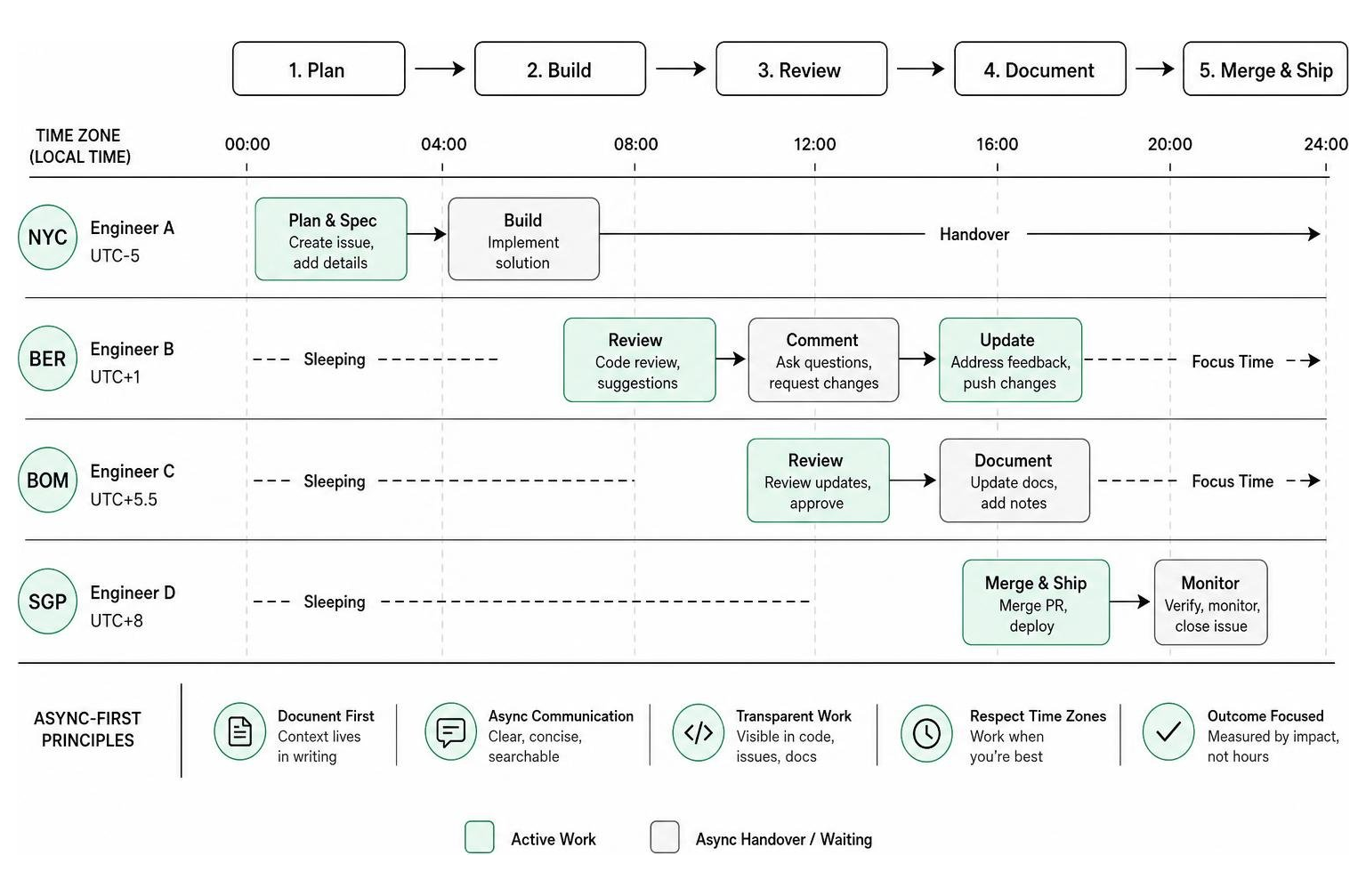
Not always, but many do. While async work gives you complete freedom over your daily schedule, many companies enforce timezone boundaries for practical collaboration. For example, a company might require you to be within +/- 2 hours of CET (Central European Time) or within specific North American timezones (PST/EST). This ensures that while you don’t have live meetings, code reviews and PR approvals can still happen within a reasonable 24-hour cycle. Always check the geographic constraints on job listings before applying.
How do async teams handle code reviews and collaboration?
Async teams rely heavily on structured, written workflows. Instead of hopping on a call to debug, engineers use tools like GitLab or GitHub to leave highly detailed, contextual comments on pull requests. Continuous Integration (CI) pipelines run automated test suites, security checks, and performance benchmarks on every commit, ensuring that code quality is maintained without manual gatekeeping. For communication, teams use threaded discussions in Slack or Teams, and document long-term decisions in Notion or Basecamp. To see the exact tools leading teams use, read our guide on the Best Async Communication Tools for Dev Teams in 2026.
What is the typical salary for a senior async engineer?
As shown in our research, a Senior Backend Engineer at a leading async-first company typically earns between $53,300 and $119,850 USD, while highly specialized roles like a Senior Forward Deployed AI Engineer can earn up to $215,750 USD depending on their geographic location. These packages are usually rounded out with robust benefits, including 16 weeks of paid parental leave, flexible PTO targets (typically 25–30 days per year), home office allowances, and stock options. For a deeper breakdown, consult our Vibe Coding Salary Guide: Compensation Trends & Benefits.
Conclusion
The era of sitting in endless meetings, pretending to be busy, and writing manual boilerplate code is coming to an end. Remote async engineering roles offer developers the ultimate professional freedom: the ability to design your work around your life, focus deeply on complex engineering problems, and leverage cutting-edge AI tools to amplify your output.
At Vibe Coding Jobs, we are dedicated to helping you find these opportunities. We curate daily, high-quality listings at the world’s best async-first companies, filtering for the exact tech stacks and AI tools (like Cursor and Claude) that you want to use.
Are you ready to stop coding in the slow lane and start building with maximum leverage? Explore our platform, find your next role, and learn more about this revolution by reading our definitive guide: What is Vibe Coding?.