
What Is Remote Contributor AI Coding — and How Do You Get Paid for It?
Remote contributor AI coding is one of the fastest-growing ways for developers to earn income in 2026. Instead of building software for a company, you help train AI models — by writing challenging code prompts, reviewing AI-generated outputs, and evaluating responses against quality rubrics.
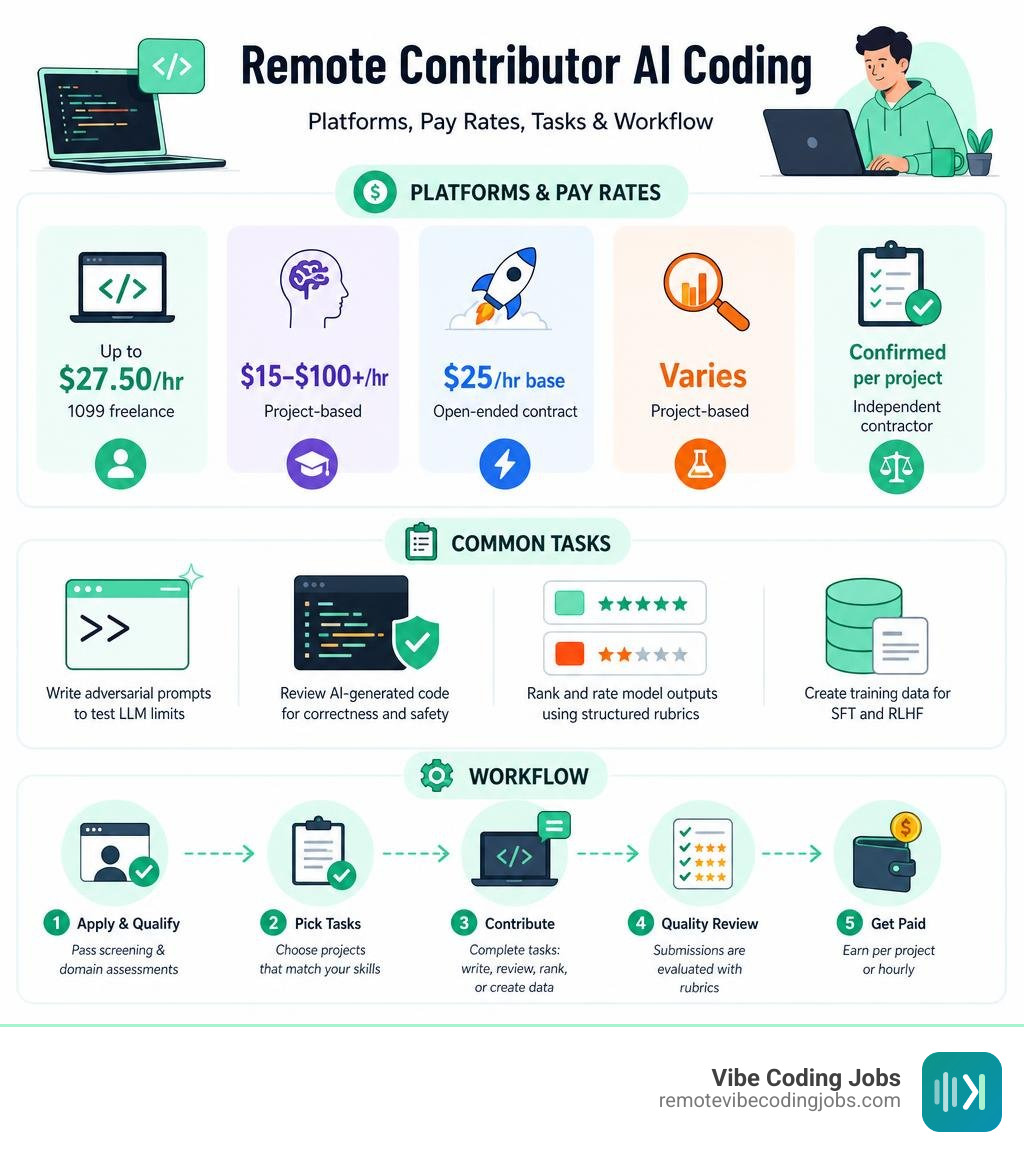
Here’s a quick snapshot of how it works and what you can earn:
| Platform | Pay Range | Contract Type | Best For |
|---|---|---|---|
| Outlier (Scale AI) | Up to $27.50/hr | 1099 freelance | Full-stack engineers |
| Mindrift | $15–$100+/hr | Project-based | Domain experts, PhDs |
| Stellar AI | $25/hr base | Open-ended contract | Flexible side work |
| Snorkel AI | Varies by domain | Project-based | Research-grade tasks |
| Meridial | Confirmed per project | Independent contractor | STEM, law, coding |
The work is fully remote and asynchronous. No fixed schedule. No AI experience required — just strong domain expertise in coding, STEM, law, or another field.
Common tasks include:
- Writing adversarial prompts to test LLM limits
- Reviewing AI-generated code for correctness and safety
- Ranking and rating model outputs using structured rubrics
- Creating training data for Supervised Fine-Tuning (SFT) and RLHF
I’m Dominic Zijlstra, cofounder of Adaptify.ai and former data scientist and DevOps engineer, and my background in automated systems and data infrastructure gives me a practical lens on remote contributor AI coding and what it actually takes to succeed. In this guide, I’ll walk you through the top platforms, real pay rates, and exactly how to get started.
Remote contributor ai coding helpful reading:
- vibe coding jobs remote
- What are the best resources for finding ‘vibe coding’ positions in the current market?
- ai agent dev remote
The Rise of Remote Contributor AI Coding Roles
The software development landscape has fundamentally shifted. We are no longer just writing code line by line; we are teaching machines how to think, reason, and debug. This paradigm shift has created a massive demand for human-in-the-loop feedback to train frontier Large Language Models (LLMs). According to recent AI Coding Jobs Market Trends, tech giants and AI research labs are spending hundreds of millions of dollars to acquire high-quality, human-annotated training data.
This has catalyzed the emergence of remote contributor ai coding roles. These positions bypass the traditional software engineering interview loop and focus instead on specialized, asynchronous tasks. Rather than shipping features for a single SaaS product, contributors evaluate code generated by unreleased models, point out logical flaws, and rewrite sub-optimal answers.
This trend is deeply connected to the broader evolution of AI Assisted Development Career Opportunities Growth Trends. AI builders have realized that simple data scraping is no longer enough to improve frontier models. To push LLMs past reasoning plateaus, they need highly skilled developers to construct complex logical puzzles, review edge cases, and evaluate outputs with absolute mathematical rigor.
Essential Skills for Remote Contributor AI Coding
To excel as a remote AI coding contributor, you do not necessarily need a PhD in machine learning. However, you do need a deep, practical understanding of modern programming languages and software architecture.
The most in-demand technical skills include:
- Python & TypeScript: These are the bedrock languages of modern AI development. You must be comfortable writing, debugging, and refactoring complex code in both environments.
- Prompt Engineering: Knowing how to talk to models is crucial. This involves crafting precise prompts that push an LLM to its absolute limits or force it to reveal logical weaknesses.
- RAG Pipelines & Vector Search: Understanding how Retrieval-Augmented Generation works is vital, as many advanced tasks require you to evaluate how models retrieve and synthesize external data.
- LLM Integration: Experience working with APIs (like OpenAI, Claude, and Gemini) and frameworks like LangChain or LangGraph is highly valued.
Beyond pure syntax, a strong product mindset is increasingly essential. As discussed in our guide on What Are Vibe Coding Jobs? A Guide to the Future of Remote Work, the rise of “vibe coding” means developers must focus on high-level architecture, system intent, and thorough validation. Experts like Parbhat Kapila | Full Stack Engineer | AI Full-Stack Engineer | Remote demonstrate that modern AI engineering requires managing complex multi-provider routing, optimizing token costs, and ensuring retrieval accuracy under real-world constraints.
How to Get Started as a Remote Contributor AI Coding Specialist
Entering this space requires a structured approach. Unlike traditional tech hiring, which can drag on for months, the onboarding pipeline for AI contributor networks is highly optimized and automated.

To get started, you will typically follow these steps:
- Profile Creation: Submit your CV and link your GitHub profile. Ensure your portfolio highlights end-to-end projects, API integrations, and clean code documentation.
- Skill-Match Assessments: You will be asked to complete a technical screening. This is not your standard LeetCode test; instead, it evaluates your ability to spot bugs in AI-generated code, explain complex concepts clearly, and write rigorous test suites.
- Identity Verification: Because these platforms handle proprietary, unreleased models, you must verify your identity using a government-issued ID.
- Onboarding & Training: Once accepted, you will complete self-service training modules that teach you how to use the platform’s specific grading rubrics and evaluation interfaces.
For a deeper dive into preparing your application, check out our resource on How to Get a Vibe Coding Job: Skills, Portfolio, Networking. Many successful contributors, such as Muhammad Hammad Asif | AI Engineer, LLM Engineer & Python Backend Developer , have built highly successful careers by combining rigorous backend expertise with structured human evaluation workflows for frontier models like Google’s Gemini.
Top Platforms for AI Training and Vibe Coding
If you are looking to join an expert contributor network, several major platforms dominate the market. Each has its own pay structure, target audience, and project types. We have compiled a comprehensive comparison of these platforms to help you find the right fit. For a broader list of top employers, check out our guide on the Best Companies Hiring AI Developers Top Employers Innovative.
Outlier AI and Scale AI
Outlier, operated by Scale AI, is one of the largest player-driven platforms in the AI training space. Over 1,000,000 experts have used Outlier to gain hands-on AI experience, helping to supply crucial human-in-the-loop feedback to the world’s leading AI labs.
If you qualify for their Remote Full Stack Engineer Jobs – Earn Training AI | Outlier AI program, you can earn up to $27.50 USD per hour evaluating full-stack software engineering tasks.
Key details of the Outlier platform include:
- Employment Status: All contributors work as 1099 independent contractors, meaning you have complete control over your hours and location.
- Surge Pricing “Missions”: Outlier frequently runs high-demand periods where you can earn an additional 7.5% to 11% on top of your base rate by completing specific tasks.
- Premium Perks: Contributors are often granted free access to premium, unreleased LLMs (worth over $200/month) to assist them in their training workflows.
Snorkel AI and Mindrift
For developers looking for highly academic or research-grade opportunities, Snorkel AI and Mindrift offer excellent avenues.
Snorkel AI invites developers to Join our Expert Community , which spans over 1,000 domains. Snorkel focuses heavily on creating enterprise-grade, reliable AI. As a contributor, you will author complex datasets, perform peer reviews, and evaluate outputs against strict safety and compliance guidelines. The work is entirely asynchronous, allowing you to contribute whenever fits your schedule.
Mindrift, on the other hand, positions itself as a premium platform for high-level domain experts. You can explore their opportunities at AI Training Jobs — Earn $15-$100+/hr from Home | Mindrift … .
- The Talent Pool: Mindrift maintains incredibly high standards; over 70% of Mindrift contributors hold a Master’s degree or PhD.
- Earning Potential: While entry-level tasks pay around $15 to $30 per hour, highly specialized domain experts in coding can earn up to $100+ per hour, with some contributors earning up to $5,400 per month on active coding projects.
Stellar AI and Meridial
Stellar AI and Meridial offer highly flexible, contract-based workflows that are perfect for developers seeking a reliable side hustle or location-independent income.
Stellar AI, which you can join at Stellar AI – Find flexible work for your unique skills , offers a community of annotators with open-ended contracts and absolutely no required schedule.
- Compensation: Stellar AI features a straightforward base pay rate of $25 an hour.
- Payment Method: Earnings are paid out weekly, primarily via PayPal, making it incredibly easy to manage your cash flow.
- Task Types: Tasks range from training general AI agents to converting real GitHub Pull Requests (PRs) into challenging training benchmarks.
Meridial acts as an expert contractor network powered by Invisible Technologies. It connects specialists in fields like STEM, law, finance, and coding directly with frontier AI labs. The projects are sourced from top-tier labs, and once you join the Meridial network, you are matched directly with projects that fit your exact profile. All work is project-based with pre-confirmed rates, and contributors are responsible for managing their own tax obligations.
Typical Workflows: Prompt Engineering, RLHF, and Code Review
What does a typical day look like for a remote contributor ai coding specialist? It is highly structured, deeply analytical, and entirely self-paced. Unlike traditional development where you write code to build a product, your goal here is to evaluate, break, and refine the code generated by AI models.

To maximize your efficiency, we recommend reviewing our resource on Remote Developer Jobs AI Tools Productivity. Understanding how to navigate these environments is key to maintaining a high quality score on contributor platforms, which in turn unlocks higher-paying tasks.
Writing Challenging Prompts and Edge Cases
One of the most engaging tasks for a contributor is adversarial prompting. Your goal is to write highly complex, multi-step programming questions designed to trick or confuse the LLM.
This involves:
- Targeting Context Windows: Creating long, detailed prompts that test how well the model retains instructions across large context windows.
- Designing Logical Traps: Asking the model to solve complex data structure problems while imposing strict, unusual constraints (e.g., optimizing a search algorithm without using standard libraries).
- Simulating Real-World Scenarios: Converting actual GitHub issues or production bugs into structured prompts to see if the AI can identify the root cause.
As noted by technical lead Vivek Nakum | Technical Project Lead & AI-Driven Developer , successful AI-first engineering requires a highly disciplined approach to prompt construction. By learning to write precise, structured prompts, you help train models to handle complex, real-world business logic rather than just generating generic boilerplate.
Code Review and RLHF Evaluation
Once the AI model generates responses to your prompts, the next phase is evaluation. This is where Reinforcement Learning from Human Feedback (RLHF) and Supervised Fine-Tuning (SFT) dataset creation come into play.
For more details on how these workflows are shaping tech careers, see our analysis of Remote Developer Jobs AI Tools Roles Careers. When evaluating model outputs, you will typically use a structured interface to:
- Verify Correctness: Run the AI-generated code in a local or sandboxed environment to ensure it executes without errors and passes all test cases.
- Evaluate Code Quality: Grade the code based on readability, performance, and modern best practices.
- Apply Safety Rubrics: Ensure the code does not introduce security vulnerabilities, such as SQL injection risks or hardcoded credentials.
- Rank Responses: If the model provides multiple outputs, you will rank them from best to worst and write detailed, objective justifications explaining your decision.
Senior developers like @erick – Senior Full Stack AI Engineer | Hire now emphasize that while AI tools dramatically accelerate the development lifecycle, strong human oversight remains the ultimate line of defense for ensuring production-grade code quality.
How to Transition from Traditional Software Engineering
If you are a traditional software engineer, transitioning into remote contributor ai coding or vibe coding roles is an excellent way to diversify your income and stay at the absolute forefront of tech.
To help you navigate this transition, we have compiled the Remote Vibe Coding Jobs Guide. The shift requires moving away from manual syntax writing and focusing on high-level system design, automated verification, and context management.
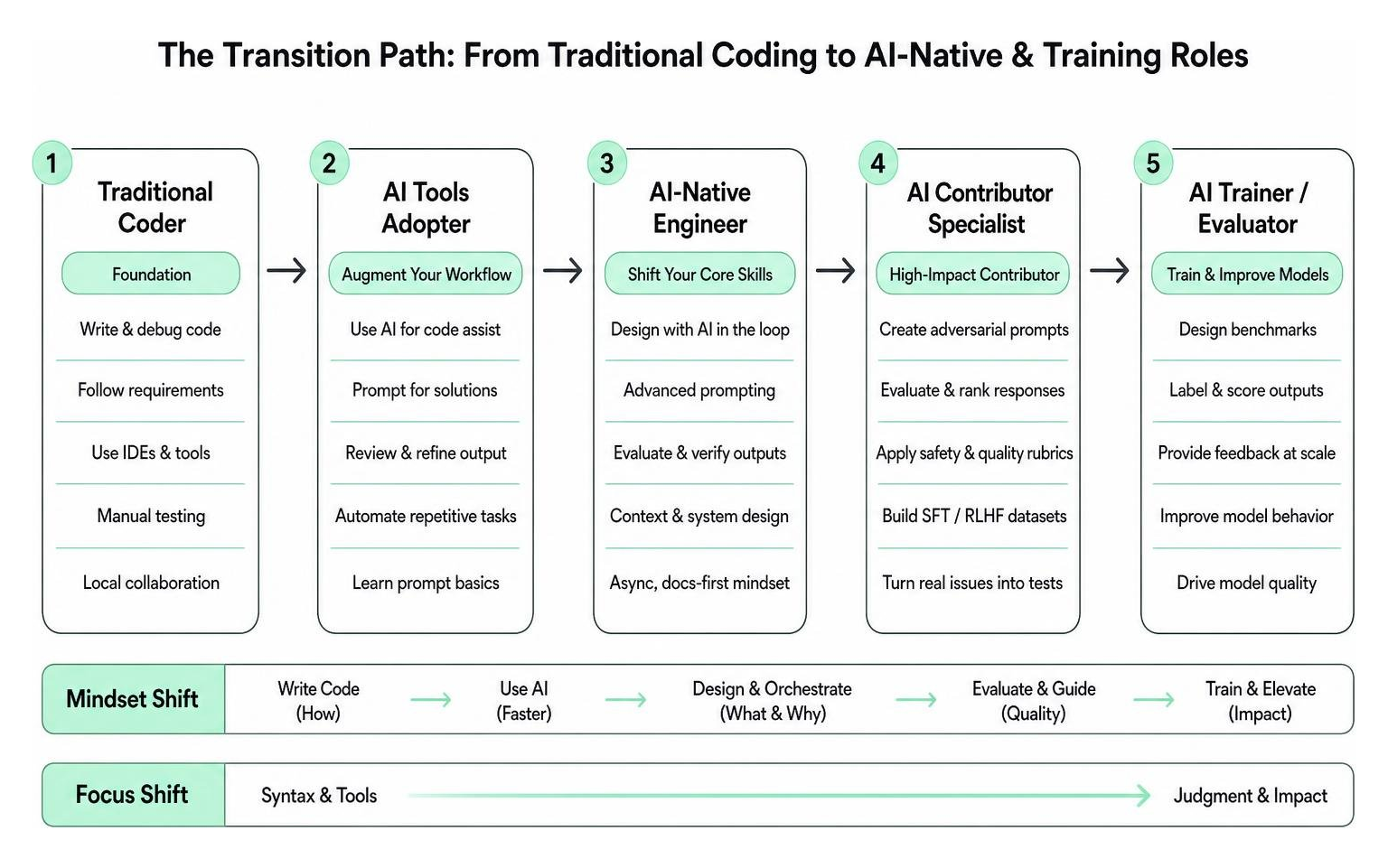
Here are the actionable steps to make the transition:
- Build an AI-Native Portfolio: Stop showcasing simple CRUD apps. Build and document projects that utilize LLM APIs, vector databases (like pgvector), and multi-agent frameworks. Show that you know how to handle API latency, token limits, and model evaluation.
- Contribute to Open Source: Actively review and contribute to AI-focused open-source repositories. Converting real-world GitHub PRs into structured benchmarks is highly valued by platforms like Stellar AI.
- Master Async-First Collaboration: AI contributor platforms operate on pure asynchronous execution. Learn to document your decisions clearly, write detailed PR descriptions, and use async communication tools effectively.
- Explore New Job Opportunities: Keep an eye on emerging roles. As highlighted in our market overview of AI Coding Jobs Remote Opportunities, companies are rapidly hiring for specialized titles like “AI Pilot,” “Agentic Engineer,” and “Vibe Coder.”
Developers like @parth_dev – Full-Stack & AI Developer | Hire now have successfully transitioned by positioning themselves as high-ownership, AI-fluent engineers who can bridge the gap between raw LLM capabilities and production-ready SaaS architectures.
Frequently Asked Questions about AI Contributor Jobs
How much do remote AI coding contributors get paid?
Compensation varies widely based on the platform, your geographic location, and your level of expertise. For a detailed breakdown of earning potential across the industry, check out our Vibe Coding Salary Guide.
Generally, entry-level annotation and generalist tasks pay between $15 and $30 per hour. However, if you possess specialized programming skills, full-stack experience, or advanced degrees, you can easily qualify for specialist projects paying $25 to $100+ per hour. Many platforms also offer surge pricing incentives during high-demand periods to boost your hourly earnings.
Do I need prior AI experience to apply?
No! You do not need a background in machine learning, neural networks, or data science to get started. The primary requirement for these platforms is deep domain expertise in your specific field (such as software engineering, Python, TypeScript, or database architecture). The platforms themselves will provide comprehensive, self-service onboarding materials and training guidelines to teach you how to evaluate and prompt the models effectively.
What happens if there are no active projects available?
Because these platforms operate on a freelance, contract-based model, task availability can occasionally fluctuate. During “task droughts,” platforms will keep your profile active in their contributor pool.
To minimize downtime and ensure a steady stream of projects, we recommend:
- Keeping your profile, CV, and linked GitHub repository completely up to date.
- Completing as many qualification tests and skill assessments as possible to unlock diverse project categories.
- Joining multiple contributor networks simultaneously so you can easily switch platforms when task volume shifts.
Conclusion
The rise of remote contributor ai coding has completely democratized how developers interact with and profit from the AI revolution. Whether you are looking for a highly flexible side hustle to complete during your quiet hours, or want to transition into a full-time, high-velocity AI-native development career, there has never been a better time to put your coding expertise to work.
At RemoteVibeCodingJobs, we aggregate the absolute best remote “vibe coding” and AI-assisted engineering roles at forward-thinking, async-first companies. We curate daily listings filtered by culture, tech stack, and modern AI tools like Cursor and Claude.
Ready to transition to an AI-first career? Find remote vibe coding jobs on our platform today and download our free playbook to fast-track your applications!