
What Is the Current State of the Vibe Coding Job Market in 2026?
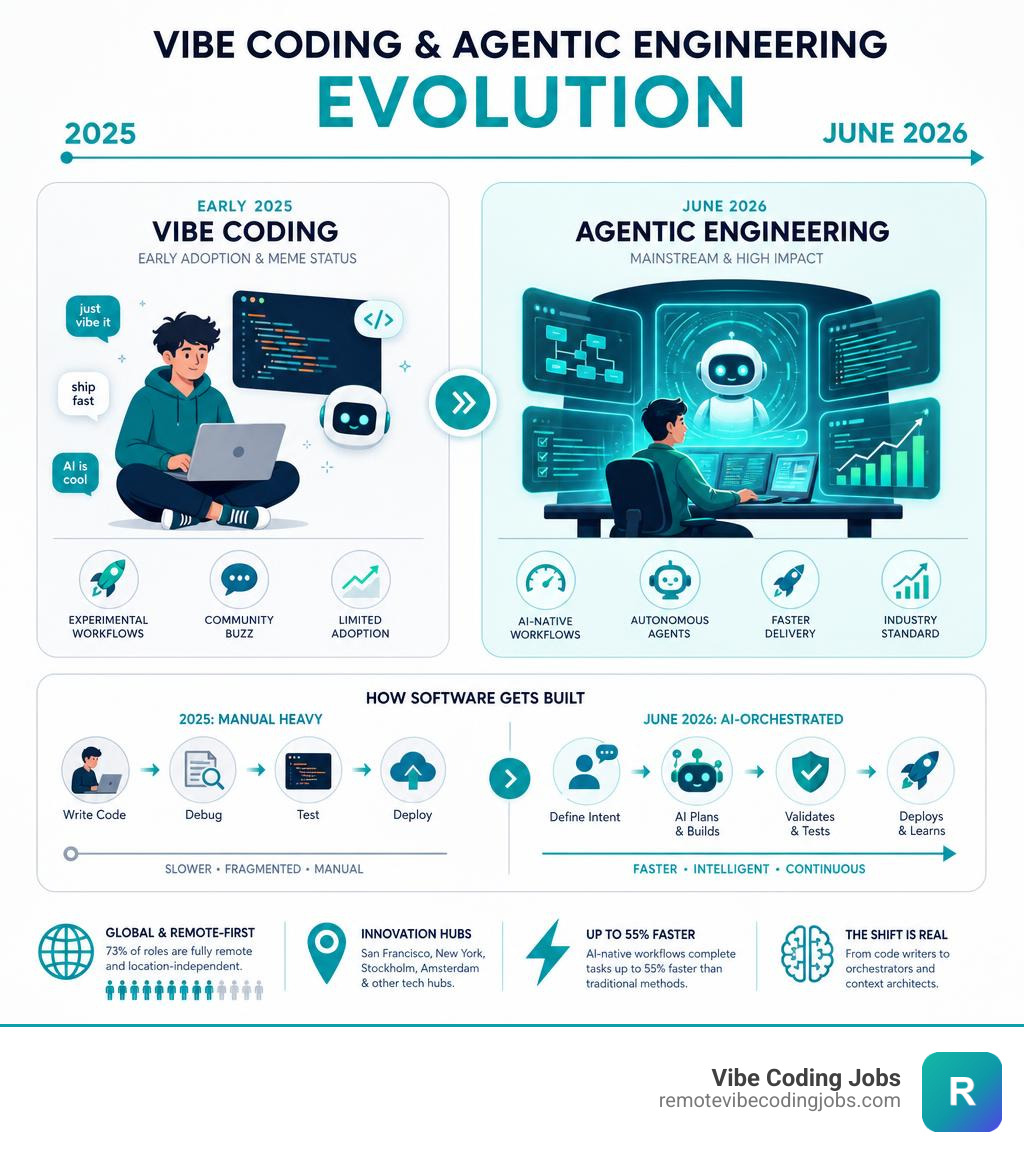
The vibe coding job market is no longer a futuristic concept or a passing trend. What started as a viral term coined by Andrej Karpathy in early 2025 has fully matured into a highly structured, rapidly growing segment of the tech industry known as agentic engineering. As of June 2026, the data shows that this paradigm shift is reshaping how software is built, shipped, and maintained.
According to our latest market tracking, there are currently 1,842 active vibe coding listings across 22 major job-board sources, representing a staggering +340% year-over-year growth in postings. To date, we have tracked 4,772 vibe-coding-titled jobs. This explosive growth is driven by a simple economic reality: developers leveraging AI-native workflows can complete tasks up to 55% faster than those relying on traditional manual coding methods.
Geographically, the market is highly distributed but concentrated around forward-thinking hubs. While 73% of these roles are fully remote and location-independent, the remaining 27% are clustered in highly innovative tech hubs like San Francisco, New York, Stockholm, and Amsterdam.
For developers, this means the job search has fundamentally changed. Companies are no longer just looking for syntax specialists who can write boilerplate code from memory. Instead, they are actively hunting for orchestrators and context architects who can direct AI models to build entire features in hours rather than weeks.
To help you navigate this rapidly evolving landscape, we have put together this comprehensive guide to finding, applying for, and landing these highly coveted roles. For a deeper dive into how this market is expanding, check out our report on Remote Vibe Coding Jobs: Career Market Growth.
What Exactly Defines a Vibe Coding Job Versus a Traditional Remote Role?
To find a genuine vibe coding position, you must first understand what separates it from a standard remote software engineering job. Many companies claim to be remote-friendly, but they often recreate the friction of the physical office online. This is what we call remote-washing.
In contrast, a true vibe coding role is built on a foundation of async-first collaboration, deep work protection, and AI-native workflows.
In these environments, documentation is not an afterthought; it is a core competitive advantage. Because teams work across multiple time zones, knowledge cannot remain locked in someone’s head. Everything from system architecture to daily progress is written down. This focus on autonomy pays off: developers working in async-first environments report 30% higher job satisfaction compared to those in traditional synchronous setups.
However, vibe coding is not about blindly accepting whatever an AI model outputs. The modern development landscape is divided into vibe-safe and vibe-unsafe sections:
- Vibe-Safe Sections: Rapid prototyping, building frontend components (using tools like v0 or Lovable), generating boilerplate code, writing automation scripts, and setting up initial project scaffolding.
- Vibe-Unsafe Sections: Core business logic, critical security protocols, database migrations, and complex system integrations. In these areas, developers must slow down, apply critical thinking, and often write code the old-fashioned way to prevent security vulnerabilities (such as exposed
.envfiles or API keys) and structural technical debt.
When evaluating potential employers, look for specific cultural signals that prove they embrace these principles. Genuine vibe coding companies often offer 4-day work weeks (which 63% of remote developers prefer), replace daily standups with written status updates, and evaluate performance entirely on shipped outcomes rather than hours logged.
To learn more about the unique lifestyle and operational benefits of this setup, read our guide on Vibe Coding Remote Benefits, Culture & Career.
What Are the Best Job Boards and Platforms for Finding Vibe Coding Positions?
Because vibe coding is an emerging category, traditional general-purpose job boards are often too broad to be useful. If you search for “software engineer” on a general platform, you will have to sift through thousands of legacy roles that require on-site presence or traditional whiteboard interviews.
To find genuine opportunities, we recommend starting with specialized platforms and using targeted search strategies:
1. Remote Vibe Coding Jobs (Our Platform)
We built Remote Vibe Coding Jobs to solve this exact curation problem. We aggregate and curate over 200+ active remote vibe coding jobs, updating our listings daily from more than 20 distinct sources. Every listing on our platform is pre-screened to ensure the company actively supports AI-assisted development and operates on async-first principles. You can easily filter roles by your preferred AI tools (like Cursor or Claude Code), tech stack, and specific cultural benefits (like a 4-day work week or “no-Leetcode” hiring).
2. General Job Boards (With Smart Filtering)
If you are searching on broader job platforms, you need to use precise search terms. Instead of searching for “Full Stack Developer,” search for:
"Cursor"or"Claude Code""Agentic engineering"or"AI-native""Rapid MVP builder"or"AI-fluent""Async-first"or"No-Leetcode"
3. Direct Company Careers Pages
Several industry-leading companies are actively pioneering the vibe coding movement and hiring at scale. Some of the top employers in this space include:
- Grafana Labs: Currently leading the market with approximately 340 active listings that encourage the use of Claude Code and Cursor.
- GitLab: A pioneer in remote, async-first work that actively integrates AI into its development pipelines.
- Anthropic & OpenAI: The creators of the models themselves, who hire developers to build internal tools and SDKs using AI-native workflows.
- Zapier & Notion: Companies heavily focused on AI automation and productivity tools, where vibe coding is a natural fit for internal product teams.
For a detailed breakdown of which organizations are currently expanding their teams, see our curated list of Companies Hiring Vibe Coding Experts.
Platform Comparison: Specialized vs. General
| Feature | Specialized Vibe Coding Platforms (e.g., Remote Vibe Coding Jobs) | Traditional General Job Boards |
|---|---|---|
| Primary Focus | AI-native, async-first, and agentic workflows | General software engineering, marketing, sales |
| Tool Filtering | Filter by Cursor, Claude Code, Windsurf, etc. | Filter by programming language or general “Remote” |
| Culture Alignment | Pre-screened for async-first, no-Leetcode, 4-day week | Highly variable; often includes “remote-washed” office cultures |
| Hiring Speed | High; companies actively seek AI-fluent builders | Slow; traditional multi-stage HR lag and whiteboard tests |
| AI Integration | Core job requirement (72% of listed companies use AI) | Often treated as a “nice to have” or not mentioned |
What Skills, Tools, and Portfolio Elements Do Vibe Coding Employers Value Most?
Landing a vibe coding job requires a different toolkit than a traditional software engineering role. While understanding programming fundamentals remains crucial, employers are looking for candidates who have mastered the art of AI orchestration.
The AI-Native Tool Stack
To stand out, you must demonstrate deep familiarity with modern AI-assisted development tools. Employers actively look for experience with:
- AI-Native IDEs: Cursor and Windsurf (which offer deep codebase indexing and agentic editing).
- Command-Line Agents: Claude Code (for rapid terminal-based refactoring and debugging).
- Full-Stack Generators & UI Builders: Replit Agent, v0 by Vercel, and Lovable.dev (for rapid scaffolding and UI prototyping).
From Syntax to Context Architecture
The most valuable skill in 2026 is not syntax memorization; it is context architecture. This involves structuring your codebase so that AI agents can understand it quickly and accurately.
This includes maintaining clear, updated context files (like SKILL.md or ARCHITECTURE.md) that outline system boundaries, using languages with strong type systems (like TypeScript or Go) to catch AI-generated errors before runtime, and mastering prompting patterns like context-first, constraint-based, and dual-agent execution (using a cheaper model to plan and a stronger model to execute).
The Vibe Coding Portfolio Recipe
In this market, shipped projects are the single most important hiring criterion. Academic credentials and certifications are secondary to demonstrated shipping ability. We recommend building a portfolio containing three specific public projects:
- A Browser Game: Built using Phaser or Three.js, deployed to a public URL. This proves you can use AI to rapidly prototype interactive, stateful applications.
- A SaaS Mini-Tool: A functional web application with a public GitHub repository. This demonstrates your ability to integrate APIs, manage databases, and handle user authentication.
- A Public Build Log: A documented case study (or blog post) detailing your prompt-to-deploy process. Include examples of failed prompts, security issues you caught during code reviews, and how you validated the AI’s output.
By showing your work transparently, you prove to hiring managers that you understand how to act as the quality control mechanism for AI-generated code. For a step-by-step roadmap on building these skills, explore our guides on How to Get a Vibe Coding Job: Skills, Courses & Advice and How to Get a Vibe Coding Job: Skills, Training & Mentorship.
How Do Salaries and Benefits for Vibe Coding Roles Compare to Traditional Tech Jobs?

Because vibe coders are highly productive, companies are willing to pay a premium for their skills. In 2026, developers who have mastered AI orchestration command 15% to 25% higher salaries than traditional developers who write code entirely by hand.
2026 Vibe Coding Salary Bands
According to our aggregated salary data, the median pay across all vibe coding positions is $160,000 per year. Here is how the compensation breaks down by experience level:
- Lead / Staff+ Roles: Median of $180,000 to $200,000+ (with top-tier developer-tooling companies offering up to $350,000 base, and total compensation packages exceeding $500,000).
- Senior Roles: Median of $150,000 (ranging from $130,000 to $170,000).
- Mid-Level Roles: Median of $115,000 (ranging from $100,000 to $130,000).
- Junior Roles: Median of $75,000 to $100,000 (note: explicit junior listings are rare, but junior developers with strong portfolios often land mid-level roles).
- Freelance / Contractor Rates: Average of $100/hour, with top-tier vibe coders commanding $150 to $200/hour for rapid MVP development.
Location-Independent Pay
One of the most progressive trends among vibe coding employers is the adoption of location-independent base salaries. Because these companies operate on async-first, global principles, they reject geographic pay discrimination. An engineer living in Spain or Poland is paid the same base rate as an engineer living in New York or San Francisco for the same role, creating a highly equitable global hiring market.
Unique Benefits
In addition to competitive base salaries, vibe coding companies offer benefits designed to protect your time and well-being:
- Deep Work Protection: Dedicated no-meeting days or core hours models.
- 4-Day Work Weeks: Often structured as Monday-Thursday or Tuesday-Friday schedules.
- Generous Learning Budgets: Allowances for AI model subscriptions, hardware upgrades, and continuous learning.
For a comprehensive breakdown of compensation trends, check out our Vibe Coding Salary Guide: Compensation Trends & Benefits and our Vibe Coding Salary Guide: Remote.
How Can You Optimize Your Resume and Ace the Vibe Coding Interview Process?
Applying for a vibe coding job requires throwing out the traditional recruitment playbook. If your resume looks like a standard list of programming languages, you will likely be overlooked. You must actively demonstrate that you are an efficient, async-first builder.
Optimizing Your Resume
When writing your resume, highlight your AI-assisted workflow and your async communication skills. Instead of using passive, traditional descriptions, use outcome-oriented language:
- Instead of: “Wrote React components and maintained backend APIs.”
- Use: “Leveraged Cursor and Claude Code to build and ship React features 55% faster, documenting architecture decisions which reduced team onboarding times by 40%.”
Make sure to list your AI tool proficiency (e.g., Cursor, Claude Code, Windsurf) alongside your traditional technical stack (e.g., Python, Go, TypeScript).
The “Loom Video Trick”
Because written and visual communication are critical in async environments, we highly recommend using the Loom video trick. When submitting your application, include a short (under 2 minutes) Loom video. In the video, walk through one of your portfolio projects, explain the prompt-and-review cycle you used to build it, and show the deployed application. This simple step demonstrates your communication skills and immediately sets you apart from hundreds of text-only applicants.
Navigating the Interview Process
Vibe coding interviews are designed to test your practical building and validation skills rather than your ability to memorize algorithms. You can expect three primary interview formats:
- The Live-Build Round: Instead of a whiteboard LeetCode test, you will be asked to build a small, functional feature in real-time using your preferred AI tools (like Cursor or Claude). The interviewer will evaluate your prompt engineering, how you structure context, and how quickly you iterate.
- The Code-Review Round: You will be handed an AI-generated codebase containing hidden bugs, security vulnerabilities (like exposed API keys), or performance bottlenecks. Your job is to audit the code, explain the risks, and correct the issues.
- Model-Choice & Failure-Mode Questions: Expect questions like: “Why did you choose Claude 3.5 Sonnet over GPT-4o for this task?” or “How do you handle AI hallucinations when generating database schemas?” Be prepared to discuss your validation strategies and how you manage token limits efficiently.
Red Flags to Watch For
When interviewing, look out for companies that are “remote-washed.” Red flags include:
- Listing AI tools as a “nice to have” but defaulting to traditional, manual whiteboard interviews.
- An excessive number of synchronous interview rounds (more than 3 or 4).
- A lack of written documentation or a company culture that relies on constant, unscheduled Zoom meetings.
For more practical tips on navigating the application journey, read our guides on Vibe Coding Jobs Remote Career Success and Vibe Coding Career: Remote Jobs, Benefits & Application Tips.
What Are the Frequently Asked Questions About Vibe Coding Careers?
Can non-technical professionals or designers transition into vibe coding roles?
Yes, absolutely. In fact, product designers and product managers are successfully transitioning into vibe coding roles—often landing as “design engineers” or “product builders.” Because AI handles the syntax generation, the barrier to entry has shifted from memorizing code to understanding system architecture and user experience.
However, you cannot be entirely non-technical. To succeed, you must develop strong code-reading skills. You need to be able to spot errors, understand program flow, and debug basic issues. For designers and PMs, the learning curve to become job-ready is typically 3 to 4 months of daily practice with tools like Cursor or Replit Agent.
To explore how different companies structure these cross-functional roles, read our analysis of the Best Companies Hiring AI Developers: Career Paths & Reviews.
Will vibe coding and AI-native development replace traditional software engineers?
No. AI is an accelerator, not a replacement. Vibe coding concentrates engineering responsibility rather than removing it. While AI can generate boilerplate code in seconds, it lacks the ability to think critically, design complex system architectures, or understand long-term business goals.
The role of the developer is evolving from a “bricklayer” (writing line-by-line syntax) to an “architect” (designing systems, ensuring security, and validating quality). The demand for engineers who can critically evaluate and guide AI partners is actually increasing, while the demand for junior developers who only write basic boilerplate is declining.
How do I find unlisted vibe coding opportunities through networking?
Many of the best vibe coding opportunities are never posted on traditional job boards. They are shared directly within tight-knit developer communities. To find these unlisted roles, we recommend:
- Joining Async-First Communities: Spend time on platforms like Dev.to, Indie Hackers, and specialized Discord or Slack groups focused on AI-assisted development.
- Building in Public: Share your build logs, prompt strategies, and deployed mini-tools on X (Twitter) and GitHub. Hiring managers frequently search these platforms for proactive builders.
- Contributing to Open-Source AI Projects: Contributing to tools, libraries, or SDKs in the AI space is a highly effective way to get noticed by well-funded startups.
To stay updated on how this job market is growing and where new niches are emerging, check out our ongoing coverage of Remote Vibe Coding Jobs: Career Market Growth.
How Can You Start Your Vibe Coding Job Search Today?
The software development landscape has changed permanently. Landing a vibe coding role in 2026 is about proving you can build faster, communicate asynchronously, and manage AI tools with high responsibility and critical judgment.
To kickstart your search today:
- Master the Tooling: Download Cursor or Windsurf and use them daily to build real, deployed projects.
- Build Your Portfolio: Create your browser game, SaaS mini-tool, and public build log to show hiring managers you can ship end-to-end.
- Optimize Your Presence: Update your resume to highlight your async communication skills and record a Loom video to accompany your applications.
If you are ready to find your next role at a company that truly values deep work, autonomy, and AI-native efficiency, we are here to help. Visit Remote Vibe Coding Jobs to browse our daily curated listings, download our free application playbook, and apply directly to top async-first companies today.