
The Remote AI Agent Developer Job Market Is Exploding in 2026
If you’re looking for an ai agent dev remote role, here’s the quick answer:
Top ways to find remote AI agent developer jobs right now:
- Job boards — Platforms like Get on Board, Wellfound, and LinkedIn list fully remote AI agent roles daily
- Salary range — Expect $2,000–$8,500/month globally; $175,000–$275,000/year in the US
- Key skills needed — LangChain, RAG pipelines, Python/TypeScript, Claude or OpenAI APIs, prompt engineering
- Top job titles — AI Agent Engineer, Agentic AI Engineer, Applied AI Engineer, AI Product Engineer
- Entry-level friendly? — Yes, especially for developers with strong API and automation fundamentals
Something big is happening in software development right now. The job market for AI agent developers has shifted from “nice to have” to “urgently hiring.” Companies are racing to build autonomous workflows — systems where AI agents plan, act, and iterate without a human in the loop for every step.
The numbers back this up. Remote AI agent roles now span the full salary spectrum, from $2,000/month for engineers in Latin America to $275,000/year for senior applied AI engineers in New York. And with over 150 remote “vibe coding” AI developer roles listed at any given time, the demand is real and growing fast.
This isn’t just a trend for big tech. Fast-moving startups are hiring remotely to build lightweight LLM-powered SaaS products. Blockchain platforms are spinning up agent-to-agent commerce networks. Enterprise analysts are defining agentic development standards — all from home offices around the world.
The agent economy isn’t coming. It’s already here.
As RVCJ Editorial, we track the remote ai agent dev remote job market daily — covering tools like Cursor, Claude, LangChain, and Copilot, and curating roles at async-first teams for developers who build with AI. We’ve analyzed hundreds of job postings, salary data, and hiring trends to bring you a clear, no-fluff guide to breaking in and leveling up.
Defining the Role: What Does an AI Agent Developer Do?
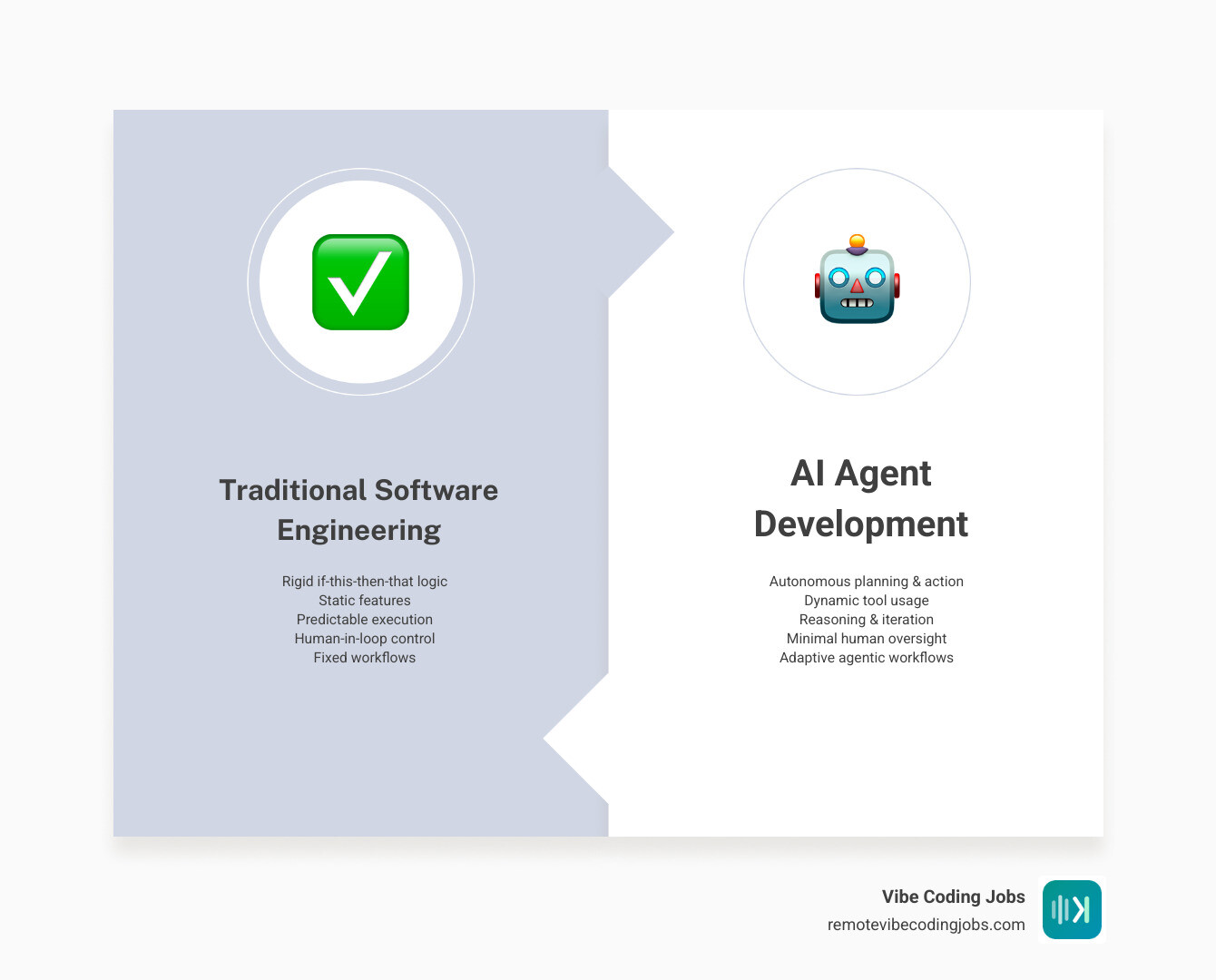
In 2026, the term “developer” has evolved. An AI Agent Developer isn’t just writing code; they are orchestrating intelligence. Unlike traditional software, which follows a rigid “if-this-then-that” logic, AI agents are designed to be autonomous. They can perceive an environment, reason through a task, and use tools to achieve a goal.
When you land an ai agent dev remote position, your daily life shifts from building static features to creating dynamic systems. You’ll spend your time working on:
- Autonomous Workflows: Designing agents that can handle multi-step tasks, such as a “Research Agent” that scrapes the web, synthesizes data, and writes a report with citations.
- RAG (Retrieval-Augmented Generation) Systems: Building the “memory” for these agents. This involves connecting LLMs to private data sources so the agent can provide accurate, context-aware answers.
- Tool-Use and Function Calling: Teaching agents how to use APIs. This might mean an agent that can check a database, send an email, or even execute code to solve a math problem.
- Hyperautomation: Implementing AI to replace repetitive business processes, often moving much faster than traditional automation.
This role is perfectly suited for remote work because it relies heavily on Remote AI Developer Job Description standards—clear documentation, API-first thinking, and Agentic Engineering: What It Is & How to Thrive in 2024 principles.
Working as an ai agent dev remote professional also means embracing Remote AI Developer Jobs: Benefits like async-first communication. Since you’re often building agents that work 24/7, your own schedule can be more flexible. You focus on the “vibe” and the logic, while the agents handle the heavy lifting of execution.
Essential Tech Stack for an AI Agent Dev Remote
To succeed in this field, you need a specific set of tools. It’s no longer just about knowing a language; it’s about knowing the frameworks that let LLMs “act.”
The Frameworks
- LangChain & LlamaIndex: These are the bread and butter of agent development. They provide the scaffolding for RAG pipelines and agentic reasoning.
- MCP (Model Context Protocol): In 2026, exposure to MCP is a huge plus. It’s becoming the standard for how agents interact with various data sources and tools.
The Languages and Databases
- Python & TypeScript: These remain the dominant languages. Python is the king of AI research and backend logic, while TypeScript is essential for building the user-facing “AI Product” side of things.
- Vector Databases: To give your agents memory, you’ll need to master tools like Pinecone, Qdrant, or Weaviate.
The Models and APIs
- Claude & OpenAI SDKs: You’ll be spending a lot of time in the documentation for Claude 3.5/4 and GPT-5. Understanding how to handle rate limits, token window management, and structured outputs is critical.
- Multi-Agent Orchestration: Learning Multi-Agent Workflows: How Top Engineers Orchestrate AI Coding Agents is the next level. This is where you build “teams” of agents that talk to each other to solve complex problems.
For a full breakdown of what to learn first, check out our guide on Remote AI Developer Jobs: Tools & Salary.
Salary Trends and Common Job Titles in 2026
The money in AI agent development is, frankly, incredible. Because the skill set is so new, companies are willing to pay a premium for engineers who actually “get” how to build autonomous systems.

Here is what the current ai agent dev remote market looks like in terms of compensation:
- US-Based/High-Tier Remote: For roles like Applied AI Engineer or Senior Agentic AI Engineer, salaries range from $175,000 to $275,000 per year. These roles often require at least a year of experience building RAG systems and working with production-level LLMs.
- Global/Latin America Market: We are seeing a massive surge in hiring across Latin America. AI Engineer roles here typically offer $2,000 to $6,000 per month, while Senior Agentic Engineers can command up to $8,500 per month.
- Enterprise Roles: Companies like Gartner are hiring Sr. Director Analysts for Agentic Development at $172,000–$203,000 per year to define standards for the entire industry.
Common Job Titles to Search For:
- Agent Engineer: Focused purely on the logic and autonomy of the AI.
- AI Product Engineer: A hybrid role building the UI/UX and the AI backend.
- Senior Gen AI Engineer: Often focuses on RAG and model fine-tuning.
- AI Native Engineer: A title used by startups that are building AI-first from day one.
For more detailed data, visit our AI/ML Engineer Salaries page.
Breaking Into the Field: From Vibe Coding to Production
You don’t need a PhD in Machine Learning to be an ai agent dev remote. In fact, many of the most successful agent developers started as “vibe coders”—developers who use AI tools like Cursor and Claude to prototype rapidly.

The Path from Zero to Hired:
- Master Vibe Coding: Start by using AI to write code for you. If you can use Cursor to build a functional app in a weekend, you’re already halfway there.
- Build a Portfolio of Agents: Don’t just show code; show agents. Build a GitHub bot that reviews PRs or a Slack bot that summarizes meetings.
- Contribute to Open Source: Find a project in the LangChain or LlamaIndex ecosystem and start fixing bugs.
- Understand the Requirements: Read through Remote AI Developer Jobs: Requirements to see where your gaps are. Usually, it’s not the AI part that trips people up—it’s the DevOps and scaling.
- Apply to AI-First Startups: Look for Best Companies Hiring AI Developers (Remote Positions). These companies care more about your ability to build fast than your degree.
If you are just starting out, check our guide on AI Coding Jobs: Entry-Level Market (Remote).
Frequently Asked Questions about AI Agent Development
Can I become an ai agent dev remote without prior AI experience?
Absolutely. Most ai agent dev remote roles are more about “engineering” than “science.” If you understand how to work with APIs, manage state in an application, and write clean code in Python or TypeScript, you can learn the AI part. The market is shifting toward AI Coding Jobs: Entry-Level Market (Remote) where software fundamentals are more important than knowing how to train a model from scratch.
What are the best regions for ai agent dev remote opportunities?
While North America offers the highest salaries, Latin America is currently the “hot zone” for remote AI hiring due to timezone alignment with US companies. However, the market is truly global. Many startups are “async-first,” meaning they don’t care where you are as long as the work gets done and you can attend an occasional sync meeting.
What does the interview process look like for an AI agent engineer?
Expect a mix of traditional and modern tests. You’ll likely face:
- Live Coding: Often using an AI assistant (they want to see how you prompt!).
- System Design: Designing a RAG pipeline or a multi-agent workflow.
- Prompting Tests: Showing you can handle edge cases and “jailbreaks” in LLM outputs.
- Culture Fit: Especially for remote roles, they want to see if you can communicate clearly in writing. Check out Best Companies Hiring AI Developers: Culture, Growth, Salaries & Interview for more tips.
Conclusion
The transition from traditional software development to agentic engineering is the biggest shift in our industry since the move to cloud computing. Whether you are a senior engineer looking for a high-paying ai agent dev remote role or a “vibe coder” looking to land your first gig, the opportunities in 2026 are endless.
The “agent economy” is creating a world where code isn’t just written—it’s directed. By mastering the tools of autonomy, you aren’t just keeping your job; you’re future-proofing your career.
Ready to stop being an agent of chaos and start being an AI Agent Developer? We’re here to help you find the right fit.