
Why Assessing Culture Fit in Tech Roles Matters More Than Ever
Finding the right culture fit in tech roles is often the deciding factor between a high-performing engineering team and a project that falls apart under pressure.
While technical skills can be taught, a mismatch in communication, ethics, and collaboration style is incredibly difficult to fix.
How to Assess Culture Fit: The Quick Answer
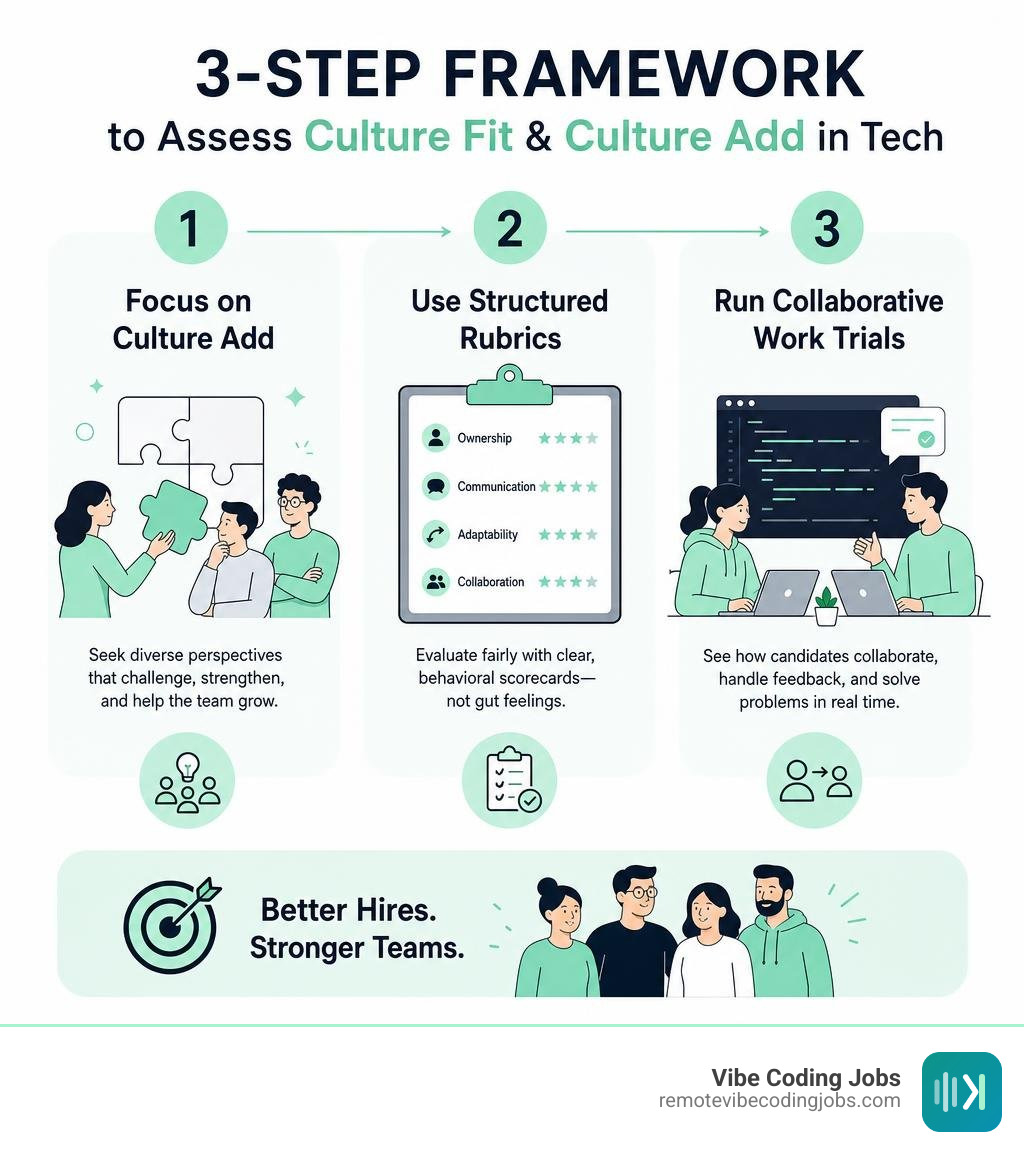
If you want to hire for cultural alignment quickly and fairly, focus on these three core strategies:
- Focus on Culture Add, Not Fit: Do not hire “carbon copies” of your current team. Look for diverse perspectives that challenge your processes and help the team grow.
- Use Structured Rubrics: Avoid “gut feelings.” Grade candidates using clear, behavioral scorecards that measure traits like ownership, communication, and adaptability.
- Run Collaborative Work Trials: Move past traditional interviews. Have candidates work on a short, paid project or a collaborative coding session to see how they handle feedback in real time.
I am Di Su, a software engineer with over 10 years of experience building scalable web solutions and optimizing technical workflows. Over the last decade, I have learned that properly evaluating culture fit in tech roles is the most reliable way to prevent costly hiring mistakes and build happy, productive teams.
Easy culture fit tech roles word list:
Why culture fit tech roles Demand a Shift from Fit to Add
As we navigate the rapidly evolving tech landscape of 2026, the way we build engineering teams has fundamentally shifted. For years, companies relied on a vague, unstructured vibe check to determine if a developer “belonged” on their team. This traditional approach to evaluating culture fit in tech roles is no longer enough. In fact, relying on outdated definitions of culture fit can actively harm your company’s growth.
To build resilient, innovative teams, we must transition our hiring philosophy from “culture fit” to “culture add.” This distinction is not just corporate wordplay—it is a critical technical hiring philosophy that directly impacts how your infrastructure and applications evolve.

The Danger of the Mirroring Bias in culture fit tech roles
When hiring managers rely on unstructured “gut feelings” to evaluate candidates, they often fall victim to the mirroring bias. This is the tendency to favor candidates who look, think, act, and communicate exactly like the existing team.
In her critical essay, The Sterile Mirage: Why ‘Culture Fit’ is the Ultimate Dark Pattern, Babie New explains how traditional culture fit checks often function as an exclusionary filter. Instead of identifying alignment on core values, these unstructured evaluations reward superficial likability—such as sharing the same hobbies or enjoying the same craft beers.
This “likeability bias” acts as a demographic tax on diversity of thought. When we hire carbon copies of our existing staff, we build an intellectual monoculture. The consequences are highly visible in product design. For example, a homogeneous team of young developers might build a complex medical application that is completely unusable for older demographics simply because they only tested the product on themselves.
To build products that serve a global audience, we must deliberately break this echo chamber. We should want our engineering processes to be challenged by clear standards, rather than keeping everyone comfortable in a “sauna of sameness.”
Defining Culture Add vs culture fit tech roles
So, what is the alternative? Rather than asking, “Does this person fit in with our current team?” we must start asking, “What does this candidate bring to our team that we currently lack?”
This is the essence of hiring for “culture add.” In his technical hiring guide, Interviewing for Culture Add, Not Culture Fit: A Technical Hiring Philosophy, Erwin Hermanto outlines how bringing in engineers who challenge existing processes is the true driver of technical innovation.
Consider the evolution of an engineering team’s infrastructure:
- Era 1: Manual deployments via SSH at midnight (high risk, high stress).
- Era 2: Writing basic bash scripts to automate repetitive tasks.
- Era 3: Implementing structured CI/CD pipelines.
- Era 4: Transitioning to declarative infrastructure and Kubernetes orchestration.
This technical evolution does not happen by hiring developers who are perfectly comfortable with the status quo. It happens because we hire “culture add” candidates who ask uncomfortable questions, challenge outdated manual processes, and introduce modern automation practices.
In our Remote Vibe Coding Jobs Guide, we emphasize that in the era of AI-assisted development (or “vibe coding”), developers possess immense leverage. When code generation is accelerated by AI tools, a developer’s individual philosophy, cognitive diversity, and willingness to introduce constructive friction become far more valuable than their ability to write boilerplate code.
The True Cost of Cultural Misalignment in Software Engineering
When an engineer is a poor cultural fit, the negative impacts ripple across the entire organization. In tech environments, where collaboration and rapid iteration are essential, a single toxic or misaligned hire can slow down team velocity and destroy morale.
Let us look at the concrete data surrounding workplace happiness, cultural alignment, and financial performance:
- Weakened Culture and Churn: 58% of employees consider leaving their job due to a weakened company culture.
- The Cost of Misalignment: Employees who do not fit well within their company’s culture are 24% more likely to leave within their first year.
- The Power of Happiness: Workplace happiness leads to a 12% boost in productivity, and companies with highly satisfied employees outperform their competitors by 20%.
- Financial Impact: Companies with a culture that attracts high-talent individuals see a 33% higher revenue. Furthermore, hiring managers who contribute positively to the company culture lead to a 27% higher revenue per employee.
To visualize how these factors play out in real-world engineering teams, let us compare the performance metrics of high-fit (culture add) teams versus low-fit (misaligned) teams:
| Metric | High-Fit (Culture Add) Teams | Low-Fit (Misaligned) Teams |
|---|---|---|
| Annual Employee Churn | Low (under 15%) | High (over 35%) |
| Average Deployment Velocity | Fast, automated, and collaborative | Slow, plagued by silos and communication blocks |
| Response to Production Incidents | High ownership, blameless post-mortems | Finger-pointing, defensive posturing, high stress |
| Adoption of New AI Tools | High adaptability, rapid experimentation | Rigid resistance to workflow changes |
| Revenue Performance | Outperforms competitors by 20-33% | Underperforms due to high replacement costs |
Impact on Team Velocity and Retention
The financial cost of replacing a software engineer is incredibly high, often costing up to double their annual salary when factoring in recruitment, onboarding, and lost productivity.
Consider a real-world comparison of cultural impact on retention. Typical customer support and call center environments experience a staggering 30% to 45% annual employee turnover rate. However, companies like Zappos, which place an absolute, uncompromising focus on cultural alignment during their hiring and onboarding processes, maintain a turnover rate of just 18% to 20% for the exact same positions with the same pay. They even offer new hires a cash incentive to quit during training to ensure only those truly aligned with their values remain.
When developers do not align with your team’s communication patterns and engineering philosophy, they quickly burn out. This burnout is rarely caused by writing too much code. More often, it is the result of reading poorly structured code, navigating bureaucratic approval processes, and dealing with constant interpersonal friction.
To protect your team’s velocity, you must foster an environment that values transparency and collaboration. For actionable insights on building a supportive remote environment, take a look at our guide on Amazing Remote Developer Culture Top Companies in 2024.
How to Design a Structured, Bias-Free Culture Assessment Process
If unstructured interviews are about as predictive of job performance as a coin flip, how do we design a system that objectively measures cultural alignment?
The answer lies in moving away from subjective “vibes” and transitioning to structured, rubric-based evaluation loops.
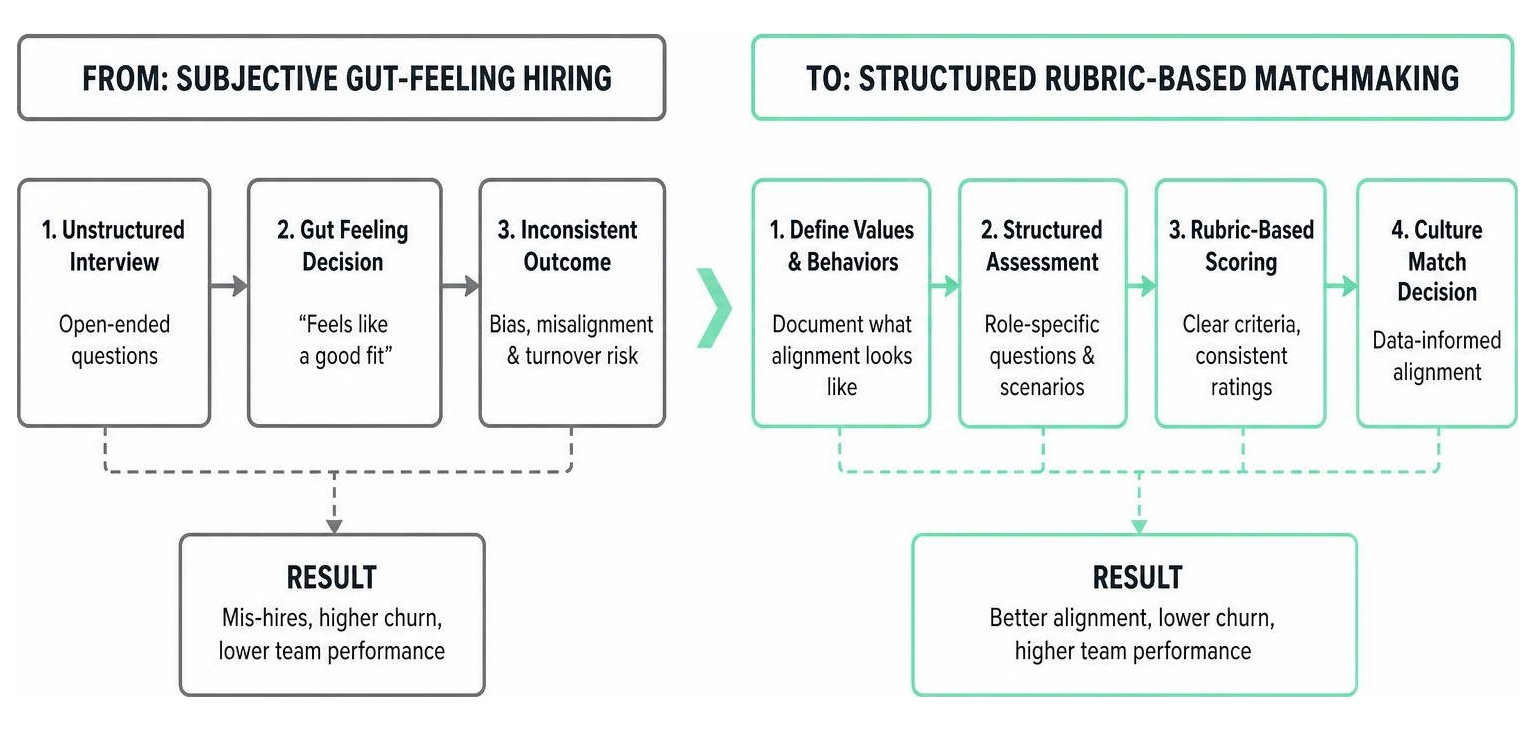
Moving from Gut Feelings to Objective Rubrics
To eliminate bias, we must document and formally define our company culture and values before we ever attempt to grade a candidate against them.
In his insightful article, Why Cultural Fit is a Lie and the Rubric is Your Only Shield, tech leader Ort Beans argues that “cultural fit” is often just a polite term for unexamined preference. Without a structured rubric, rejection feedback like “they just weren’t a fit” leaves candidates at a dead end with no actionable path for improvement.
To fix this, we should adopt structured behavioral rubrics—similar to Amazon’s famous Leadership Principles. We must map our hiring goals to specific behavioral markers and grade candidates on a clear scale. For example, instead of grading someone on whether they are “easy to work with,” evaluate them on concrete principles such as:
- Bias for Action: Do they rapidly prototype solutions to validate ideas, or do they get stuck in analysis paralysis?
- Ownership: Do they take full responsibility for production failures and focus on systemic fixes, or do they blame external timelines?
- Deliver Results: Can they balance technical perfection with the business need to ship working software?
Involving the Team and Hiring Managers
Hiring should never be a top-down decision made solely by an HR department. It must be a collaborative matchmaking process. As highlighted in the recruitment philosophy Hiring is Matchmaking, not Selection, successful hiring is about finding a shared alignment between the candidate’s professional goals and the team’s engineering philosophy.
To achieve this matchmaking balance, we recommend implementing the following practices:
- Utilize Separate Interview Panels: Assign one panel to focus entirely on technical capabilities and a completely separate, diverse panel to evaluate cultural values. This prevents technical brilliance from blinding interviewers to major behavioral red flags.
- Involve Peer Developers: Let potential teammates run a portion of the interview. This allows them to observe how the candidate naturally interacts, communicates technical concepts, and handles peer-to-peer discussions.
- Run Collaborative Paid Work Trials: Instead of arbitrary homework assignments that candidates cannot defend, run a short, paid work trial (ranging from a few hours to a few days). Have the candidate pair-program or collaborate on a real-world ticket with your team to see how they actually communicate under pressure.
Top Behavioral Questions to Evaluate Tech Candidates
To uncover a candidate’s true mindset and move past rehearsed, clichéd answers, we must ask specific, scenario-based behavioral questions.

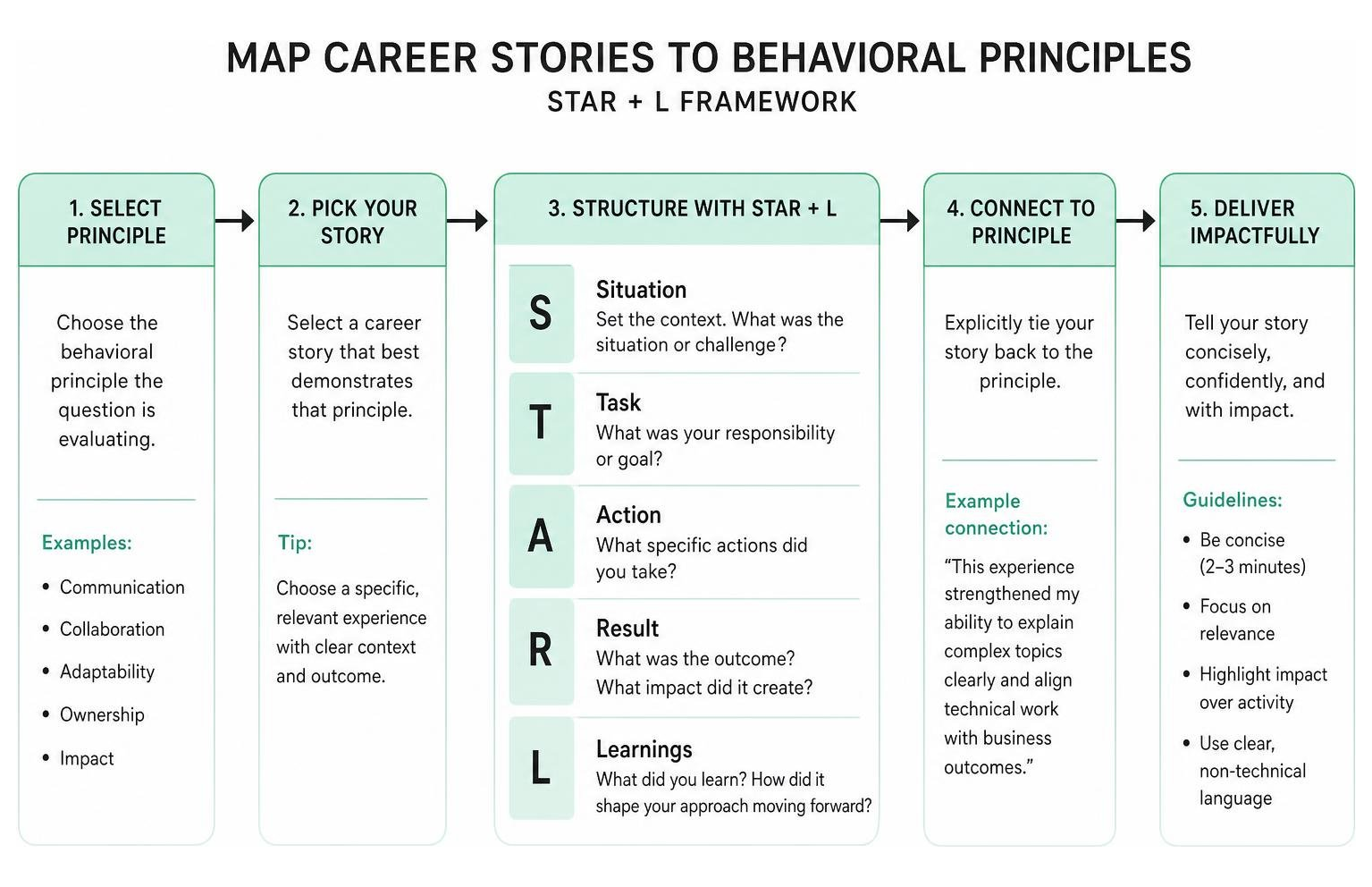
When evaluating answers, we look for the STAR+L method. This framework helps candidates structure their stories logically, and it helps us grade their answers objectively:
- Situation (10%): What was the context of the challenge?
- Task (10%): What was the candidate’s specific responsibility?
- Action (40%): What specific actions did they take?
- Result (20%): What was the quantitative business or technical outcome?
- Learning (20%): What did they learn, and how did they apply that knowledge afterward?
Assessing Collaboration and Communication
Here are the top behavioral questions we use to evaluate a developer’s communication patterns and team enablement:
- “Describe a time when you had a strong disagreement with your team lead or manager over an architectural decision. How did you handle it, and what was the outcome?”
- What to look for: We want to see if the candidate can disagree constructively, present data-driven arguments (such as user retention or performance metrics), and ultimately commit to the team’s decision even if they disagreed initially. Avoid candidates who sound defensive or arrogant.
- “Walk me through a situation where you had to explain a highly complex technical issue to a non-technical stakeholder (like a product manager or executive). How did you structure your explanation?”
- What to look for: Look for the ability to translate technical complexity into business impact without over-explaining coding details or using exclusionary jargon.
- “How do you typically deliver constructive feedback to your peers during code reviews? Can you give me a specific example of a time your feedback was met with resistance, and how you resolved it?”
- What to look for: This reveals their empathy, collaboration style, and commitment to maintaining clean codebases without creating personal friction.
Evaluating Adaptability and Learning in the AI Era
In 2026, the technical skills required for software engineering are evolving faster than ever. Languages and frameworks shift, and developers must constantly adapt.
- “Tell me about a time when you had to build a functional prototype or solve a complex problem using an unfamiliar technology or AI-assisted tool. How did you approach the learning curve?”
- What to look for: Look for high agency and an intrinsic hunger to learn. The candidate should demonstrate how they validate LLM-generated code, maintain separation of concerns, and ensure code quality when using modern AI tools.
- “Describe a scenario where a sudden change in product requirements or a tight deadline forced you to make a technical trade-off. How did you decide what to cut, and how did you communicate those trade-offs to your team?”
- What to look for: We want to see how they balance technical excellence with shipping practical business solutions. Do they make decisions based on concrete metrics, or do they rely on subjective feelings?
For a deeper look at how modern engineering cultures are shifting in response to AI-assisted workflows, check out our guide on Vibe Coding Jobs Remote Career Interview Culture.
How Candidates Can Prepare for Culture Fit Evaluations
If you are a candidate heading into a final-stage interview, you must realize that your technical skills have already been proven. The final round is not a test of your coding speed—it is an evaluation of how your skills deploy into a living team ecosystem without causing “version conflicts.”
A painful reality check is shared in the popular post on Medium, where a highly skilled production engineer describes acing every single technical round only to be rejected at the final stage for “not being a culture fit.”
The rejection was not about their personality; it was about specific, fixable communication patterns. They spent ten minutes rambling during their introduction, over-indexed on “I” instead of “we,” and failed to connect their technical achievements to concrete business results. This mistake cost them multiple high-paying offers before they restructured their approach.
To avoid these pitfalls, we recommend mapping your career achievements to a personal rubric before your interview:
Avoiding Common Interview Mistakes
When preparing your behavioral stories, make sure to avoid these three incredibly common mistakes:
- Rambling and Over-Explaining: Keep your “Tell me about yourself” pitch to a concise 90 seconds. Limit your behavioral answers to under three minutes. If you ramble, hiring managers will assume you struggle to prioritize information on the job.
- Using Defensive or Arrogant Language: Avoid defensive phrases like, “In the end, I was proven right, and they realized their mistake.” This is a massive red flag that signals a toxic, hard-to-work-with attitude. Instead, use collaborative phrasing: “We analyzed the performance data together and decided to pivot our approach.”
- Ignoring the “We” Mindset: If your mock interview recordings contain dozens of “I” statements and zero “we” statements, you are signaling a lone-wolf mentality. Highlight how you supported your teammates, unblocked peers, and contributed to the collective success of the engineering team.
Frequently Asked Questions about culture fit tech roles
Why is cultural fit considered more critical than technical skills for long-term success?
Technical skills are highly teachable, especially in 2026 with the assistance of advanced AI coding tools. However, core behavioral traits—such as empathy, integrity, transparency, and a growth mindset—are deeply ingrained and incredibly difficult to teach. A developer with slightly less experience who possesses high agency and a hunger to learn will rapidly outpace a highly skilled but rigid “lone wolf” who refuses to collaborate or adapt to new workflows.
How can companies assess cultural fit without harming diversity?
To prevent cultural assessments from turning into exclusionary demographic filters, companies must:
- Define “fit” objectively using structured behavioral rubrics rather than vague “gut feelings.”
- Focus on “culture add” by actively seeking out diverse industry backgrounds, cognitive styles, and perspectives.
- Utilize diverse, multi-member hiring panels to minimize individual unconscious bias.
- Avoid using informal social activities (like the “beer test”) as hiring filters.
What are the red flags of poor cultural fit during an interview?
The most common red flags of cultural misalignment include:
- Blame Shifting: Shifting blame to product managers, legacy codebases, or tight timelines when discussing past project failures, rather than taking full ownership.
- Rigid Process Adherence: Demonstrating extreme resistance to changing tech stacks or adopting modern AI-assisted workflows (such as insisting on a single framework regardless of context).
- Lone-Wolf Mentality: Over-emphasizing solo achievements while showing a lack of interest in mentoring peers, participating in code reviews, or collaborating across departments.
Conclusion
At the end of the day, building a world-class engineering team is a process of matchmaking, not strict selection. When we move away from subjective “vibes” and embrace structured, objective “culture add” rubrics, we build highly collaborative, innovative, and resilient teams that can navigate any technical challenge.
If you are a remote developer looking to join a forward-thinking, async-first team that values high agency, modern workflows, and healthy collaboration, we are here to help. At RemoteVibeCodingJobs, we curate daily job listings filtered specifically by culture, tech stack, and modern AI tools like Cursor and Claude.
Ready to take the next step in your career and find a team where you can truly add value? Explore AI Coding Tools for Vibe Coding and download our free remote career playbook today!