
AI Code Documentation Jobs Are Exploding — Here’s What You Need to Know
AI code documentation jobs are one of the fastest-growing categories in tech right now. Here’s a quick breakdown of what they are and who they’re for:
| Question | Quick Answer |
|---|---|
| What are they? | Roles that combine engineering and writing to build, structure, and automate documentation for AI systems and developer tools |
| Who’s hiring? | Companies like Google, Microsoft, Mistral AI, Bentley Systems, and thousands of AI startups |
| What skills do you need? | Python or TypeScript, LLM/RAG knowledge, structured content experience, and strong communication |
| What do they pay? | From ~$87K for senior technical writers up to $400K+ for lead documentation engineers at top AI companies |
| Are they remote? | Many are hybrid or fully remote, especially at AI-native companies |
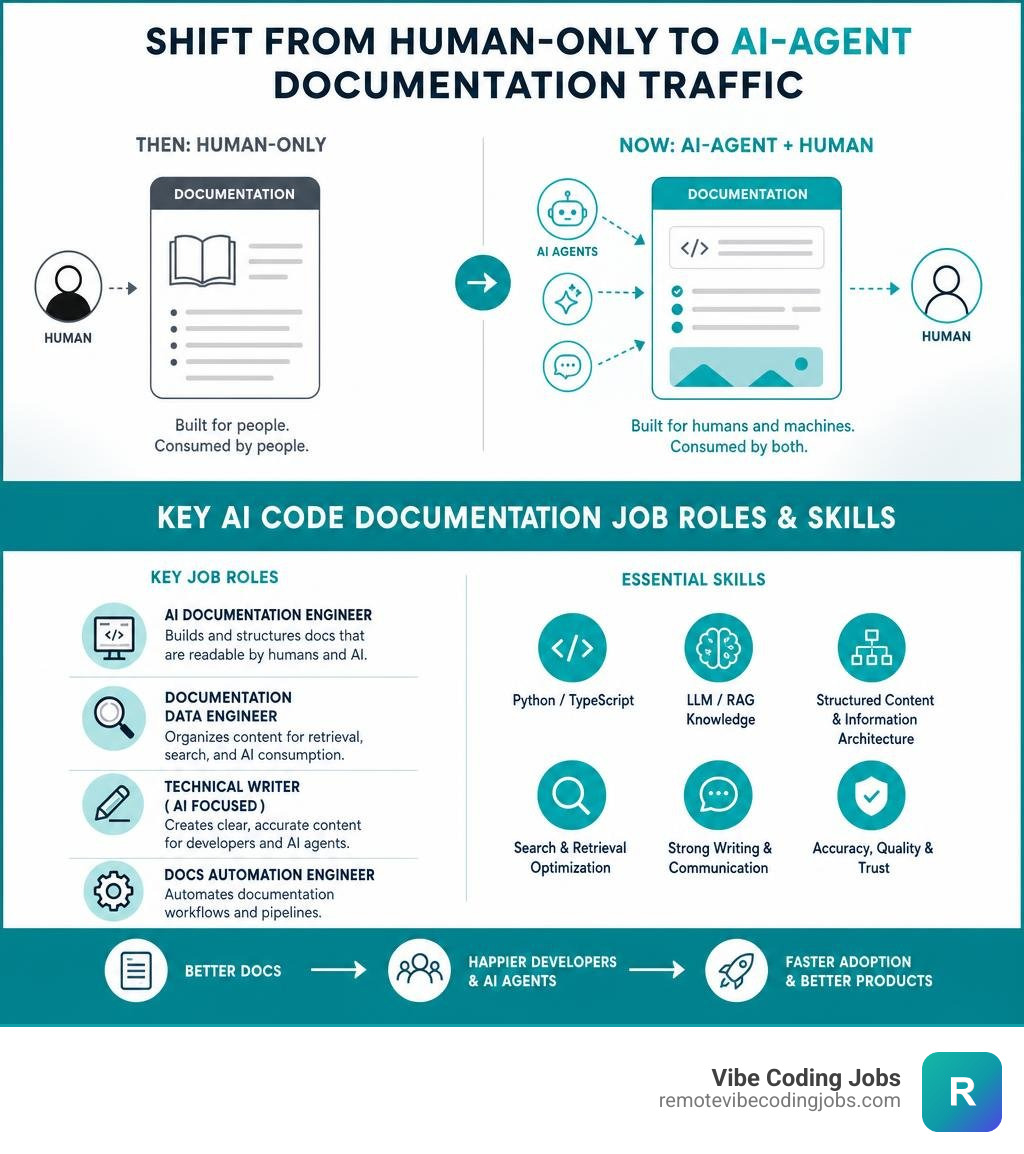
Nearly half of all traffic to documentation sites now comes from AI agents — tools like Cursor, Claude Code, ChatGPT, and Perplexity. That single shift has turned documentation from a “nice to have” into mission-critical infrastructure. Companies that once treated docs as an afterthought are now hiring engineers specifically to make their content readable by both humans and machines.
This is a new kind of role. It’s not pure technical writing. It’s not pure engineering. It sits right at the intersection of both — and demand is outpacing supply fast.
I’m RVCJ Editorial, the team behind Remote Vibe Coding Jobs, where we cover AI-assisted development, remote hiring trends, and career guidance for developers building with tools like Cursor, Claude, and Copilot — including the booming space of ai code documentation jobs. We’ve tracked this job category from niche to mainstream, and what we’re seeing right now is a genuine inflection point.
Ai code documentation jobs vocab explained:
What is an AI Documentation Engineer?
An AI Documentation Engineer is a specialized software professional who bridges the gap between traditional technical communication and modern artificial intelligence systems. Historically, technical writers focused entirely on human readability, creating PDFs or static web pages. Today, an AI Documentation Engineer treats documentation as structured, machine-readable data.

This role differs significantly from a traditional technical writer or documentation specialist. While technical writers focus on syntax, style guides, and clarity for human eyes, AI Documentation Engineers spend their time building content pipelines, defining semantic metadata models, and ensuring that Large Language Models (LLMs) can easily parse, index, and retrieve information. According to the AI Documentation Engineer Job Details | Bentley Systems, this role is fundamentally engineering-focused, requiring a strong understanding of how software architecture interacts with content delivery systems.
Rather than just writing help articles, these engineers design the pathways through which AI tools consume knowledge. They ensure that when a developer asks an AI coding assistant to explain an API, the system retrieves accurate, up-to-date, and context-rich answers.
Core Responsibilities of the Role
The day-to-day work of an AI Documentation Engineer is varied and highly technical. Some of the core responsibilities include:
- Building AI-Assisted Tooling: Developing scripts and tools for automatic content classification, tagging, summarization, and automated quality checks.
- Designing Content Pipelines: Creating transformations that make legacy documentation formats (like DITA XML) AI-ready. This involves structuring content so it can be cleanly chunked, indexed, and processed by retrieval-augmented generation (RAG) systems.
- RAG Integration: Collaborating with platform teams to hook documentation repositories directly into active RAG pipelines and LLM APIs.
- Semantic Enrichment: Adding rich metadata, structured schemas, and context markers to raw text so that AI agents understand the relationships between different parts of a codebase or API.
- Maintaining Toolchains: Integrating AI capabilities directly into existing publishing workflows (such as Git-based docs-as-code setups) without disrupting the work of traditional writers.
How AI Code Documentation Jobs Are Evolving in 2026
In 2026, the software engineering landscape has shifted dramatically. AI-powered tools are automating many of the repetitive, boilerplate tasks that once filled junior developers’ days. This shift has had a massive impact on entry-level coding and documentation jobs.
As highlighted in our guide on AI Coding Jobs: Entry Level & Beginners, the pure “syntax translator” role is disappearing. Instead, junior developers and documentation specialists are expected to step up as problem solvers, system architects, and AI orchestrators. Instead of manually writing boilerplate API descriptions, they use AI to generate the first drafts and then spend their energy on validating, structuring, and optimizing that information for broader consumption.
This evolution has made ai code documentation jobs incredibly dynamic. Understanding how to manage, structure, and audit AI-generated content has become a core survival skill for anyone entering the software industry today.
Core Skills and Qualifications for AI Code Documentation Jobs
To land one of these competitive roles, you need a unique blend of technical expertise and communication skills. The industry is looking for professionals who can read code as easily as they write English.
According to a guide on AI for code documentation: automating comments and docs – Graphite, top candidates must understand how code generation tools interact with source repositories. The core qualifications for these roles include:
- Programming Experience: Proficiency in languages like Python or TypeScript/JavaScript is essential. You need to be able to write scripts, build APIs, and understand the structures of the codebases you are documenting.
- LLM and RAG Knowledge: Hands-on experience with LLM APIs, prompt engineering, and building or optimizing Retrieval-Augmented Generation (RAG) pipelines.
- Structured Content Expertise: Familiarity with structured authoring standards like DITA XML, Markdown, and schema-driven data models.
- Data Pipeline Skills: Experience working with content pipelines, data transformation, and modern version control.
Technical Requirements and Tooling
AI Documentation Engineers work with a modern, hybrid tech stack that combines developer tools with content management systems:
- API Specifications: Deep familiarity with OpenAPI and AsyncAPI to generate accurate, interactive reference documentation that doesn’t drift from the source of truth.
- Git Workflows & CI/CD: Using Git-based docs-as-code workflows and integrating document generation directly into Azure DevOps, GitHub Actions, or GitLab pipelines.
- Structured Editors: Experience with tools like Oxygen XML or OpenDITA to manage enterprise structured content.
- Vector Databases & Indexing: Basic understanding of how vector embeddings work to help improve search and retrieval accuracy for AI chat interfaces.
Career Paths and Job Titles in AI Code Documentation Jobs
Because this field is evolving so rapidly, you will see a variety of job titles when searching for opportunities. Some of the most common titles include:
- AI Technical Writer: A role focused on translating complex AI/ML concepts into clear documentation, user guides, and model descriptions.
- Machine Learning Documentation Specialist: A specialist who documents training datasets, model limitations, and ethical AI compliance standards.
- NLP Documentation Engineer: An engineering-focused role dealing with natural language processing pipelines and language model inputs.
- Lead Documentation Engineer: A strategic leadership role responsible for defining documentation architectures across entire enterprises.
Professionals looking to transition into these roles often come from traditional developer backgrounds or senior technical writing positions. As we discuss in our deep dive on AI Coding Jobs: Remote Options & Growth, building a portfolio of AI-assisted projects is one of the fastest ways to prove your capabilities to hiring managers.
AI-Native Documentation Platforms vs. Traditional Tools
The explosion of ai code documentation jobs has been accompanied by a massive wave of innovation in the tool space. Today, documentation tools are split into several distinct categories, each serving a different part of the developer workflow.

To understand how these tools fit together, let’s look at the key differences between them:
| Tool Category | Core Purpose | Key Examples | Primary Users |
|---|---|---|---|
| AI-Native Platforms | Full-scale publishing platforms built from the ground up for both human readers and AI agents. | Mintlify, GitBook, Fern | Product teams, API developers |
| AI Writing Assistants | Tools designed to help human writers draft, edit, and localize content faster. | Docuwriter, ClickHelp | Technical Writers, Content creators |
| Retrieval Infrastructure | Middleware that indexes existing documentation and feeds it to LLMs. | Kapa.ai | Platform Engineers, Support teams |
| In-Docs Chat Solutions | Embedded chat widgets that answer reader questions directly on the docs site. | ReadMe AI, Kapa | End-user developers |
These platforms make it easier than ever to keep documentation in sync with fast-moving codebases. For example, tools like Fern and Mintlify can automatically generate complete API references directly from an OpenAPI specification, preventing the documentation from drifting when developers update the underlying code.
Making Documentation AI-Ready
Creating documentation that AI agents can easily understand requires a deliberate strategy. It is no longer enough to publish a clean HTML page; you must make your content semantically rich and easily discoverable by automated scrapers and IDE integrations.
As detailed in our article on the Best AI Tools for Code Documentation: Streamline Your Workflow, there are several key steps to making documentation AI-ready:
- Generate
llms.txtandskill.mdFiles: These are structured, lightweight discovery files placed at the root of a documentation site. They act like arobots.txtfor AI, telling coding assistants exactly what information is available and where to find it. - Support Model Context Protocol (MCP): Implementing MCP servers allows AI coding tools (like Claude Code or Cursor) to query your documentation in real-time during an active coding task.
- Provide Clean Markdown Access: Serving a clean, unbloated Markdown version of your documentation alongside standard HTML makes it much easier for AI agents to parse without getting tripped up by complex UI layouts.
- Semantic Enrichment: Using consistent metadata and structured schemas to provide clear context for every code snippet.
Cross-Functional Collaboration in AI Documentation
AI Documentation Engineers do not work in a vacuum. They sit at the center of several cross-functional teams, acting as a bridge between technical and non-technical stakeholders:
- Platform Engineers: To integrate documentation pipelines into CI/CD systems and maintain the infrastructure that hosts AI-ready files.
- Product Teams: To ensure that new features are documented as soon as they are built, using automated workflows triggered by product management tools.
- AI Researchers: To align model documentation with safety, compliance, and ethical standards.
- Documentation Leaders: To establish guidelines for tone, structure, accessibility, and quality assurance across all content.
Many organizations are establishing dedicated Communities of Practice to share best practices, tools, and workflows for keeping internal and external documentation optimized for the AI era.
Frequently Asked Questions about AI Code Documentation
What is the difference between llms.txt and MCP?
While both tools help AI systems interact with your documentation, they serve completely different purposes.
An llms.txt file is a static discovery file. It acts as a map, telling AI systems what content exists on a documentation site and where to find it. It is designed to be read once or indexed periodically.
On the other hand, the Model Context Protocol (MCP) is an active, live retrieval layer. It allows AI coding tools to query your documentation dynamically while a developer is working on a task, pulling in exact code examples and API details on demand.
Do I need a computer science degree for AI documentation jobs?
No! While a solid technical foundation is required, many companies prioritize practical skills, a strong portfolio, and a deep understanding of software fundamentals over a formal computer science degree.
If you can demonstrate proficiency in prompt engineering, show that you can build and document real projects using AI-assisted tools, and explain complex technical concepts clearly, you can land a highly competitive role in this field.
Why are AI documentation skills in high demand across industries?
AI technologies are being adopted rapidly across highly regulated sectors like fintech, healthcare, and government. In these industries, documentation is not just about helping developers; it is about regulatory compliance, data privacy, and ethical safety.
Whether it is meeting GDPR guidelines, ensuring HIPAA compliance in medical software, or documenting the decision-making processes of autonomous systems, companies need experts who can write precise, transparent, and legally sound documentation for their AI models.
Conclusion
The rise of ai code documentation jobs is a clear indicator of how fast the software engineering landscape is changing in 2026. Documentation is no longer a static archive of past work — it is a dynamic, machine-readable asset that powers the next generation of AI development tools.
Whether you are an experienced developer looking to transition into a high-leverage role, or a technical writer eager to master the latest AI toolchains, there has never been a better time to build your skills in this space.
Ready to take the next step in your career? We invite you to Find the best remote vibe coding and AI documentation roles on RemoteVibeCodingJobs, where we curate the best daily listings at async-first companies that embrace AI-assisted workflows. Let’s build the future of development together!