
The 2026 Software Engineer Job Market: What the Data Actually Shows
The software engineer job market in 2026 is not dead — but it has split into two very different realities depending on your skills.
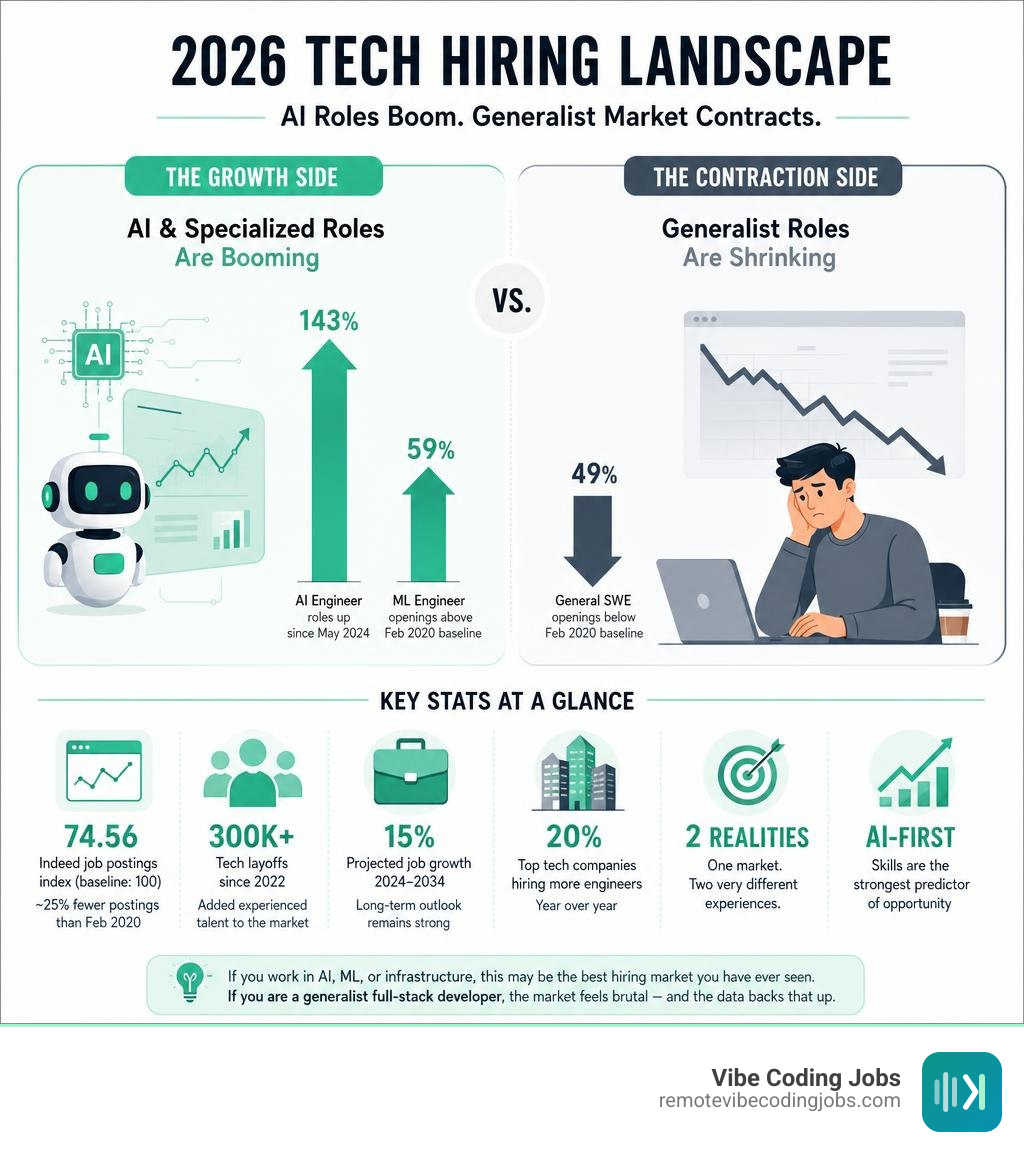
Quick snapshot for July 2026:
| Signal | What It Means |
|---|---|
| Indeed job postings index: 74.56 (baseline: 100) | ~25% fewer postings than pre-pandemic Feb 2020 |
| AI Engineer roles up 143% since May 2024 | Explosive demand for AI-specialized talent |
| General SWE openings 49% below Feb 2020 baseline | Traditional roles are shrinking |
| ML Engineer openings 59% above Feb 2020 baseline | AI-adjacent roles are booming |
| 15% projected job growth 2024–2034 (BLS) | Long-term outlook remains strong overall |
| Top tech companies hiring 20% more engineers YoY | Recovery is real, but concentrated |
The honest picture: if you work in AI, ML, or infrastructure, this may be the best hiring market you have ever seen. If you are a generalist full-stack developer, the market feels brutal — and the data backs that up.
Last year, analysts described the tech hiring landscape as “weird.” Job seekers could not get responses. Hiring managers could not fill roles. In 2026, that paradox has not gone away — it has deepened.
Over 300,000 tech layoffs since 2022 flooded the market with experienced engineers. At the same time, AI Engineer roles grew 143% and companies like Ramp (+94%), Wiz (+84%), and Datadog (+68%) scaled their engineering headcount aggressively. The result is a market where two completely opposite experiences exist under the same job title: “Software Engineer.”
I’m Di Su, a software engineer with over 10 years of experience in web development and scalable systems, and I’ve watched the software engineer job market shift dramatically — both from the inside as a practitioner and through the lens of building tools that help developers find the right opportunities. In this piece, I’ll break down exactly what is happening, who is hiring, and where the real opportunities are hiding in 2026.
Similar topics to software engineer job market:
The Bifurcated Reality of the Software Engineer Job Market
When we zoom out and look at the macro trends of July 2026, the loudest mistake anyone can make is looking at industry averages. Averages lie. They smooth over a dramatic, tectonic split in our industry.
As detailed in the comprehensive report on the State of the software engineering job market in 2026, we are no longer dealing with a single cohesive market. The hyper-lucrative, zero-interest-rate policy (ZIRP) era of 2021 and 2022 was an artificial bubble. Waiting for that specific, undisciplined market to return is a failing career strategy. Instead, what has emerged is a highly disciplined, deeply divided “tale of two cities.”
On one side of the divide lies the traditional full-stack and CRUD (Create, Read, Update, Delete) developer market. This segment is experiencing a persistent generalist glut. Because AI-assisted coding tools can now handle routine boilerplate code in seconds, the sheer volume of human hours required to build standard business applications has contracted significantly.
On the other side is the specialized AI infrastructure, machine learning, and systems engineering market. This sector is facing an unprecedented, dry-mouthed talent drought. Companies are practically throwing bags of cash at anyone who can orchestrate large-scale GPU clusters, design efficient retrieval-augmented generation (RAG) pipelines, or manage the massive data flows that modern models require.
To help visualize how stark this divide is, we can compare the two profiles directly:
| Attribute | Traditional Software Engineer (Generalist CRUD) | AI Infrastructure / ML Specialist |
|---|---|---|
| Market Supply | High (flooded by layoffs and bootcamp graduates) | Extremely Low (highly specialized skill sets required) |
| Hiring Velocity | Slower (weeks or months of multi-stage interviews) | Lightning-fast (often closed in under a week) |
| Typical US Compensation | $110,000 – $180,000 (largely flat or slightly down) | $245,000 – $450,000+ (surging with heavy equity) |
| Primary Focus | Feature delivery, API integrations, standard UI | GPU clustering, distributed training, latency reduction |
| Impact of AI Tools | Highly automated; tasks compressed | Leveraged to build and deploy complex AI architectures |
This bifurcation means that when we talk about the software engineer job market, we are actually talking about two entirely different economic curves operating under a single job title.
How AI is Reshaping the Software Engineer Job Market
AI is not killing software engineering jobs, but it has fundamentally rewritten the job description. The days of making a comfortable living solely by writing standard React components or basic REST endpoints are drawing to a close.
As explored in the analysis of the Software Engineer Job Market 2026: Two Markets, One Title | danilchenko.dev, baseline AI skills have rapidly transitioned from a shiny resume differentiator to absolute table stakes. If you aren’t using advanced AI-assisted development tools in your daily workflow, you are competing with one hand tied behind your back.
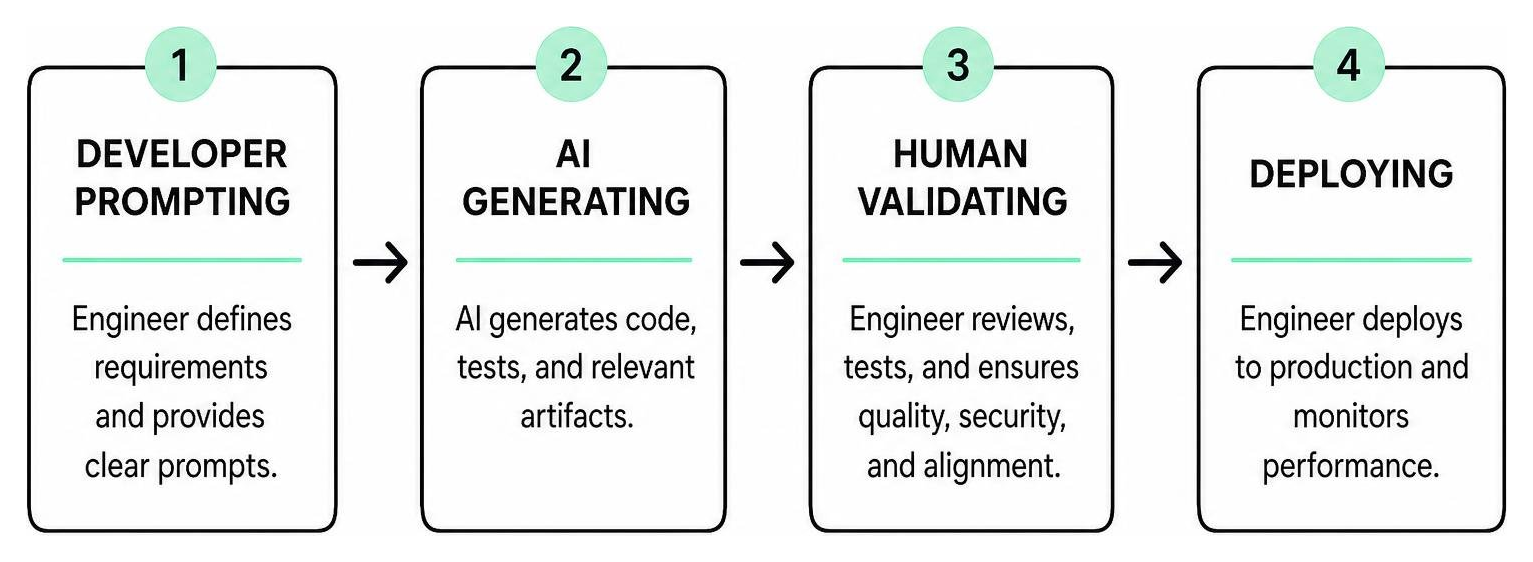
Tools like Claude Code, Cursor, and Windsurf have allowed experienced developers to work at an incredible pace. We call this the “vibe coding” revolution. It doesn’t mean developers just sit back and let the machine do everything. Rather, it means the developer shifts from being a manual “code typist” to acting as a systems architect, strategic prompter, and rigorous quality controller.
Because a single mid-level engineer leveraging these tools can now easily absorb the workload of two or three entry-level developers, the demand for manual, repetitive coding has plummeted. This shift is also heavily impacting salaries and expectations across the board. For a deeper dive into how this affects what you should be earning, take a look at our analysis of Remote Developer Salary Trends 2026.
We are seeing a massive productivity multiplier. The developers who thrive in this environment are those who understand how to design complex systems, evaluate model outputs critically, and integrate AI capabilities directly into production environments.
The Squeeze on Entry-Level Roles in the Software Engineer Job Market
If there is a tragedy in the current market, it is happening at the entry level. Since 2015, over 177,000 software engineers have entered the tech industry via traditional degrees, bootcamps, and self-taught paths. But as traditional programming roles contracted by one-third since 2020, newcomers have found themselves caught in a historic squeeze.
According to data discussed in the State of the software engineering job market in 2026, part 2, entry-level software engineering roles have declined by roughly 28% from their 2022 peak. Even more concerning is that intern hiring and general software engineering recruitment have completely decoupled. While senior hiring has shown clear signs of a recovery, intern intakes at major tech firms continue to fall. In 2025, only 1 in 10 engineering hires at larger companies were recent graduates, down from nearly 3 in 10 in 2023.
Because the market is flooded with laid-off, highly experienced generalist engineers, employers can afford to be incredibly selective. University pedigree has suddenly surged back in importance for new graduates trying to land their first interviews.
For junior developers, the bar has never been higher. To stand out, you can no longer rely on standard portfolio projects like a basic todo app or a cloned social network. You have to demonstrate AI-augmented productivity, an understanding of system architecture, and real-world problem-solving. For those looking to map out their progression from junior to senior in this highly competitive climate, we’ve put together a comprehensive guide on the Remote Developer Career Path: Junior to Senior Guide 2026.
If you are a senior engineer, however, your leverage remains strong, especially in remote-first environments. You can explore how these dynamics affect top-tier pay scales in our Remote Senior Software Engineer Salary Guide 2026.
The AI Revolution: Evolution, Not Extinction
The panic that AI is going to completely eliminate the software engineering profession is deeply misguided. What we are witnessing is an evolution, not an extinction event.
As highlighted in the recruiting data from Senior SWE Glut & the $250K AI Infra Drought: 2026 Data, the real bottleneck for companies trying to build the future isn’t a lack of ideas — it’s the sheer difficulty of scaling and securing AI systems. Building a prototype using a basic API wrapper is easy. Running a production-grade system that handles millions of requests, manages token costs, orchestrates complex GPU clustering, and maintains low latency is incredibly hard.
Interestingly, our collective trust in raw AI code output has actually dropped. Industry surveys show that developer trust in the accuracy of AI-generated code collapsed to 29% in 2026, down from 40% a year prior. Furthermore, 45% of developers report that debugging poorly written AI code often takes more time than writing the code from scratch.
This is precisely why experienced human engineers are more important than ever. We need developers who can apply deep engineering judgment, design robust system architectures, and ensure that AI integrations actually work reliably in the real world. The role has shifted from writing syntax to managing complexity and ensuring quality.
The Recruitment Catch-22: AI Slop and the Trust Crisis
If you have applied for a job recently, you already know that the recruitment process feels fundamentally broken. We are currently living through a bizarre “Catch-22” where hiring managers are desperate for great talent, yet highly qualified engineers can’t even land an initial phone screen.

What is causing this disconnect? In a word: trust. Or rather, the complete collapse of it.
As analyzed in Tech jobs market in 2026, part 3: hiring managers & job seekers, AI tools have broken the traditional application pipeline. Because candidates can now use automated tools to instantly generate and submit thousands of highly optimized, keyword-stuffed resumes and cover letters, inbound application channels have become completely flooded with noise.
When a single open role at a Seattle startup receives over 800 inbound applications in a matter of days, and 98% of them are unqualified or AI-generated “slop,” hiring managers do the only logical thing: they completely shut down inbound applications. They stop looking at cold resumes altogether.
To make matters worse, the rise of “fake candidates” has created a massive security and trust crisis. Recruiters are regularly encountering applicants who use real-time AI voice assistants, deepfakes, or even third-party proxies to pass remote technical screenings.
Because of this, companies are retreating to safer, high-signal hiring methods. If you want to bypass the broken ATS (Applicant Tracking System) filters and actually land an interview in 2026, you must change your approach.
Here are the most effective networking and referral strategies we recommend:
- Leverage Warm Referrals: A referral from an existing employee bypasses the inbound resume pile entirely. Tap your immediate network first.
- Contribute to Open Source: Building in public and contributing to active repositories is a verifiable way to prove your technical capabilities.
- Optimize Your LinkedIn for Sourcing: Recruiters are actively outbound sourcing on LinkedIn to avoid inbound spam. Use specific keywords related to your actual architectural and system achievements.
- Showcase Verifiable Work: Share production-grade projects, detailed technical blog posts, or video walk-throughs of complex system designs that prove you are a real person who builds real things.
- Target Niche Job Boards: Avoid massive, generic job boards that encourage mass-applying. Focus on curated platforms that pre-vet opportunities and prioritize cultural and technical fit.
High-Growth Sectors and Regional Divergence
While traditional Big Tech has adopted a highly cautious, modest hiring stance — with the exception of Google, which has seen a 62% increase in advertised engineering roles compared to last year — other sectors are experiencing explosive, double-digit headcount growth.

If you want to find the fastest-growing opportunities in the software engineer job market, you need to look outside the traditional consumer tech giants. The real hiring surge is happening in three key infrastructure layers:
- Fintech: Scale-ups like Ramp (+94% headcount growth over two years) and Stripe (+29% growth) are hiring aggressively to build out complex global payment systems.
- Cybersecurity: Security firms like Wiz (+84% growth) are expanding rapidly. The cybersecurity sector faces a massive global shortage of 3.5 million roles, with only 74 qualified candidates existing in the US for every 100 open positions.
- Observability: Companies like Datadog (+68% growth) are scaling fast because AI companies are spending historic amounts (sometimes upwards of $170M a year) on observability platforms to monitor their complex AI agents and infrastructure.
We are also seeing significant regional divergence. According to the [June 2026] Tech Job Market Trends Monthly | Zero To Mastery, the US and the UK are driving the majority of the recovery in developer vacancies.
In contrast, European-headquartered companies remain highly cautious. Germany and France have experienced slight declines in open roles. However, the European market is seeing a unique hiring wave for compliance engineers, AI risk assessors, and technical documentation specialists, largely driven by the implementation of the EU AI Act.
For developers seeking to navigate this shifting landscape, targeting remote-first, async-friendly companies in these high-growth sectors is a highly effective way to future-proof your career. You can learn more about how to position yourself for these roles in our guide on the Vibe Coding Career & Remote Job Market.
Frequently Asked Questions about the Tech Job Market
Is the software engineering job market oversaturated in 2026?
No, the market is not oversaturated, but it has permanently shifted. The Indeed software development job postings index in the United States stood at 74.56 as of July 10, 2026 (with Feb 1, 2020, as the baseline of 100). This indicates a stabilization of the market at a lower, healthier volume compared to the unsustainable ZIRP bubble of 2021-2022.
The feeling of oversaturation comes from the “generalist glut” — there are indeed too many candidates applying for traditional full-stack and front-end roles using generic, AI-generated resumes. However, specialized areas like AI engineering, systems programming, observability, and cybersecurity are experiencing a severe talent shortage.
What programming languages are most in demand for 2026?
- Python: The undisputed king for machine learning, data engineering, and AI integration.
- Go (Golang): Growing rapidly for cloud infrastructure, distributed systems, and high-performance tooling.
- TypeScript / JavaScript: Remains highly relevant for full-stack and product engineering, though the market now expects front-end developers to easily work across the entire stack using modern AI-assisted workflows.
How do compensation trends differ between AI and traditional roles?
The compensation gap has widened significantly. Traditional, generalist software engineering salaries have largely flattened, with entry-level roles averaging $85,000 to $105,000 and senior roles hovering between $160,000 and $200,000.
AI and machine learning specialists, however, command a massive premium. According to recent data, mid-level AI infrastructure engineers easily secure $200,000 to $245,000, while senior and staff-level specialists at frontier labs frequently see total compensation packages ranging from $300,000 to $600,000+. To see how these numbers translate to remote-first positions, check out our Vibe Coding Salary Guide for Remote Roles.
Conclusion
The software engineer job market in 2026 is no longer about raw headcount growth; it is about efficiency, specialization, and adaptability. The developers who are thriving are those who have embraced the “vibe coding” revolution — leveraging advanced AI tools to handle routine tasks while they focus on high-value system design, architecture, and security.
If you are tired of shouting into the void of broken, AI-flooded job application portals, it’s time to change how you search. At Vibe Coding Jobs, we cut through the noise. We aggregate remote, high-signal “vibe coding” and AI-assisted development roles at forward-thinking, async-first companies. Our daily curated listings are filtered by culture, tech stack, and the specific AI tools you love using, like Cursor and Claude.
Ready to take control of your career and find an employer that values modern, highly efficient development workflows?
- Explore remote developer salaries to benchmark your market value.
- Find your next future-proof role by browsing the Best Remote Developer Jobs 2026: Future-Proof Your Career.