
What Remote Web Developers Actually Earn in 2026
The remote web developer salary landscape in 2026 is wider than most developers expect — and knowing where you fall can mean a difference of $50,000 or more per year.
Here’s a quick snapshot before we dig in:
| Role / Level | Typical Annual Range (USD) |
|---|---|
| Junior Remote Web Developer (global) | $59,272 – $90,000 |
| Mid-Level Remote Web Developer | $110,000 – $140,000 |
| Senior Remote Web Developer | $140,000 – $220,000+ |
| Frontend Developer (US remote) | $76,000 – $135,000 |
| Freelance Web Developer (US remote) | $59 – $96/hr (~$135,000/yr) |
| Global Average (all levels) | $70,969 |
| US Remote Tech Median | $128,000 |
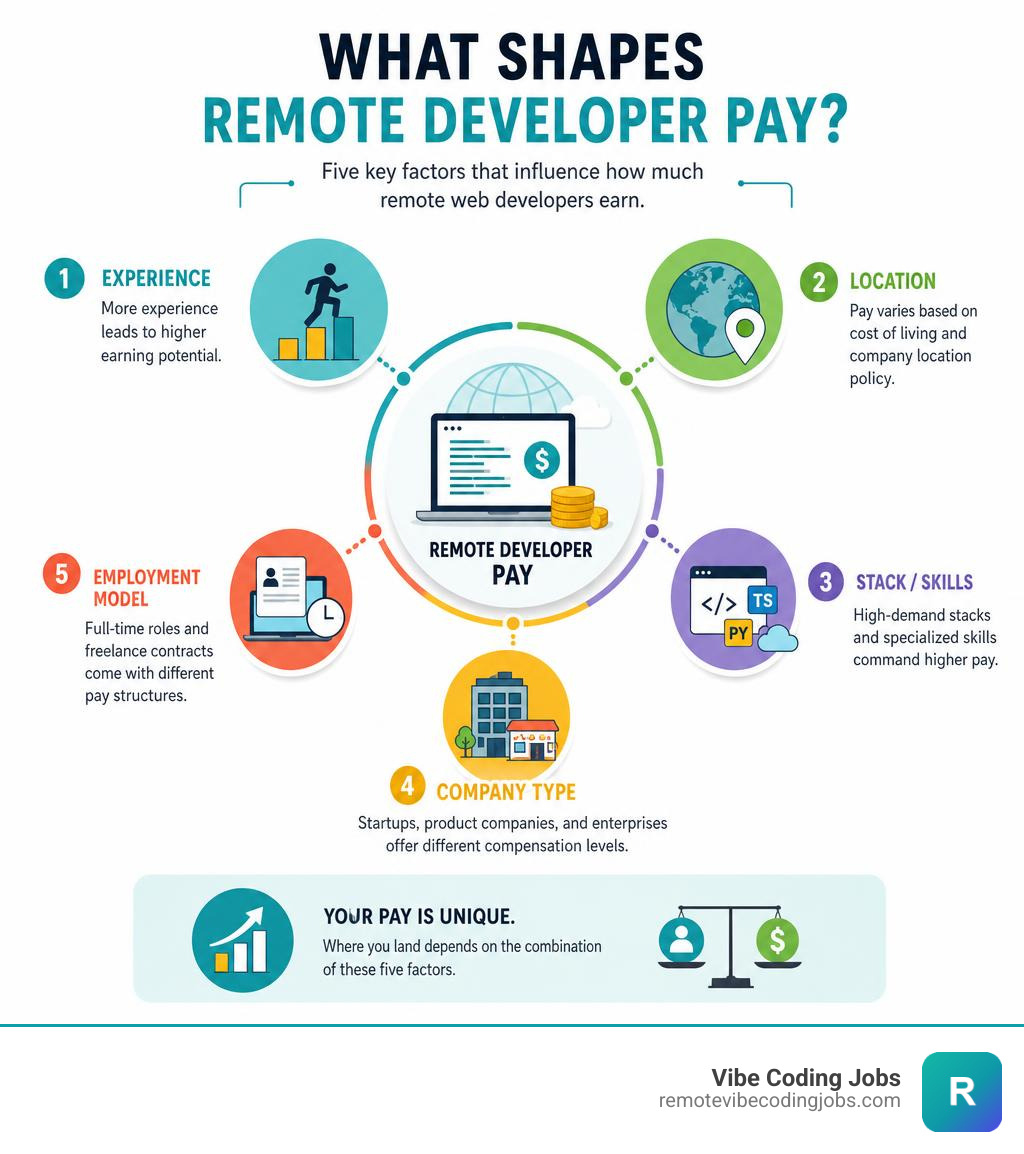
A few things shape where you land on that range:
- Experience level — junior, mid, or senior
- Tech stack — Python/AI, TypeScript, and cloud skills pay more
- Location policy — some companies pay the same globally; others adjust by city
- Employment model — full-time vs. freelance contract
- Company type — remote-first startups vs. enterprise, AI products vs. legacy SaaS
The biggest mistake developers make is benchmarking against a generic “developer average.” Your actual number depends on your stack, your employer’s pay philosophy, and how well you negotiate.
At RVCJ Editorial, we cover remote developer hiring, AI-assisted development trends, and remote web developer salary benchmarks for engineers building with tools like Cursor, Claude, and Copilot — so we’ve pulled together the most current data available to help you figure out exactly what to ask for.
Remote web developer salary benchmarks in 2026
The simplest answer: remote web developers globally average about $70,969 per year in 2026, but that number hides a lot.
A junior working their first remote role may see offers closer to $59K globally or $67K-$90K in stronger US remote markets. A senior full-stack engineer at a competitive remote-first tech company can push into $170K-$220K+, especially with backend, cloud, AI, or architecture responsibilities.
For broader context:
- Remote web developer global average: $70,969
- Remote developer average: $111,845
- Remote software engineer average: $141,205
- US remote tech median: $128,000
- Professional remote roles median: $95,000
- Full-time US remote median across all occupations: $82,000
That gap tells us something important: “web developer” can mean anything from simple website maintenance to senior product engineering across frontend, backend, DevOps, and AI-assisted workflows.
For more benchmarks, you can also browse remote developer salary benchmarks.
| Category | Typical 2026 Compensation |
|---|---|
| Global remote web developer average | $70,969 |
| Junior remote web developer | $59,272-$90,000 |
| Entry-level full-stack developer | $67,000-$90,000, higher with AI fluency |
| Mid-level remote developer | $110,000-$140,000 |
| Senior remote developer | $140,000-$220,000+ |
| Frontend developer, US remote | $76,000-$135,000 |
| Backend specialist | Often similar to or above full-stack when cloud/security-heavy |
| Full-stack developer | Often earns a premium when strong in product and backend |
| Freelance web developer, US remote | $59-$96/hr, median $75/hr |
| Annualized freelance income at 1,800 billable hours | About $135,000 |
What is the average salary for a remote entry-level full-stack web developer in 2026?
A realistic 2026 salary target for a remote entry-level full-stack web developer is:
- Global junior benchmark: around $59,272
- US remote junior range: roughly $67,000-$90,000
- Junior remote developer average: about $88,976
- AI-fluent entry-level developer range: about $70,000-$100,000
If you are brand new, do not assume remote automatically means higher pay. Entry-level remote roles are competitive because many developers want location freedom. Some employers apply a 5%-10% remote discount to entry-level or support-heavy roles because they believe junior developers require more mentorship.
That said, entry-level full-stack developers can still negotiate well if they show proof of independent delivery. Hiring teams want to know you can work without someone peeking over your shoulder every 15 minutes like a very anxious owl.
Strong proof includes:
- A deployed full-stack app
- Clean GitHub repositories
- Written documentation
- Tests or CI setup
- Examples of async communication
- Evidence you can debug without panic-Googling every stack trace
- Familiarity with AI coding tools, plus the judgment to verify their output
For junior developers, the salary question is less “What do I deserve in theory?” and more “Can I prove I can ship remotely?”
Remote web developer salary by experience level
Experience is still the biggest salary lever.
Junior developers are paid for potential. Mid-level developers are paid for execution. Senior developers are paid for judgment, architecture, mentoring, and reducing expensive mistakes before they become production incidents at 2:13 a.m.
| Experience Level | Typical 2026 Range | What Employers Pay For |
|---|---|---|
| Junior | $59K-$90K | Fundamentals, learning speed, portfolio, communication |
| Mid-level | $110K-$140K | Independent delivery, feature ownership, debugging |
| Senior | $140K-$220K+ | Architecture, scale, mentoring, reliability, business impact |
| Staff/principal | $180K-$260K+ in stronger companies | Cross-team strategy, technical direction, high-leverage systems |
Senior technical roles often earn 8%-15% more remotely than comparable office roles because companies compete across markets for proven talent. Entry-level roles can see the opposite: a small discount because remote junior onboarding is harder.
For a deeper breakdown by level, see our guide to remote developer salary expectations by experience level in 2026.
How remote full-stack, frontend, and backend salaries compare
Full-stack, frontend, and backend roles overlap, but the pay patterns are different.
Frontend developers working remotely often land in the $76K-$135K total pay range, with a median around $101K in US remote data. Strong frontend engineers who understand design systems, accessibility, performance, React, TypeScript, and product analytics can earn more than generic web developers.
Backend specialists often earn a premium when their work includes:
- Distributed systems
- API architecture
- Cloud infrastructure
- Security
- Databases
- Performance and reliability
- Payments or fintech systems
Full-stack developers can earn a premium when they are truly full-stack, not “I can center a div and write one API route if emotionally supported.” The highest-paid full-stack developers usually combine:
- React or similar frontend frameworks
- Node.js, Python, Go, or Java backend skills
- SQL and database design
- Cloud deployment
- Testing
- Product thinking
- AI-assisted development workflows
A senior full-stack product engineer who can take an idea from rough spec to production is one of the strongest profiles in the remote market.
The biggest factors that influence remote developer compensation

Remote salaries are shaped by more than job title. The biggest compensation factors are:
- Seniority
- Location policy
- Tech stack
- Company size
- Industry
- Funding stage
- Equity and bonus structure
- Remote maturity
- Time zone overlap
- Communication ability
- AI tool proficiency
- On-call expectations
Two developers with the same “Remote Web Developer” title can have completely different compensation if one is building marketing sites for a small business and the other is scaling a healthcare SaaS platform with millions of users.
Remote web developer salary by region and country
Regional differences remain huge in 2026.
Common remote developer averages include:
| Region | Average Remote Developer Salary |
|---|---|
| North America | $82,757 |
| Western Europe | $69,720 |
| Asia | $56,483 |
These averages should be treated carefully. They blend junior and senior developers, local employers and global employers, and full-time employees and contractors.
The biggest difference is usually not where the developer lives. It is who the employer is and how they set pay.
A developer working for a local employer may earn local-market compensation. A developer working for a US-based or globally competitive remote company may earn much more, especially if the company uses national or location-agnostic pay bands.
This is why remote work creates geographic arbitrage. If you earn a strong remote salary while living in a lower-cost area, your savings rate can increase dramatically. But tax residency, employment law, contractor setup, and benefits all matter. A bigger gross salary is nice; accidentally creating tax chaos is less nice.
How location-based pay changes remote earnings
Location-based pay means the company adjusts salary based on where you live. Location-agnostic pay means the company pays based on role and level, regardless of location.
Common remote pay models include:
- City-based pay: salary changes by metro area
- Country-based pay: salary changes by country
- Regional bands: broad bands such as North America, Europe, Asia
- National bands: one band for an entire country
- Location-agnostic pay: same pay for the same role and level
- Contractor pricing: negotiated rate based on value, market, and leverage
Remote software engineers working for US companies while living abroad may earn 10%-20% less than US-resident peers if the company uses location-based pay. Other companies do not adjust as heavily, especially for senior or hard-to-hire specialists.
If a company brings up location-based pay, ask:
- “Is this role paid from a global, national, or local salary band?”
- “What is the approved range for this level?”
- “Does the band change if I move?”
- “How are performance, promotion, and equity handled?”
- “Is compensation based on cost of labor or cost of living?”
For more on this, read Vibe Coding Salary Remote Work Location Growth.
Company size, industry, and remote maturity
Company type matters almost as much as experience.
Startups may offer lower cash but more equity upside. Enterprise companies may offer stronger benefits, clearer bands, and more stability. AI product companies, security companies, fintech, developer tools, cloud infrastructure, and data-heavy SaaS businesses often pay more because the engineering work is directly tied to revenue or risk reduction.
Remote maturity also matters. Async-first teams usually understand remote work better than companies that are “remote” but still run eight meetings a day and expect everyone to be online at the same time. That meeting load has a cost, even if it does not show up on the offer letter.
Look for companies with:
- Clear remote policies
- Transparent compensation bands
- Async documentation habits
- Reasonable time zone expectations
- Equipment and home office support
- Promotion criteria
- Healthy on-call practices
- Strong written communication culture
Full-time salary vs freelance and remote contract rates

Full-time and freelance compensation look similar only if you squint. Freelancers may earn more per hour, but they also cover taxes, health insurance, unpaid time off, admin work, sales, software, and quiet weeks where every prospect suddenly “circles back next quarter.”
Full-time employees often earn less per hour but receive benefits, paid time off, retirement contributions, equipment, equity, and promotion paths.
How freelance remote web developer rates compare to salaries
In the US remote market, freelance web developers commonly charge:
- Median: $75/hour
- Typical range: $59-$96/hour
- Annualized at 1,800 billable hours: about $135,000
Global remote freelance rates are often closer to $64/hour, while senior US contractors can command $120-$200+/hour depending on specialization.
But annualized freelance math can be misleading. If you charge $75/hour and work 2,080 hours, that looks like $156,000. But most freelancers do not bill every working hour. A more realistic model uses 1,500-1,800 billable hours after accounting for sales calls, proposals, bookkeeping, learning, vacations, and the occasional client who says “small change” and then describes a full rebuild.
High-paying freelance niches include:
- Full-stack JavaScript
- Headless CMS integrations
- Performance optimization
- Accessibility and WCAG compliance
- Complex React and Node.js apps
- AI-assisted rapid prototyping
- API integrations
- E-commerce optimization
When full-time remote pays better than contracting
Full-time remote can be better when the total package is strong.
Benefits can add tens of thousands of dollars in value, especially when the offer includes:
- Health insurance
- Paid time off
- Retirement match
- Annual bonus
- Equity
- Home office stipend
- Learning budget
- Coworking budget
- Paid parental leave
- Internal mobility
- Mentorship
- Promotion path
Full-time is also better if you want predictable income, deeper product ownership, and less time selling yourself. Not everyone wants to spend Monday morning writing proposals and explaining why “just one landing page” is not a $50 task.
When contracting pays better than full-time remote
Contracting can pay better when you have specialized skills and strong client demand.
Contracting is especially attractive if you can offer:
- Senior full-stack delivery
- AI-assisted speed
- Performance improvements
- Migration projects
- Backend architecture
- Accessibility audits
- Security hardening
- Headless CMS implementation
- Conversion-focused frontend work
- Retainer support
The best contractors do not sell hours. They sell outcomes. A $150/hour contractor who fixes a revenue-blocking checkout issue quickly may be cheaper than a $50/hour contractor who takes three weeks and five confused Slack threads.
Skills, stacks, and benefits that raise your remote developer salary
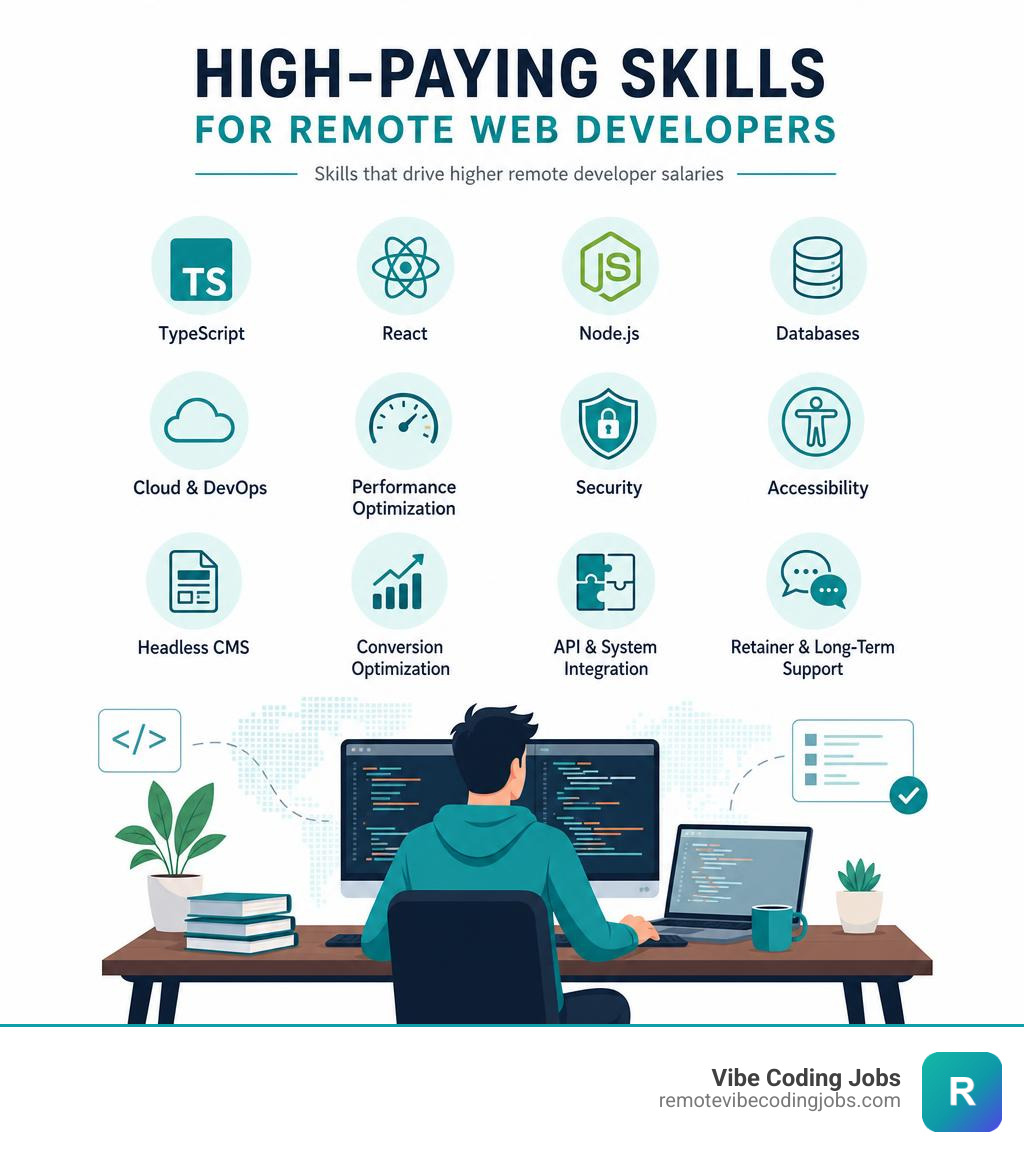
The highest-paid remote web developers tend to combine web fundamentals with business-critical specializations.
High-paying skills include:
- TypeScript
- React and modern frontend architecture
- Node.js
- Python
- SQL and database design
- API architecture
- Cloud platforms
- Docker and Kubernetes
- DevOps basics
- Security fundamentals
- Performance optimization
- Accessibility
- Testing and CI/CD
- System design
- AI-assisted development
- Prompt engineering
- Product thinking
- Clear written communication
For broader salary trends, see our Vibe Coding Salary Guide 2026.
Programming languages and frameworks that command the highest remote salaries
In 2026, the strongest salary premiums are tied to AI, cloud, backend complexity, and scarce expertise.
Notable benchmarks include:
- Python AI/ML specialists: $136,905 average
- Machine learning engineers: $168,730 average
- Machine learning job growth: 53% since 2020
- Senior AI-first developers: often $150K-$250K+
- Freelance AI-fluent developers: often $100-$300/hour in premium cases
For web developers, the best-paying stack is often not one language. It is a combination:
- TypeScript plus React
- Node.js plus cloud infrastructure
- Python plus AI/ML
- SQL plus data-heavy product work
- Go or Rust for backend performance
- Kubernetes and DevOps for deployment ownership
- API design for platform and integration work
Go, Rust, Scala, and Elixir can command premiums because fewer developers use them well and they are common in performance-sensitive systems. Java remains strong in enterprise backend roles. TypeScript is one of the safest bets for full-stack web development because it spans frontend, backend, tooling, and AI-assisted workflows.
Explore related benchmarks for Python Engineer Salary and AI/ML Engineer Salary.
Benefits and perks commonly offered to remote web developers
Remote compensation is not just base salary. Common 2026 perks include:
- Home office stipend: $1,000-$3,000 annually
- Professional development budget: $2,000-$5,000 annually
- Equipment budget
- Internet stipend
- Coworking budget
- Flexible PTO
- Health benefits
- Equity
- Annual bonus
- Wellness stipend
- Conference budget
- Async schedules
- Company retreats
- Mental health support
Do not ignore these. A $120K offer with excellent benefits may beat a $130K offer with no equipment budget, weak PTO, and a meeting culture that eats your soul one calendar invite at a time.
How AI fluency changes web developer market value
AI fluency is now a real salary factor.
Developers using tools like Cursor, Claude, and Copilot can move faster, but speed alone is not enough. Employers pay for developers who can use AI while still applying engineering judgment.
AI-fluent developers are stronger when they can:
- Write precise prompts
- Review generated code carefully
- Catch security and logic issues
- Refactor AI output
- Design architecture before generating code
- Build tests
- Document decisions
- Use AI for debugging, not blind copy-paste
- Ship faster without lowering quality
AI tools also change the junior market. Basic implementation work is easier to automate, so juniors need stronger portfolios and clearer proof of thinking. Seniors, meanwhile, can use AI as leverage: faster scaffolding, better documentation, quicker experiments, and more time for architecture.
Read more in Remote Developer Jobs: AI Tools, Trends & Salary.
How juniors and seniors can negotiate better remote web developer offers
Negotiating remote offers is different because location policy, benefits, equipment, equity, and employment classification all matter.
A simple negotiation process:
- Research remote-specific salary benchmarks.
- Ask for the approved salary band before naming your number.
- Clarify whether the role uses location-based pay.
- Compare total compensation, not just base salary.
- Prepare proof of impact.
- Use a range, not a single number.
- Negotiate benefits if salary is fixed.
- Get everything in writing.
For deeper tactics, see Remote Developer Salary Negotiation Tips: Get Paid What You’re Worth.
Entry-level negotiation tactics for remote web developers
Entry-level developers have less leverage, but not zero leverage.
Your best negotiation assets are proof and clarity. Before negotiating, prepare:
- A portfolio with 2-3 polished projects
- Deployed apps, not only screenshots
- GitHub repositories with clean READMEs
- Documentation examples
- Tests where possible
- Examples of async collaboration
- Internship, freelance, or open-source work
- A short explanation of your tech stack
Instead of saying, “I was hoping for more,” say something like:
“My target range is $80K-$90K based on remote junior full-stack benchmarks and the scope of this role. Is there flexibility within the approved band?”
If salary is fixed, negotiate:
- Home office stipend
- Learning budget
- Earlier salary review
- Mentorship plan
- Conference budget
- Better title alignment
- Paid certifications
- More PTO
For juniors, an early review timeline can be very valuable. If you accept $72K but get a written 6-month compensation review tied to clear goals, that may beat holding out forever for a perfect first offer.
Mid-level and senior negotiation tactics
Mid-level and senior developers should negotiate from impact.
Use examples like:
- “I reduced page load time by 40%.”
- “I led the migration from legacy JavaScript to TypeScript.”
- “I improved deployment reliability.”
- “I mentored three junior engineers.”
- “I reduced incident frequency.”
- “I shipped a feature tied to revenue growth.”
- “I designed APIs now used by multiple product teams.”
Senior developers should also clarify:
- Level and title
- Bonus target
- Equity range
- On-call expectations
- Promotion path
- Team scope
- Architecture ownership
- Time zone expectations
- Meeting load
- Hiring or mentoring responsibilities
Senior remote engineers can often justify a premium because replacing them is expensive and slow. If you bring architecture judgment, communication skill, and AI-assisted productivity, say so directly.
How to evaluate a remote web developer offer
Before accepting, compare the full package:
| Offer Component | What to Check |
|---|---|
| Base salary | Is it market-aligned for level, stack, and location policy? |
| Bonus | Is it guaranteed, target-based, or discretionary? |
| Equity | What is the vesting schedule and likely value? |
| Benefits | Health, retirement, leave, wellness, insurance |
| Remote setup | Equipment, internet, coworking, home office budget |
| PTO | Is it real PTO or “unlimited” but culturally awkward? |
| Location adjustment | Does pay change if you move? |
| Tax setup | Employee, contractor, or employer-of-record? |
| Career path | Clear promotion criteria? |
| Culture | Async or meeting-heavy? |
| Manager quality | Supportive, clear, technically credible? |
| Time zones | Sustainable overlap? |
| On-call | Paid, rotated, documented? |
A high salary can still be a bad offer if the role has unclear expectations, weak management, or constant timezone pain. Remote freedom should not mean “always available.”
Frequently Asked Questions about remote web developer salary
Do remote web developers get paid less than office developers?
Sometimes.
In 2026, the answer depends on seniority and company pay policy:
- Senior technical roles often earn 8%-15% more remotely
- Entry-level and support-heavy roles may earn 5%-10% less
- Mid-level generalist roles are often close to parity
- Location-based pay can reduce offers for lower-cost areas
- Location-agnostic companies may pay the same regardless of where you live
The strongest remote salaries usually go to senior developers, specialists, and engineers with hard-to-hire skills.
Is $65K a realistic remote web developer salary in 2026?
Yes, $65K is realistic, especially for:
- Junior developers
- First remote roles
- Global remote jobs
- Frontend-heavy roles with limited backend scope
- Developers still building portfolio depth
- Companies using local or regional pay bands
But $65K should not be your ceiling. In the US remote market, many junior full-stack developers target $67K-$90K, while mid-level developers often move into $110K-$140K.
If you are offered $65K, evaluate:
- Is this your first professional developer role?
- Is there mentorship?
- Is there a written review timeline?
- Are benefits strong?
- Does the role help you build marketable skills?
- Can you move up within 6-12 months?
A $65K first remote role can be a smart stepping stone. A $65K senior role is a red flag wearing a tiny fake mustache.
What is the fastest way to increase a remote web developer salary?
The fastest salary growth usually comes from combining skill growth with market movement.
Focus on:
- TypeScript and modern React
- Backend depth with Node.js, Python, Go, or Java
- SQL and database design
- Cloud deployment
- Testing and CI/CD
- Performance optimization
- Accessibility
- AI-assisted development
- System design
- Strong written communication
- Portfolio proof
- Negotiation practice
- Applying to roles with transparent bands
Switching companies can also raise pay faster than waiting for annual raises, especially when moving from junior to mid-level or mid-level to senior.
For more salary growth tactics, read our Vibe Coding Salary Remote Guide.
Conclusion
The remote web developer salary market in 2026 is full of opportunity, but it rewards precision.
Here is the recap:
- Global remote web developers average about $70,969
- Junior developers often land between $59K and $90K
- Entry-level full-stack developers can target $67K-$90K, higher with strong AI fluency
- Mid-level remote developers often earn $110K-$140K
- Senior remote developers can reach $140K-$220K+
- Frontend roles commonly range from $76K-$135K
- Freelancers often charge $59-$96/hour, with a $75/hour US remote median
- Python AI/ML, cloud, backend systems, TypeScript, and AI-assisted workflows raise earning power
- Location policy can change your offer by 10%-20% or more
- Total compensation matters more than base salary alone
At RemoteVibeCodingJobs, we help developers find remote AI-assisted development roles at async-first companies. Our listings are curated daily and filtered by culture, tech stack, and AI tools like Cursor and Claude, so you can spend less time digging through noisy job boards and more time applying to roles that actually fit.
If you are benchmarking your next offer, start here: browse remote developer salary benchmarks.