
What Android Developers Are Actually Worth in 2026
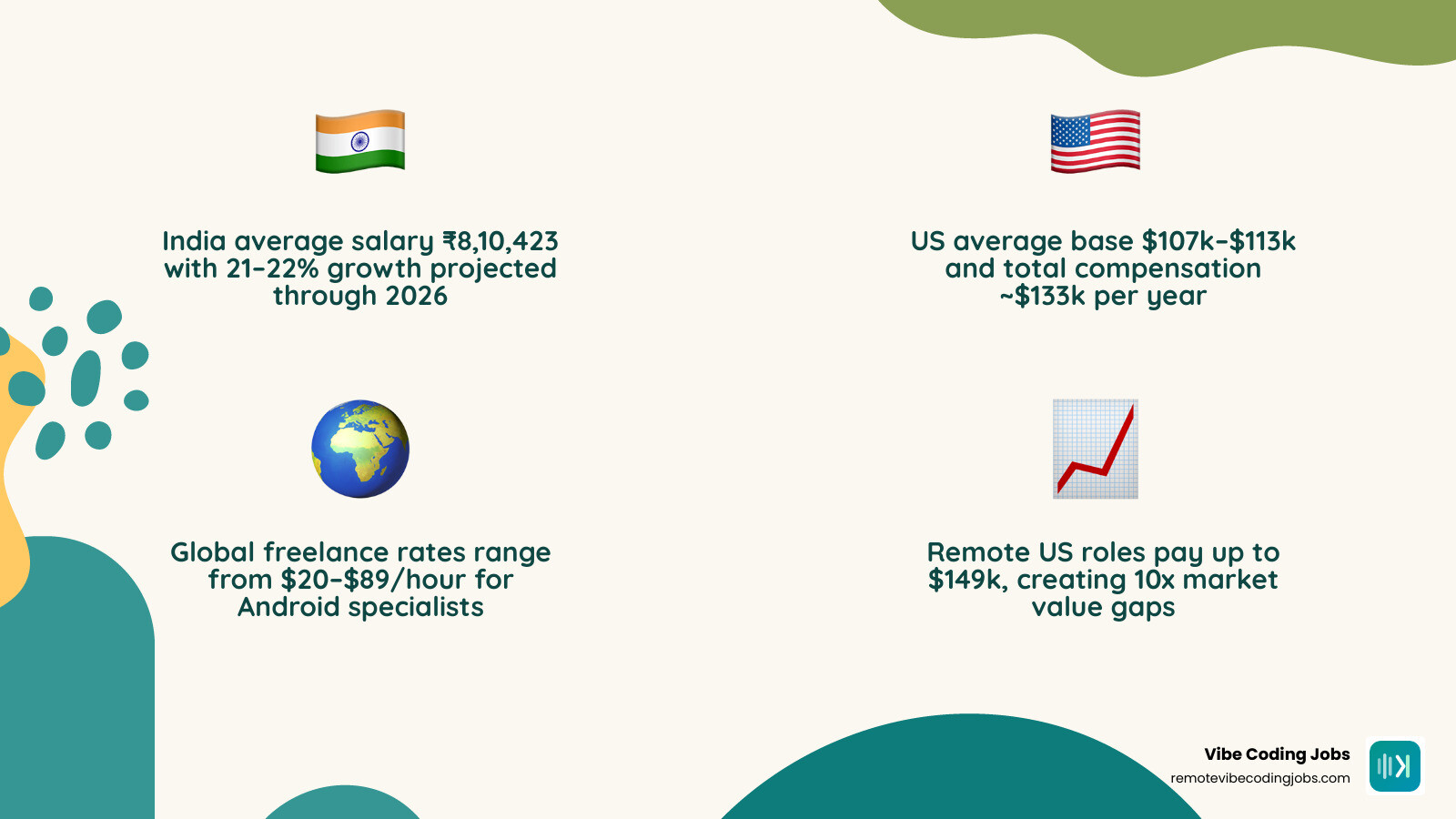
Understanding your android developer market value starts with knowing the numbers — here’s a quick snapshot:
| Metric | Value |
|---|---|
| India average salary | ₹8,10,423/year |
| India salary range | ₹1.5L – ₹12.5L/year |
| US average base salary | $107,059 – $113,383/year |
| US total compensation | ~$133,413/year |
| Global freelance rates | $20 – $89/hour |
| Experienced freelance rates | $75 – $150/hour |
| US job openings | 237,147 active roles |
| Projected employment growth | 21–22% through 2025–2026 |
The Android developer job market in 2026 is not a single market — it’s several markets running at the same time. A fresher in Pune and a senior Kotlin architect working remotely for a US startup are both “Android developers,” but their market value can differ by 10x or more.
What drives that gap? Skills, seniority, location, and whether you own features or own architecture. The global application development market jumped from $325 billion in 2023 to $415 billion in 2024 — and that rising tide is lifting salaries, but not evenly.
This guide breaks it all down, whether you’re benchmarking your current salary, negotiating a new offer, or planning which skills to build next.
Written by RVCJ Editorial, the team behind Remote Vibe Coding Jobs — we cover android developer market value, remote hiring trends, and AI-assisted development careers for engineers building with modern toolchains. Our work sits at the intersection of developer compensation data and async-first remote job markets, so you get context that goes beyond raw salary numbers.
What android developer market value means in 2026
In 2026, market value means more than base pay. For Android developers, it includes:
- Base salary
- Bonus
- ESOPs or equity
- Freelance hourly rate
- Benefits
- Remote flexibility
- Scope of ownership
- Demand for your exact skills
In other words, two developers with the same years of experience can have very different value. One may be shipping screens in legacy XML. Another may be leading Compose migration, improving app startup time, and owning release pipelines. Same title, very different market price.
Android still matters because it remains the dominant mobile platform globally, with huge reach and a massive Play Store ecosystem. Native Android also stays important in areas where performance, hardware access, or platform-specific APIs matter most.
How to measure android developer market value realistically
We recommend measuring your value with a mix of compensation and scope:
- Salary band for your city or remote market
- Total compensation, not just CTC headline
- Level of ownership
- Tech stack relevance
- Business impact
- Ability to work independently
A realistic benchmark asks:
- Do we own app architecture or just ticket execution?
- Can we lead Kotlin and Jetpack Compose decisions?
- Do we manage CI/CD, testing, and release quality?
- Can we mentor juniors and reduce delivery risk?
That is why a simple average salary can be useful, but incomplete. Use salary reports plus role scope plus current hiring demand. If you want a broader framework, our Developer Market Value guide is a good starting point.
Why Android developers still matter in a cross-platform world
Cross-platform tools are real, useful, and often the right choice. But native Android is still where companies go when they need:
- Better performance
- Deeper device integration
- Strong offline behavior
- Better handling of sensors, Bluetooth, NFC, and biometrics
- Platform-specific UI and security controls
This matters in fintech, commerce, health, logistics, automotive, IoT, and AR use cases. Android powers more than phones now. It shows up in cars through Android Auto and Android Automotive, in smart devices, and in spatial experiences using ARCore. So no, native Android did not vanish into a Flutter-shaped cloud.
Android developer salary in India by experience, city, and company type
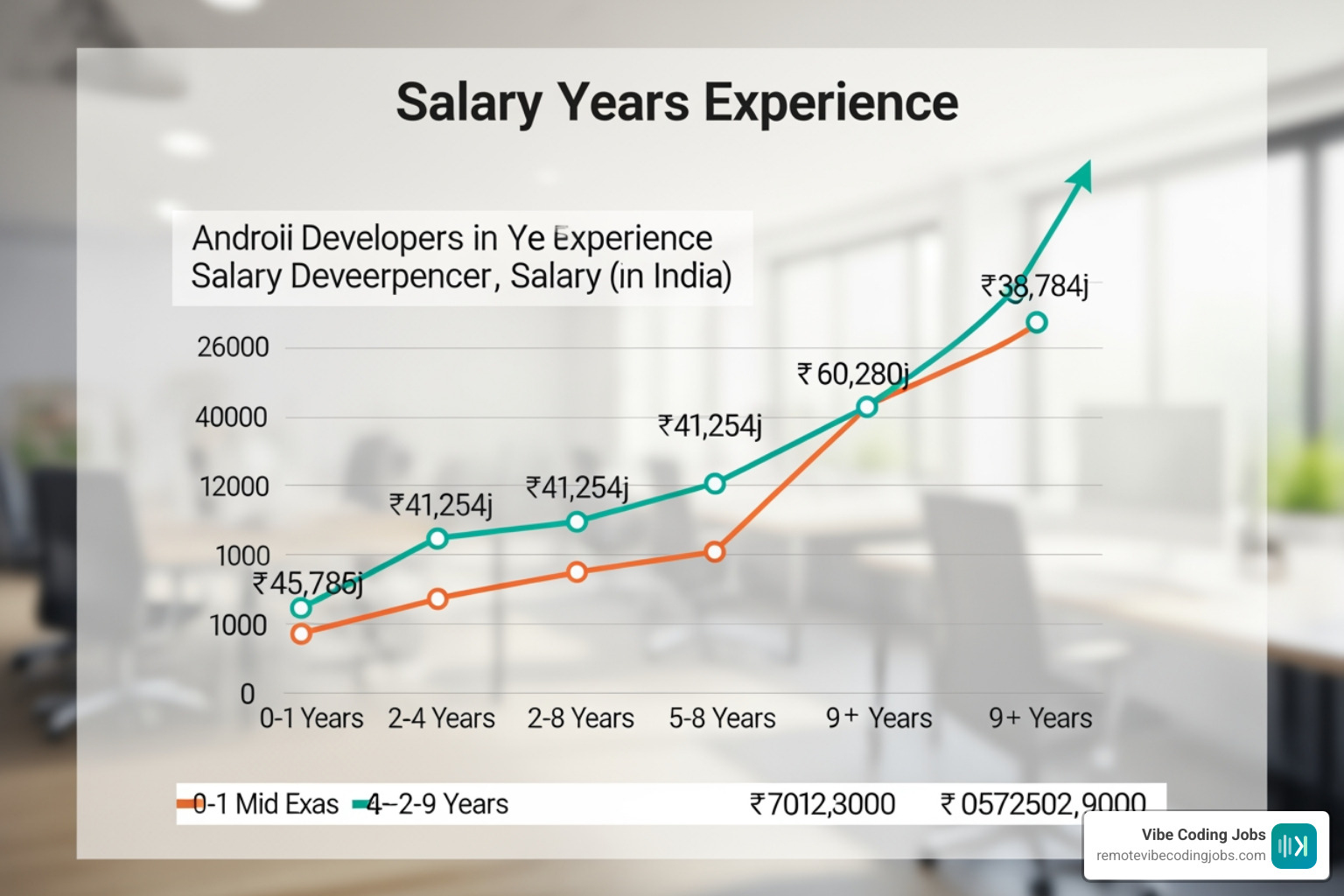
India remains one of the largest Android talent markets, and pay varies widely. Reported salary data shows an average around ₹8,10,423 per year, with a broader range from roughly ₹1.5 lakh to ₹12.5 lakh annually across large salary samples.
Android developer market value in India by experience level
A practical 2026 India view looks like this:
| Experience level | Typical India range |
|---|---|
| Entry-level / fresher | ₹1.5L – ₹4.5L |
| 1 year | ₹1L – ₹9L |
| 2 years | ₹1.8L – ₹11L |
| 3 years | ₹2.4L – ₹12.6L |
| 4 years | ₹3L – ₹15L |
| 5 years | ₹3.1L – ₹20L |
| Senior / lead in strong product teams | Higher, depending on scope and equity |
What matters is not just years, but what changed during those years.
Entry-level developers usually earn the least because they need support and often work on small features, bug fixing, or maintenance tasks.
Mid-level developers see the fastest jump when they can:
- Build features independently
- Work with APIs, local storage, and app lifecycle issues
- Write testable Kotlin code
- Use Compose and modern Android architecture
Senior developers move into a different pay band when they own architecture, performance, stability, release reliability, and team decision-making. That is where career growth stops being about “years completed” and starts being about “risk removed.”
Which Indian cities pay the most after cost of living
The highest-paying Indian cities for Android roles typically include:
- Bangalore
- Gurgaon
- Hyderabad
- Mumbai
- Pune
- Chennai
Bangalore often leads on pure compensation, especially in product companies, fintech, and SaaS. Gurgaon can be strong for enterprise tech and startup roles. Hyderabad benefits from large tech employers and growing product engineering demand. Mumbai pays well, but cost of living can eat a bigger chunk of salary. Pune and Chennai often offer slightly lower pay but sometimes better real purchasing power.
A few practical takeaways:
- Bangalore often gives the highest ceiling
- Hyderabad can offer a strong salary-to-cost balance
- Pune is often underrated for mid-level developers
- Mumbai salaries need to be weighed carefully against rent
- Remote roles can beat all city-based comparisons if location-independent pay applies
Startups vs enterprises, product vs services, and full-time vs freelance
Company type changes compensation more than many developers expect.
| Work type | Typical upside | Typical tradeoff |
|---|---|---|
| Startup | Faster growth, ESOPs, broader ownership | More risk, less structure |
| Enterprise | Stability, benefits, predictable raises | Slower growth, narrower scope |
| Product company | Better pay for strong mobile ownership | Higher hiring bar |
| Service company | Easier entry, varied client exposure | Often lower pay ceiling |
| Full-time | Stability, benefits, appraisal cycle | Less pricing flexibility |
| Freelance/contract | Higher upside, global clients | Income volatility |
In India, product companies usually pay more than service firms for Android talent with modern skills. Startups may pay slightly lower base than large enterprises at early stage, but compensate with ESOPs and faster title growth. Late-stage startups and funded product teams can also outpay enterprises for senior Android specialists.
Freelance and contract work can be attractive if you have a strong portfolio, client communication skills, and steady inbound demand. But there is a big difference between “billing high rates” and “actually staying fully booked.” The spreadsheet is always optimistic. Reality occasionally has trust issues.
How India compares with the US and global Android pay
The salary gap between India and the US remains large. But remote work has created more overlap than before, especially for senior developers.
US salary benchmarks for Android developers
US salary data in 2026 generally clusters around these figures:
- Average base salary: about $107,059 according to PayScale’s Android SDK salary data
- Another benchmark places average US base pay at about $113,383, with total compensation near $133,413, according to Built In’s 2026 Android salary overview
Additional patterns from US data:
- Entry-level roles often start around $85,000
- Developers with 7+ years can average around $154,000
- Remote Android roles in the US can reach about $149,714 on average in some datasets
That means Indian Android developers are not competing against one global salary number. They are competing in layered markets:
- Domestic India pay bands
- India remote roles
- Global contractor markets
- Premium remote roles at async-first teams
Global freelance and contract rates for Android specialists
Hourly pricing shows just how wide the market is.
Reported global Android rates in 2026 range from about $20 to $89 per hour, depending on region and seniority. Experienced freelancers often charge around $75 to $150 per hour in premium markets. Senior US Android developers are commonly in the $45 to $82 per hour range, while senior Eastern European developers may be closer to $30 to $50 per hour.
For a deeper hourly benchmark, see Android Developer Hourly Rate & Salary 2026: $20–$80/hr.
What this means for India-based developers:
- Domestic freelance rates are usually lower than US rates
- Remote international contracts can materially raise earning potential
- Seniority plus specialization matters far more than just “Android” as a label
- Contract pricing rewards outcome ownership, not just coding hours
How remote work changed android developer market value
Remote work did three big things to Android pay:
- It increased competition.
- It widened access to better-paying employers.
- It put more focus on output, communication, and autonomy.
A senior Android engineer in India can now access roles that previously required relocation. That has created a kind of compensation middle zone: not always full US salary, but often well above local market rates.
At the same time, remote work made employers more disciplined about what they pay for. They want developers who can work asynchronously, write clearly, handle ambiguity, and ship without daily hand-holding.
For more context, see our guides on Remote Developer Salaries in 2026: What to Expect and Vibe Coding Salary Remote vs Onsite.
The skills and specializations that raise Android developer pay fastest
In 2026, Kotlin alone is not a premium. It is table stakes. The premium starts where modern Android depth meets business-critical complexity.

Core skills now expected for strong Android compensation
For strong mid-level and senior pay, employers increasingly expect:
- Kotlin
- Jetpack Compose
- Coroutines and Flow
- MVVM or MVI
- Dependency injection
- Modularization
- Automated testing
- Android Studio mastery
- Material Design understanding
- Clean Architecture practices
Developers who still rely only on Java, XML-heavy UI work, and ad hoc architecture often hit salary ceilings. Compose has gone from “nice to have” to “expected” in many modern teams.
High-premium specializations in 2025-2026
The highest-paying Android specializations now include:
- Kotlin Multiplatform
- Android Automotive and AOSP work
- NDK and C++ performance work
- On-device machine learning
- ARCore
- IoT and hardware integration
- Security hardening
Research-based market reports point to especially strong premiums for Android Automotive, AOSP platform work, and NDK/C++ expertise. Compose and Kotlin remain valuable, but they are no longer rare enough to command the biggest premium by themselves.
Security-heavy mobile work can also pay more, especially in fintech, payments, and enterprise apps where device integrity, encryption, and secure storage matter.
Skills that separate mid-level from senior Android developers
The mid-to-senior jump is where compensation often accelerates fastest.
Senior Android developers usually show these traits:
- Architecture ownership
- Performance tuning ability
- Strong code review judgment
- Mentoring and team enablement
- Release management experience
- CI/CD ownership
- Clear stakeholder communication
This is also where AI-assisted development starts to matter. Developers who use modern tools well can ship faster, write tests sooner, and reduce repetitive effort. But the premium is not for “using AI.” It is for using AI without lowering code quality, security, or maintainability. Anyone can generate code. Not everyone can stop generated code from setting the app on fire.
For a broader look at compensation bands, see Vibe Coding Salary Pay Range.
Job demand, supply, and career prospects for Android developers
Demand remains healthy, but it is uneven by level.
US data shows 237,147 active Android job openings and projected employment growth of roughly 21% to 22% through 2025-2026. Broader market growth also supports hiring: the app development market rose sharply from 2023 to 2024, and Android remains the largest global mobile platform by user base.
Demand vs supply in India: why senior talent earns more
India has plenty of aspiring Android developers. It does not have enough truly strong senior Android developers with modern architecture and delivery ownership.
That creates a supply-demand split:
- Entry-level market: crowded
- Mid-level market: competitive but healthy
- Senior specialist market: undersupplied
This is why many freshers struggle while experienced Android engineers still get multiple recruiter calls. Employers are not just hiring “Android.” They want people who can modernize codebases, improve performance, own releases, and work across product, QA, backend, and design.
Fintech, internet products, commerce apps, enterprise mobility, and outsourced mobile delivery all contribute to continued demand.
Career progression and salary growth trajectory
A common Android path looks like this:
- Junior Android Developer
- Mid-level Android Engineer
- Senior Android Engineer
- Staff Engineer or Lead Mobile Engineer
- Engineering Manager or Mobile Architect
Typical growth patterns:
- Junior to mid-level: biggest gains come from independent delivery
- Mid-level to senior: biggest gains come from architecture and ownership
- Senior to staff/lead: gains come from cross-team influence and business impact
- Manager path: adds people leadership, planning, hiring, and delivery accountability
If you stay only at feature level, salary growth slows down. If you become the person who prevents production issues, improves build times, leads migrations, and helps others ship faster, salary growth tends to improve.
Where the market is headed through 2026 and beyond
The market direction is still favorable for Android developers, especially those aligned with modern stacks and AI-assisted workflows.
Key trends include:
- Continued Android dominance in global device share
- Wider adoption of Kotlin and Compose
- Growth in on-device AI and ML features
- More enterprise investment in mobile modernization
- Growth in outsourced and contract Android services
- More remote and async hiring for proven senior talent
For market-wide Android trends, see Android development statistics driving mobile trends.
Total compensation, negotiation, and the best next move
Base salary matters, but total compensation often changes the real answer.
Non-salary benefits Android developers in India should evaluate
When comparing offers, we recommend checking:
- Health insurance
- Performance bonus
- Joining or retention bonus
- ESOPs or stock options
- Work-from-home stipend
- Device or laptop budget
- Learning and certification budget
- Conference support
- Paid leave quality
- Notice period terms
A slightly lower salary with better stock, stronger insurance, shorter notice period, and real remote flexibility can be a better deal than a larger CTC with hidden limitations.
How to negotiate your Android compensation using market data
Good negotiation is easier when we use evidence.
Start with:
- Salary benchmarks for your level
- City or remote market comparisons
- Skill premiums for Compose, KMP, ML, security, or AOSP
- Scope-based examples from your current work
- Measurable impact: crash reduction, app size reduction, performance gains, delivery speed
A simple negotiation structure works well:
- State your target range.
- Explain why your experience supports it.
- Tie your value to outcomes, not effort.
- Compare total compensation, not base alone.
- Ask about review cycle, bonus, and equity if base is fixed.
If you need help framing the conversation, our Remote Developer Salary Negotiation Tips: Get Paid What You’re Worth guide can help.
Best opportunities for increasing your android developer market value this year
If we wanted to increase Android market value quickly in 2026, we would focus on five moves:
- Specialize in a premium niche
- Build public proof of work
- Show measurable business impact
- Improve async and remote communication
- Target better-paying remote teams
The best specialization plan usually looks like this:
- Keep core Android fundamentals strong
- Add Compose and Clean Architecture if missing
- Pick one premium niche such as KMP, Automotive, on-device ML, security, or NDK
- Build 2 to 3 portfolio examples that show depth
- Publish code, case studies, or technical write-ups
You can also benchmark broader mobile compensation using Mobile Developer Salaries and explore current openings through Remote Mobile Developer Jobs.
Frequently Asked Questions about android developer market value
What is a good Android developer salary in India in 2026?
A good salary depends on level, city, and company type. Broadly:
- Freshers: ₹3L to ₹5L can be reasonable
- Mid-level: ₹6L to ₹12L is common in many markets
- Senior product-company or premium remote roles: well above that, especially with bonuses or equity
If you have Compose, architecture ownership, testing discipline, and strong communication, you should usually target above average.
Is remote Android work still worth it for developers in India?
Yes, especially for experienced developers. Remote work can improve access to better employers, stronger pay bands, and more interesting products. The tradeoff is that expectations are higher. Employers want autonomy, written communication, and reliable delivery. Remote work is not free money. It is performance money.
Which Android specialization pays the highest right now?
The strongest premiums in 2025-2026 appear in:
- Android Automotive and AOSP
- NDK/C++
- On-device ML
- Kotlin Multiplatform
- Security-focused mobile engineering
For most developers, Compose plus strong architecture is the best foundation. Premium specializations come after that, not instead of it.
Conclusion
The 2026 picture is clear: android developer market value is still strong, but it is no longer defined by title alone. In India, average pay remains around ₹8.1 lakh, yet actual earnings vary dramatically by experience, city, company type, and specialization. Senior Android developers with modern skills and ownership continue to earn the biggest premium.
Our short version:
- India offers solid growth, but wide pay variation
- Product companies and premium remote teams usually pay best
- Compose and Kotlin are baseline, not elite differentiators
- Specializations like KMP, Automotive, NDK, ML, and security raise pay fastest
- Remote work expands opportunity, but rewards autonomy and outcomes
If you are planning your next move, focus less on generic “Android experience” and more on demonstrable leverage: architecture, delivery, performance, communication, and niche depth.
For more compensation context, read our Vibe Coding Salary guide and explore salary data on our salaries page.