
What Is Java Developer Market Value in 2026?
Java developer market value is strong in 2026 — and if you want the short answer, here it is:
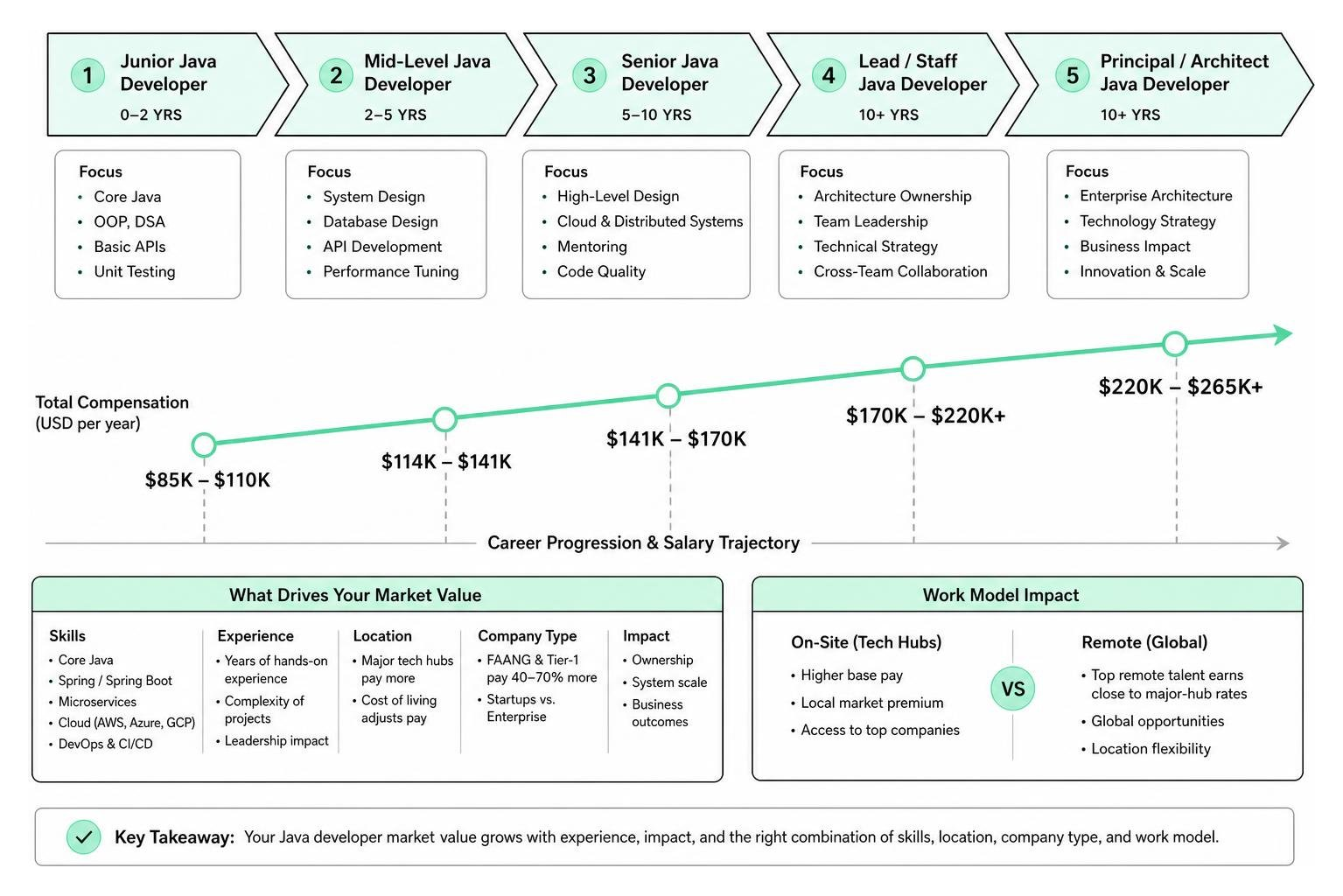
| Experience Level | Base Salary Range (US) | Total Compensation |
|---|---|---|
| Entry-Level (0-2 yrs) | $85,000 – $110,000 | ~$110,000 – $130,000 |
| Mid-Level (2-5 yrs) | $110,000 – $145,000 | ~$140,000 – $175,000 |
| Senior (5-10 yrs) | $141,000 – $180,000 | ~$170,000 – $220,000+ |
| Lead / Principal (10+ yrs) | $180,000+ | ~$220,000 – $265,000+ |
| Java Architect (US) | $144,000 – $188,000 | Up to $220,000+ |
Median total compensation for a US Java developer in 2026: $190,532 ($145,478 base + $45,054 in bonuses).
Java has powered enterprise software for over two decades. It runs banking systems, e-commerce platforms, Android apps, and government infrastructure. More than 9 million Java developers work globally, with roughly 174,000 based in the US. Senior-level salaries grew 2.3% year-over-year — above the national average — signaling that demand is holding firm even as AI reshapes the tech hiring landscape.
The key factors that drive your personal market value:
- Experience level — the single biggest variable
- Location — San Francisco pays 40–50% more than the national average
- Specializations — Spring Boot, Kafka, and cloud-native skills add 10–40% premiums
- Company type — FAANG and Tier-1 tech pay 40–70% more than standard enterprise
- Remote vs. on-site — top remote talent now earns close to major-hub rates
We’re RVCJ Editorial, the team behind Remote Vibe Coding Jobs — we cover java developer market value, remote hiring trends, and AI-assisted development careers for engineers building with modern toolchains. In the sections below, we break down every compensation factor so you can benchmark your worth and negotiate with confidence.
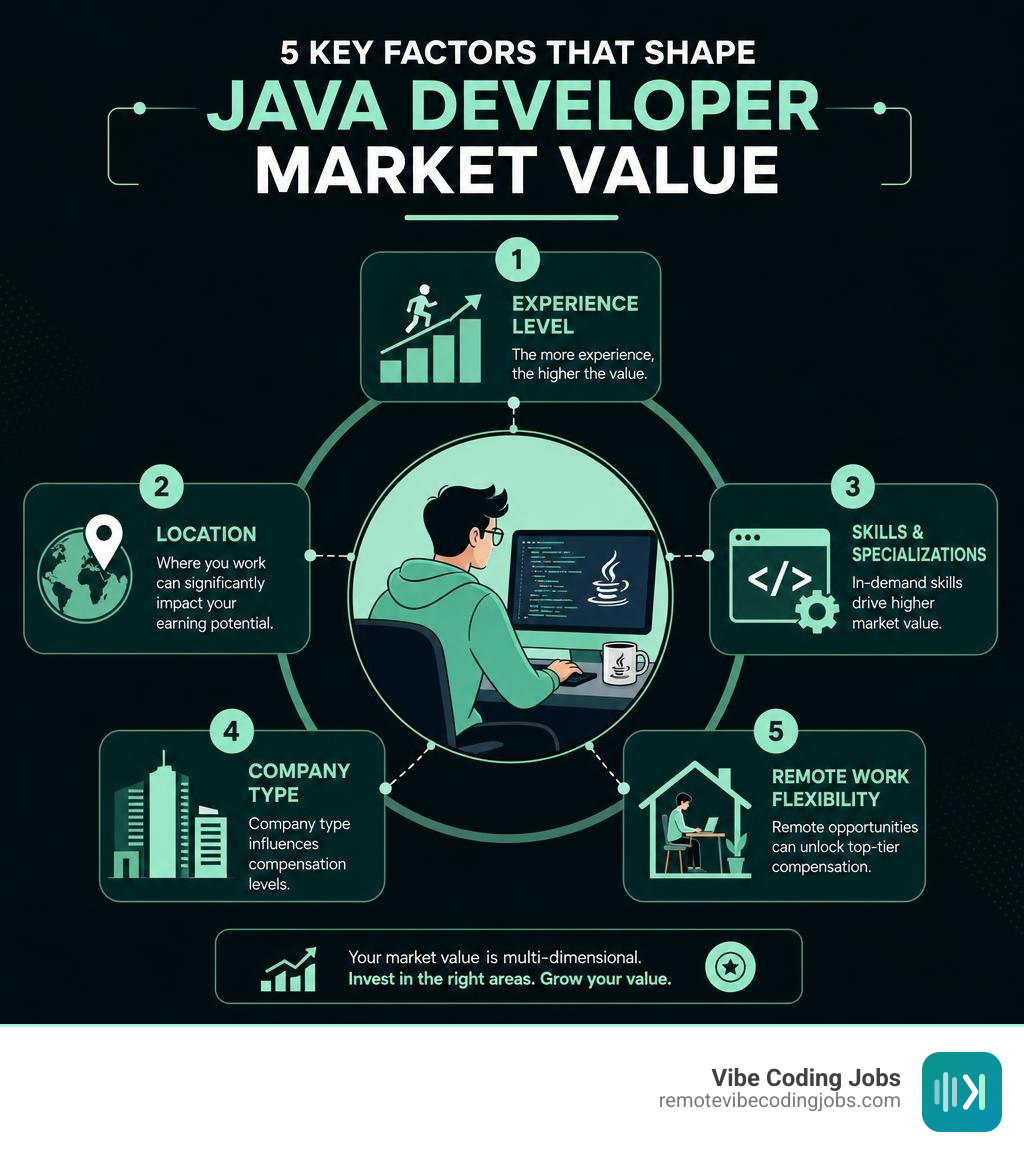
Java developer market value basics:
Defining the Java Developer Market Value in 2026
To truly understand the java developer market value, we have to look past the base salary. In 2026, tech compensation is increasingly structured around total compensation packages. While the national average base salary for a Java developer hovers around $104,712 to $138,886 depending on the data source, the median total compensation in the United States has climbed to $190,532. This includes a robust $145,478 base and $45,054 in annual bonuses and equity incentives.
According to the 2026 Java Developer Salary Guide – Motion Recruitment, senior-level roles have experienced a steady 2.3% year-over-year salary growth. This is a notable achievement in a market that has seen stabilization across other software engineering disciplines. Why is this happening? Quite simply, Java is used in more organizations than any other development language. As legacy systems undergo modernization and migrate to cloud architectures, the demand for stable, highly-performant backend systems keeps Java engineers at the top of corporate hiring lists.
Entry-Level and Mid-Level Java Developer Market Value
If you are just starting out or have a few years of coding under your belt, the market remains highly lucrative. For entry-level Java developers (0 to 2 years of experience), base salaries generally range between $85,000 and $110,000. At this stage, companies are looking for solid foundational knowledge of object-oriented programming (OOP), relational databases, and basic API design.
As you transition into a mid-level role (2 to 5 years of experience), your java developer market value takes a significant leap. Nationally, mid-level salaries are anticipated to range from approximately $114,000 to $141,000 in 2026. The Java Developer Salary Guide for 2026 – Underdog.io notes that this is the stage where developers transition from being “line cooks” executing recipes to “sous chefs” who can design components, manage database migrations, and optimize application performance independently.
Senior and Principal Java Developer Market Value
For those who have spent 5 to 10+ years in the JVM trenches, the financial rewards are substantial. Senior-level Java developers can expect base salaries between $141,000 and $170,000 nationally, with total compensation packages frequently crossing the $200,000 mark when bonuses and stock options are finalized.
At the very top of the technical ladder, lead developers, principal engineers, and senior architects command the highest premiums. A senior-level Java architect in the USA earns a base salary between $144,417 and $188,690. In major tech hubs, total packages for principal engineers regularly exceed $265,000. At this level, companies are no longer paying for syntax; they are paying for architectural ownership, the ability to scale distributed systems, and the leadership required to guide complex engineering teams through major migrations.
Geographic Variations and the Remote Work Premium

Where you sit still matters, but not in the way it used to. Historically, software engineers had to live in high-cost cities like San Francisco or New York to secure top-tier pay. Today, the rules of compensation have evolved. While in-office roles in high-cost hubs still offer eye-watering base salaries, the gap between remote and local pay has narrowed dramatically.
In the San Francisco Bay Area, a mid-to-senior Java developer’s base salary ranges from $170,000 to $220,000+. In New York City, that range sits at $160,000 to $210,000+. However, if you are looking for remote java developer jobs, the national remote pay band for skilled US-based Java engineers is a highly competitive $140,000 to $190,000. Many forward-thinking companies now utilize location-agnostic pay models, meaning they pay a flat, high-tier rate regardless of where the developer chooses to live.
This geographic flexibility has also opened up a massive global market. For companies looking to optimize their development budgets, hiring offshore remains an incredibly attractive option. According to the Java Developer Hourly Rate & Salary 2026: $30–$68/hr by Region, a senior Java developer in Eastern Europe costs a median of $38/hr, compared to $68/hr or more for an equivalent US developer. This represents a 44% savings for identical technical expertise.
Domestic US Tech Hubs vs. Remote Pay Bands
For domestic US developers, navigating regional pay bands is a key part of evaluating your java developer market value. If you are negotiating a remote offer, it is vital to consult a remote developer salary guide 2026 to see if the employer uses a tiered system (e.g., Tier 1 for SF/NYC, Tier 2 for Austin/Denver, Tier 3 for rural areas) or a unified national average.
While some companies still apply a 10% to 15% cost-of-living reduction for remote workers living in lower-cost states, top-tier talent can often bypass these tiers entirely by demonstrating specialized skills in high-demand frameworks or system architecture.
Global Arbitrage: India, Indonesia, and Eastern Europe
For international developers, the local market value of a Java engineer varies widely by region:
- India: Java is the largest backend stack in India by a wide margin. According to the Java Developer Salary in India (Updated 2026) – Codegnan, a fresher starts at ₹3.5 to ₹7 LPA, while senior product engineers and architects at Global Capability Centers (GCCs) earn between ₹35 and ₹60 LPA (often exceeding ₹70 LPA to ₹1 Crore when RSUs are factored in).
- Indonesia: The local market is growing rapidly. The average salary for a Java developer in Indonesia is around $18,900 per year, with senior professionals earning up to $22,680 to $34,020 annually, according to the Java Developer Salary in Indonesia 2026 – Jobicy.
- Eastern Europe & Ukraine: Known for highly skilled engineering talent, the region boasts a massive concentration of vetted Java developers. The Java Developer Salary Worldwide Compared to Ukraine – Mobilunity highlights that outsourcing to Eastern European hubs allows Western companies to save 40% to 60% on fully-loaded costs while maintaining exceptional software quality.
High-Value Skills and Specializations That Boost Compensation
If you want to maximize your java developer market value, sitting comfortably on core Java syntax isn’t going to cut it. The developers who command the highest salary premiums are those who build a deep specialization in modern ecosystem tools, distributed data systems, and cloud infrastructure.
The Spring Boot and Microservices Premium
Spring Boot has become the absolute standard for enterprise Java development. It is the framework that allows developers to spin up production-ready microservices in a fraction of the time it used to take.
Learning and mastering Spring Boot yields a 10% to 20% salary premium over core Java knowledge alone. When combined with deep expertise in microservices architecture, REST APIs, and containerization tools like Docker and Kubernetes, your market value shoots toward the upper end of the senior pay scale. Companies are actively looking for engineers who can confidently manage containerized environments and orchestrate complex deployments.
Emerging Tech: Cloud-Native Java and AI Integration
The modern Java ecosystem is moving fast, and staying ahead of the curve pays off:
- Cloud Platforms (AWS, Azure, GCP): Knowing how to deploy, monitor, and scale Java applications in cloud environments is a non-negotiable skill for top-tier earners.
- Modern Runtimes (GraalVM and Quarkus): These technologies enable ultra-fast startup times and lower memory footprints, making Java highly competitive in serverless and cloud-native environments.
- AI-Assisted Coding & “Vibe Coding”: In 2026, the market pays for architectural judgment and rapid execution. Developers who leverage AI tools like Cursor, Claude Code, and LLMs to accelerate their workflows can achieve 2x to 5x productivity gains. At RemoteVibeCodingJobs, we see a growing segment of forward-thinking companies looking specifically for “AI-fluent” Java developers who can architect complex systems while using AI to handle routine boilerplates.
Java vs. Other Languages: A Comparative Analysis
How does Java stack up against other heavyweight programming languages in 2026? Let’s take a look at how average senior-level salaries compare:
| Language | Average Senior US Salary | Key Strengths in 2026 | Job Security |
|---|---|---|---|
| Java | $141,000 – $180,000 | Enterprise scale, cloud-native backend, fintech | Extremely High |
| C++ | $150,000 – $232,000 | Low-latency systems, game engines, high-frequency trading | High (Niche) |
| Python | $135,000 – $175,000 | AI/ML, data science, rapid prototyping | Very High |
While C++ often commands a slightly higher salary ceiling in specialized niches like high-frequency trading, and Python dominates the AI/ML research space, Java remains the undisputed king of enterprise-grade backend systems. It offers an unmatched combination of high compensation, massive job availability, and long-term job security.
Startup Equity vs. Corporate Total Compensation
When evaluating your java developer market value, you will inevitably face a choice: do you take a stable, high-cash corporate role, or do you dive into a startup?

Corporate roles (especially in banking, healthcare, and insurance) offer high base salaries, predictable cash bonuses, and excellent health benefits. Startups, on the other hand, often ask you to accept a lower base salary in exchange for equity (stock options or RSUs).
When evaluating a startup offer, you must look closely at the equity package:
- Percentage Ownership: Focus on your percentage of company ownership rather than just the raw number of options.
- Vesting Schedule: The standard is a 4-year vest with a 1-year cliff (meaning you must stay a full year to receive your first 25% of shares).
- 409A Valuation: Understand the current fair market value of the stock to calculate your potential upside.
If you have a lower risk tolerance, a corporate role with a guaranteed $190K total compensation package is hard to beat. But if you believe in a startup’s mission and leadership, taking a lower base for a slice of equity could lead to a massive windfall down the road.
Demographics and Job Security in the Java Ecosystem
The Java developer community in the United States is incredibly robust, numbering around 174,000 professionals. Statistically, the demographic breakdown of Java developers is as follows:
- Gender: Approximately 72.6% male and 27.4% female.
- Race and Ethnicity: 64.8% White, 15.3% Asian, and 11.1% Hispanic/Latino.
- Education: 75% of Java developers hold a Bachelor’s degree, while 22% hold a Master’s degree.
Interestingly, having a Master’s degree yields a slight salary premium nationally, but practical experience and framework mastery remain the ultimate indicators of your market value.
In terms of job security, Java developers enjoy one of the most stable career paths in tech. The US Bureau of Labor Statistics projects continued strong growth for software development roles through the end of the decade. Because Java is the foundation for over 30% of Fortune 500 enterprise systems, the demand for developers to maintain, scale, and modernize these systems is virtually guaranteed.
Frequently Asked Questions about Java Developer Salaries
Is Java still a high-paying career choice in 2026?
Absolutely. Java powers the world’s most mission-critical enterprise systems. While newer languages generate hype, Java’s constant performance upgrades (such as virtual threads in recent LTS releases) and massive production footprint ensure that skilled Java engineers remain some of the highest-paid backend developers in the industry.
How can I land a high-paying remote Java job without Leetcode?
Many modern, async-first companies are moving away from abstract algorithmic puzzles. Instead, they evaluate candidates based on practical, real-world skills. You can secure a fantastic remote role by:
- Building a strong portfolio of open-source contributions or personal projects demonstrating Spring Boot and microservices.
- Focusing your job search on platforms that highlight practical hiring. Read our guides on remote coding jobs no leetcode and remote coding jobs no leetcode practical skills to learn how to showcase your system design and debugging capabilities effectively.
What is the average hourly rate for freelance Java developers?
In the United States, freelance Java developers typically charge between $45 and $75 per hour. For strong senior developers or architects with specialized cloud and JVM tuning skills, contract rates can easily reach $100 to $150+ per hour.
Conclusion
Understanding your java developer market value is the first step toward building a highly rewarding, long-term career. Whether you are a junior engineer mastering your first REST API or a senior architect designing distributed systems, the 2026 Java ecosystem offers incredible financial stability and growth.
As the industry evolves, the most successful developers will be those who combine deep Java fundamentals with modern, AI-assisted development workflows. At RemoteVibeCodingJobs, we specialize in connecting talented, AI-fluent developers with forward-thinking, remote-first companies.
Ready to see what you are worth in today’s market? Explore remote developer salaries on our platform and find your next high-paying, remote Java role today!