
No More Boring Dev Jobs: Remote AI Coding Opportunities You Can Apply to Today
Remote AI Coding Opportunities You Can Start Applying to Right Now
Remote AI coding opportunities are growing fast — and many of them are open today, with no prior AI experience required.
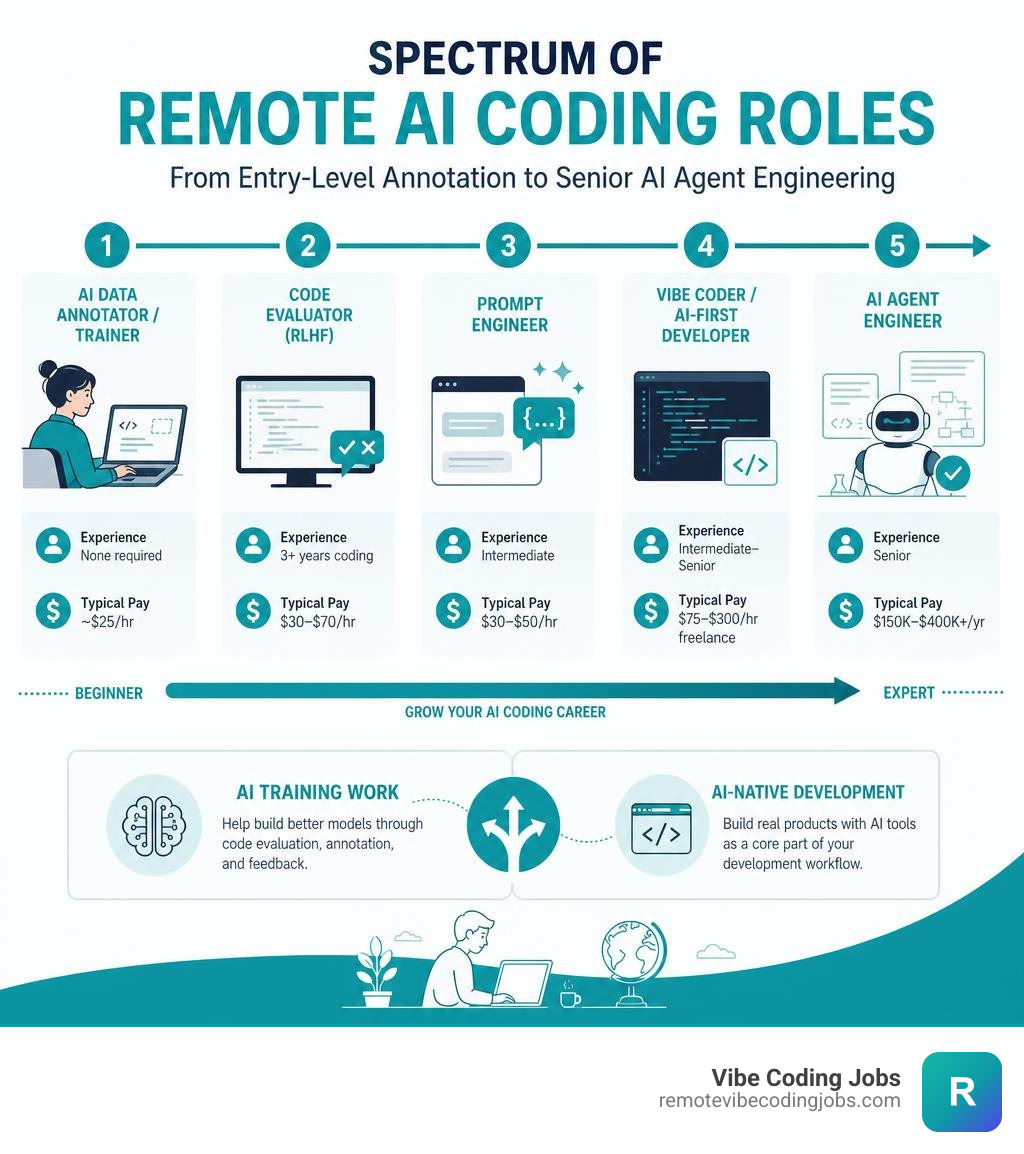
Here’s a quick look at the main types available right now:
| Role Type | Experience Needed | Typical Pay |
|---|---|---|
| AI Data Annotator / Trainer | None required | ~$25/hr |
| Code Evaluator (RLHF) | 3+ years coding | $30–$70/hr |
| Prompt Engineer | Intermediate | $30–$50/hr |
| Vibe Coder / AI-First Developer | Intermediate–Senior | $75–$300/hr freelance |
| AI Agent Engineer | Senior | $150K–$400K+/yr |
Over 105,000 remote AI jobs are currently listed across the US alone. Roles range from entry-level data annotation (no coding background needed) to senior AI agent engineering positions paying well into six figures.
The landscape breaks down into two broad tracks:
- AI training work — helping companies like Outlier, Stellar AI, and RWS TrainAI build better models through code evaluation, annotation, and feedback
- AI-native development — building real products using tools like Cursor, Claude Code, and Windsurf as a core part of your workflow
Whether you’re a senior engineer looking to shift into AI-first roles or a developer who wants flexible contract work on the side, there’s an entry point here for you.
We’re RVCJ Editorial, the team behind Remote Vibe Coding Jobs — we cover the full spectrum of remote AI coding opportunities, from RLHF contract work to senior vibe coding roles at async-first companies. Our team tracks global remote developer hiring daily so you don’t have to.
Handy remote ai coding opportunities terms:
The Rise of Remote AI Coding Opportunities in 2026
The software engineering landscape has shifted dramatically. We are no longer just writing software line-by-line; we are orchestrating intelligence. In June 2026, the demand for traditional, syntax-focused development is giving way to a massive boom in AI-native development and “vibe coding.”
With over 105,000 remote AI jobs listed across the United States on major job platforms, the market is screaming for professionals who know how to leverage large language models (LLMs). This evolution has unlocked a goldmine of AI Coding Jobs: Remote Opportunities for developers who want to escape the monotony of legacy maintenance and step into the future of tech.

This shift isn’t just about using a fancy autocomplete tool. It is about a fundamental change in how software is conceived, built, and shipped. By handing off the repetitive boilerplate work to specialized AI agents, developers are experiencing a massive boost in productivity leverage, allowing them to focus entirely on product design, system architecture, and user experience.
From Syntax Typists to AI Architects
For decades, being a software engineer meant being a syntax typist. You spent hours debugging missing semicolons, writing boilerplate CRUD operations, and wrestling with dependency configurations. Today, vibe coding leverages AI-powered tools to accelerate development using natural language prompts instead of writing every line manually. This shifts the developer’s role from typing syntax to architecting solutions and prompt engineering.
When you transition to this workflow, your primary tools change. Instead of staring at a blank text editor, you are collaborating with tools like Cursor, Claude Code, Windsurf, Bolt.new, and Lovable. You describe the “vibe” of the feature you want, and the AI builds it.
This doesn’t mean programming fundamentals are dead. In fact, understanding system design, databases, and logic is more valuable than ever. It allows you to write better prompts, guide the AI when it goes off course, and quickly debug complex edge cases. If you want to make this transition, check out our guide on How to Get a Vibe Coding Job with Remote AI.
The Productivity Boom of AI-Native Engineering
The productivity gains of AI-native engineering are staggering. Consider the case of an engineer who achieved an unbelievable 353 commits in a single day through AI agent orchestration. By setting up autonomous loops where agents wrote code and other agents reviewed and tested it, a single developer effectively operated with the throughput of an entire traditional engineering team.
This is the power of the AI-native development lifecycle. In this new paradigm, validation methodology becomes your primary craft. Because AI can generate hundreds of lines of code in seconds, your job is to specify, steer, and validate rather than write code by hand.
This requires a rigorous focus on:
- Test-Driven Development (TDD): Writing robust specifications and tests first, which then act as guardrails for the AI.
- Behavior-Driven Development (BDD): Ensuring the AI-generated features perfectly match the user stories.
- Contract and Mutation Testing: Verifying that API contracts are strictly adhered to and that your test suites are actually effective at catching hallucinated bugs.
Key Types of Remote AI Coding Roles
The world of remote ai coding opportunities is highly diverse, offering entry points for various skill levels and backgrounds. Whether you want to train the models behind the scenes or build product-grade applications using them, there is a role for you.
| Feature | AI Training & RLHF Roles | AI-First Software Engineering |
|---|---|---|
| Primary Goal | Improve model accuracy, safety, and coding capabilities | Build end-user products, systems, and agentic workflows |
| Typical Tasks | Coding evaluation, ranking outputs, writing explanations, RLHF | API integration, agentic loops, prompt engineering, system design |
| Experience Level | Entry-level to Senior (No AI experience required) | Mid-level to Senior (Requires building LLM apps) |
| Payment Structure | Hourly contract rates ($25 – $70/hr) | Annual salaries ($100K – $250K+) or high freelance rates |
| Core Tools | Web interfaces, Python/JS, Git, feedback rubrics | Cursor, Claude Code, FastAPI, LangGraph, AWS |
Entry-Level Remote AI Coding Opportunities
If you are looking to get your foot in the door without prior experience in machine learning, AI training roles are a fantastic starting point. These roles primarily focus on Reinforcement Learning from Human Feedback (RLHF).
In these positions, you help train large language models to write production-grade code. You do this by crafting computer science questions, evaluating and ranking multiple code snippets generated by AI, and writing detailed, logical explanations of why one code approach is superior to another.
Platforms like G2I Inc. and Outlier offer steady streams of contract projects where you repair and refactor AI-generated code for correctness, efficiency, and style, injecting your feedback directly into the model’s reward pipeline. To learn how to land these roles, explore Entry-Level Remote AI Coding Jobs for Beginners.
Advanced Remote AI Coding Opportunities
For seasoned developers who want to build the next generation of software, advanced AI engineering roles are booming. These positions require you to design and implement fully agentic workflows—systems where AI doesn’t just suggest code, but autonomously executes multi-step tasks, calls external APIs, and uses self-correction loops.
These roles demand fluency in tools like LangGraph, FastAPI, and Python, alongside an understanding of cost-efficient model routing (such as knowing when to route a simple query to a cheaper model like Claude Haiku versus a premium model like Claude 3.5 Sonnet).
If you are interested in pushing the boundaries of what software can do, check out the open Remote AI Engineer Jobs on our platform, or look at cutting-edge positions like the Staff/Senior AI Engineer, AI for Code role, which focuses on building deeply integrated coding agents for millions of developers worldwide.
Compensation, Requirements, and Top Platforms
Before diving into the application process, it is essential to understand what these roles pay, what equipment you will need, and how companies onboard remote talent.

The market for remote ai coding opportunities is highly competitive, but it rewards those who can demonstrate strong technical foundations and adaptability. For a deeper dive into market trends, read our analysis on AI Coding Jobs: Remote Options and Growth.
What You Can Expect to Earn
Compensation for remote AI coding roles varies based on your experience, location, and the complexity of the work:
- AI Data Annotation & Training: Base rates typically start around $25 per hour (as seen with Stellar AI) and average $30 per hour for Tier 2 coding experts on platforms like Outlier.
- Contract Code Evaluation (RLHF): Platforms like G2I Inc. offer rates ranging from $30 to $70 per hour based on your location and seniority, with most standard projects running at around $30/hr.
- Vibe Coding & AI-First Freelancing: Freelance vibe coders who can ship MVPs at lightning speed routinely charge $75 to $150+ per hour, with top-tier consultants reaching up to $300/hr.
- Senior AI Engineering Roles: Full-time, senior AI-first roles at major tech companies and fast-growing startups command impressive annual salaries ranging from $150,000 to $400,000+.
Technical and Location Requirements
While “no experience in AI” is a common hook for training roles, you still need to meet specific technical, age, and location criteria to qualify:
- Technical Skills: For coding-specific training and engineering roles, you must be proficient in core languages like Python, TypeScript/JavaScript, Java, C++, or Rust. You should also be comfortable using GitHub and writing clean, well-documented code.
- Language Fluency: Excellent written English is non-negotiable. You must be able to articulate complex logical concepts clearly when explaining why a specific piece of AI code is buggy or inefficient.
- Location Constraints: While the work is remote, many platforms restrict hiring to specific accepted locations (such as the US, Canada, UK, Germany, Brazil, Spain, and other select countries in Europe and Latin America) due to tax and compliance laws.
- Age and Verification: You must be at least 18 years old and pass a thorough identity verification process before starting work.
To find companies actively hiring under these parameters, check out our curated list of the Best Companies Hiring AI Developers: Remote Opportunities. You can also browse active job boards and listings like Remote Coding Expertise for AI Training – Tier 2 – EarnBetter , search through Artificial intelligence coding jobs in Remote – Indeed , or check out specific platform postings like Remote Coding Expertise for AI Training – Competition Coders .
Pros and Cons: AI Coding vs. Traditional Software Engineering
Like any career path, remote AI coding has its unique trade-offs. Understanding these can help you decide whether to pursue this full-time or keep it as a lucrative side hustle.
The Pros
- Unmatched Flexibility: Most contract AI training roles have no fixed schedules. You can log on and complete tasks whenever it suits you—whether that is during a child’s nap, late at night, or while traveling.
- Rapid Skill Development: Working directly with the latest LLMs forces you to stay at the absolute cutting edge of technology. You will learn model behaviors, prompt optimization, and code-review instincts far faster than you would in a traditional maintenance role.
- High Productivity and Satisfaction: Vibe coding allows you to build complete, functional products in a fraction of the time, keeping the creative momentum high and reducing burnout.
The Cons
- Variable Hours and Stability: Many contract-based RLHF roles have fluctuating workloads. Projects can start and stop abruptly based on client demand, making it less stable than a traditional salaried position.
- Intellectual Fatigue: Reviewing hundreds of AI-generated code snippets and explaining logic errors in writing can be mentally draining over long periods.
- Strict Quality Audits: Platforms run continuous quality checks on your work. If your explanations or code reviews do not meet their strict rubrics, your contract can be paused.
For a deeper comparison of how these paths match up long-term, explore our article on Remote Vibe AI Coding Jobs.
Frequently Asked Questions about Remote AI Coding
Do I need a computer science degree for remote AI coding jobs?
No, a computer science degree is not strictly required for many of these roles, especially in the vibe coding and freelance space. While a degree can help you pass the screening for higher-paying RLHF tiers, many companies value practical skills, a strong portfolio of AI-assisted builds, and your ability to write clear prompts and validate outputs.
To learn more about navigating the entry-level market without a formal CS background, see our guide on the AI Coding Jobs: Remote Positions and Entry-Level Job Market.
What are the best AI tools to learn for vibe coding?
If you want to maximize your speed and qualify for top-tier vibe coding roles, we recommend building projects with:
- Cursor: An AI-first code editor that allows you to chat with your codebase and make multi-file edits seamlessly.
- Claude Code: Anthropic’s powerful command-line tool for agentic development.
- Windsurf: An innovative agentic IDE designed for deep collaboration between human and AI.
- Bolt.new & Lovable: Excellent platforms for rapid, full-stack web prototyping directly from natural language prompts.
- GitHub Copilot: The industry standard for inline code completions and quick explanations.
How do AI training platforms onboard and pay remote contractors?
The onboarding process for platforms like Stellar AI, Outlier, and RWS TrainAI typically follows these steps:
- Application & Skill Match Test: You share your background and take a timed test evaluating your coding, debugging, and English writing skills.
- Contractor Agreements: Once passed, you review and sign standard 1099 independent contractor agreements.
- Identity Verification: You complete a quick ID check to verify your age and location.
- Payment Setup: You link your PayPal or Stripe account. Payments are usually processed weekly based on the tasks you completed or hours logged.
Conclusion
The era of spending forty hours a week writing repetitive boilerplate code is coming to an end. Remote ai coding opportunities offer an exciting, flexible, and highly lucrative alternative for developers who want to work smarter, build faster, and stay ahead of the technological curve.
At RemoteVibeCodingJobs, we make finding these roles simple. We aggregate the absolute best remote “vibe coding” and AI-assisted development jobs at async-first companies. Our team curates daily listings filtered by company culture, tech stack, and specific AI tools like Cursor and Claude, ensuring you only apply to forward-thinking teams that embrace the future of work.
Ready to leave boring dev jobs behind and supercharge your career? Compare Vibe Coding vs Traditional Careers and find your next remote opportunity on our platform today!