
Top AI Coding Agents That Actually Do the Work
The Best Agentic Coding Tools in 2026 (Ranked)
Agentic coding tools are AI systems that don’t just suggest code — they plan, write, test, and fix it autonomously, with minimal hand-holding from you.
Here are the top agentic coding tools developers are using right now:
| Tool | Best For | Interface | Starting Price |
|---|---|---|---|
| Claude Code | Complex engineering, full codebase reasoning | Terminal | ~$5–50/mo (API) |
| Cursor | Everyday coding, VS Code users | GUI (IDE) | Free / $20/mo Pro |
| Codex (OpenAI) | Multi-agent workflows, teams | App/Editor/CLI | Pay-as-you-go |
| Gemini CLI | Google Cloud teams, free tier users | Terminal | Free |
| Aider | Open-source, bring-your-own-key | Terminal | Free |
| Windsurf | Agentic power + IDE familiarity | GUI (IDE) | Free / $15/mo Pro |
The way developers write software has fundamentally shifted. A year ago, AI coding meant autocomplete and the occasional function suggestion. Today, you assign a task — “add rate limiting to this Express app” — and the agent reads your files, installs the package, edits the code, runs the tests, and self-corrects when something breaks.
It’s the difference between a passive consultant and a skilled contractor who just gets it done.
One developer put it plainly in a recent community thread: “Claude Code is just #1 because of how brilliant it is — and that’s a sentiment shared by many.” The tools are that good. But the space is also moving so fast that rankings can flip in a month.
This guide cuts through the noise. We tested and researched the leading options so you can pick the right tool for your stack, workflow, and budget — without wasting days on trial and error.
RVCJ Editorial covers AI-assisted development and remote developer workflows for the team at Remote Vibe Coding Jobs, with hands-on experience evaluating agentic coding tools across terminal, IDE, and cloud environments. We’ll walk you through what’s actually worth your time in 2026.
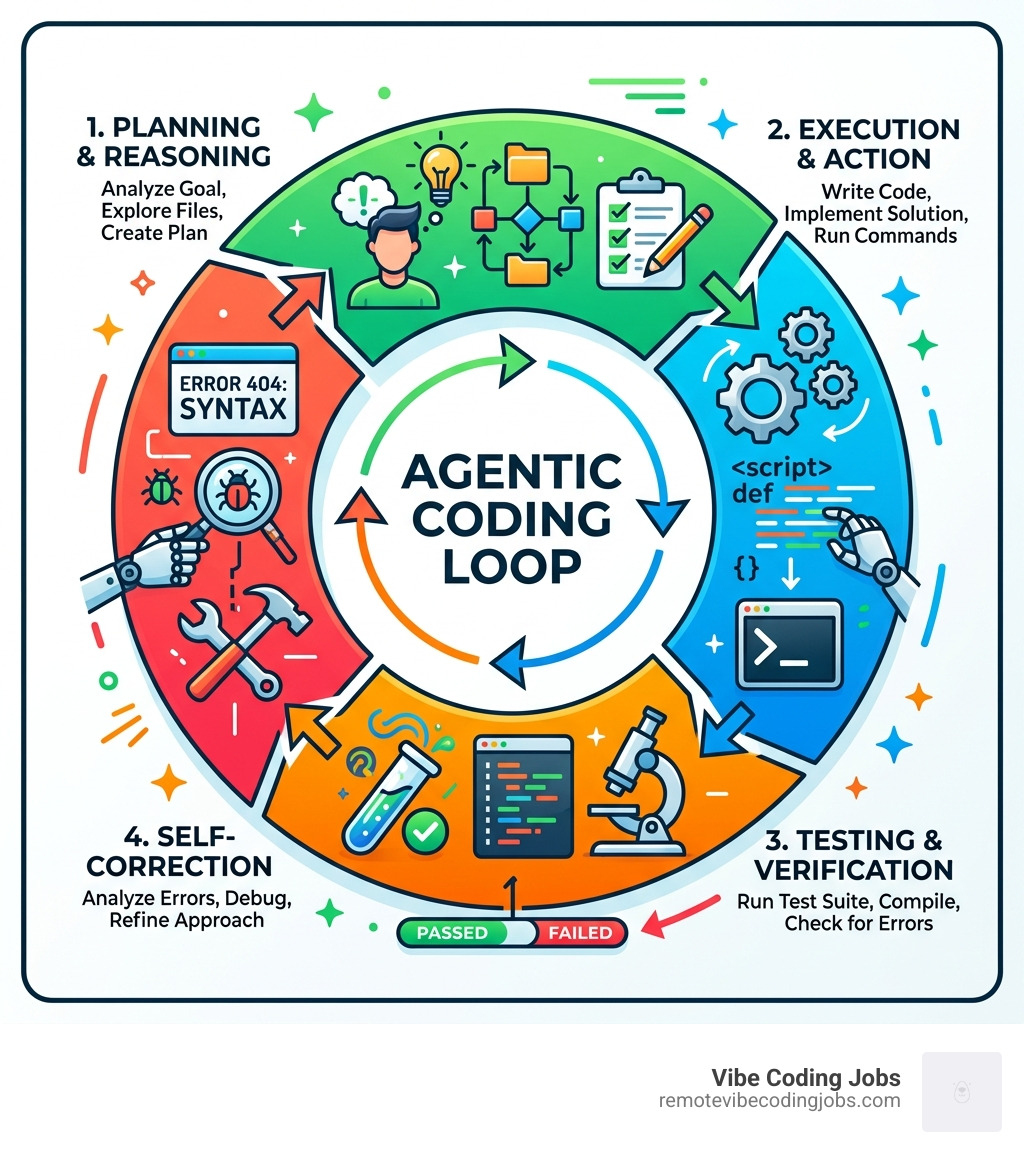
Defining the Agentic Coding Revolution
To understand why agentic coding tools are taking over, we have to look at how they differ from the AI assistants we used in 2023 and 2024. Traditional assistants are reactive; they wait for you to type and then offer a suggestion. They are “passive consultants.”
Agentic coding tools, however, operate on a “reason-and-act” loop. When you give them a goal, they don’t just guess the next line of code. They browse your file system, read your package.json, check your environment variables, and create a multi-step plan. If a command fails, they don’t give up—they read the error message and try a different approach. This level of autonomy is what defines the “vibe coding” era, where the developer acts more like a creative director or a Senior Agentic AI Developer (Google Cloud Platform / Vertex AI) than a manual typist.
These tools support the entire lifecycle of software:
- Greenfield Development: You can scaffold a Python Flask app with a database and routing from a single prompt. The agent builds the architecture while you focus on the “vibe” and business logic.
- Brownfield Modernization: Agents excel at the “boring” but complex work, like refactoring a legacy JavaScript module into TypeScript or updating deprecated APIs across hundreds of files.
- Self-Correction: Unlike a chatbot that might hallucinate a library, an agentic tool will actually try to run
npm install. If the package doesn’t exist, it searches for the correct one.
For a deeper dive into how this shift is changing the job market, check out our guide on Agentic Engineering: What It Is & How to Thrive in 2024. Many forward-thinking companies are already using platforms like the AI Coding Assistant – Agentic Coding Platform to bridge the gap between human intent and autonomous execution.
Top Agentic Coding Tools for 2026
The landscape is crowded, but a few heavy hitters have emerged as the “most competent” based on community sentiment and technical benchmarks. Whether you prefer a terminal-first workflow or a polished GUI, there is an agent for you.

The most popular tools right now include Cursor: The best way to code with AI, which has become the go-to for many “vibe coders,” and Codex | AI Coding Agent, which offers a unified command center for team-based development. Newer players like Cubent – Next-Gen Agentic AI for Software Engineers and Verdent AI|Agentic Coding with Multiple Parallel Agents are pushing the boundaries by allowing multiple agents to work on a project simultaneously.
Cursor: The Gold Standard for Agentic Coding Tools
Cursor is arguably the most successful fork of VS Code ever made. It has seen explosive growth because it integrates AI directly into the editor’s core rather than just adding it as a sidebar plugin.
- Composer 2: This is Cursor’s “agent mode.” You can describe a feature, and Composer will open multiple files, edit them in parallel, and ask you to review the diffs.
- Codebase Indexing: Cursor creates a semantic index of your entire project. You can ask, “Where are the menu label colors defined?” and it will find the exact CSS-in-JS file or theme config, even in a massive repo.
- Tab Autocomplete: Its specialized model is “magically accurate,” often predicting entire blocks of logic based on the context of your previous edits.
| Feature | Cursor | Windsurf |
|---|---|---|
| Base Editor | VS Code | VS Code |
| Agentic Mode | Composer 2 | Flow |
| Context | Full Indexing | Real-time Context |
| Best For | Pro Developers | Fast Prototyping |
Claude Code: The Powerhouse of Agentic Coding Tools
If Cursor is the “friendly” IDE, Claude Code is the “brilliant” terminal companion. Developed by Anthropic, it is a CLI tool that lives where senior developers spend most of their time. It is currently ranked as one of the most competent tools for complex engineering because it uses “extended thinking” to solve problems.
Claude Code doesn’t just write code; it manages your git history, runs your test suites, and can even be left to run in a “headless” mode for CI/CD tasks. One of its best features is the CLAUDE.md file, which acts as a memory bank for your project’s coding standards and conventions. This is a must-have for anyone looking to hire an AI Agent Developer (Agentic AI Developer) who needs to hit the ground running.
Codex and Gemini CLI: Enterprise Agentic Coding Tools
For teams already deep in the Google or OpenAI ecosystems, there are powerful CLI and enterprise options.
Google Cloud’s Gemini CLI is a favorite for developers who want a free, high-performance agent that integrates perfectly with Vertex AI and GCP. It uses a “reason and act” loop to handle tasks like adding rate limiters or refactoring legacy modules.
Codex, powered by OpenAI, functions as an “always-on” command center. It supports multi-agent workflows, allowing different agents to handle issue triage, PR reviews, and feature building in parallel. This scalability makes it ideal for large organizations that need to maintain high code quality across thousands of repositories. For those looking to lead these efforts, companies are frequently searching for a Senior Agentic AI Developer (Google Cloud Platform / Vertex AI) to manage these autonomous systems.
Security, Risks, and Best Practices
With great autonomy comes great responsibility. Giving an AI agent the ability to run terminal commands and install packages introduces new security risks. We’ve seen cases where agents, taking instructions too literally, have moved critical fixtures to the wrong files or attempted to install unvetted dependencies.

To stay safe, we recommend these best practices:
- Human-in-the-Loop: Never let an agent merge code directly to production. Always use pull requests and have a human review the “agentic” diffs.
- Strict Governance: Use tools that support dependency governance, ensuring the agent only pulls from approved sources.
- Model Context Protocol (MCP): This emerging standard allows you to safely connect your agents to external tools, databases, and APIs without giving them “the keys to the kingdom.”
- Audit Trails: Log every action your agent takes. This is essential for compliance and for debugging when an agent gets stuck in an infinite loop.
If you are an Agentic AI Engineer, your job is increasingly about building these guardrails rather than just writing the code itself.
Orchestration and Future Trends
The future of agentic coding tools isn’t just a single “super-agent”—it’s a team of specialized agents working together. This is where orchestration frameworks like CrewAI and LangGraph come in.
Instead of one agent trying to do everything, you might have one agent focused on architecture, another on writing tests, and a third on documentation. They communicate using shared memory and schemas, ensuring that the “communication gap” often found in multi-agent systems is bridged.
We are also seeing the rise of the Model Context Protocol (MCP). This protocol acts as a standard for how agents interact with the world. It allows a tool like Claude Code to “see” into your Jira tickets, your Slack channels, and your production logs to provide better context for its coding decisions.
As these tools become more integrated, the demand for an AI Engineer (Agentic AI Experience) will only grow. The shift from “writing code” to “orchestrating agents” is the defining trend of the 2026 tech landscape.
Frequently Asked Questions about Agentic Coding
What is the difference between an AI assistant and an agentic coding tool?
An AI assistant (like traditional Copilot) provides suggestions and autocompletes lines of code while you type. An agentic coding tool (like Claude Code or Cursor’s Composer) is autonomous. You give it a high-level goal, and it plans the steps, navigates your files, executes terminal commands, runs tests, and fixes its own errors until the task is complete.
Which agentic coding tool is best for senior developers?
Senior developers often prefer Claude Code or Aider because they are terminal-native and offer deeper reasoning capabilities for complex architectural changes. However, Cursor remains a top choice for seniors who want the most polished, integrated IDE experience.
How does the Model Context Protocol (MCP) enhance coding agents?
MCP allows agentic coding tools to connect to external data sources and tools (like Google Drive, Slack, or GitHub) using a standardized protocol. This gives the agent more context—for example, it could read a design document in your Notion and then implement the code in your editor based on those specific requirements.
Conclusion
The era of manual boilerplate is over. Whether you are building a new startup from scratch or maintaining a massive enterprise codebase, agentic coding tools are the force multipliers that allow you to ship faster and with higher quality.
At Remote Vibe Coding Jobs, we believe the future of work is “vibe coding”—a world where you focus on the vision and the architecture while your agents handle the execution. We curate daily listings for async-first companies that embrace this future, focusing on roles that value your ability to leverage tools like Cursor and Claude.
If you’re ready to step into the next phase of your career, Compare vibe coding vs traditional development to see how your skills stack up in this new autonomous world. The agents are ready to work; the question is, what will you build with them?