
How to Escape the 9-to-5 with Ruby on Rails Freelancer Jobs
The 2026 Market for Ruby on Rails Jobs Freelancer Developers
Ruby on Rails jobs for freelancers are more accessible than ever in 2026 — with remote-first companies, async workflows, and a growing demand for experienced Rails engineers across e-commerce, SaaS, and AI training projects.
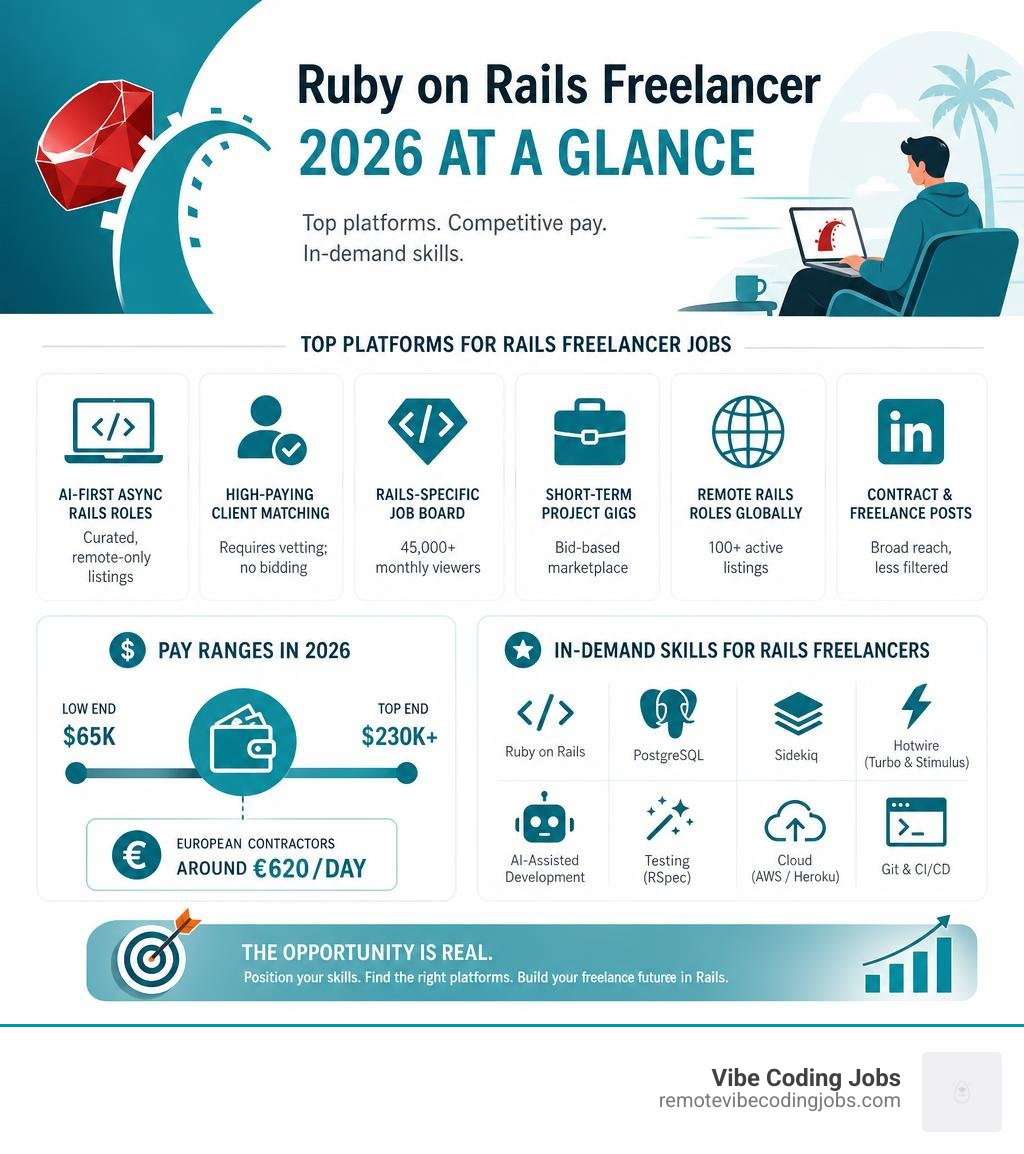
Here’s where to find freelance Ruby on Rails gigs right now:
| Channel | Best For | Notes |
|---|---|---|
| Vibe Coding Jobs | AI-first async Rails roles | Curated, remote-only listings |
| Direct Outreach | High-paying custom contracts | Pitching directly to bootstrapped founders |
| Open Source & GitHub | Inbound client inquiries | Showcasing clean code and contributions |
| Professional Networking | Long-term consulting gigs | Building relationships with tech leaders |
The Rails freelance market spans a wide pay range. Salary data from active job boards shows annual figures from roughly $65K on the low end to over $230K for senior specialists — with experienced European contractors charging around €620/day.
What’s changed in 2026? Companies now expect Rails freelancers to be comfortable with AI-assisted development tools like Cursor and Claude alongside traditional skills like PostgreSQL, Sidekiq, and Hotwire.
The demand is real. Companies like Fleetio, Rootly, and Missive are actively posting senior Rails roles. Bootstrapped founders are hiring freelancers directly. And a new wave of AI data training roles specifically wants Rails engineers to evaluate LLM-generated code.
The opportunity is there — you just need to know where to look and how to position yourself.
I’m the RVCJ Editorial team — we cover remote work trends, AI-assisted development, and developer hiring for engineers who build with tools like Cursor, Claude, and Copilot, including tracking the latest in ruby on rails jobs for freelancers across global async-first companies. In this guide, we’ll walk you through every step — from finding the right platforms to landing and managing high-quality Rails contracts.
Quick look at ruby on rails jobs freelancer:
Weighing the Pros and Cons of Freelance Rails Development

Transitioning to a ruby on rails jobs freelancer lifestyle is an exciting leap, but it is vital to weigh the benefits against the realities before handing in your resignation letter.
The Pros: Autonomy, Income, and Flexibility
- Complete Autonomy: You are the captain of your own ship. You choose the projects that align with your technical interests and decline work that feels tedious.
- Uncapped Income Potential: Instead of waiting for an annual 3% raise, you can scale your income by setting your own rates, taking on multiple parallel projects, or focusing on high-value consulting.
- Geographic Freedom: Whether you want to work from a local café or a beach in France, freelance Rails development allows you to work remotely from anywhere with just a laptop and a stable internet connection.
- Direct Impact: Freelancers often work directly with founders or decision-makers, bypassing layers of corporate middle management. You get to see your code ship to production in days or even hours rather than months.
The Cons: Admin Overhead and Client Hunting
- Administrative Overhead: You are no longer just a developer; you are now the accountant, the project manager, and the HR department. Handling invoices, chasing down payments, and filing self-employment taxes can take up a significant portion of your week.
- The “Feast or Famine” Cycle: There will be months when you have more work than you can handle, followed by quiet periods where you must actively search for your next contract.
- No Paid Time Off or Benefits: If you do not work, you do not get paid. Health insurance, retirement contributions, and vacation days are entirely your responsibility.
To help you visualize the differences, here is how freelance Rails roles stack up against traditional employment:
| Feature | Full-Time Rails Employment | Freelance / Contract Rails Roles |
|---|---|---|
| Income Stability | High, predictable monthly salary | Variable, depends on active contracts |
| Earning Potential | Capped by salary bands | Uncapped; based on hourly/daily rates |
| Tax Management | Handled by employer (W2 / PAYE) | Handled entirely by you (1099 / Sole Prop) |
| Work Schedule | Rigid (typically 9-to-5) | Flexible (set your own hours) |
| Admin Tasks | None (focus purely on coding) | High (invoicing, contracts, client acquisition) |
Where to Find High-Paying Ruby on Rails Jobs Freelancer Gigs

Finding steady contract work requires a diversified approach. Instead of relying on a single source, successful freelancers utilize a combination of curated job boards, direct outreach, and professional networking.
Curated Job Boards
Curated platforms save you hours of filtering through low-quality listings.
- Vibe Coding Jobs: If you are a developer who leverages cutting-edge AI tools (like Cursor, Claude, and v0) to accelerate your Rails development, we curate the best remote roles at forward-thinking, async-first companies. Explore our listings at remotevibecodingjobs.com.
- Specialized Tech Boards: Niche platforms focusing purely on remote development are excellent resources for finding high-quality contracts. By filtering for remote-first companies, you can bypass local geographic restrictions and access global opportunities.
Freelance Marketplaces and Premium Networks
- Premium Talent Networks: Many high-paying clients prefer using vetted talent networks that match developers directly with projects. On these platforms, you typically set your own rates, and the network handles billing, invoicing, and client matching, eliminating bidding wars entirely.
- General Freelance Marketplaces: For quick, budget-friendly tasks or short-term system maintenance gigs, general freelance marketplaces can provide a steady stream of smaller projects to fill gaps between larger contracts.
Direct Outreach and Company Careers Pages
Many companies bypass traditional marketplaces entirely and post independent contractor opportunities directly on their public careers pages or company blogs. For example:
- At companies like Goldavenue, they frequently hire for freelance roles structured as renewable 6-month contracts requiring high-quality API design and performance tuning.
- If you prefer product-focused ownership, many bootstrapped startups hire independent contractors for project-based work, where you work directly with founders on building and scaling products.
- Many fast-growing platforms hire part-time help, favoring fast iteration cycles and asynchronous communication via tools like Slack or Telegram.
To secure these roles, check out our dedicated guide on remote ruby on rails developer jobs.
Vetting Processes for Ruby on Rails Jobs Freelancer Platforms
Premium platforms do not just let anyone join; they maintain high standards to protect client relationships.
- Technical Screening: Vetting processes often utilize a multi-stage screening process that includes timed algorithms, live coding challenges, and a real-world test project.
- Portfolio Reviews: Vetting teams will inspect your GitHub, looking for clean ActiveRecord usage, comprehensive RSpec test coverage, and idiomatic Ruby patterns.
- Soft Skills Assessment: Because freelance roles require direct client interaction, platforms screen for proactive communication, fluent English, and reliable time management.
How to Position Yourself for Premium Ruby on Rails Jobs Freelancer Roles
To command premium rates, you must stand out from the sea of generic applicants:
- Develop a Niche: Do not just be a “web developer.” Position yourself as an e-commerce performance optimization specialist, a legacy Rails migration expert, or an AI-integration engineer.
- Build a Pragmatic GitHub Portfolio: Show that you write clean, maintainable code. Highlight real-world applications rather than basic tutorial repositories.
- Contribute to Open Source: Contributing to the Rails core, popular gems, or maintaining public plugins demonstrates deep framework knowledge and community trust.
- Gather Client Testimonials: Ask past clients for written recommendations. Highlighting a review where a client praises your ability to “simplify complex problems instead of over-engineering them” is gold.
Ready to take the next step? Browse Senior Rails Freelance Roles on Vibe Coding Jobs to find your next contract.
Essential Skills and Tech Stacks for Rails Freelancers in 2026
The Rails ecosystem has evolved rapidly. To remain competitive as a freelancer in 2026, you need to master both classic patterns and modern additions to the stack. The official Ruby on Rails Guides are also worth keeping bookmarked when you need a reliable reference for framework conventions and updates.
- Rails 8 & Modern Architecture: You should be intimately familiar with the latest Rails conventions, including solid database design, caching strategies, and modern asset pipelines.
- Hotwire (Turbo & Stimulus): Many modern teams are actively transitioning away from heavy React frontends to Hotwire. Mastering Turbo Streams and Stimulus controllers allows you to build highly interactive UIs with half the code.
- Robust Background Processing: Sidekiq and Redis remain the gold standard for handling asynchronous background jobs, webhooks, and heavy calculations.
- Databases & DevOps: PostgreSQL and MySQL are essential. You must know how to optimize slow queries, manage database indexes, and deploy applications seamlessly using Heroku, AWS, or Docker.
- Testing and Quality Assurance: Writing thorough unit and integration tests using RSpec, RuboCop, and SimpleCov is non-negotiable for professional freelance projects.
If you are looking to combine these modern backend skills with cutting-edge AI features, check out AI and Rails Developer Jobs on Vibe Coding Jobs.
The Rise of AI-Assisted Vibe Coding in Rails Development
The developer landscape has experienced a paradigm shift. Today, top-tier freelancers do not write every line of boilerplate code by hand. Instead, they practice “vibe coding” – leveraging powerful AI coding assistants like Cursor and Claude.
By using natural language prompts, you can generate complex migrations, write comprehensive RSpec test suites, and scaffold new features in a fraction of the time. This allows you to focus on high-level architecture, business logic, and database optimization, dramatically increasing your freelance output and profitability.
Managing Your Freelance Business: Contracts, Rates, and Clients
Running a successful freelance business requires robust administrative practices. If you do not manage your contracts and client relationships professionally, you will quickly find yourself overwhelmed.
- Setting Your Rates: You can charge an hourly rate (common for ongoing support) or a daily rate (preferred by senior consultants, with experienced European contractors often charging around €620/day). For fixed-scope projects, value-based pricing is highly lucrative.
- Contracts & Statements of Work (SOW): Never write a single line of code without a signed contract. Your contract must clearly define the project scope, payment terms (e.g., Net 15 or Net 30), intellectual property ownership, and termination clauses.
- Asynchronous Communication: Clear, proactive updates via Slack, GitHub, or Telegram keep clients happy and reduce the need for constant, unproductive meetings.
- Timezone Overlap: When working with global clients, ensure you can maintain a minimum of 4 to 5 hours of daily overlap with their primary working hours (such as CET or US Eastern Time) to facilitate smooth collaboration.
Frequently Asked Questions about Freelance Rails Jobs
What are the typical hourly rates for freelance Ruby on Rails developers in 2026?
Freelance rates vary based on your experience and geographic location:
- Junior Developers (1–3 years XP): $35 to $60 per hour.
- Mid-Level Developers (3–6 years XP): $60 to $100 per hour.
- Senior Developers (7+ years XP): $100 to $180+ per hour (or €500 to €800+ daily rates).
What types of projects most commonly hire freelance Rails developers?
- SaaS MVPs: Startups looking to build functional prototypes quickly using Rails’ rapid development capabilities.
- E-Commerce Backends: Established online retailers requiring performance tuning, API integrations, and custom database work.
- AI Data Training: Modern contract roles where Rails experts review and evaluate AI-generated code to train large language models.
How do I handle taxes and contracts as an independent contractor?
As an independent contractor, you are responsible for paying your own income and self-employment taxes. It is highly recommended to set aside 25% to 35% of every invoice into a separate tax savings account. Consult a local certified accountant to set up your business entity (like an LLC or Sole Proprietorship) and obtain professional liability insurance to protect your business assets.
Conclusion
Transitioning to a ruby on rails jobs freelancer career path offers unmatched freedom, high earning potential, and the ability to work on your own terms. By leveraging modern frameworks like Rails 8, mastering AI-assisted vibe coding tools, and using specialized job boards, you can successfully escape the traditional 9-to-5.
Ready to find remote contract roles that value your modern tech stack and AI-assisted development skills? Explore curated, async-first opportunities on remotevibecodingjobs.com today!