
Why AI Coding Job Matching Is Replacing Generic Developer Job Boards
AI coding job matching platforms help developers find better-fit roles by comparing their real skills, preferred tools, work hours, and career goals against job requirements. For remote developers, the best options do more than scan for “software engineer.” They can prioritize roles that match your stack, async culture, AI-tool experience, seniority, and target companies.
When comparing AI developer matching platforms, look for tools that let you:
- Set clear include and exclude criteria for skills, industries, locations, and companies.
- Explain why a role matched, including missing skills or deal-breakers.
- Generate tailored application materials for a small number of high-fit jobs.
- Keep you in control before anything is submitted in your name.
This shift matters because modern engineering roles increasingly ask for practical AI-assisted building skills. Employers are looking beyond resume keywords and generic coding tests toward signals such as problem framing, debugging AI-generated code, testing, deployment, and judgment about cost or latency.
But automation is not automatically useful. A bad default keyword list or an incorrect applicant-tracking-system link can quietly hide roles you would have wanted. The winning approach is usually not sending hundreds of AI-written applications. It is using automation to discover more opportunities, then applying with care to the few where your experience and the work genuinely line up.
I am Dominic Zijlstra, a technologist and entrepreneur who has built automated systems, data infrastructure, and developer-focused products as a data scientist, DevOps engineer, and communications systems engineer. In this guide to AI coding job matching, I will focus on how developers can use these systems without giving up control of their career search.
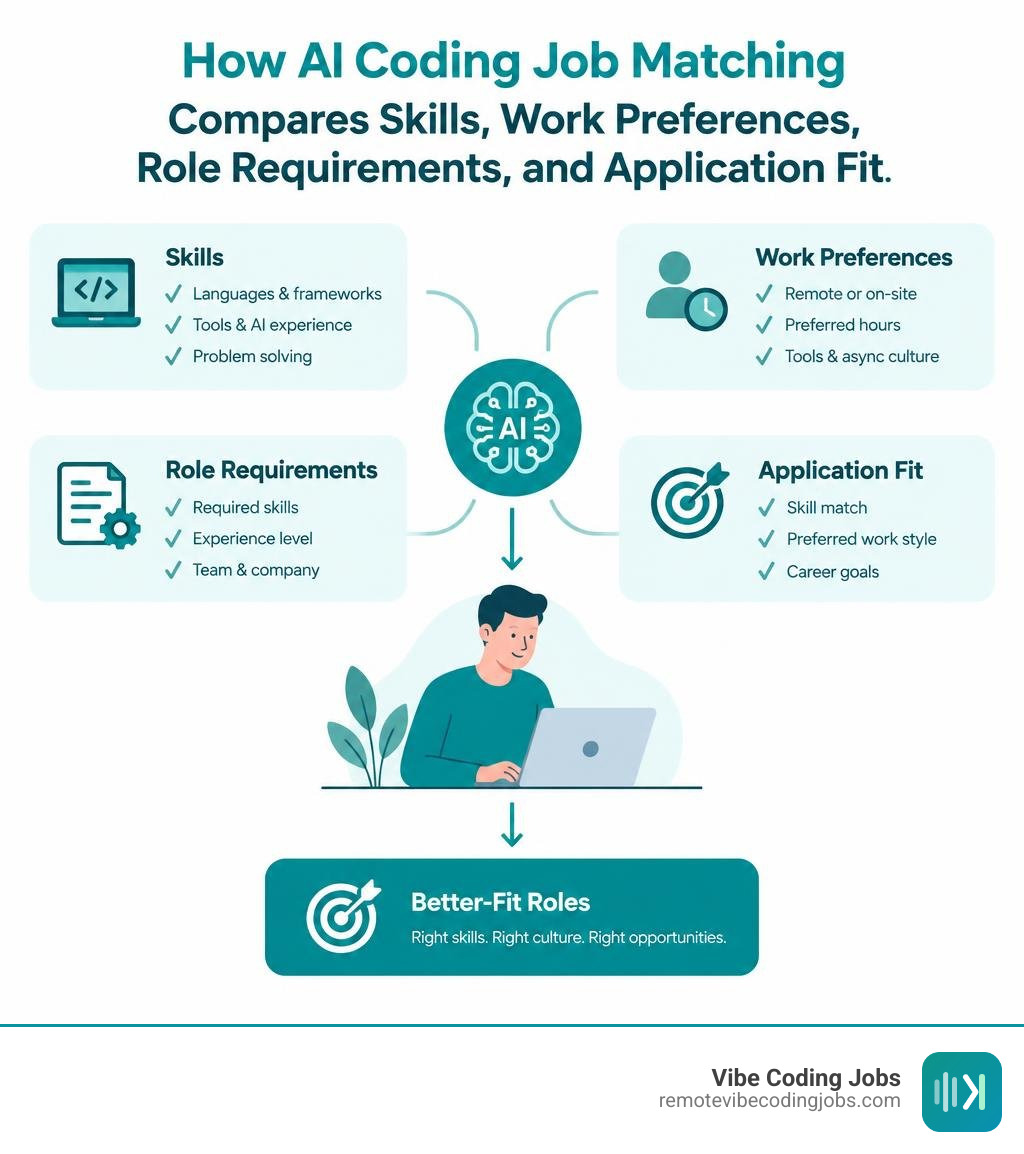
Essential ai coding job matching terms:
Core Mechanics of Modern AI Coding Job Matching Platforms
Traditional recruitment relied on blunt relational database queries. A recruiter entered a boolean search such as React AND Node AND AWS, and the applicant tracking system (ATS) returned a list of resumes containing those exact character sequences. This produced enormous false positive rates while filtering out qualified engineers who formatted their credentials differently.
Modern platforms operate as automated matching engines. Instead of surface-level keyword scraping, they treat candidate profiles and job descriptions as multidimensional structured records. The process extracts verified capabilities, compensation bounds, working hours, and operational preferences, running them through deterministic scoring functions and machine learning evaluation pipelines.

To deliver low-latency results, production hiring platforms optimize their evaluation paths. High-throughput filtering engines can score thousands of candidates against strict binary constraints—such as suspension status, workspace verification, and baseline conversational screening scores—before computing continuous mathematical rankings across the eligible cohort in milliseconds.
Algorithmic Scoring in AI Coding Job Matching
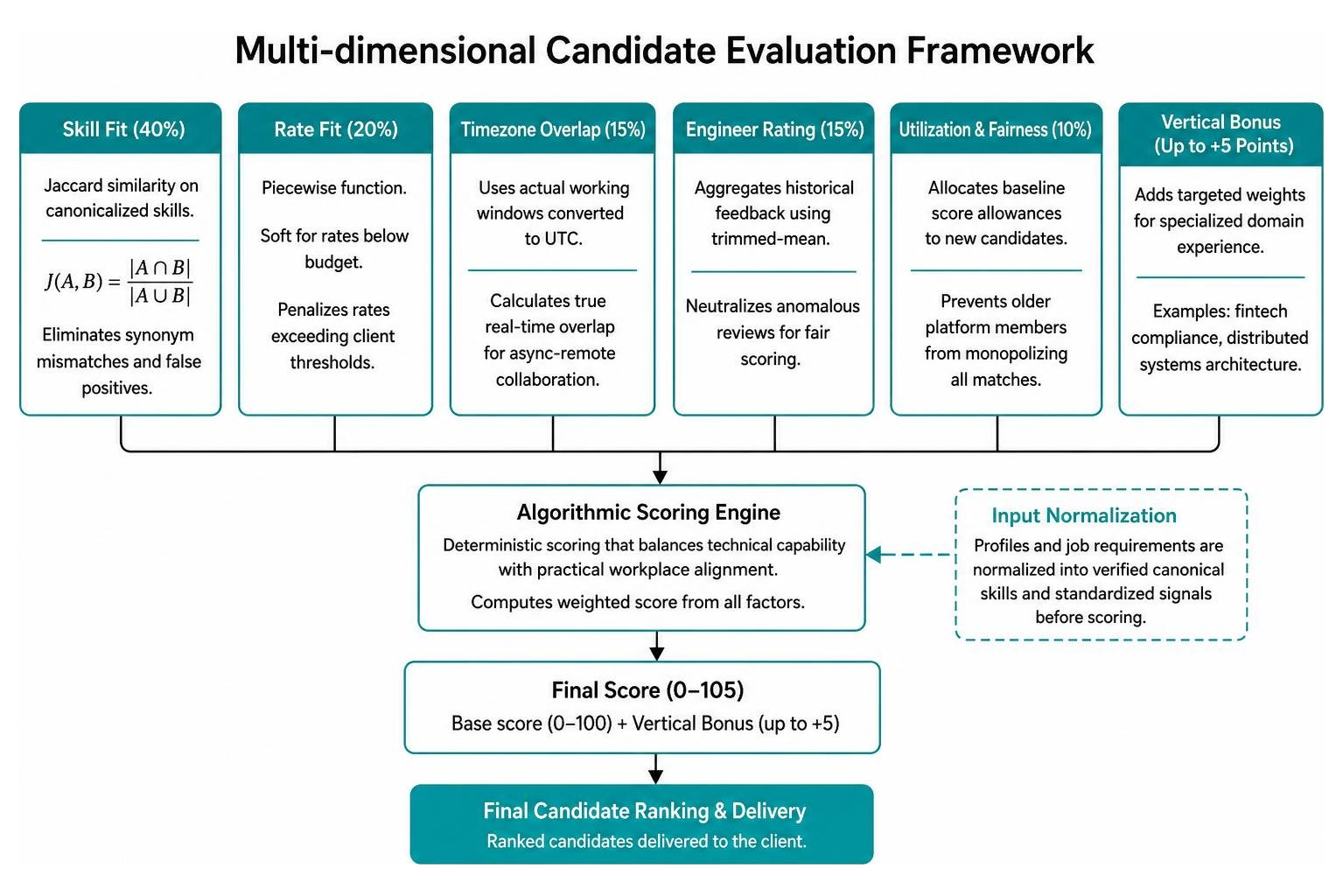
Deterministic scoring breaks down complex developer qualifications into verifiable mathematical signals rather than vague impressions. A representative multi-factor scoring formula balances technical capability with practical workplace alignment:
- Skill Fit (40%): Evaluates canonical skill overlap between candidate capabilities and employer requirements.
- Rate Fit (20%): Uses a piecewise function that softly handles rates below budget while penalizing rates exceeding client thresholds.
- Timezone Overlap (15%): Converts self-reported local working hours into UTC windows to calculate true real-time overlap.
- Engineer Rating (15%): Aggregates historical feedback using a trimmed-mean calculation to neutralize anomalous reviews.
- Utilization & Fairness (10%): Allocates baseline score allowances to new candidates, preventing older platform members from monopolizing all matches.
- Vertical Bonus (Up to +5 Points): Adds targeted weights for specialized domain experience such as fintech compliance or distributed systems architecture.
Computing timezone fit using actual working windows rather than simple geographic UTC offsets makes async-remote collaboration reliable. An engineer located in India working a shifted schedule can achieve full overlap with a North American engineering team, and the matching engine reflects that availability immediately.
Vector Embeddings vs. Deterministic Jaccard Similarity
The industry remains divided on whether dense vector embeddings or canonical set mathematics provide better results for developer matching. Cosine similarity across large language model (LLM) embeddings captures semantic nuance, but it frequently generates false positives for niche, long-tail technical skills. For example, an embedding model might see Apache Kafka and RabbitMQ as close neighbors in vector space, yet a team building low-latency event streaming may strictly require deep Kafka internal partition knowledge.
To solve this, advanced matching engines use Jaccard similarity across canonicalized skill taxonomies. The Jaccard index measures overlap by dividing the number of skills shared between a candidate and a job by the total number of unique skills appearing across both sets. A score of 1.0 means perfect overlap, while 0.0 means no shared skills at all.
Normalizing raw profile text into verified canonical skills before computing the Jaccard index eliminates synonym mismatches without hallucinating technical equivalence. This precision is essential when matching for modern development roles, where developers combine traditional programming fundamentals with agentic frameworks to accelerate delivery. To understand the shifts driving this demand, explore what is vibe coding and how it is reshaping the developer ecosystem.
Architectural Patterns and Customization for Job Seekers
Job search automation gives developers leverage, but running these systems requires sound software design. Off-the-shelf tools frequently fail because their default configuration reflects their author’s career persona, not yours.
Open-source projects demonstrate how client interfaces, backend microservices, and LLM proxies structure job data, while command-line agents can orchestrate scraping, fit evaluation, and document generation.
Building a reliable local search engine requires clean architectural patterns:
- Single Source of Truth (SSOT): Centralize career history, verified metrics, project outcomes, and technical preferences in version-controlled markdown or YAML files.
- Unified Wrapper Commands: Use wrapper scripts to ensure your AI coding assistants interact with project directories through consistent execution paths.
- Deterministic Promotion Gates: Require explicit manual approval before generated applications move from transient storage to final submission pipelines.
Two-Layer Architecture and Data Flow Controls
A resilient career-automation pipeline separates strategic human data from transient operational scraping:
- Strategic Layer (Human-Authored): Contains your verified work history, explicit compensation baselines, targeted company lists, and hard deal-breakers.
- Operational Layer (Agent-Generated): Stores raw job scrapes, intermediate fit scores, tokenized resume variants, and draft cover letters.

This structure prevents AI hallucinations from contaminating your source documents. When an agent analyzes an ATS listing, it evaluates the posting against your strategic baseline and writes the score to the operational layer. High-scoring roles pass through a promotion gate where you inspect the match reasoning before taking action.
Eliminating ATS Slugs and Hidden Keyword Traps
Relying on generic platform settings can quietly break your job search pipeline. A developer who inadvertently leaves a negative keyword like Embedded in their configuration file will silently exclude every AI hardware and IoT opportunity.
Another common failure point is the ATS slug mismatch. If an automated scraper attempts to query a company board using an assumed company name rather than their exact ATS identifier, the scanner receives 404 errors and skips hundreds of valid openings. Robust pipelines validate endpoints beforehand and use multi-word positive keyphrases to preserve discovery breadth.
Tactical Application: High-Precision Search vs. Automation Volume
The rise of automated job tools has sparked an arms race between candidates sending hundreds of auto-applications and employers deploying aggressive spam filters. Mass-application bots that blast generic resumes rarely result in offers; recruiting teams quickly filter out unverified submissions.

The winning strategy uses automation for discovery, screening, and company intelligence, followed by surgical, high-context applications.
Surgical vs. Mass Application Strategies in AI Coding Job Matching
High-precision matching pipelines use agent loops to generate targeted, verifiable application materials:
- Drafter-Reviewer Agent Pairs: One agent generates a resume tailored to the target job spec, while a secondary reviewer agent verifies the claims against your strategic master profile to prevent embellishment.
- Dynamic Document Trimming: The system cuts the lowest-scoring bullet points first, keeping the resume within a clean two-page limit while maximizing relevance.
- ATS Text Extraction Audits: Compiling resumes with LaTeX or modern typesetting engines can sometimes introduce layout artifacts. Running an extraction check via utilities like
pdftotextensures the text layer reads cleanly for automated parsers.
Understanding these dynamics is critical as industry hiring bars adjust. To explore how salary bands and hiring requirements are evolving, review our analysis of remote developer jobs and AI tool trends.
Practical Portfolios for Vibe Coding and AI-Native Roles
As routine syntax generation becomes commoditized, engineering teams look for developers who can orchestrate and direct AI tools effectively. Showing practical project work proves you can manage models, catch edge-case bugs, and deploy production software.
- Spec Decomposition: Document your architectural choices, system boundaries, and how you broke complex features down into precise model prompts.
- Model Error Recovery: Provide concrete case studies where an LLM produced broken logic or security flaws, detailing how you identified, tested, and resolved the issue.
- Cost and Latency Management: Demonstrate how you optimized API token consumption, structured vector retrieval, and reduced inference latency in real projects.
For a step-by-step guide on creating these artifacts, read our walkthrough on building a portfolio with AI tools, and consult our benchmark on vibe coding salary ranges to understand compensation across experience levels.
Evaluating Modern AI Developer Matching Tools and Frameworks
Developers navigating the current ecosystem can choose from several tool architectures depending on their desired balance of local control and automation:
| Feature / Dimension | Open-Source CLI Frameworks | Automated Cloud Aggregators | Deterministic Matching Engines |
|---|---|---|---|
| Execution Environment | Local Machine (Node/Bun/Python) | Cloud Hosted SaaS | Managed Hiring Platform |
| Data Privacy | Total (Local files & keys) | Shared with Provider | Platform-Controlled |
| Matching Mechanism | LLM Prompt Evaluation | Heuristic Keyword Filters | Weighted Jaccard & Rule Sets |
| Document Generation | Dynamic LaTeX / Typst Compiles | Generic PDF Templates | Standardized Profiles |
| ATS Verification | Local pdftotext Auditing |
Basic Formatting Check | Direct Platform API Match |
| Human Supervision | Mandatory Promotion Gates | Fully Automated Submissions | Verified Assessment Pipeline |
Engineers looking for companies hiring vibe coders should prioritize platforms that surface verified, async-first teams rather than scrapers pulling from generic aggregators. You can browse current openings directly on companies hiring vibe coders.
Open-Source CLI Frameworks vs. Autonomous Cloud Agents
Local CLI tools provide transparency and security. By running agents directly on your machine through command interfaces like Claude Code, your raw career data and API keys stay under your control. These setups allow you to configure custom scraping loops, parse HTML job boards through API proxies, and execute automated sanity checks on every generated file.
Cloud-based platforms offer convenience and continuous background scanning, but they require careful review to prevent unmonitored mass applications. The most effective balance uses background scanners to aggregate roles and generate match briefs, while keeping application generation and submission under your direct supervision.
AI-Native Assessment Signals Over Traditional LeetCode
The software industry is steadily moving away from abstract LeetCode algorithms toward practical AI-assisted assessments. Modern evaluation platforms and specialized candidate assessment models focus on whether a developer can build and ship software using modern tools.
These platforms evaluate engineers on real-world capabilities:
- Debugging Agentic Code: Identifying race conditions, hallucinated libraries, and logic errors in model-generated pull requests.
- System Architecture: Designing maintainable, modular codebases that accommodate AI-driven workflows.
- Paid Work Trials: Completing focused engineering milestones that mirror day-to-day team challenges.
To explore companies that prioritize hands-on development over abstract puzzles, check our directory of remote coding jobs with no LeetCode.
Frequently Asked Questions About AI Job Search
How do AI matching algorithms evaluate candidate code without LeetCode?
Modern matching platforms assess practical development workflows rather than memorized data structures. Candidates are evaluated on how effectively they prompt models, decompose problem specs, audit AI-generated code for security flaws, and manage token budgets and API latency. Many forward-thinking companies test these skills through short, paid work trials where engineers build real features using their preferred editor and AI extensions.
What is the biggest risk when configuring an automated AI job agent?
The single biggest risk is unvalidated default configuration. If you rely on an open-source tool’s default keyword blocklists, you may accidentally filter out roles you are fully qualified for. Other common risks include broken ATS company slugs that return 404 errors, and autonomous auto-apply bots submitting hallucinated details without your explicit sign-off.
How does vibe coding experience translate to entry-level engineering roles?
Vibe coding experience becomes a strong asset when backed by solid software engineering fundamentals. Junior developers who combine AI generation tools like Cursor, Claude, and Gemini with Git proficiency, database basics, automated testing, and clean deployment workflows can deliver at the level of mid-level engineers. Demonstrating you can guide an AI tool while catching errors and testing edge cases makes for a compelling entry-level portfolio.
Conclusion
The engineering hiring landscape is shifting permanently toward strategic automation and verifiable building skills. High-performing developers no longer spend hours scrolling through cluttered, generic job boards or blasting hundreds of auto-generated resumes into ATS resume black holes. Instead, they use AI matching pipelines to identify high-fit opportunities and apply with targeted, high-context materials.
At RemoteVibeCodingJobs, we help developers navigate this transition by curating daily remote listings across teams that celebrate AI-assisted development, async culture, and modern toolchains. Whether you are building scalable backend systems or looking for specialized roles like remote Swift coding jobs, taking control of your matching pipeline is the most effective way to accelerate your career.