
Find Legitimate Async First Developer Jobs Without the Meeting Trap
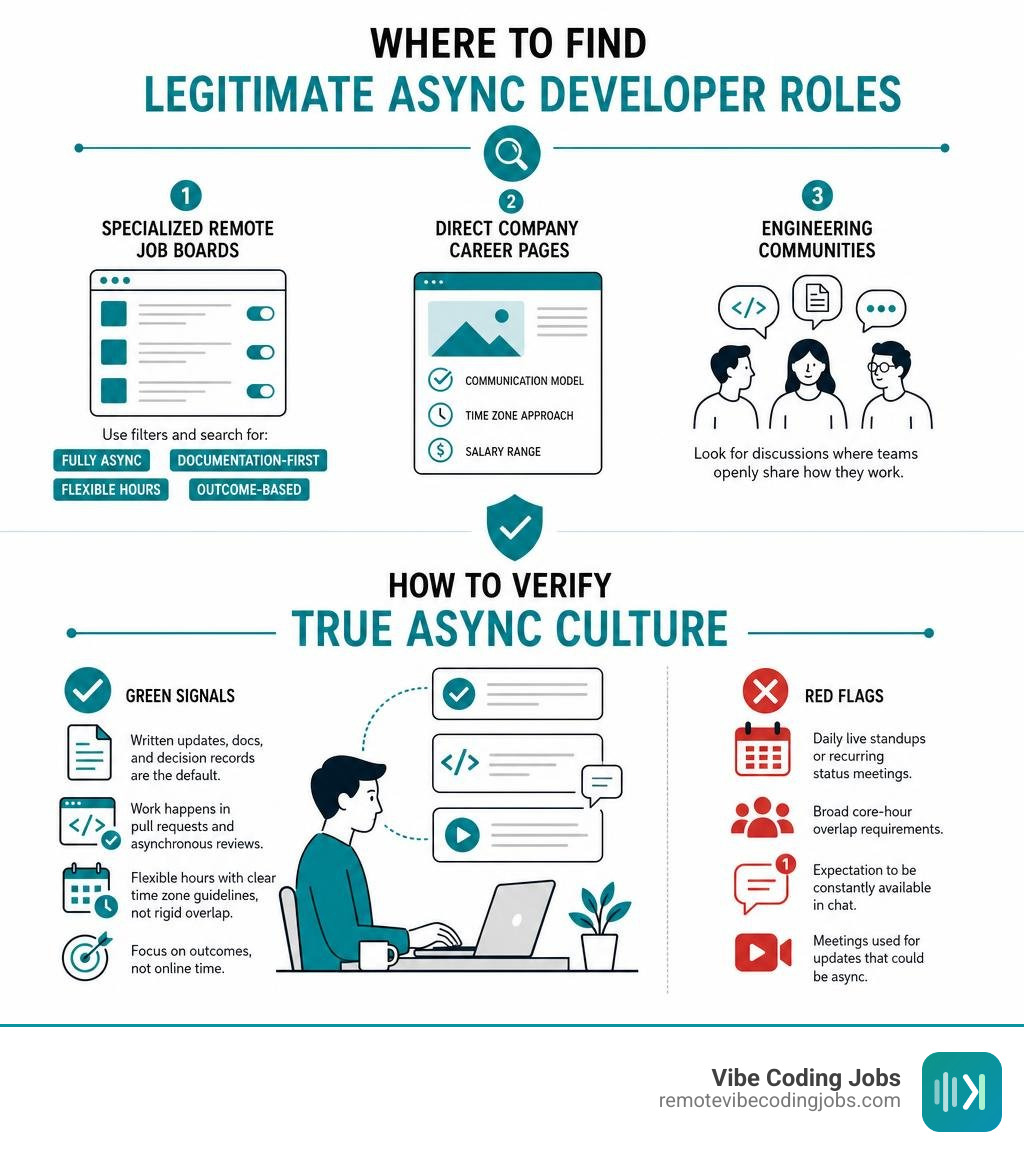
The best places to find async first developer jobs are specialized remote job boards, direct company career pages, and engineering communities that state their communication model, time zone rules, and salary range clearly. Filter for phrases such as fully async, documentation-first, flexible hours, and outcome-based, then reject listings that require daily live standups, broad core-hour overlap, or constant chat availability.
A real async-first role is not simply a job you do from home. It is a role where written updates, pull requests, decision records, and recorded walkthroughs are the default. Meetings still happen, but mainly for urgent incidents, sensitive conversations, complex debugging, or relationship building.
That distinction matters. Many listings use the word “async” because they mention asynchronous programming, yet still expect developers online all day. Others offer remote work but pack calendars with recurring calls. The opportunities worth your time protect focus, judge output over online presence, and let people contribute across time zones.
I am Dominic Zijlstra, a technologist and entrepreneur with experience in data infrastructure, DevOps, automated systems, and building technology products. In this guide, I will help you find and assess async first developer jobs with the practical signals that separate flexible, high-trust teams from remote jobs with a different commute.
Discover more about async first developer jobs:
- The Ultimate Free Coding Job Playbook to Fast-Track Your Career
- Finding Swift UI Remote Positions and Cursor Claude Roles
- How Culture Alignment Helps You Land Cursor Developer Jobs
Understanding the Market for Async First Developer Jobs
The demand for asynchronous talent has shifted from an experimental remote model into an established operational strategy. Over 2,000 async jobs are currently listed in the United States alone. However, filtering through the noise requires understanding market composition. Approximately 50.2% of listings returned for async searches are fully remote, while the rest are hybrid or on-site roles using asynchronous tools like ticket queues or pull requests.
When searching for async remote developer jobs, you will find that full-time opportunities represent over 81% of active postings. Companies hiring under this model range from distributed infrastructure pioneers like GitLab, Docker, Supabase, Oyster, and Sporty Group to early-stage AI startups looking for rapid product delivery.
| Workplace Characteristic | True Async-First Engineering Culture | Pseudo-Async / Synchronous Remote |
|---|---|---|
| Primary Communication | Written documentation, RFCs, and pull requests | Slack pings, huddles, and ad-hoc Zoom calls |
| Calendar Structure | 0–2 hours of scheduled meetings per week | Daily standups, sync sprint rituals, and check-ins |
| Working Hours | Fully flexible across any global time zone | Mandated 4–6 hour synchronous time zone overlap |
| Performance Metric | Shipped code, system stability, and written clarity | Green activity dots, instant chat replies, and logged hours |
| Documentation Style | Context-rich, searchable, and public by default | Fragmented chats, unrecorded calls, and ephemeral notes |
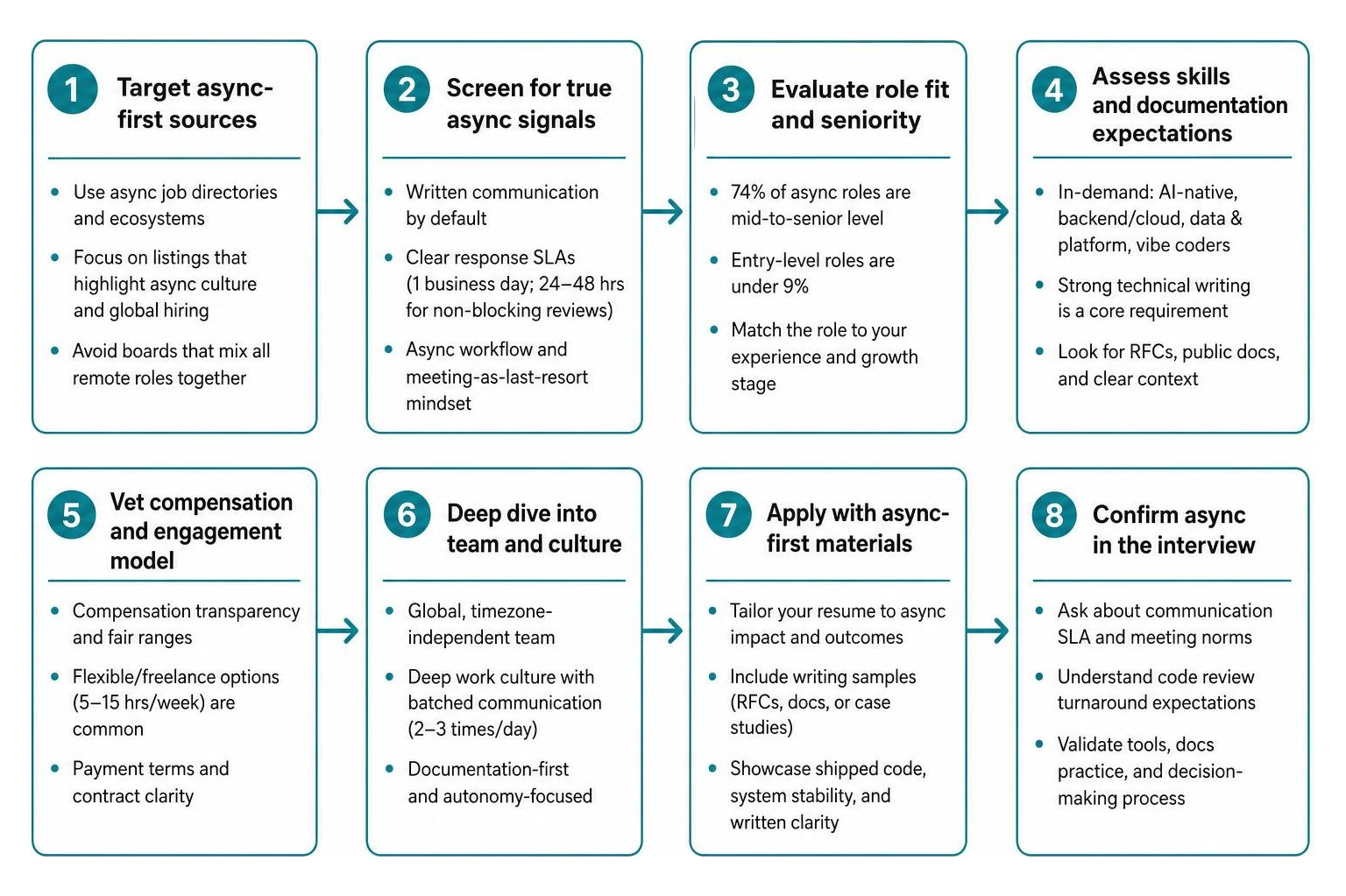
The data also reveals that mid-to-senior engineers represent nearly 74% of listed asynchronous openings, with entry-level positions accounting for under 9%. Because async teams rely heavily on autonomy and self-directed problem-solving, businesses historically reserved these positions for seasoned staff. As AI development tools accelerate learning curves, new pathways are opening for early-career developers who demonstrate high agency.
Defining True Asynchronous Work vs Synchronous Remote
The core difference between true asynchronous work and standard remote work lies in the default mode of collaboration. Synchronous remote environments recreate open-plan office interruptions through digital channels. The calendar invite arrives: “Quick sync to discuss the API changes.” Thirty minutes blocked. Then another. By Friday, your calendar is a mosaic of small meetings, and your actual development time is whatever fragments remain.
When developers are interrupted mid-task, research shows they rush to catch up, resulting in elevated stress and cognitive fatigue. Writing complex software requires continuous, uninterrupted blocks of 2 to 4 hours. True asynchronous engineering protects this focus by treating real-time meetings as a last resort rather than a default.
In a genuine async team, the entire workflow is calibrated to support a deep work culture developer jobs finding focus flow environment. Engineers work during their individual peak circadian hours. Instead of demanding instant replies, teams establish explicit response SLAs, such as responding within one business day for general queries and 24 to 48 hours for non-blocking code reviews. Communication is batched 2 to 3 times per day, freeing minds to build clean, maintainable systems.
In-Demand Skill Sets and Titles for Async First Developer Jobs

Engineering departments hiring asynchronously prioritize developers who can operate as independent product units. While backend architecture, distributed systems, and API design remain foundational, the emergence of AI tooling has created a surge in modern job titles:
- AI-Native Software Engineers & Agentic Developers: Early-career and senior builders who steer AI tools to ship production features. Openings like AI-Native Software Engineer – Early Career – Americas | Jquasar and JR AI Agentic Developer | Flexgen highlight how frameworks like LangGraph, CrewAI, FastAPI, and MCP servers are becoming standard requirements.
- Backend & Cloud Infrastructure Engineers: Roles requiring Node.js, Python, Go, Docker, Kubernetes, and cloud platforms like AWS and GCP. Clear documentation and automated CI/CD pipelines are critical for roles such as the 🚀 FirstCron We’re Hiring – Node.js Developer (2–3 Years Experience) | Asim Mahmood listing.
- Data & Platform Engineers: Distributed teams building data pipelines using cloud warehouses, Python, SQL, and medallion data architectures, seen in postings like Data Engineer (Junior) | Firsty .
- Vibe Coders & Rapid Prototypers: Flexible freelance and part-time developer roles (such as 5–15 hours weekly) focused on turning experimental product concepts into working web applications using Next.js, Tailwind, Cursor, and Claude.
Alongside these technical competencies, technical writing is evaluated as a primary engineering skill. In an async team, your ability to explain architectural trade-offs in an RFC directly determines your engineering impact.
Top Channels and Platforms to Source Asynchronous Engineering Roles
Finding authentic asynchronous positions requires targeting platforms and employers that reject synchronous micromanagement. Rather than scrolling through traditional job boards that lump all work-from-home setups together, developers should look for no BS tech companies hiring remotely find your dream job listings that explicitly outline their communication protocols and global hiring models.
Specialized Asynchronous Job Directories and Ecosystems
Dedicated job platforms eliminate the guesswork of remote screening by categorizing openings based on communication styles, timezone independence, and compensation transparency.
- RemoteVibeCodingJobs: Our dedicated job board curating daily AI-assisted coding and asynchronous developer roles. We filter positions based on engineering culture, tool adoption (like Cursor and Claude Code), and true schedule autonomy so you can target async-first remote developer jobs flexible hours without calendar bloat.
- Curated Remote Feeds: Target specialized tech listings and niche communities that evaluate positions by communication autonomy, timezone independence, and technical stack expectations.
Direct Engineering Hubs and Open Repositories
Some of the best async opportunities never appear on standard job boards. Forward-thinking companies often hire directly through developer communities, public handbook repositories, and open-source contributions.
Founders and technical leaders like Zayd Ashir emphasize systems thinking and architectural foresight over basic syntax tests. Many low-bureaucracy startups have eliminated traditional resumes, cover letters, and sprint ceremonies entirely, evaluating applicants directly on their GitHub portfolios and production contributions.
You can also target early-career opportunities at companies embracing AI-first development through listings like AI-First Software Engineer (Entry Level) | WorkLitho , where candidate evaluation focuses on live IDE problem-solving and prompt-engineering capabilities.
How to Evaluate and Land Legitimate Engineering Roles
Landing an async developer job requires demonstrating that you can thrive in a high-trust, self-directed environment. Because hiring managers cannot monitor your screen, they look for verifiable signals of high agency, clear written reasoning, and structured execution.

Screening Company Culture for Real Async First Developer Jobs
During the interview process, you must vet the employer just as thoroughly as they vet you. Many organizations claim to offer flexible remote work while running synchronous surveillance cultures. When you ace the interview how to prepare for remote developer interviews, ask targeted questions to reveal their operational reality:
- “How many hours of recurring synchronous meetings are on an average engineer’s calendar each week?”
- “What are the team’s explicit expectations regarding chat response times on Slack or Discord?”
- “How are technical decisions proposed, debated, and finalized across different time zones?”
- “If an engineer is blocked outside of headquarters business hours, what is the documented path to unblock them?”
Red flags include mandates for fixed core hours spanning more than 3–4 hours daily, vague expectations around constant availability, or daily verbal standups that could easily be handled in a written thread.
Tailoring Your Resume and Interview Strategy for Async Teams
To stand out for an async-first role, your application materials should reflect asynchronous craftsmanship:
- Highlight Written Artifacts: Link directly to public pull requests, technical design proposals (RFCs), architecture decision records (ADRs), or detailed technical blog posts.
- Quantify Autonomous Impact: Frame your achievements around business outcomes and shipped systems rather than ticket completion counts.
- Submit Video Walkthroughs: When submitting a portfolio project or take-home challenge, include a concise 3-to-5 minute Loom or recorded screen share explaining your architectural trade-offs, testing approach, and edge-case handling.
- Demonstrate AI Tool Mastery: Detail how you integrate tools like Cursor, Claude Code, and Copilot into your daily workflow to accelerate debugging, scaffolding, and test suite generation.
Essential Tooling, Workflows, and Communication Habits for Async Success
Operating effectively on an asynchronous engineering team requires mastering a modern operational stack and structured communication habits. When implemented correctly, an async-first remote developer jobs communication workflow eliminates communication bottlenecks and turns distributed time zones into a continuous delivery advantage.
Documentation-Driven Development and Decision Logs
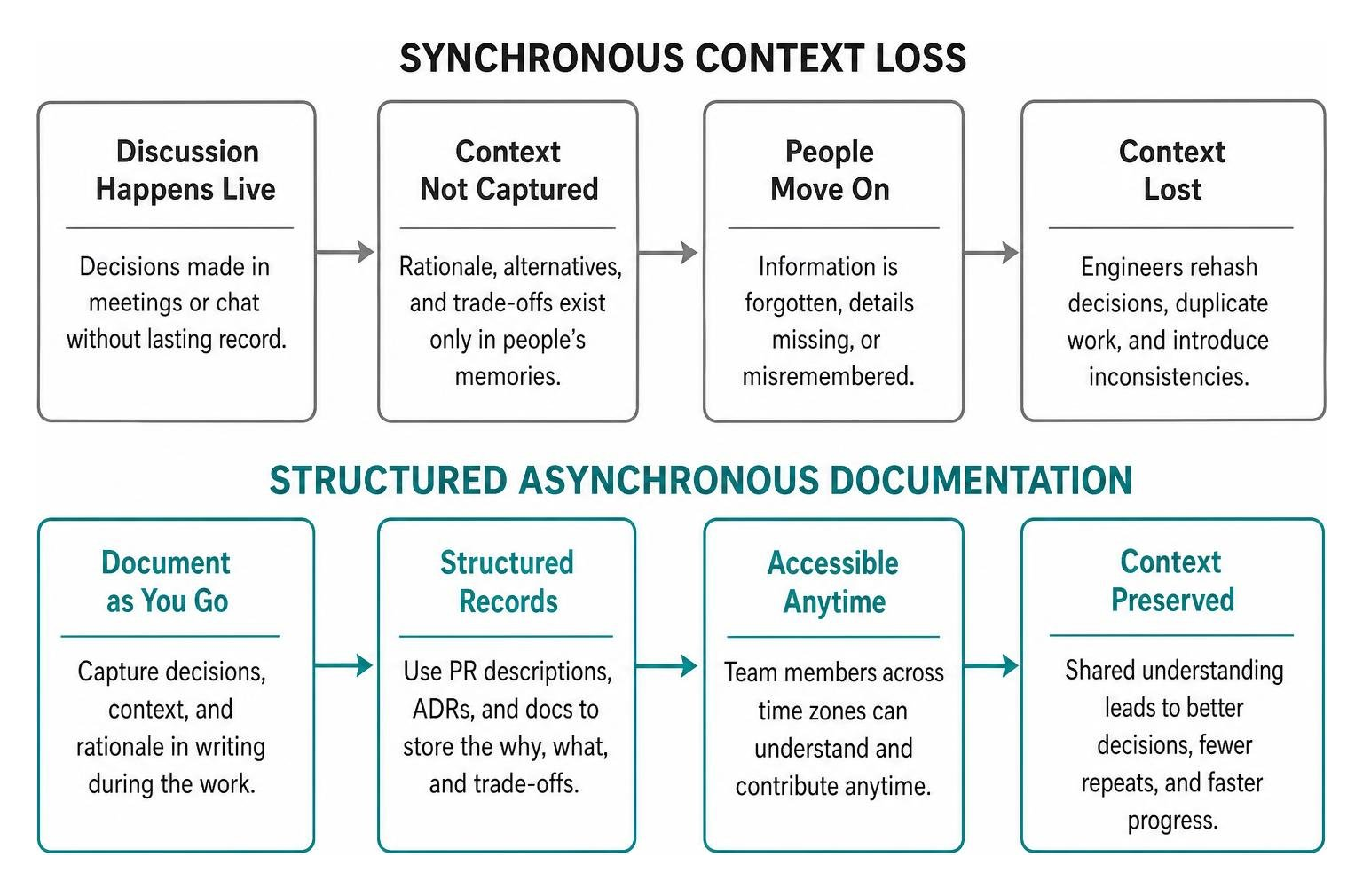
Human memory is reconstructive rather than reproductive. Relying on conversational memory from unrecorded meetings leads to context loss and technical debt. Async-first teams practice documentation-driven engineering by maintaining clear records across every stage of the development lifecycle:
- Architecture Decision Records (ADRs): Short, structured markdown files stored within the repository explaining the context, alternatives considered, and rationale behind architectural choices.
- Context-Loaded Pull Requests: PR descriptions that include the business context, reproduction steps, screenshots or terminal outputs, and direct links to relevant issues.
- Follow-the-Sun Handoffs: At the end of a local workday, developers leave explicit written status handoffs detailing what was completed, open blockers, and recommended next steps for teammates starting their day in another hemisphere.
AI-Native Engineering and High-Velocity Shipping
Modern asynchronous software development is heavily intertwined with AI acceleration. Using remote developer jobs AI tools productivity techniques, engineers can automate boilerplate creation, generate comprehensive unit tests, and resolve complex errors without waiting for a senior colleague in another time zone to jump on a call.
By leveraging AI coding assistants like Cursor and Claude Code with Model Context Protocol (MCP) servers, developers can prototype full-stack applications in hours. Teams value engineers who possess the systems thinking required to direct, audit, and securely control AI outputs—combining rapid vibe-coding speed with rigorous engineering standards.
Frequently Asked Questions About Async Developer Roles
What salary ranges can developers expect in asynchronous positions?
Compensation for asynchronous developer jobs is highly competitive with traditional tech hubs. Because async companies recruit globally, many benchmark compensation against major tier-one or tier-two markets:
- Entry-Level / Junior AI Developers: $75,000 to $95,000 USD, often including equity packages and flexible performance bonuses.
- Mid-Level Engineers (2–5 Years Experience): $105,000 to $155,000 USD across backend, frontend, and data engineering positions.
- Senior AI & Platform Engineers: $140,000 to $225,000 USD at high-growth organizations and venture-backed startups.
- Staff Engineers & Technical Leaders: $160,000 to $235,000+ USD for specialized roles in distributed systems, security, and cloud infrastructure.
How do async companies handle junior developer onboarding and mentorship?
High-performing async companies do not leave junior developers to struggle in isolation. Instead of relying on informal shoulder taps, they build structured onboarding playbooks:
- Comprehensive Handbooks: Step-by-step documentation covering local environment setup, deployment processes, coding conventions, and architectural overviews.
- Paired Asynchronous Reviews: Senior engineers provide detailed, constructive video and written feedback on PRs, explaining the architectural “why” behind code suggestions.
- Shadowing and Onboarding Buddies: New hires are paired with dedicated mentors for check-ins, asynchronous Q&A threads, and targeted pair-programming sessions for complex debugging.
How do distributed engineering teams resolve urgent blocking issues?
Async-first does not mean “never synchronous.” When critical production incidents occur, distributed teams follow established escalation protocols:
- On-Call Pager Rotations: Clear rotation schedules ensure designated engineers are alerted for high-severity system outages regardless of time zone.
- Severity Matrices: Well-defined rubrics establish when an issue warrants a live emergency incident bridge versus when it should be resolved via standard ticketing.
- Blameless Post-Mortems: After an incident is resolved, teams document root causes, timelines, and preventative action items in shared searchable repositories to prevent recurring issues.
Conclusion
The transition toward asynchronous software engineering represents a fundamental improvement in how modern software is built. By replacing continuous calendar interruptions with written clarity, structured documentation, and deep work blocks, async-first environments empower engineers to ship higher-quality software while maintaining full ownership over their daily schedules.
Whether you are building distributed backend systems, exploring agentic AI architectures, or looking for Swift development positions, finding an async-first team allows you to reclaim your focus flow.
Explore our curated listings, refine your written portfolio, leverage modern AI tooling, and take the next step in building a sustainable, high-impact remote engineering career.