Vibe Your Way to a New Career with These Remote Developer Postings
The Rise of Vibe Dev Remote Postings in 2026
vibe dev remote postings are exploding right now — and if you know where to look, the opportunities are genuinely exciting.
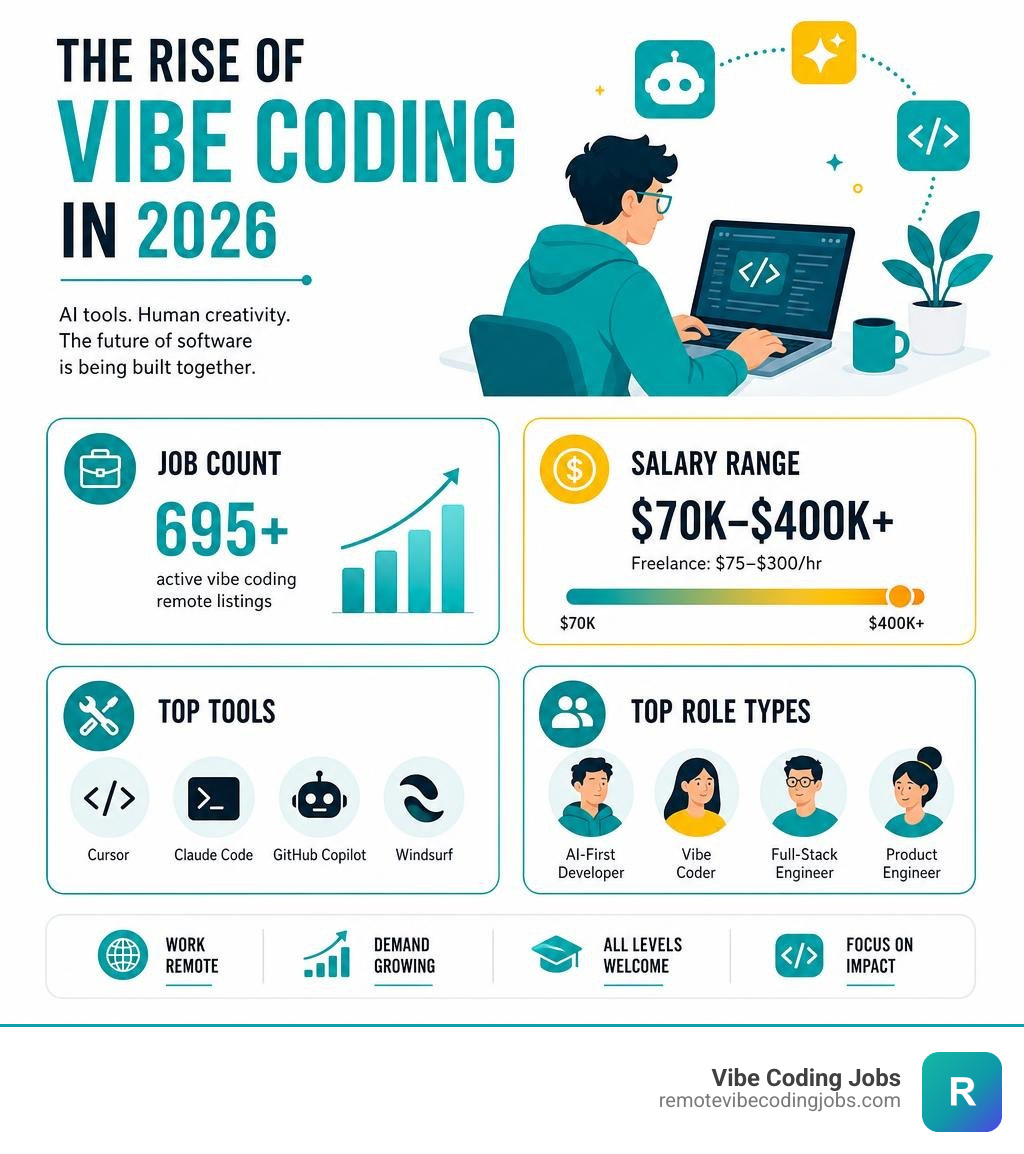
Here’s a quick snapshot of what’s out there:
| What You’re Looking For | What You’ll Find |
|---|---|
| Number of active listings | 695+ curated vibe coding jobs |
| Common job titles | AI-First Developer, Vibe Coder, Full-Stack Engineer, Product Engineer |
| Top tools required | Cursor, Claude Code, GitHub Copilot, Windsurf |
| Salary range | $70K–$400K+ (freelance: $75–$300/hr) |
| Work arrangement | Mostly remote, some hybrid |
| Experience needed | Entry-level to senior; no CS degree required |
The way software gets built is shifting fast. Developers are no longer expected to write every line of code by hand. Instead, the most in-demand engineers in 2026 are the ones who can steer AI tools — describing what they want in plain language, reviewing what comes back, and shipping faster than ever before.
Job boards are reflecting this shift in real time. Roles that once required years of deep syntax knowledge now ask for prompt engineering skills, system-level thinking, and hands-on experience with AI coding assistants. It’s a different kind of developer — and companies are actively hunting for them.
This isn’t a niche trend anymore. It’s how modern engineering teams are being built.
I’m RVCJ Editorial, the team behind Remote Vibe Coding Jobs — we cover AI-assisted development, remote hiring trends, and practical career guidance for developers who use tools like Cursor, Claude, and Copilot to ship better software, and tracking vibe dev remote postings is what we do every day. Read on for everything you need to find, evaluate, and land the right role.
Quick vibe dev remote postings definitions:
What is Vibe Coding and How is it Changing Software Engineering?
At its core, vibe coding represents a fundamental shift in how we build digital products. Instead of manually typing out every bracket, semicolon, and variable declaration, developers use natural language to express their intent. You describe the “vibe” of what you want to build, and advanced AI systems generate the functional code to back it up.
This approach has transformed the software engineering landscape. The developer’s role has evolved from a manual translator of business logic into code to a high-level system architect and product strategist. You orchestrate multiple AI agents, write structured prompts, and guide the development process.
This transition has led to major productivity gains. Teams using these workflows report 2-5x increases in shipping speed within the first month. Experienced developers benefit the most from this shift. Their deep technical knowledge allows them to design robust system architectures, spot subtle logic flaws in AI outputs, and keep projects on track when AI models hit a wall.
To better understand this shift, read our comprehensive guides on What is Vibe Coding and Is Vibe Coding Real Unveiling the Truth Behind the Trend.
The differences between these two eras of software creation are distinct:
| Feature | Traditional Coding | Vibe Coding |
|---|---|---|
| Primary Input | Programming syntax (Java, C++, Python, etc.) | Natural language prompts, system design schemas |
| Focus Area | Syntax correctness, debugging compiler errors | System architecture, product UX, prompt engineering |
| Development Speed | Hours to weeks per feature | Minutes to hours per feature |
| Skill Requirements | Deep knowledge of language-specific APIs | Analytical thinking, system design, tool orchestration |
| Core Tools | Standard IDEs, manual compilers, basic linters | AI-native IDEs (Cursor, Windsurf), agentic workflows |
For a deeper dive into how these two methodologies compare, check out our analysis on Vibe Coding vs Traditional Coding.
How to Decode Vibe Dev Remote Postings
When you are searching through vibe dev remote postings, you will notice that the language in job descriptions has changed. Companies are no longer just looking for a specific number of years of experience in React or Go. Instead, they are looking for candidates who can demonstrate proficiency in AI-native workflows.
To understand these postings, you need to look for key indicator phrases:
- AI-Assisted Development / AI-Native Developer: This means the company expects you to use AI tools as your primary companion.
- Prompt Orchestration: The ability to write, refine, and structure complex prompts to guide AI models through multi-step development tasks.
- System Design and Architecture: Since the AI handles the bulk of the repetitive coding, your main task is figuring out how database schemas, APIs, and front-end components connect securely.
- Debugging AI-Generated Code: Postings will often ask for candidates who have the technical intuition to identify when an AI is stuck in a logic loop and can guide it back on track.
If you want a step-by-step breakdown on reading between the lines of modern job listings, read our guide on Decoding Vibe Dev Job Descriptions.
Top Trends in Vibe Dev Remote Postings for 2026
The job market for AI-fluent professionals in 2026 is highly active. Companies across various stages of growth are adapting their hiring practices to find developers who can work alongside AI.

We are seeing several clear trends across different company sizes:
- Startups: Early-stage companies are looking for rapid MVP builders. They need generalists who can use tools like Bolt.new or Lovable to build functional prototypes in days rather than months. These roles value speed, product intuition, and end-to-end execution.
- Mid-Size Companies: These organizations are hiring “Product Engineers” who can maintain a balance between fast iteration and code quality. They want engineers who can use Cursor to build new features while ensuring that security, testing, and documentation are not overlooked.
- Large Enterprises: Enterprises are hiring specialized roles like “Lead Developer Experience” or “AI Systems Architect.” These professionals are responsible for rolling out AI-assisted development strategies across large engineering departments, selecting the right tooling, and ensuring secure code generation.
The compensation for these roles is highly competitive. According to our Vibe Coding Salary Guide Remote, entry-level vibe coders can expect to earn between $70,000 and $100,000. Mid-level developers typically see ranges from $100,000 to $150,000, while senior AI-first developers can command salaries between $150,000 and $250,000+, with some specialized enterprise roles reaching up to $400,000. Freelancers and contractors are also seeing strong demand, with hourly rates ranging from $75 to $300 per hour depending on their expertise.
To understand the broader hiring landscape, refer to our Remote Vibe Coding Jobs Guide.
Where to Find the Best Vibe Dev Remote Postings
If you search for these roles on general job boards, you will often have to sift through thousands of traditional software engineering roles that do not support AI-assisted workflows. To find companies that actively encourage the use of AI, you need to look in the right places.
The most effective approach is to use curated platforms that focus specifically on this space. On our job board, we aggregate listings from async-first companies that support AI-native development. You can filter jobs by the specific AI tools they use (such as Cursor or Claude Code) and their remote work policies.
For a list of companies that are actively building out their AI-fluent teams, check out our resources on Remote Vibe AI Coding Jobs and Companies Hiring Vibe Coders AI Developers.
Real-World Examples of Companies Hiring Vibe Developers
To give you a better idea of what these opportunities look like in practice, let’s look at some real-world job postings from companies hiring in 2026:
- Vibe Bio: This company builds an AI-powered pharmaceutical intelligence platform. They have recruited for a remote Full-Stack Engineer – Vibe Bio to help scale their client-facing platform. This role involves integrating large language models via APIs, designing front-end architectures, and working with a modern tech stack of React, PostgreSQL, AWS, and Python.
- Manta Ray Labs: This team actively recruits Vibe Coding Developers for Web3 projects. They look for developers who are highly skilled in leveraging AI programming tools like ChatGPT, Copilot, and Claude to build applications. The role combines AI-assisted development with Web3 requirements like smart contracts, wallet integrations, and on-chain data.
- Vibe.co: A fast-growing streaming TV advertising platform that reached a $100 million revenue run rate in under two years. They have hired for a Lead Developer Experience role with a salary range of €90,000–€120,000 plus equity. This position is focused on establishing AI-assisted development practices, managing the adoption of coding agents like Claude Code and Cursor, and optimizing developer workflows. You can learn more about their team on the Vibe.co Remote Developer Roles page.
Other notable opportunities include contract roles like the Hiring Fullstack Engineer @Vibe position based in France, which focuses on building robust API integrations, and specialized regional postings like the Remote Leverage hiring Vibe Coder in European Union | LinkedIn listing.
Key Skills and AI Tools Required for Vibe Developers
To stand out when applying for vibe dev remote postings, you need to be familiar with the modern AI-powered developer toolkit.

Here are the primary tools that companies are looking for in 2026:
- Cursor: An AI-first code editor built on top of VS Code. It allows you to chat with your codebase, generate edits in place, and auto-complete multi-line changes with high accuracy.
- Claude Code / Claude: Anthropic’s developer-focused tools are highly valued for their reasoning capabilities, complex debugging, and understanding of large codebases.
- Windsurf: An AI-native IDE that excels at collaborative agentic workflows, helping developers manage complex multi-file edits seamlessly.
- Bolt.new & Lovable: These tools are popular for rapid front-end prototyping and building full-stack web applications entirely from natural language descriptions.
- GitHub Copilot: The standard AI autocomplete tool that remains a staple in many enterprise development environments.
While these AI tools handle the bulk of code generation, you still need a solid foundation in core web technologies. The most common languages and frameworks requested in vibe coding postings are TypeScript, JavaScript, Python, React, Next.js, and Node.js.
Understanding these programming fundamentals is a major advantage. It allows you to write better prompts, understand the structure of the generated code, and step in to make manual adjustments when the AI output needs fine-tuning.
To explore this toolkit in more detail, read our guide on the Vibe Coding Tools AI Powered Arsenal.
Transitioning to an AI-First Career Path
If you are transitioning from a traditional software development background, or entering the tech industry for the first time, here are the steps we recommend to build an AI-first career:
- Shift Your Mindset: Move your focus from memorizing syntax to mastering system architecture and product logic. Spend your time thinking about how data flows through your application, how to secure your endpoints, and how to create a great user experience.
- Build a Practical Portfolio: The best way to prove your skills to employers is by showing them what you have built. Create real, functional web applications using AI tools and document your process.
- Document Your AI Workflows: Show employers how you collaborate with AI. A great practice is to include files like SKILL.md or ARCHITECTURE.md in your public repositories. These files explain the system design and provide context on how you used AI agents to build the project.
- Learn Prompt Engineering: Practice writing structured, clear prompts. Learn how to give AI models the right context, define their role, and break down complex features into smaller, manageable instructions.
For a detailed roadmap on how to make this transition, read our guides on How to Get a Vibe Coding Job and the Vibe Coding Remote Career Path.
Frequently Asked Questions About Vibe Coding
What is the average salary for a vibe coding role?
Vibe coding compensation is highly competitive. Entry-level positions generally range from $70,000 to $100,000 per year. Mid-level roles typically pay between $100,000 and $150,000, while senior AI-first developers and systems architects can earn anywhere from $150,000 to $250,000+. Freelance rates are also strong, ranging from $75 to $300 per hour depending on your technical expertise and product design skills.
Do I need a computer science degree to get a vibe coding job?
No, many companies hiring for vibe coding positions value practical skills, problem-solving abilities, and a strong portfolio over formal credentials. Because these roles rely heavily on your ability to leverage AI tools effectively, showing functional projects that you have built and deployed is often much more valuable to employers than a traditional CS degree.
Can vibe coding completely replace traditional software developers?
No, vibe coding is an evolution of the software developer’s role, not a replacement. While AI tools are excellent at writing boilerplate code, generating standard functions, and automating repetitive tasks, human developers remain essential. Companies still need humans to design complex system architectures, ensure security compliance, navigate business requirements, and provide creative problem-solving when AI tools reach their limits.
Conclusion
The rise of vibe dev remote postings in 2026 represents an exciting new chapter for software engineering. By shifting the focus from manual coding to system design, product strategy, and AI orchestration, vibe coding opens up new opportunities for both experienced developers and aspiring tech professionals.
If you are ready to take the next step in your career and join an forward-thinking, async-first team, we can help. Visit our platform at Remote Vibe Coding Jobs to browse our curated daily listings, find companies that support AI-assisted workflows, and access our free playbook to help you land your next remote role.