Where the Good Jobs Are: A Curated Coding Job Board Guide
The Job Search Is Broken – Here’s How a Curated Coding Job Board Fixes It
A curated coding job board cuts through the noise of mass-market platforms by manually vetting both jobs and candidates – so you only see real, active roles that match your stack and experience level.
Quick answer: What to look for in a curated coding job board in 2026
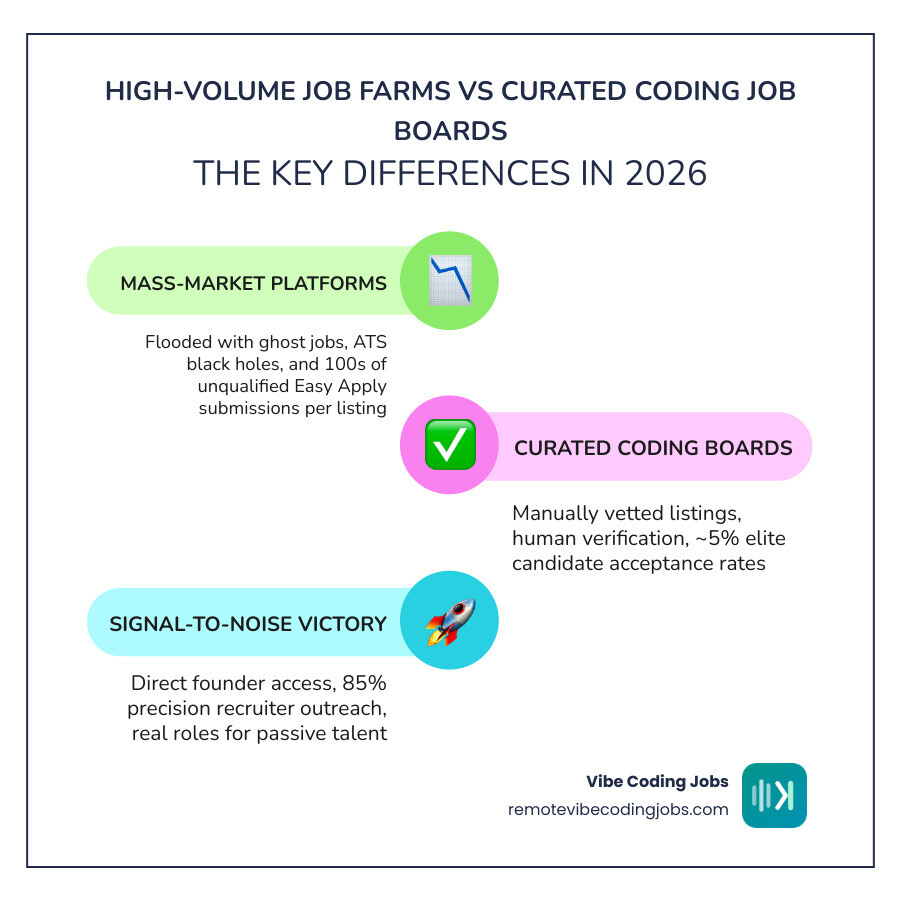
- Human Vetting: Platforms that manually review candidates to maintain a high signal (often ~5% acceptance rate).
- Direct Access: Boards that provide direct lines to founders or hiring managers, bypassing traditional HR filters.
- Niche Focus: Specialized listings for frontend, backend, or AI-native “vibe” coding roles.
- Transparency: Clear data on equity, salary, and tech stacks provided upfront.
- Active Hiring Tags: Verified listings that ensure the role is currently open and not a “ghost job.”
You spend hours tailoring your resume. Then silence. Or worse – an automated rejection from a job that was already filled weeks ago.
This is the daily reality on high-volume job platforms. Job postings can rack up hundreds of applicants within hours. Recruiters often rely on keyword filters and ATS systems that reject qualified engineers before a human ever sees their name. One common complaint across developer communities is that mass-apply systems create “black holes” where low-effort applications flood inboxes, making it nearly impossible for anyone to stand out.
The numbers back this up:
- 70% of software engineers are passive candidates – not actively job hunting, but open to the right opportunity
- 85% of recruiters on large professional networks focus on mass outreach rather than precision targeting
- ATS systems can lag days behind a company’s actual hiring status, meaning you might apply to a ghost job without knowing it
The fix isn’t applying to more jobs. It’s applying to better ones – on platforms built to filter signal from noise.
I’m RVCJ Editorial, the team behind Remote Vibe Coding Jobs, where we cover AI-assisted development, remote hiring trends, and practical job-search strategy for developers building with tools like Cursor, Claude, and Copilot – including how to find the right curated coding job board for your specific stack and career stage. This guide breaks down exactly where the good jobs are hiding in 2026. For broader labor-market context, the U.S. Bureau of Labor Statistics Occupational Outlook Handbook for Software Developers is a useful reference.
Why Every Senior Engineer Needs a Curated Coding Job Board in 2026
By 2026, the traditional job search has evolved from a discovery problem into a signal-to-noise problem. For senior engineers, time is the most valuable asset. Spending forty hours a week navigating mass-application workflows is a recipe for burnout. This is where a curated coding job board becomes an essential part of a professional toolkit.
Unlike general platforms, curated boards prioritize quality over quantity. They act as a “spear” rather than a “net.” In a market where 70% of engineers are passive candidates, top-tier talent isn’t looking for more job listings; they are looking for better introductions. Curated marketplaces solve this by implementing human vetting. For instance, some premium platforms maintain a candidate acceptance rate of approximately 5%, ensuring that when a company sees your profile, they know you’ve already cleared a high bar of technical and professional excellence.

Solving the Resume Black Hole Problem
We’ve all been there: you submit a perfect application and never hear back. This “black hole” is often caused by Applicant Tracking System (ATS) lag. A job might be filled internally, but the listing stays live on a large job platform for weeks because the sync hasn’t triggered.
Curated boards eliminate this by manually verifying listings. When you use a specialized curated platform, you are often accessing roles that have been double-checked for freshness. Furthermore, many of these boards offer direct founder access. Instead of your resume sitting at the bottom of a pile of 500 applicants, it goes directly to the person making the decision. This reduces the friction of the “automated rejection” loop that plagues general sites.
The Shift Toward High-Signal Hiring
In 2026, recruiters have moved away from mass “spray and pray” tactics. Research shows that many recruiters on general platforms focus on high-volume outreach, but this often lacks technical precision. Curated boards flip the script. They offer “reverse marketplaces” where companies apply to you.
By focusing on high-signal data – such as verified tech stacks, salary transparency, and relocation preferences – these platforms ensure that every interaction has a high probability of success. If you are specifically looking for stability and deep-tech roles, checking specialized listings for Remote Backend Developer Jobs allows you to bypass the entry-level noise and focus on roles that value your architectural expertise.
5 Types of Curated Platforms for Every Developer Niche
The “one size fits all” job board is dead. Today, the most effective way to find a role is to use a board that understands your specific sub-discipline. Whether you are a startup enthusiast or a DevOps specialist, there is a curated coding job board tailored to your needs.

Best Curated Coding Job Board Features for Startups
For those who want to get in on the ground floor, startup-focused boards are the gold standard. These platforms prioritize salary and equity transparency, which is often hidden on corporate sites. You can filter by funding round – such as Series B or Seed – to find a company that matches your risk tolerance. The best startup-focused platforms also provide direct access to founders or hiring managers and keep role details current. If you’re a generalist who loves building from scratch, Remote Fullstack Developer Jobs on these boards are frequently the highest-signal opportunities available.
Specialized Boards for Frontend and DevOps
General boards often struggle to differentiate between a “Web Developer” and a “Senior Frontend Architect.” Curated boards for frontend roles focus on framework expertise, tagging jobs specifically for React, TypeScript, or Design Systems. This “Zero Noise” approach means you won’t waste time on roles that don’t match your specific JavaScript flavor.
On the infrastructure side, DevOps and SRE roles require a different kind of curation. These boards look for “infrastructure engineering” skills rather than just “IT support.” You can find these high-level roles by browsing Remote Frontend Developer Jobs or specialized infrastructure lists that verify the company’s tech stack before listing the role.
Niche Marketplaces for AI and Machine Learning
With the explosion of AI in 2026, general job boards are flooded with “AI prompts” that are actually just basic marketing roles. A true curated board for AI/ML roles focuses on systems administration, data curation, and model orchestration. These boards are essential for finding roles that require deep technical knowledge of RAG pipelines or LLM infrastructure. If you are looking to move into the cutting edge of the industry, checking Remote Machine Learning Engineer Jobs on a curated site ensures you are looking at actual engineering roles, not just “AI-adjacent” fluff. You can explore the full range of these specialized positions at Remote Engineering Jobs.
The Rise of Vibe Coding and AI-Assisted Roles
A new category of developer has emerged in 2026: the “Vibe Coder.” Also known as Agentic Engineering, this is the practice of using high-level intent and AI tools like Cursor, Claude, and Windsurf to build software at 10x speed. This isn’t just about using a chatbot; it’s a fundamental shift in the “builder identity.”
Finding a Curated Coding Job Board for AI-Native Developers
Traditional job boards don’t have a filter for “AI-fluent.” They might search for “Python,” but they won’t tell you if a company embraces a “vibe coding” workflow. Modern curated boards now include filters for specific AI tools. They look for developers who can orchestrate AI agents and manage the software development lifecycle (SDLC) through natural language prompts. If your workflow involves heavy use of Cursor or Claude, you need to find companies that don’t just “allow” these tools but require them for their high-velocity teams. If you’re a company looking to stay ahead, you can Hire AI Engineer talent that already masters these agentic workflows.
Why “Vibe Coding” is the New Industry Standard
Vibe coding shifts the developer’s role from “code typist” to “software architect.” By delegating boilerplate and syntax to AI, engineers can focus on strategic thinking and user value. Research suggests this can lead to a 2x to 5x increase in productivity within the first month of adoption.
The industry is moving toward “agentic interviews,” which test your ability to guide an AI to a solution rather than your ability to invert a binary tree on a whiteboard.
| Feature | Traditional Job Boards | Curated Job Boards | Vibe Coding Boards |
|---|---|---|---|
| Volume | High (High Noise) | Medium (High Signal) | Targeted (AI-Native) |
| Vetting | Automated/None | Human-Powered | Culture & Tool-Fit |
| Speed | Slow (Weeks) | Fast (Days) | Ultra-Fast (Real-time) |
| Primary Tool | Resume/LinkedIn | Vetted Profile | Portfolio/Loom/AI-Flow |
How to Optimize Your Profile for High-Signal Marketplaces
Applying to a curated coding job board is different from a standard application. Because these platforms often use human-powered vetting, your profile needs to communicate “impact” rather than just “duties.”
Standing Out to Hiring Managers in 2026
In a curated marketplace, your GitHub isn’t just a collection of repositories; it’s a proof of work.
- The Loom Video Trick: In 2026, a two-minute Loom video walking through a complex feature you built is worth more than ten paragraphs of a cover letter. It shows your communication style and your “vibe” immediately.
- Quantify Impact: Instead of saying you “wrote React code,” say you “increased user retention by 15% by refactoring the onboarding flow.”
- Startup Fit: Highlight your experience in small, high-velocity teams. Mentioning your ability to own a project from “prompt to production” is a massive green flag for modern startups.
Metrics That Prove Curation Effectiveness
How do you know if a board is actually curated or just a glorified scraper? Look for these metrics:
- Candidate Acceptance Rate: If a board accepts 100% of applicants, it’s not curated. Premium boards often hover around 5-10%.
- Response Times: On curated boards, you should see a response (even if it’s a no) within 48-72 hours.
- Qualified-Screen Pass Rate: If you get an interview through a curated board, your chances of passing the initial screen should be significantly higher because the “signal” was already verified.
- Signal-to-Noise Ratio: You should only receive 1-3 high-quality introductions per month rather than 50 spammy recruiter messages.
Frequently Asked Questions about Curated Job Boards
Why are curated boards better than mass-market job platforms?
Mass-market platforms like LinkedIn are built for reach, while curated boards are built for precision. On general sites, the “Easy Apply” feature leads to hundreds of unqualified applicants, forcing recruiters to use aggressive keyword filters that often miss great talent. A curated coding job board uses human vetting to ensure that every candidate meets a specific technical bar, saving everyone time.
Do curated coding job boards charge candidates?
Most curated boards are free for candidates. They typically operate on an “employer success fee” model, meaning they only get paid when a company successfully hires you. This aligns the platform’s incentives with your own: they want to find you a high-quality job you’ll actually stay at. Some offer “premium” tiers for faster access to exclusive roles, but the core marketplace is usually free for engineers.
How often are curated listings updated?
Top-tier curated boards refresh their listings every 24 hours. Because they use manual verification and “Actively Hiring” tags sourced from hiring manager social posts, the jobs you see are guaranteed to be open. This prevents the “ghost job” phenomenon where you apply for a position that was filled three weeks ago.
Conclusion
The job market in 2026 demands a more sophisticated approach than the “spray and pray” methods of the past. As the industry moves toward async-first cultures and AI-assisted development, your choice of platform matters more than ever.
At remotevibecodingjobs.com/, we believe the future of work is about “vibes”—the alignment of culture, tech stack, and modern AI tools. Curation is the only way to protect your time and find a role that respects your skills. Whether you are looking for a 4-day work week, a remote-first startup, or a team that encourages you to use Cursor and Claude to ship faster, the “good jobs” are out there. You just have to look where the noise has been filtered out.
Ready to find your next role? Skip the black hole and join the builder economy today.