
Navigating Culture Fit: The New Rules for AI Assisted Coding
The New Rules for AI Assisted Dev Positions in 2026
AI assisted dev positions are one of the fastest-growing job categories in tech right now, with over 9,000 openings in the US alone — 6,000+ posted in just the past month.
Here’s a quick snapshot of what these roles look like today:
| Role | Typical Salary | Key Tools |
|---|---|---|
| Entry-Level AI Developer | $70K–$100K | Cursor, Bolt.new, GitHub Copilot |
| Mid-Level AI Engineer | $100K–$150K | Claude Code, Windsurf, Cursor |
| Senior AI-First Developer | $150K–$250K+ | Full AI stack + architecture |
| Staff AI Tooling Engineer | $204K–$300K | Agent pipelines, LLM infra |
| Freelance AI Developer | $100–$300/hr | Varies by project |
The rules for getting hired in software development have changed — fast.
It’s no longer just about knowing a language or framework. Companies like Airbnb, Sentry, and Brex are actively rebuilding their internal developer infrastructure around AI agents. They’re hiring people who can think in systems, guide AI tools effectively, and ship production-ready code at a pace that wasn’t possible two years ago.
The term “vibe coding” — describing the shift from writing syntax manually to directing AI with natural language — has gone from a niche Reddit joke to a legitimate hiring criterion at Fortune 500 companies.
This isn’t a distant future trend. It’s the job market right now.
Whether you’re a senior engineer skeptical of the hype, a junior developer using AI scaffolding to punch above your weight class, or a manager trying to hire for skills that didn’t exist three years ago — understanding this shift is no longer optional.
I’m RVCJ Editorial, the team behind Remote Vibe Coding Jobs, where we cover AI assisted dev positions, async hiring trends, and the tools shaping modern engineering workflows. In the sections below, we’ll break down exactly what these roles require, what they pay, and how to navigate the culture fit expectations that come with them.
Defining Vibe Coding and the Shift in AI Assisted Dev Positions
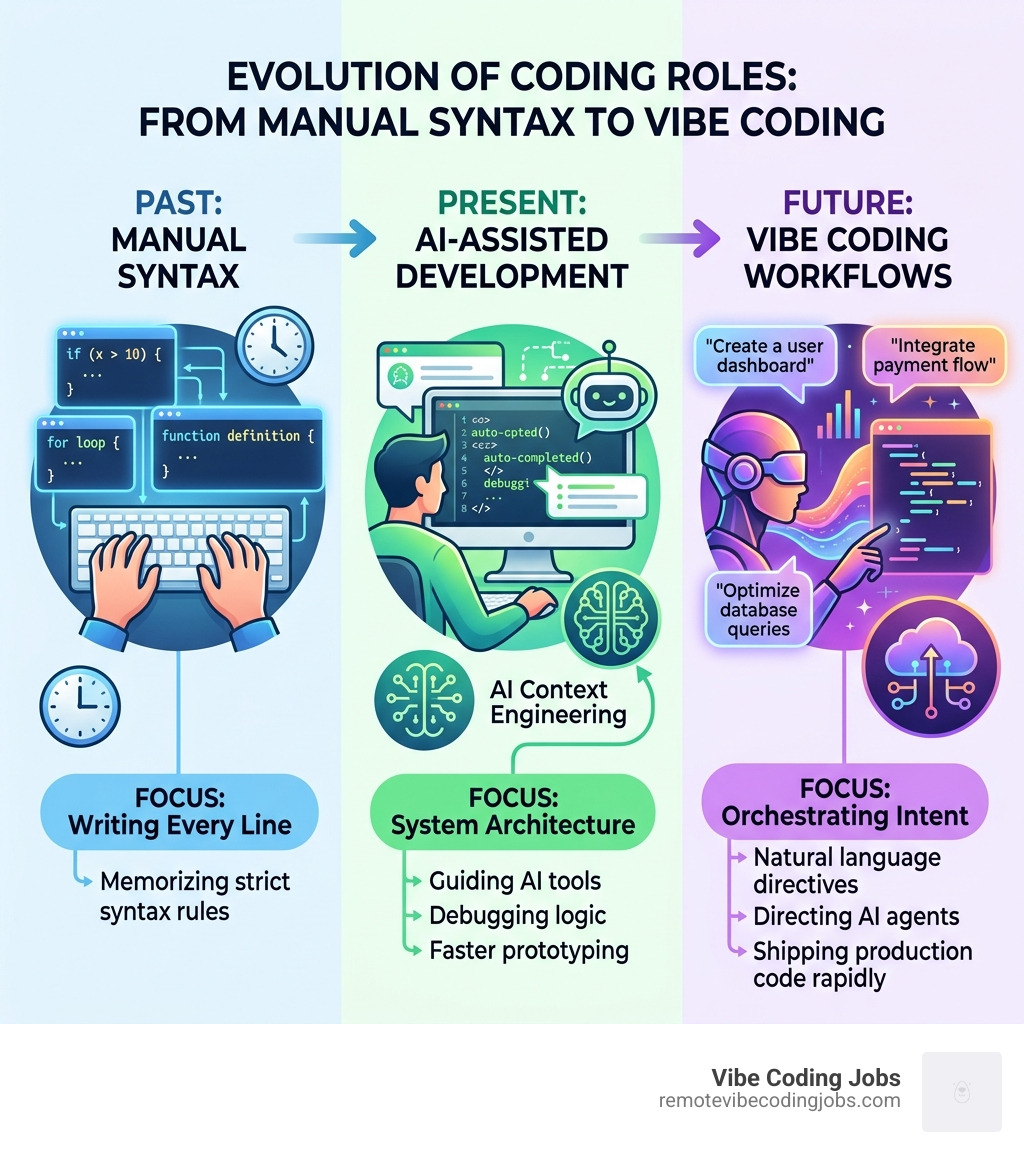
In 2026, the term “vibe coding” has matured into a professional philosophy. At its core, vibe coding is the transition from being a “code typist” to a “software architect.” Instead of spending hours debugging a semicolon or memorizing the specific syntax for a complex library, we now describe the “vibe”—the intent, logic, and desired outcome—of our software in natural language.
This shift is fundamentally redefining ai assisted dev positions. Traditional roles focused heavily on manual implementation. Today, the core competency is the ability to maintain a high-level architectural mental model while letting AI handle the heavy lifting of code generation. According to current Remote AI Developer Jobs: Requirements, the modern developer needs to be fluent in “context engineering”—knowing exactly what information to provide an AI so it can generate functional, secure, and scalable code.
Developers transitioning to this workflow report massive productivity gains, often seeing a 2x to 5x increase in output within their first month. It’s not just about speed, though; it’s about the democratization of creation. We’re seeing creative professionals and former managers return to the codebase because the barrier to entry—syntax mastery—has been lowered, replaced by the need for strong logical reasoning and product vision.
The 2026 Tech Stack: Essential Tools for AI-Fluent Professionals
If you are applying for ai assisted dev positions, your “stack” is no longer just React or Go; it’s the suite of AI agents you use to manipulate those languages. The industry has consolidated around a few “essential” tools that every AI-fluent professional must master:
- Cursor: Currently the gold standard for AI-native IDEs. It goes beyond simple autocomplete by understanding your entire codebase, allowing for “Composer” mode where it can write across multiple files simultaneously.
- Claude Code: A terminal-based agent that is highly praised for its reasoning capabilities. It excels at complex refactoring and understanding deep architectural patterns.
- Windsurf: The first “agentic” IDE that offers a “Flow” state, where the AI and developer work in a continuous, synchronized loop.
- Bolt.new and Lovable: These are the go-to tools for rapid prototyping, allowing developers to move from a prompt to a deployed full-stack application in minutes.
Choosing the right tool for the job is a skill in itself. For a deep dive into how these compare, we recommend checking out Cursor vs Copilot vs Claude.
Major tech players are also getting into the mix. For example, the Member of Technical Staff, Developer Experience – MAI Superintelligence Team | Microsoft AI focuses specifically on building the infrastructure that makes these tools possible, including CI/CD pipelines for massive ML training workloads. Being “AI-fluent” in 2026 means knowing how to orchestrate these tools to move from an idea to a production-ready pull request in a fraction of the traditional time.
Why Companies are Restructuring for Agent-Ready Infrastructure
It’s one thing for an individual to use an AI tool; it’s another for a 1,000-person engineering org to be “agent-ready.” Leading companies like Airbnb and Sentry are currently undergoing massive internal restructures to ensure their developer systems are accessible to AI agents.
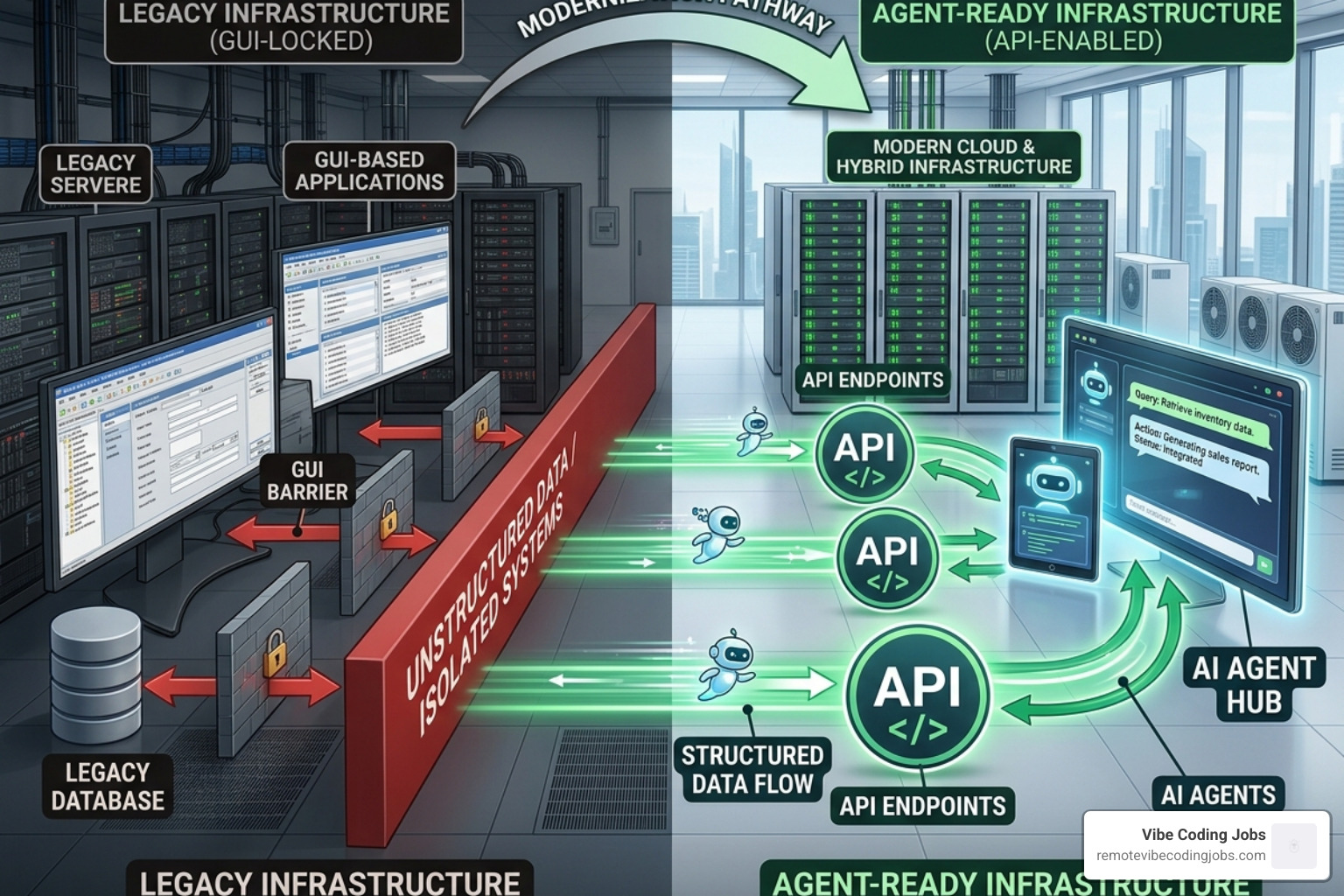
Traditional internal tools were designed for humans, meaning they were locked behind graphical user interfaces (GUIs). To be agent-ready, these systems must be API-first. As noted in the job description for a Staff Software Engineer, Dev AI, Developer Infrastructure – Careers at Airbnb, the goal is to build “building blocks” that allow AI agents to navigate the software development lifecycle (SDLC) autonomously.
This involves:
- Context Injection: Making sure the AI has access to the right documentation, logs, and previous PRs.
- API Exposure: Turning internal dashboards into endpoints that an agent can query.
- Automated Guardrails: Since AI can generate code faster than humans can review it, companies are building automated “harnesses” that test for security, performance, and style before a human even sees the code.
The Barbell Pattern: Navigating Career Growth
One of the most fascinating trends we’ve observed in 2026 is the “barbell pattern” of AI adoption. In this scenario, productivity gains are concentrated at the two ends of the experience spectrum, while mid-level engineers often face a plateau.
- Juniors: With AI “scaffolding,” a junior engineer can often outpace a senior who doesn’t use these tools. The AI compensates for their lack of syntax knowledge, allowing them to ship features that would traditionally require years of experience.
- Senior Managers/Architects: These professionals have the deep architectural knowledge to “direct” the AI effectively. They can spot a flaw in a system design instantly and use AI to implement the fix in seconds.
- The Mid-Level Plateau: Mid-level engineers sometimes resist these tools because they have spent years mastering manual syntax—a skill that is rapidly being commoditized. There is a “unlearning” process required that can be uncomfortable.
To stay competitive, engineers must focus on AI-Assisted Development: Career Opportunities + Growth Trends, which emphasizes moving toward high-level system design and product engineering.
Emerging Roles and Salaries in AI Assisted Dev Positions
The shift in how we work has birthed entirely new job titles with high compensation packages. We are seeing a move away from generic “Software Engineer” titles toward more specialized AI-centric roles.
- AI Enablement Engineer: These pros own the adoption of AI tools within an org. They configure agents, triage tool failures, and run enablement sessions.
- AI Systems Architect: This role focuses on the “agent-readiness” mentioned earlier—designing systems that AI agents can actually work within.
- Product Engineer (AI-First): A hybrid role that blends traditional engineering with product design, using AI to rapidly iterate on user-facing features.
Salaries for these ai assisted dev positions are impressive. A Staff Software Engineer, AI Developer Tooling – Careers at Sentry | Sentry can expect a base salary between $240,000 and $300,000. Even entry-level “vibe coders” are seeing starts in the $90k-$130k range. For a full breakdown of what you can earn, see Remote AI Developer Jobs: Tools + Salary.
Maintaining Quality in AI-Generated Codebases
The biggest challenge in ai assisted dev positions isn’t generating code—it’s ensuring that code is “production-ready.” AI is excellent at creating functional “happy path” code, but it can struggle with edge cases, security vulnerabilities, and long-term maintainability.
| Feature | Traditional Workflow | AI-Assisted (Vibe) Workflow |
|---|---|---|
| Speed | Slow, manual typing | Instant generation via prompt |
| Focus | Syntax and implementation | Architecture and intent |
| Error Source | Human typos/logic gaps | AI hallucinations/context loss |
| Review Process | Peer review of logic | Automated testing + Peer review |
| Maintenance | High manual effort | AI-assisted refactoring |
To maintain quality, top-tier AI developers use “Spec-Driven Development.” They write detailed specifications and tests first, then prompt the AI to fulfill those specs. This ensures that the generated code isn’t just a “vibe,” but a robust piece of engineering. Security is also a major focus; AI-fluent devs use tools to scan for “pedigree”—making sure the AI hasn’t inadvertently introduced insecure patterns or licensed code snippets.
Hiring and Evaluation: Identifying High-Agency Talent
Hiring managers have had to throw out the old playbook. When anyone can pass a LeetCode test using ChatGPT, how do you find real talent? The answer lies in identifying “high-agency” individuals.

A high-agency developer doesn’t just wait for a ticket; they use AI to prototype solutions, find bugs, and suggest improvements autonomously. They are “force multipliers” who use AI to handle the mundane, freeing them to solve the hardest problems.
How to Hire for High-Agency AI Assisted Dev Positions
When evaluating candidates for ai assisted dev positions, we recommend a “Bring Your Own AI” interview. Instead of banning tools, encourage them. Watch how the candidate:
- Prompts: Do they give vague instructions, or do they provide structured context?
- Verifies: Do they blindly paste AI code, or do they walk through it and explain the logic?
- Iterates: When the AI makes a mistake (and it will), how quickly can the candidate debug and redirect the agent?
Candidates with solo projects are often the best hires. A completed, deployed app built by one person using AI is a stronger signal than five years of “maintenance” experience at a legacy firm. This is why AI Coding Jobs: Entry Level + Growth Potential suggests that a strong AI-built portfolio is the new resume.
Frequently Asked Questions about AI Assisted Development
What is the ‘barbell pattern’ in AI adoption?
The barbell pattern refers to the phenomenon where junior developers and senior architects see the highest productivity gains from AI, while mid-level engineers often struggle. Juniors use AI as “scaffolding” to perform at a higher level, while seniors use it to execute their complex architectural visions faster. Mid-level engineers, who often focus on implementation speed as their primary value, find that AI commoditizes their core skill, requiring them to shift toward architecture or product design to stay relevant.
Can I get an AI-assisted dev position without a CS degree?
Yes, absolutely. In 2026, the “proof is in the product.” Many companies now value a portfolio of AI-assisted projects over a formal degree. If you can demonstrate that you understand software logic, can architect a system, and can effectively use tools like Cursor or Claude to ship a working product, you are highly hirable. Vibe coding has lowered the “syntax barrier,” making practical skills and prompt engineering the new gold standard.
How does vibe coding change the 10x productivity debate?
The “10x developer” was once a myth or a rarity; with AI, it is becoming a standard. By automating routine tasks like unit testing, documentation, and boilerplate code, developers can focus entirely on high-value features. While a 10x increase in “lines of code” is easy, the real 10x comes from “feature velocity”—the ability to move a product forward ten times faster while maintaining high quality through automated guardrails.
Conclusion
The era of manual, line-by-line coding isn’t over, but it is no longer the primary way value is created in software engineering. AI assisted dev positions are the new frontier, offering higher salaries, faster career growth, and the ability to build more than ever before.
At Remote Vibe Coding Jobs, we are dedicated to helping you navigate this shift. Whether you are looking for a role at an AI-first startup or a major tech giant like Airbnb, the opportunities are endless for those who embrace the “vibe.”
Ready to find your next role? Visit https://remotevibecodingjobs.com/ to browse curated listings for AI-fluent professionals and join the future of development today.