
Vibe Coding Job Applications Are Booming — Here’s What You Need to Know
Vibe coding job applications have exploded in 2026, and if you’re ready to get hired, here’s the fast answer:
How to apply for vibe coding jobs:
- Build a portfolio of 3-5 live, public URLs showing AI-assisted projects
- Master core tools: Cursor, Claude Code, Bolt.new, and Lovable
- Highlight prompt engineering and code review skills on your resume
- Target Lead and Staff+ listings — that’s where 80%+ of roles sit
- Apply through specialized job boards that curate verified vibe coding roles
The market is real and it’s moving fast. There are now 1,842 active listings across 22 job board sources, up 340% year-over-year. The median salary sits at $160,000 — roughly 20% above the wider software engineering median. And 73% of roles are fully remote.
The term itself was coined by AI researcher Andrej Karpathy in February 2025. He described it as staying in a flow of ideas, describing what you want in natural language, and letting AI handle the implementation — without getting bogged down in every line of syntax.
That idea went from a tweet to a hiring page faster than almost any developer specialism in recent memory.
But applying for these roles isn’t the same as applying for a traditional software engineering job. Hiring managers want to see shipped products, not just a CV. They want proof you can guide AI tools, review the output critically, and own a feature end-to-end — from prompt to deployed URL.
This guide walks you through exactly how to do that.
I’m Di Su, a software engineer with over 10 years of experience in web development and scalable product building, and I’ve spent time on both sides of the hiring process — including navigating vibe coding job applications as the field formalized in 2025 and 2026. My background in full-stack development and growth engineering gives me a practical lens on what actually gets candidates hired in this market.
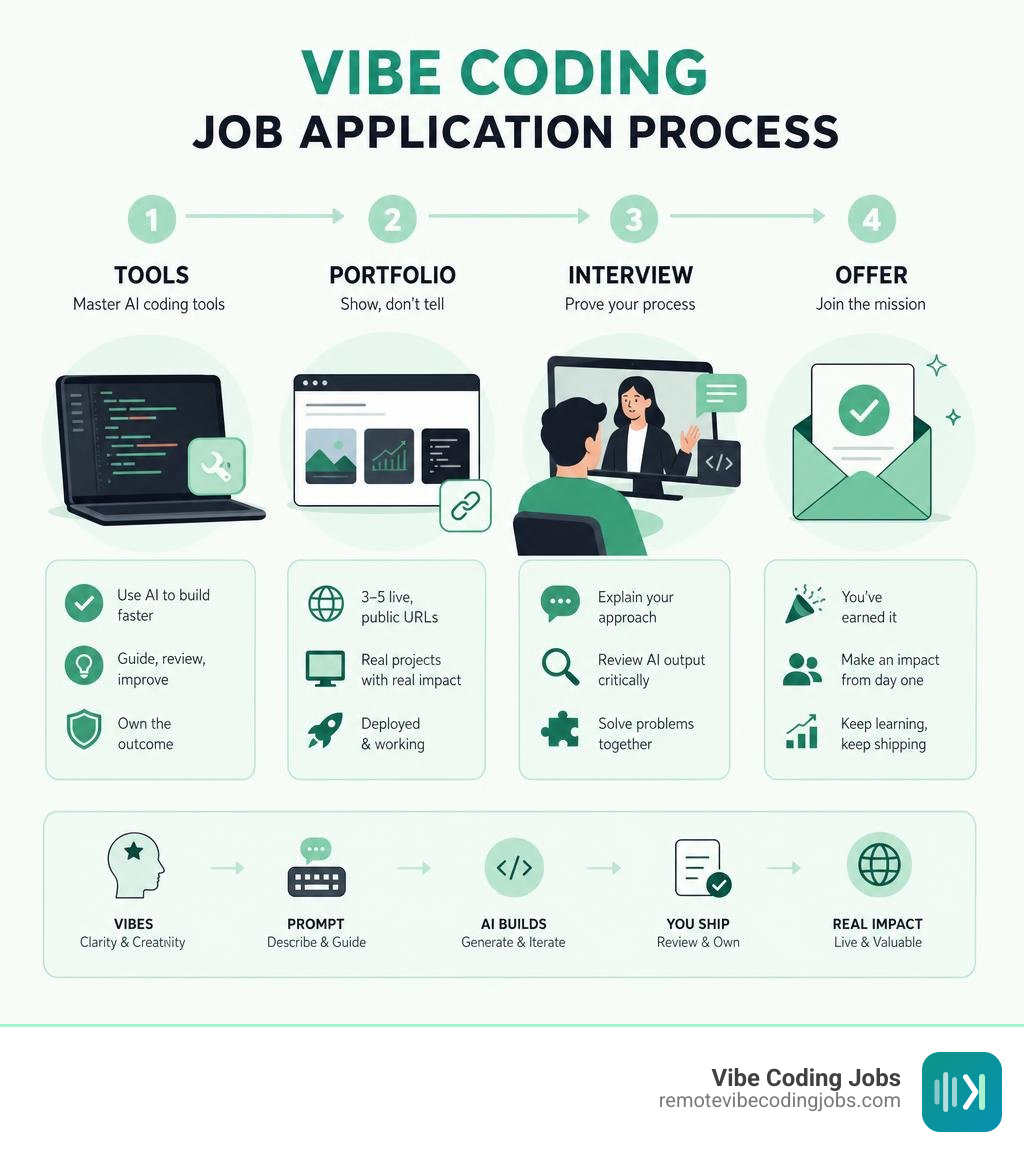
Vibe coding job applications terms explained:
What is Vibe Coding and How Does It Impact the 2026 Job Market?
To understand how to approach your job hunt, we first need to define the paradigm shift taking place. At its core, vibe coding is a modern software development approach where natural language prompts guide AI tools to generate, refactor, and optimize code. Instead of spending hours manually typing out boilerplate syntax, a vibe coder operates as a director, software architect, and strategist.
In our detailed breakdown of What is Vibe Coding?, we outline how this changes the daily rhythm of engineering. Instead of being isolated “code typists,” developers spend their time on high-level system design, product thinking, and validation.
This shift has captured the attention of major tech players. As reported in the Tech Firms Want to Hire Engineers Skilled in Vibe Coding – Business Insider analysis, companies are no longer treating AI assistance as a “nice-to-have” hobbyist tool. It is now a non-negotiable core skill at forward-thinking startups and large enterprises alike.
In a typical day-to-day workflow, a vibe coder will:
- Translate product requirements and user feedback directly into structured prompts.
- Rapidly prototype MVPs and build out full-stack features using AI-native environments.
- Review AI-generated diffs, run integration tests, and manually tweak edge cases where the AI’s logic falls short.
- Manage deployment, continuous integration, and environment configurations.
By letting AI handle the repetitive mechanical tasks, developer velocity increases by 2x to 5x within the first month. This allows engineering teams to stay small, agile, and focused on building product experiences that users love.
The Vibe Coding Job Market: Salaries, Roles, and Top Employers
The financial and operational data surrounding this sector proves that vibe coding is a highly lucrative career path. According to our Vibe Coding Salary Guide, the median pay across all tracked vibe coding positions in 2026 is $160,000 per year. This represents a substantial 20% premium over the traditional software engineering median of $132,000.
The distribution of these roles shows that the market is heavily skewed toward experienced developers who can act as multipliers for their teams. As outlined in the comprehensive guide on Where Vibe Coding Jobs Are (Pay, Skills, Portfolio in 2026) | Sorceress Blog | Sorceress, the active listings are concentrated at the upper tiers of seniority:
- Junior Roles: Only 6 active listings explicitly tagged for junior vibe coders, with a median salary of $75,000.
- Mid-Level Roles: 16 active listings, with an average salary of $130,000.
- Senior Roles: 107 listings, with a median salary of $150,000 (coastal US listings cluster higher at $180,000–$220,000).
- Lead Roles: 407 listings, representing the largest absolute cohort, with a median salary of $180,000.
- Staff+ Roles: 233 active listings, commanding a median salary of $200,000.
- Freelance Market: Freelance vibe coders command an average of $100 per hour, with elite portfolios pulling in $150 to $200 per hour (and specialized agentic workflow experts earning up to $400/hr on contract).
Major tech organizations are leading this recruitment wave. Grafana Labs leads the market tracker with 340 listings tagged for vibe coding or equivalent AI-fluent workflows. They are followed by GitLab with 17 listings, and Spotify with 11 listings.
To help you visualize how these salary bands stack up against traditional development roles, we have compiled the market data below:
| Experience Level | Traditional Software Dev Median | Vibe Coding Median (2026) | Premium / Difference |
|---|---|---|---|
| Junior | $65,000 | $75,000 | +15% |
| Mid-Level | $110,000 | $130,000 | +18% |
| Senior | $135,000 | $150,000 | +11% |
| Lead | $155,000 | $180,000 | +16% |
| Staff+ | $175,000 | $200,000 | +14% |
Essential Skills and Tools for Vibe Coding Job Applications
To stand out when submitting vibe coding job applications, you must demonstrate deep familiarity with the modern, AI-native developer ecosystem. In our guide on How to Land a Remote Vibe Coding Job: Skills, we emphasize that employers look for a blend of traditional engineering fundamentals and cutting-edge AI orchestration.
The essential tool stack you must master includes:
- Cursor: The context-aware IDE that has become the industry standard for iterative, AI-assisted development.
- Claude Code / Codex CLI: Terminal-based AI agents that allow developers to work directly from command-line interfaces, manage SSH servers, and execute sub-agents.
- Bolt.new & Lovable: Powerful web-based platforms for design-to-code generation and rapid full-stack prototyping.
However, knowing the tools is only half the battle. You must also understand structured codebase management. For example, the open-source community guidelines in the README.md at main · EnzeD/vibe-coding repository advocate for a disciplined “Memory Bank” structure. This methodology uses Markdown files (like architecture.md, progress.md, and activeContext.md) within a .cursorrules configuration to keep the AI aligned. This structured prompting prevents the LLM’s context window from drifting and ensures your codebase remains modular rather than turning into a monolithic mess.
Senior vs. Junior Expectations in Vibe Coding Job Applications
The expectations for candidates vary wildly depending on seniority. As discussed in our analysis of Why Junior Developers Struggling Find Jobs 2026, junior developers often struggle because they treat AI tools as a magic wand. They accept AI-generated code blindly without understanding the underlying logic, leading to fragile applications that break under pressure.
In contrast, senior engineers use their deep architectural knowledge as a multiplier. When applying for senior or lead vibe coding roles, your application must highlight your ability to:
- Guide the AI through complex system design decisions that account for legacy constraints.
- Spot architectural flaws, security vulnerabilities, and scaling bottlenecks in AI drafts.
- Establish robust testing frameworks and continuous integration pipelines to catch errors automatically.
- Orchestrate multi-agent workflows to automate repetitive team processes.
Production Risks and Code Hardening in Vibe Coding Job Applications
Vibe coding in production environments carries significant risks that traditional development processes are naturally designed to prevent. As highlighted in the candid, first-hand account on Medium, relying solely on AI generation without close review can introduce subtle, dangerous bugs into your system.
Common production risks include:
- Memory Leaks: WebSocket handlers that fail to clean up idle connections, eventually crashing servers at 2 AM.
- Race Conditions: Idempotency logic in payment or webhook handlers that passes unit tests but fails under heavy concurrent traffic.
- Query Timing Issues: Database queries (such as MongoDB sorting or PostgreSQL joins) written without indexes, causing performance degradation under production loads.
When submitting your application, you must prove that you understand “code hardening.” Show hiring managers that you treat AI output as a first draft from a junior assistant. Emphasize your testing workflows, your use of automated linters, and your rigorous approach to manual code reviews.
How to Build a Portfolio and Stand Out in Your Application
Because vibe coding deprioritizes academic credentials, your portfolio is your most important asset. In our resource on How to Get a Vibe Coding Job: Skills, Portfolio, we recommend building a “Minimum Viable Portfolio” consisting of three to five public projects.

To make your portfolio stand out, follow this step-by-step creation process:
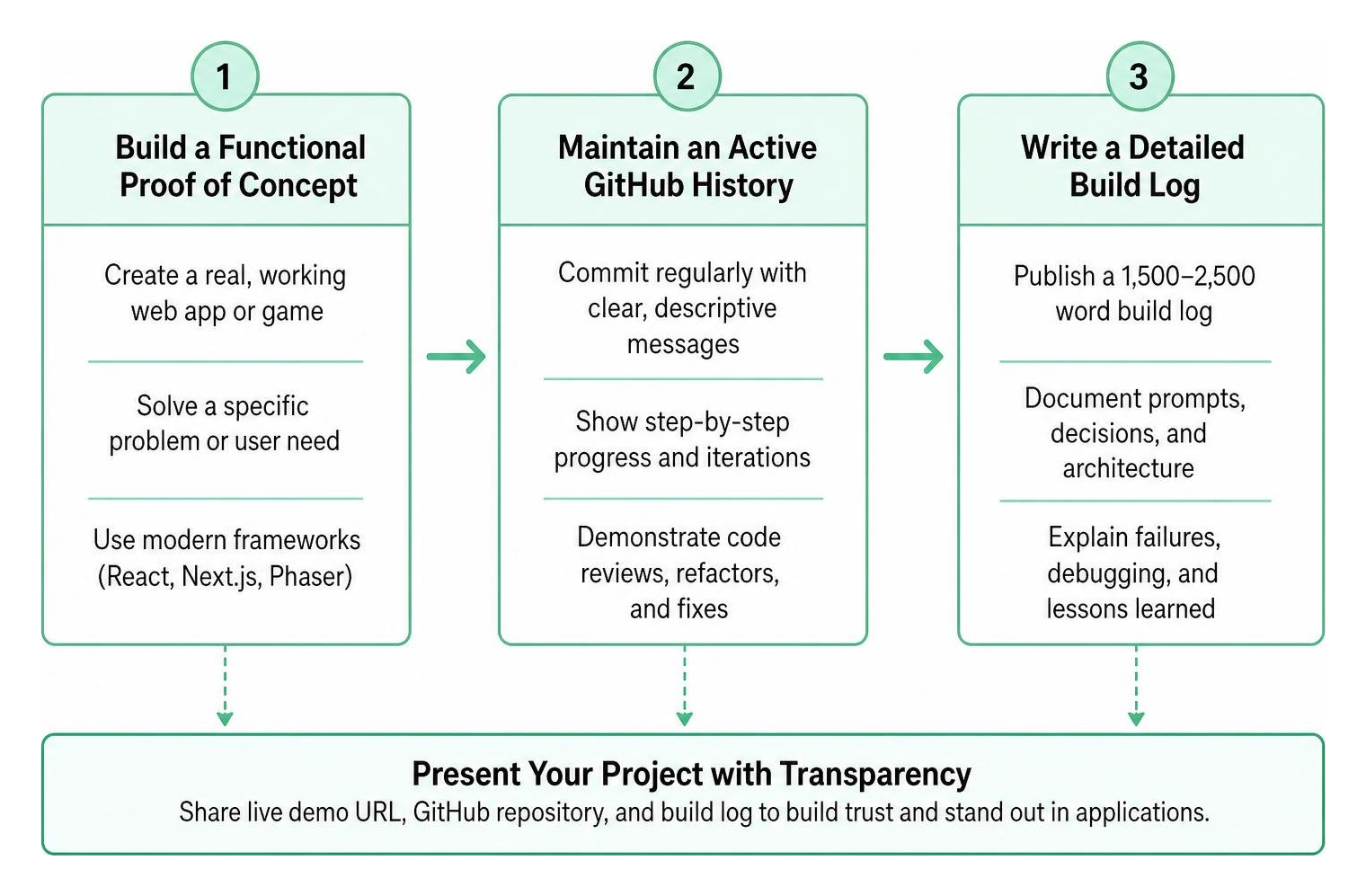
- Step 1: Build a Functional Proof of Concept (POC): Create a real, working web application or interactive browser game (using frameworks like React, Next.js, or Phaser) that addresses a specific problem or user need.
- Step 2: Maintain an Active GitHub Commit History: Ensure your repository shows a clear, step-by-step commit history. This proves to hiring managers that you actively reviewed, refactored, and hardened the AI-generated code over time.
- Step 3: Write a Detailed Build Log: Publish a 1,500-to-2,500-word build log documenting your development journey. Detail the prompt chains you used, the architectural decisions you made, the failures you encountered, and how you debugged the AI’s mistakes.
By presenting live, interactive URLs alongside transparent documentation of your development process, you dramatically reduce the perceived hiring risk for engineering managers.
Frequently Asked Questions about Vibe Coding Jobs
To help you navigate your job search, we have compiled answers to the most common questions candidates ask when preparing their applications.
Do I need a Computer Science degree for vibe coding?
No. As we discuss in our breakdown of How to Get a Vibe Coding Job: Requirements, Qualifications, academic credentials and high CGPAs are secondary in this market. Employers care about your hands-on ability to build, debug, and ship functional software. A strong portfolio of shipped products and a clear understanding of system architecture will easily outperform a traditional degree on your resume.
What are the best AI tools to learn for vibe coding?
While basic completions are helpful, you should focus on mastering the advanced tools detailed in our guide on Must-Have AI Tools for Vibe Coding. Focus your time on:
- Cursor: For day-to-day full-stack development and codebase indexation.
- Claude Code: For terminal-based execution, command-line operations, and git management.
- Windsurf: For collaborative, multi-agent coding environments.
- Bolt.new & Lovable: For rapid visual prototyping and quick MVPs.
How do I pass a live coding interview as a vibe coder?
Vibe coding interviews are highly collaborative. As outlined in How to Get a Vibe Coding Job: Interview, Cover Letter, Networking, you will rarely be asked to solve abstract whiteboard puzzles. Instead, you will likely be asked to bring your own laptop and build a feature or debug a broken component in real-time using your preferred AI tools.
To pass, you must demonstrate strong prompt engineering, explain your architectural decisions clearly, and show that you can spot and correct AI errors on the fly.
Conclusion
The era of manual boilerplate coding is giving way to a more strategic, high-velocity approach to software development. By mastering the right tools, documenting your review processes, and building a portfolio of functional public projects, you can position yourself at the forefront of this shift.
At Vibe Coding Jobs, we curate remote, AI-assisted engineering roles at forward-thinking, async-first companies. We filter listings by culture, tech stack, and specific AI tools so you can find a team that aligns with your workflow.
Ready to take the next step in your career? Learn How to Get the Benefits of Async-First Remote Developer Jobs and explore our daily listings to find your next remote role today.