
How to Master Daily Async Coding Jobs Without the Zoom Gloom
The Meeting-Free Work Style That’s Reshaping Developer Careers in 2026
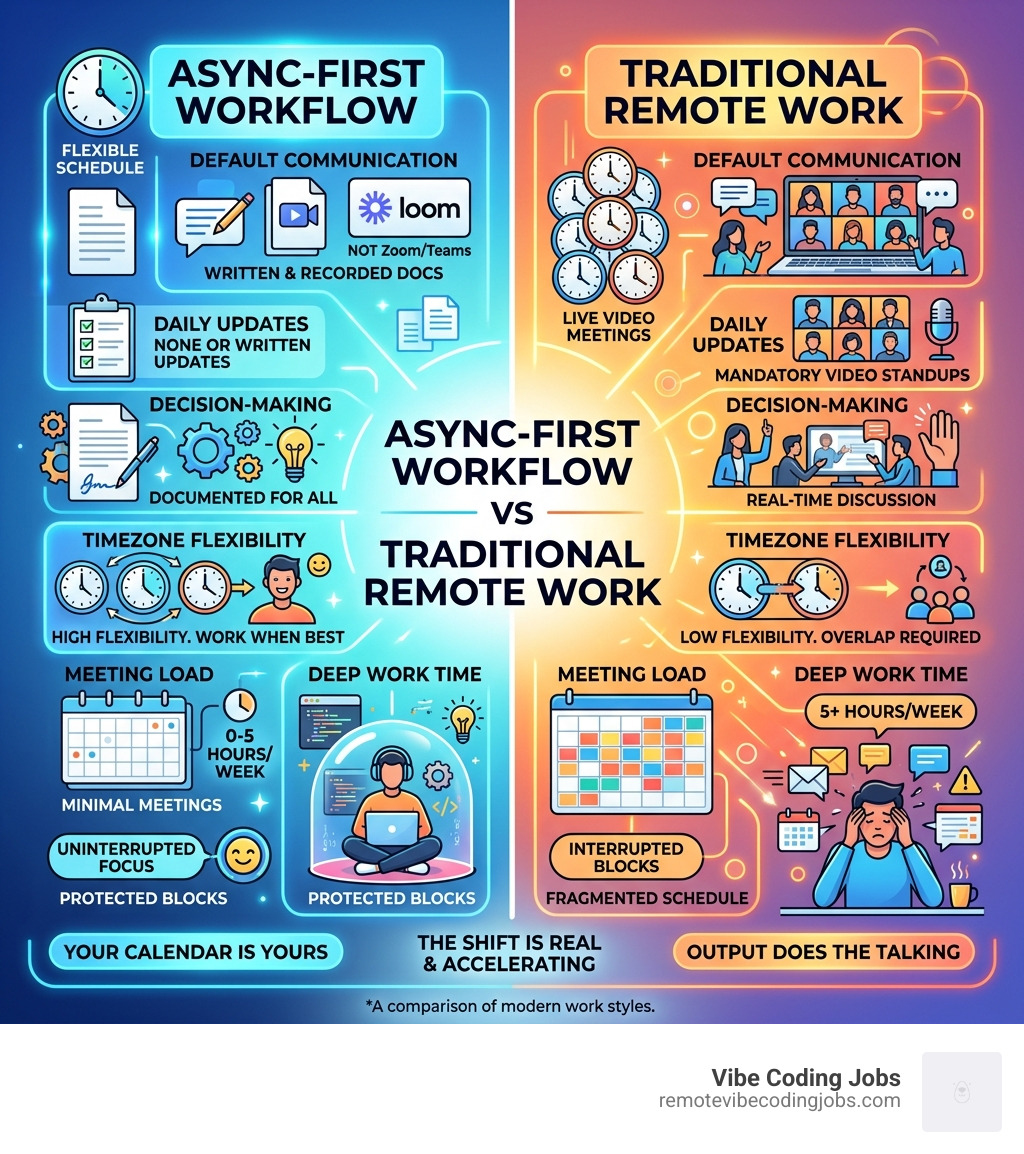
Async first jobs are roles at companies where written communication, documentation, and deep focus time replace the default of live meetings and constant Zoom calls.
Here’s what that means in practice:
| Feature | Async-First Job | Traditional Remote Job |
|---|---|---|
| Default communication | Written (docs, Slack, Loom) | Live meetings (Zoom, Teams) |
| Daily standup | Written update or none | Video call |
| Decision-making | Documented for anyone to read | Discussed in real-time |
| Timezone flexibility | High — work when you focus best | Low — overlap hours required |
| Meeting load | 0–5 hours per week | 5+ hours per week |
| Deep work time | Protected by default | Fragmented by schedule |
In short: async-first means your calendar is yours, and your output does the talking.
By May 2026, over 600 async jobs are listed in the US alone, with 55% of those fully remote. The shift is real, and it’s accelerating fast — especially in engineering, ML/AI, and vibe coding roles at lean, high-output tech companies.
But “async-first” isn’t just a perk. It’s a whole different way of working. And it’s not for everyone.
One developer on r/ExperiencedDevs put it bluntly: the zero-meeting promise sounds almost too good to be true. And honestly? It sometimes is. Async work done badly just replaces meeting fatigue with Slack notification anxiety. Done well, it gives you uninterrupted focus time, timezone freedom, and the kind of autonomy that lets you do your best work.
This guide breaks down exactly what async-first jobs look like in 2026, which companies are hiring, what the real challenges are, and how to land one.
I’m RVCJ Editorial, the team behind Remote Vibe Coding Jobs — we cover AI-assisted development, async culture, and remote hiring for developers building with tools like Cursor, Claude, and Replit, and we track async first jobs across the market daily. Whether you’re evaluating your first async role or looking to level up in a no-meetings environment, this guide gives you the full picture.
What Are Async First Jobs and Why Are They Taking Over in 2026?
In 2026, the term “remote-first” has started to feel a bit dated. Many remote companies simply moved the office grind to Zoom, leading to “meeting bloat” where developers spend five hours a day in calls and only three hours actually building. Async first jobs flip this script.
Being “async-first” means that the default mode of operation is asynchronous. If we have a problem to solve, we don’t “hop on a quick call.” We write a pitch in Notion, record a two-minute Loom, or open a discussion thread in GitHub. This approach respects the “maker’s schedule,” allowing for long, unbroken blocks of deep work.
As we’ve seen in our async-first remote work guide, this culture is a massive win for productivity. When you aren’t interrupted every 30 minutes by a notification or a calendar invite, you can reach a “flow state” much faster. This is particularly vital for “vibe coding”—the 2026 trend of high-velocity, AI-assisted development. Vibe coders use tools like Cursor and Claude to ship features at 10x speed; they can’t afford to have their momentum killed by a “sync” meeting that could have been an email.
The async-first remote developer jobs productivity benefits aren’t just about speed, though. It’s about autonomy. In an async environment, you are judged by your output, not your “green dot” status on Slack. This level of trust is a breath of fresh air for experienced developers who want to manage their own time—whether that means taking a mid-day gym break or working from a completely different timezone without waking up at 3 AM for a standup.
The Tech Stack of the Modern Async Developer
To survive and thrive in async first jobs, you need more than just a laptop and an internet connection. You need a stack that facilitates “alignment without presence.”

The 2026 async stack is built around transparency and documentation. Here are the heavy hitters:
- Linear: The gold standard for issue tracking. It’s built for speed and keeps everyone aligned on what’s being built without needing a status meeting.
- Notion/Slab: These act as the “company brain.” Everything from architectural decisions to vacation policies is documented here.
- Loom: Sometimes text isn’t enough. A quick video walkthrough of a new feature or a bug report provides the nuance of a meeting without the scheduling nightmare.
- Slack (with Async Norms): In an async culture, Slack is used differently. There is no expectation of an immediate reply. We use threads religiously and set status indicators to show when we are in “Deep Work” mode.
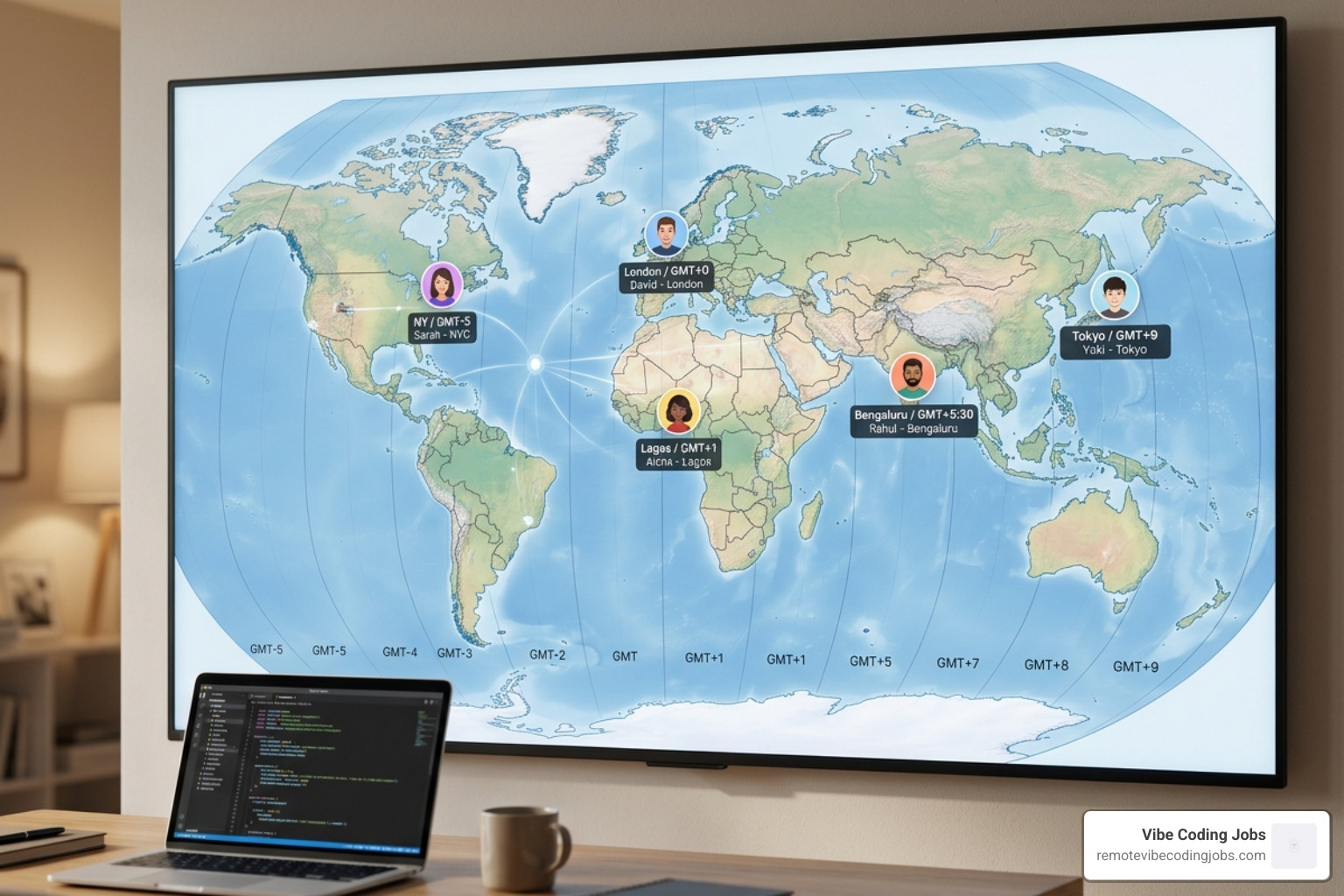
We’ve curated a list of the best async communication tools for dev teams in 2026 that goes deeper into how these tools integrate. The goal is to create a “paper trail” of decisions. If a developer in Berlin makes a choice at 10 AM, a developer in Los Angeles should be able to read the “why” behind it when they wake up eight hours later.
This relies heavily on async remote developer jobs flexible communication skills. You have to be a good writer. You have to be able to explain complex technical concepts clearly in a GitHub PR or a Slack message. In the async world, your writing is your presence.
Leading Companies and Roles in the Async Movement
The async movement isn’t just for tiny startups anymore. Some of the most influential companies in tech and AI have realized that meetings are a tax on innovation.
Top Companies Hiring for Async First Jobs
If you’re looking for the best async-first remote developer jobs top companies, these five are currently leading the pack:
- Hugging Face: The “GitHub of AI” is famously remote-friendly and relies on async workflows to coordinate a massive global community of researchers and engineers.
- Linear: They don’t just build the tool; they live the philosophy. Linear is known for its high-quality, low-meeting culture.
- PostHog: An open-source product OS that defaults to public, written communication. They even have a public handbook that outlines their async “small teams” philosophy.
- Supabase: The open-source Firebase alternative operates across dozens of timezones using GitHub and Slack as their primary “office.”
- Weaviate: A leading vector database company that leverages async work to stay agile in the fast-moving AI infrastructure space.
You can find a more exhaustive breakdown of async-first remote developer jobs roles teams companies on our blog, where we track live openings at 90+ companies that value this culture.
High-Demand Roles from ML to Product
While engineering roles make up the bulk of the market (with 38 open engineering roles across the top 5 companies), other departments are catching up. Out of 92 total async-first roles we recently tracked:
- ML/AI: 10 jobs (Hugging Face and PostHog are big hirers here).
- Sales/GTM: 19 jobs. Yes, even sales is going async, using recorded demos and written pitches.
- Product: 3 jobs. Product Managers in these roles focus on “PRDs” (Product Requirements Documents) and specs rather than “syncing” with stakeholders.
The beauty of these async-first remote developer jobs flexible hours is that they are available globally. Whether you are in EMEA or the US, these companies are looking for high-agency individuals who don’t need a manager hovering over their shoulder.
The Reality Check: Challenges of 100% Async Work
We wouldn’t be doing our job if we didn’t talk about the “dark side” of async. It’s not all brunch and deep work; it requires a specific kind of mental fortitude.
The most common pain point is message fatigue. When you remove meetings, the communication has to go somewhere. Often, it lands in Slack. If a company doesn’t have strict async norms, you can end up with “micromanagement via pings”—the feeling that you have to be “always on” and replying to messages every five minutes to prove you’re working.
Other challenges include:
- Documentation Debt: If someone forgets to document a decision, a developer in a different timezone might be blocked for 12 to 24 hours waiting for an answer.
- Isolation: Without the social “watercooler” of Zoom calls, some people feel lonely. Successful async companies combat this with optional social “hangouts” or annual retreats.
- Junior Struggles: It is significantly harder to be a junior developer in an async environment. You can’t just turn around and ask a senior dev a question. You have to be able to unblock yourself or wait for a written reply.
To survive, you need a deep work culture developer jobs finding focus flow mindset. You have to be okay with silence. You also have to be proactive about your mental health and work-life balance. As we discuss in our guide on async-first remote developer jobs culture tools salary, setting “hard boundaries” for when you are offline is the only way to avoid burnout in a 24/7 global team.
How to Land and Thrive in Async First Jobs
Landing a role at a top-tier async company like Linear or Supabase is competitive. They aren’t just looking for “good coders”; they are looking for “good communicators who can code.”
Essential Skills to Land Async First Jobs
In 2026, “Vibe Coding” is the ultimate skill set for async roles. Companies want builders who can leverage AI tools like Cursor and Claude to move fast. They don’t want someone who spends three days perfecting a CSS button; they want someone who can prompt an AI to build the UI, then spend their time thinking about the system architecture and user experience.
If you want to be on the radar for vibe coding companies hiring in 2026 top async-first roles, focus on these areas:
- Technical Writing: Can you write a clear, concise GitHub PR? Can you document a bug so well that a stranger could fix it without talking to you?
- Self-Management: You need to be your own project manager. You should have a “graveyard of shipped projects”—a portfolio of live apps, tools, or open-source contributions that prove you can finish what you start.
- AI Orchestration: Show that you can use AI to close the gap between an idea and a deployed product.
Interviewing for Async Culture
Expect the interview process to mirror the work. You might not have five rounds of back-to-back Zoom calls. Instead, you might see:
- Written Take-Home: A project where you are judged not just on the code, but on your documentation and how you handle “async” feedback.
- Paid Trials: Many async companies (like PostHog) offer a “trial week” where you work on a real task with the team for a few days.
- High-Agency Communication: During the process, don’t ask “What should I do next?” Instead, say “I noticed X, so I’m going to do Y unless you think Z is better.” This shows you have the async-first remote developer jobs flexible culture DNA.
Frequently Asked Questions about Async Work
Is async-first suitable for junior developers?
Generally, it’s a “Hard Mode” for juniors. Most async companies prefer mid-to-senior level talent because these roles require a high degree of self-sufficiency. However, if a junior has a strong “vibe coding” portfolio and excellent writing skills, they can succeed—provided the company has a world-class documentation culture.
What are the typical salary ranges for async jobs?
Salaries for async first jobs are highly competitive and often follow US or global benchmarks rather than local ones. We’ve seen Senior Product Managers at async firms earning between $150K and $220K, while Senior QA or Engineering roles often fall in the $100K to $180K range, depending on the company’s funding and size.
How many meetings should I expect in an async-first role?
In a healthy async-first environment, you should expect 0 to 5 hours of meetings per week. This usually includes one weekly team sync (often social or high-level planning) and perhaps a bi-weekly 1-on-1 with your manager. If you’re hitting 10+ hours of meetings, you’re in a “remote-first” company, not an async-first one.
Conclusion
The era of the “Zoom Gloom” is ending. As more companies realize that deep work is the engine of innovation, async first jobs will become the standard for the world’s most talented builders.
At RemoteVibeCodingJobs, we believe the future of work is about results, not hours logged. By mastering the tools of the trade—from AI-native IDEs like Cursor to async-first platforms like Linear—you can reclaim your calendar and your sanity. The async-first remote developer jobs benefits are clear: more focus, more freedom, and the ability to work on world-changing tech from anywhere on the planet.
Ready to find your next no-meetings role? Check out our daily curated listings and join the movement of developers who are “vibing” their way to a better career.