The Best AI Assisted Dev Openings to Apply For Right Now (June 2026)
AI assisted dev openings are multiplying fast — and the best ones move quickly. Here’s a snapshot of what’s available right now across experience levels:
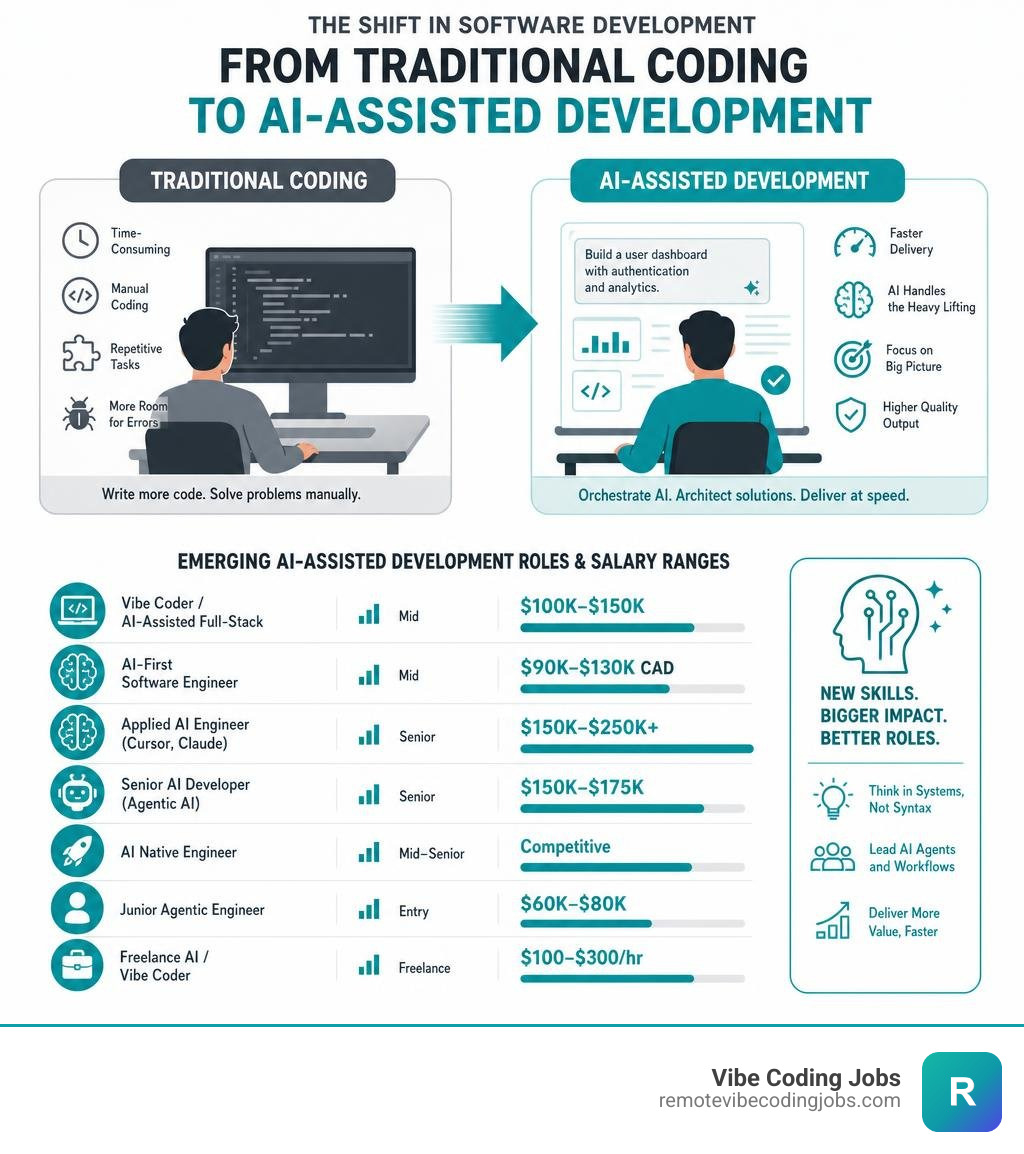
| Role | Level | Salary Range | Remote? |
|---|---|---|---|
| Vibe Coder / AI-Assisted Full-Stack | Mid | $100K–$150K | Yes |
| AI-First Software Engineer | Mid | $90K–$130K CAD | Yes |
| Applied AI Engineer (Cursor, Claude) | Senior | $150K–$250K+ | Yes |
| Senior AI Developer (Agentic AI) | Senior | $150K–$175K | Hybrid |
| AI Native Engineer | Mid–Senior | Competitive | Yes |
| Junior Agentic Engineer | Entry | $60K–$80K | Yes |
| Freelance AI / Vibe Coder | Freelance | $100–$300/hr | Yes |
The software development market is growing fast — projected to hit $61 billion by 2029, up from $24 billion in 2024. That’s a 20% annual growth rate. And companies aren’t slowing down on hiring to match it.
In fact, CIOs plan to increase software spending by 3.9% in 2026, more than any other IT category. The demand for developers who can work with AI — not just alongside it — is at the center of that growth.
The old fear was that AI would kill developer jobs. What’s actually happening is the opposite: AI is creating entirely new roles, from AI Systems Architects to Forward Deployed Engineers to AI Native Engineers who direct fleets of coding agents rather than writing every line by hand.
As the Stack Overflow team put it in a recent analysis, “Reports of software development’s death are greatly exaggerated.” The shift isn’t from more developers to fewer — it’s from developers who write syntax to developers who architect, orchestrate, and validate at speed.
I’m RVCJ Editorial, the team behind Remote Vibe Coding Jobs — we cover AI assisted dev openings, async-first hiring trends, and practical career guidance for engineers building with tools like Cursor, Claude, Copilot, and Windsurf. We’ve curated hundreds of verified remote roles for AI-first developers and know exactly what companies are looking for right now.
Below, we break down the top openings this week, what skills they require, and how to position yourself to land one.
The Rise of the Vibe Coder: How AI is Redefining Software Engineering
The term “vibe coder” started as an internet meme, but in June 2026, it represents a highly lucrative reality. In practice, vibe coding means shifting the developer’s day-to-day workflow from manual syntax typing to high-level system orchestration. Instead of wrestling with semi-colons and boilerplate API routes, developers use natural language prompts to direct AI agents that handle the heavy lifting.
This shift doesn’t mean developers do less work; rather, they do different work. The traditional software engineering workflow involves writing code, compiling, debugging, and repeating. The AI-first workflow is a continuous loop of specification, generation, and rigorous validation. Because AI can generate hundreds of lines of code in seconds, the human developer’s role pivots to that of an editor, architect, and quality controller.
The productivity gains are hard to ignore. Teams using advanced AI development pipelines are shipping products in days that used to take months. This massive jump in leverage is giving rise to exciting hybrid roles:
- AI Systems Architect: Engineers who design how multiple AI models, custom databases, and agentic workflows interact with legacy enterprise systems.
- Forward Deployed Engineer: Highly autonomous builders who work directly with customers to prototype and deploy AI-driven web applications in record time.
- Product Engineer: Full-stack developers who combine technical execution with product design, using AI to bridge the gap between initial concept and production-ready code.
Understanding these shifts is key to unlocking the massive AI Assisted Development Career Opportunities Benefits available in today’s market.
Key Skills Required for AI Assisted Dev Openings
To land one of the top ai assisted dev openings, you need to demonstrate deep proficiency in the modern AI development stack. Companies are no longer looking for developers who occasionally use AI for autocomplete; they want engineers who have fully integrated these tools into their development lifecycle.
The primary tools defining the space include:
- Cursor & Claude Code: The gold standards for context-aware, multi-file editing and terminal-based agentic workflows.
- Windsurf: An agentic IDE designed for deep human-AI collaboration on complex codebases.
- Bolt.new & Lovable: Platforms optimized for rapid web development, design-to-code translation, and instant MVP generation.
Candidates are expected to understand the nuances of prompt engineering—such as structured prompting, context window management, and system instructions—while maintaining a strong grasp of system design. To stand out, engineers are increasingly pursuing specialized training to validate their skills, as highlighted in our guide on AI Assisted Development Career Opportunities Growth Certifications.
Essential Human Skills vs Offloaded AI Tasks
As AI takes over repetitive tasks, the line between what is automated and what requires human oversight has become clear:
| Offloaded to AI | Reserved for Humans |
|---|---|
| Boilerplate code generation | High-level system architecture |
| Writing unit and integration tests | Business logic and product strategy |
| Basic debugging and syntax fixing | Security auditing and compliance |
| Automated documentation | Evaluating AI outputs with critical judgment |
While AI can write code, it does not understand why a business needs a specific feature or how a system might fail under unique production loads. This makes foundational computer science skills more important than ever. Developers must understand data structures, database optimization, and networking to ensure that the code their AI assistants generate is scalable and secure. This balance of skills is shaping the future of the industry, as detailed in our analysis of AI Coding Jobs Future Trends Entry Level.
Navigating the Best AI Assisted Dev Openings in June 2026

The job market for AI-fluent developers is incredibly diverse, spanning nimble startups, global tech enterprises, and private equity-backed portfolio companies. Because AI tools allow smaller teams to achieve massive output, remote and async-first companies are leading the charge in hiring.
If you are looking to break into this space, keeping an eye on dedicated platforms is essential. You can find curated listings on specialized Remote AI Developer Jobs Boards Openings that focus specifically on companies embracing AI-native workflows.
Salary Trends and Compensation for AI Assisted Dev Openings
The compensation for AI-fluent developers reflects the immense value they bring to organizations. Because an AI-assisted developer can often match the output of multiple traditional engineers, companies are willing to pay premium rates.
- Entry-Level Vibe Coders: Typically start between $70,000 and $100,000 annually, making it an incredibly lucrative path for those just starting out. You can explore these entry-level paths further in our breakdown of AI Coding Jobs Entry Level Remote Opportunities.
- Mid-Level Developers: Earn between $100,000 and $150,000, leveraging their experience to guide AI tools through more complex business logic.
- Senior AI-First Developers: Regularly command salaries ranging from $150,000 to $250,000+ at top startups and tech giants.
- Freelance Vibe Coders: Can easily charge between $100 and $300 per hour (with some specialized roles ranging from $75 to $150/hr for rapid MVP building) due to their ability to deliver working products in a fraction of the traditional time.
We also see platform-specific opportunities, such as remote AI developer roles on premium talent networks like Remote AI Developer Jobs – Crossover, which offer compensation up to $200,000 USD/year for highly skilled engineers who pass their rigorous screening processes.
Top Industries and Companies Hiring AI-First Talent
A wide range of industries are actively recruiting for AI-first roles. Major tech enterprises like Lenovo are hiring for positions like Senior AI Developer – – 78212 to build out agentic AI platforms, and Engineer, AI Application Development – – 78270 to integrate Next.js and Python with advanced AI frameworks like LangChain.
Enterprise AI software providers are also massive hubs for talent. For instance, C3 AI frequently maintains over 100 open engineering and AI-related positions across global offices and remote teams, focusing heavily on Forward Deployed Engineering.
Meanwhile, the Web3 and blockchain sectors are blending decentralized tech with AI, creating roles for AI Workflow Engineers and AI Blockchain Security Engineers. Platforms like 30,000+ Ai Developer jobs in United States – LinkedIn and 41341 Ai Developer Job Vacancies In June 2026 – Naukri.com show a massive volume of active listings, while platforms like AI First Software Engineer | Remotiva highlight positions offering between $90,000 and $130,000 CAD for engineers who treat AI as a first-class tool.
To find the organizations that best align with your working style, check out our curated list of the Best Companies Hiring AI Developers Remote Startup Big Tech.
How Companies Evaluate and Interview AI-First Engineers
The hiring process for AI-assisted roles is undergoing a massive transformation. Traditional interviews that require candidates to memorize algorithmic puzzles are increasingly being replaced by practical, tool-assisted assessments. Companies want to see how you collaborate with AI to solve real-world problems.
If you are preparing for these interviews, understanding what to expect at the entry level can give you a significant advantage. Read more about getting started in our guide on AI Coding Jobs Entry Level Beginners.
The Shift from LeetCode to Real-World AI Orchestration
Instead of banning AI during technical screens, forward-thinking companies are actively encouraging its use. The interview becomes a test of your ability to write precise specifications, manage context, and validate generated outputs.
A great example of this paradigm shift can be seen in the job specifications for modern AI Native Engineers, such as the open-source blueprint found in this AI-Native Engineer Job Description Gist. In these roles, the primary artifact authored by the engineer is not the code itself, but a highly precise “spec file” or prompt instruction. The interview evaluates how cleanly you decompose a massive problem into small, testable units that an AI agent can execute.
Measuring Productivity and Output of AI-Fluent Developers
How do companies know their investment in AI-fluent talent is paying off? They look at metrics that measure overall team leverage and velocity:
- Feature Velocity: How quickly a concept goes from product spec to production code.
- Commit Frequency: High-leverage developers orchestrating AI agents can achieve dozens or even hundreds of commits per week across multiple repositories.
- Code Review Cycle Time: The speed at which code is validated, refined, and merged.
- Test Coverage: AI-assisted developers can generate comprehensive unit and integration tests alongside their features, drastically reducing regression bugs.
By focusing on these high-impact metrics, companies can build leaner, more ambitious teams, as we discuss in our post on AI Coding Jobs Future Remote Benefits.
Managing Code Quality and Security in AI-Generated Codebases

While AI tools allow us to build at breakneck speeds, they also present unique challenges. If left unchecked, AI can generate redundant code, introduce subtle security vulnerabilities, or create “architectural drift” where different parts of the system don’t align.
To combat this, modern development teams are adopting advanced integration standards like the Model Context Protocol (MCP). MCP allows AI tools and agents to safely interact with local development environments, databases, and secure APIs, ensuring that the AI has the exact context it needs without risking security breaches.
Best Practices for AI-Driven Development Lifecycles (AI-DLC)
To keep codebases clean and secure, companies hiring for ai assisted dev openings expect engineers to follow a strict AI-Driven Development Lifecycle (AI-DLC):
- Test-Driven Development (TDD): Write your tests first. By establishing clear, failing tests before generating code, you give the AI a deterministic target to hit.
- Spec-Driven Generation: Author precise markdown files (like
ARCHITECTURE.mdorSKILL.md) to guide your AI agents, ensuring they follow established design patterns. - Deterministic Governance: Implement strict linting, formatting, and automated security scanning in your CI/CD pipelines to catch AI hallucinations before they reach production.
By mastering these practices, you position yourself as a highly reliable engineer who can scale systems safely. For more on how companies structure these modern development teams, check out our resource on Companies Hiring AI Developers Vibe Coders.
Frequently Asked Questions about AI-Assisted Development
Will AI replace human software developers?
No. AI is expanding the software market, not shrinking it. Because building software is becoming cheaper and faster, companies are choosing to build more products, tackle more ambitious features, and integrate AI into legacy systems. Human judgment, architectural design, and strategic problem-solving remain entirely irreplaceable.
What tools should I learn to get hired as an AI developer?
Focus on mastering Cursor, Claude Code, and Windsurf for your daily coding environment. For rapid prototyping and full-stack web applications, spend time with Bolt.new and v0. Additionally, understanding agent frameworks and integration protocols like MCP is highly valued by top employers.
Can I get an AI-assisted developer job without a CS degree?
Yes, absolutely. Because vibe coding values practical building and rapid execution, having a strong portfolio of live, AI-built applications is often more persuasive to hiring managers than a formal degree. Focus on building real-world projects, contributing to open-source, and proving you can deliver clean, working software.
Conclusion
The era of manual, line-by-line coding is evolving into a more creative, high-leverage discipline of software orchestration. Whether you are an experienced engineer looking to multiply your output or a newcomer eager to break into the industry, the current wave of ai assisted dev openings offers unprecedented career potential.
At RemoteVibeCodingJobs, we are dedicated to helping you navigate this exciting shift. We curate daily listings from async-first, forward-thinking companies that actively encourage the use of cutting-edge AI tools.
Ready to take the next step in your engineering career? Learn more about async-first remote developer jobs benefits and find your next high-paying, flexible role today!