
The Remote Senior Developer Job Market Is Bigger Than You Think
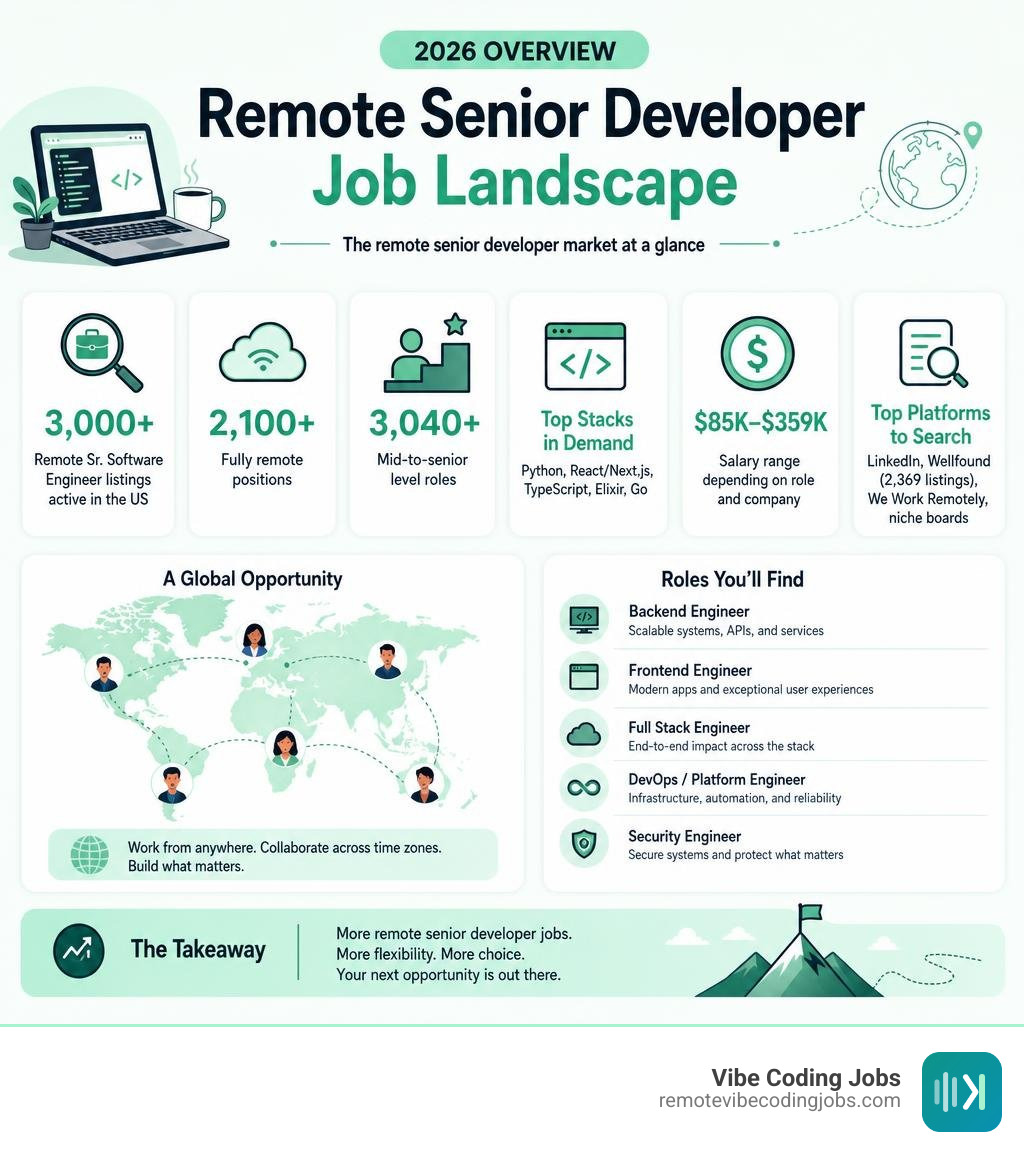
Remote senior developer jobs are more plentiful right now than at almost any point in tech history. Here’s a quick snapshot of what the market looks like in July 2026:
| What You Want to Know | The Quick Answer |
|---|---|
| How many roles are available in the US? | 3,000+ remote Sr. Software Engineer listings active right now |
| How many are fully remote? | Over 2,100 fully remote positions |
| What experience level? | Most (3,040+) are mid-to-senior level |
| Top stacks in demand | Python, React/Next.js, TypeScript, Elixir, Go |
| Salary range | $85K–$359K depending on role and company |
| Best platforms to search | Curated niche boards, specialized remote platforms |
The market is noisy, though. Thousands of listings, vague job titles, and unclear remote policies make it hard to find roles that actually fit your stack, your experience level, and the kind of async culture you want to work in.
This guide cuts through that noise.
We’re RVCJ Editorial, the team behind Vibe Coding Jobs — we cover AI-assisted development, remote hiring trends, and job-search strategy for senior engineers navigating remote senior developer jobs in the modern market. We’ll walk you through everything you need to land the right role faster.
Glossary for remote senior developer jobs:
The Landscape of Remote Senior Developer Jobs in 2026
The market for senior-level engineering talent is undergoing a massive structural shift. While the early 2020s were characterized by a frantic rush to remote work, and the subsequent years saw a pushback from traditional corporate structures demanding hybrid models, 2026 has established a clear division.
On one hand, we have traditional enterprises operating under strict hybrid or geographic mandates. On the other hand, we have modern, high-velocity tech companies that have embraced fully remote setups to tap into global talent pools.
Understanding the distinction between these job categories is critical before you begin your search:
- Fully Remote (100% Remote): These roles allow you to work from anywhere within a country, or even globally, without any expectation of office visits. Companies hiring for these positions have designed their operations around asynchronous communication.
- Remote-Eligible: This is a hybrid middle ground. Often used by larger financial institutions or enterprise companies, “remote-eligible” means the role can be performed remotely, but eligibility is subject to team structures, manager approval, or geographic proximity for occasional team on-sites.
- Hybrid: These roles require you to live near a specific hub and spend 2-3 days a week in the office.
If your goal is true flexibility and location independence, focusing your energy on fully remote positions is your best strategy. When looking for the ideal environment, you can check out our deep dive into the top Remote Senior Developer Jobs to see which organizations are fully committing to location-agnostic engineering teams this year.
Data from major industry sources shows that out of thousands of active senior software engineer listings, more than 2,100 are categorized as fully remote. This indicates a healthy, resilient market for senior talent who refuse to return to a physical office.
In-Demand Tech Stacks for Remote Senior Developer Jobs
While fundamental problem-solving skills remain evergreen, the specific technologies companies are hiring for have consolidated around several high-performance stacks in 2026.
In the frontend landscape, React continues to dominate, with Next.js serving as the standard framework for production-grade web applications. For instance, recent federal project listings for Senior Frontend React Developers highlight the critical need for React 19, TypeScript, and state management libraries like TanStack Query. These enterprise-grade applications require developers who know how to optimize large-scale single-page applications to avoid input lag and manage complex data validation seamlessly.
Similarly, we see a massive volume of remote teams looking for full-stack capability. Organizations are actively recruiting for roles that combine modern frontend interfaces with robust backend services.
On the backend, several languages and frameworks are leading the charge:
- Python (FastAPI & Django): Highly favored for microservices, data orchestration, and AI-integrations. Companies are frequently seeking contractors for senior backend roles to build highly scalable API layers.
- Elixir (Phoenix): Increasingly chosen by modern remote-first companies building real-time, highly concurrent systems. For example, global payroll platform Remote utilizes Elixir and Phoenix on AWS to handle massive transaction volumes.
- Go & Rust: The default choices for systems engineering, performance-critical tooling, and cloud-native infrastructure.
The Rise of AI-Assisted Workflows in Remote Senior Developer Jobs
We cannot talk about software development in 2026 without addressing the elephant in the room: AI-assisted engineering, often referred to as “vibe coding.”
Vibe coding is not about replacing the senior engineer; it is about elevating them. Instead of spending hours writing boilerplate code, configuring webpack, or typing out repetitive unit tests, senior developers are using advanced AI tools to act as orchestrators. You write the high-level architecture, design the system patterns, and guide the AI tools to generate, refactor, and test the code.
Progressive remote-first companies are no longer treating AI tool fluency as a “nice-to-have.” They are listing it as an explicit requirement.
Many job descriptions now mandate experience with tools like Cursor, Claude Code, GitHub Copilot, and Windsurf. In these environments, the expectation is that a senior developer utilizing AI workflows can ship high-quality features 2x to 5x faster than those relying solely on manual typing.
If you want to stay ahead of this trend, it is essential to understand how these tools are reshaping expectations. Read our guide on Remote Developer Skills in Demand to learn how to position your AI-assisted workflow expertise to prospective employers.
Compensation and Salary Ranges for Senior Engineers
Compensation for remote senior developer jobs in 2026 is highly variable, influenced heavily by company funding stages, location policies, and technical complexity.
While some fully remote companies utilize localized geographic pay scales (adjusting your salary based on the cost of living where you reside), others offer flat, global rates to secure top-tier talent regardless of location.
For broader labor-market context, the U.S. Bureau of Labor Statistics tracks outlook and wage data for software developers, which can help senior engineers compare remote offers against wider software engineering trends.
Here is a general overview of the salary landscape across different regions and primary stacks in 2026:
| Tech Stack / Focus | Region / Policy | Annual Salary Range (USD) | Equity / Benefits |
|---|---|---|---|
| Full-Stack (React / Python) | US-Based Remote | $120,000 – $180,000 | 401(k) Match, Stock Options |
| Frontend (React / Next.js) | US Federal Projects | $130,000 – $195,000 | Health, Generous PTO |
| Backend (Elixir / Phoenix) | Global Async-First | $85,000 – $120,000 | Global health coverage, home office stipend |
| Principal / Lead Systems | High-Cost US Hubs (NYC/Chicago) | $195,000 – $359,000 | High equity, performance bonuses |
To understand how these numbers shift based on your specific level of experience and chosen lifestyle, check out our comprehensive analysis of the Vibe Coding Salary Range.
For developers targeting premium markets, senior and principal engineering roles in tech hubs like New York and Chicago frequently command salaries well north of $200,000, peaking near $359,000 for highly specialized roles.
Conversely, global companies building distributed teams often offer highly competitive international rates. For example, a Senior Backend Engineer at a global remote-first company might see a salary range of $53,300 to $119,850 USD, paired with outstanding perks like unlimited paid time off, extensive parental leave, and a dedicated learning budget to offset the localized base salary.
Key Skills and Experience Companies Look For
To land a premium remote senior role, you must demonstrate more than just an ability to write clean code. In a remote setting, senior engineers are expected to operate with an extreme degree of autonomy and act as force multipliers for their teams.
Here are the core areas companies evaluate:
- System Architecture and Design: You must be able to design scalable, fault-tolerant systems. This includes database optimization (such as PostgreSQL partitioning and connection pooling), microservices architecture, and cloud infrastructure patterns.
- Observability and Reliability: Modern teams expect seniors to implement robust monitoring, tracing, and alerting pipelines. You should be comfortable working with Service Level Objectives (SLOs) and Service Level Indicators (SLIs).
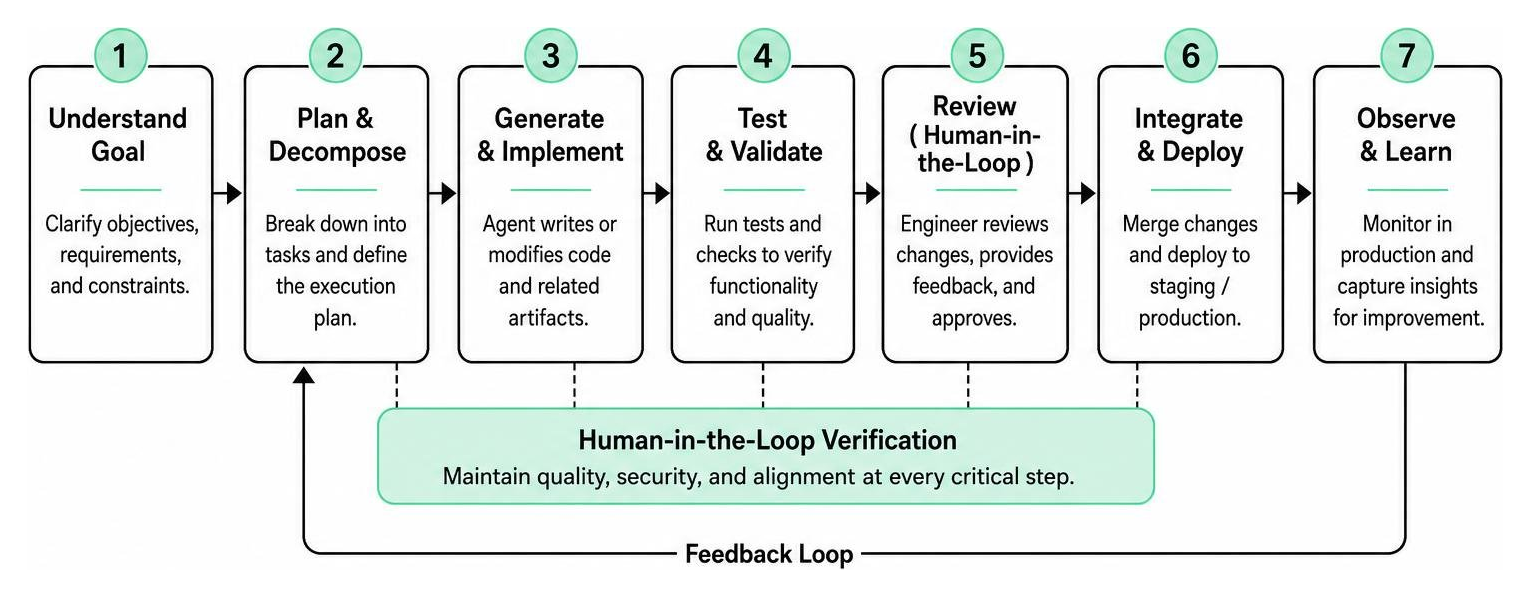
- Agentic and Automated Workflows: With the rise of AI, companies want engineers who can design and operationalize “agentic” workflows—using autonomous AI agents to handle routine execution, while maintaining strict human-in-the-loop verification layers.
Async-First Culture and Autonomy
The secret weapon of highly successful remote developers is a mastery of asynchronous communication. In an async-first company, traditional synchronous meetings like daily standups are replaced by detailed written updates, comprehensive documentation, and collaborative pull request reviews.
To excel in this environment, you need:
- Exceptional Written Communication: You must be able to write clear, concise engineering proposals (RFCs), architectural decisions records (ADRs), and bug reports.
- Timezone Independence: The ability to move projects forward without needing real-time feedback from team members located ten timezones away.
- Proactive Documentation: Treating documentation not as an afterthought, but as a core deliverable of your engineering output.
If this highly autonomous way of working appeals to you, explore our curated list of Async-First Remote Developer Jobs to find teams that value deep focus over back-to-back Zoom meetings.
How to Navigate the Remote Interview Process
The interview process for remote senior developer jobs in 2026 has evolved significantly to match the realities of modern development. Traditional whiteboard algorithms are increasingly being replaced by practical assessments that mirror daily work.
A typical multi-stage remote interview process now looks like this:
- Initial Screen: A brief video call focusing on your career background, remote work experience, and alignment with the company’s culture.
- Technical Take-Home or Live System Design: Instead of writing sorting algorithms from memory, you will likely be asked to design a real-world system (e.g., a rate limiter or a notification engine) and explain your architectural trade-offs.
- AI-Assisted Practical Assessment: Progressive companies are now conducting “vibe coding” evaluations. You may be given a complex codebase and asked to implement a new feature or debug an issue using your preferred AI tools (like Cursor or Claude). The interviewers are not testing how fast you type, but how effectively you prompt, verify, and guide the AI to produce secure, production-grade code.
- Culture and Async Fit: An evaluation of your written communication skills, often involving an asynchronous exercise or a review of how you collaborate on a shared document.
Where to Find High-Quality Remote Engineering Roles
If you want to avoid the endless scroll of generic job boards, you need to target your search using platforms that specialize in remote and modern technical roles.
- Niche Curated Job Boards: Focus on platforms that specialize in dedicated remote roles. Look for verified remote-first companies hiring right now rather than wading through outdated listings on general job sites.
- Startup-Focused Networks: Seek out networks that specialize in startup roles offering healthy mixes of salary and equity, which are ideal for senior engineers looking for high-impact positions.
- AI-Native Platforms: If you are an engineer who has fully embraced AI-assisted workflows and wants to work with forward-thinking teams, specializing your search around AI-friendly companies is key. To find roles that explicitly value these modern skills, take a look at our guide on Vibe Coding Remote Career Paths.
Frequently Asked Questions about Remote Senior Developer Jobs
What is the average salary for a remote senior developer in 2026?
In 2026, the average salary for a remote senior developer ranges from $120,000 to $180,000 USD annually in the United States. Highly specialized roles, such as Lead Systems Engineers or Principal Developers in major tech hubs, can reach between $195,000 and $359,000 USD. Internationally, fully remote companies offering localized compensation packages typically pay between $85,000 and $120,000 USD, often accompanied by robust equity packages and comprehensive remote work stipends.
How has AI changed the expectations for senior developers?
AI tools like Cursor, Claude Code, and GitHub Copilot have shifted the senior developer’s role from “code writer” to “software architect.” Companies now expect senior engineers to leverage these tools to automate boilerplate tasks, write tests, and prototype features rapidly. The focus has moved away from syntax memorization toward high-level system design, security, code quality verification, and orchestrating complex automation workflows.
What is the difference between fully remote and remote-eligible roles?
A fully remote role allows you to work from anywhere (often with some country-specific limitations for tax compliance) with zero requirement to visit a physical office. A remote-eligible role is typically a hybrid position where the company allows remote work but may require proximity to a regional office hub for occasional on-sites, team meetings, or hybrid schedules.
Conclusion
The market for remote senior developer jobs in 2026 is full of opportunity for engineers who are willing to adapt. By mastering in-demand stacks like React/Next.js and Python, embracing AI-assisted “vibe coding” workflows, and proving your ability to operate autonomously in async-first environments, you can secure a highly flexible, top-paying role from anywhere in the world.
Ready to skip the generic job boards and find companies that actually value modern, AI-driven development workflows? Head over to Vibe Coding Jobs to browse our curated daily listings and land your next remote role today.