
Where to Find Remote Scala Developer Jobs in 2026
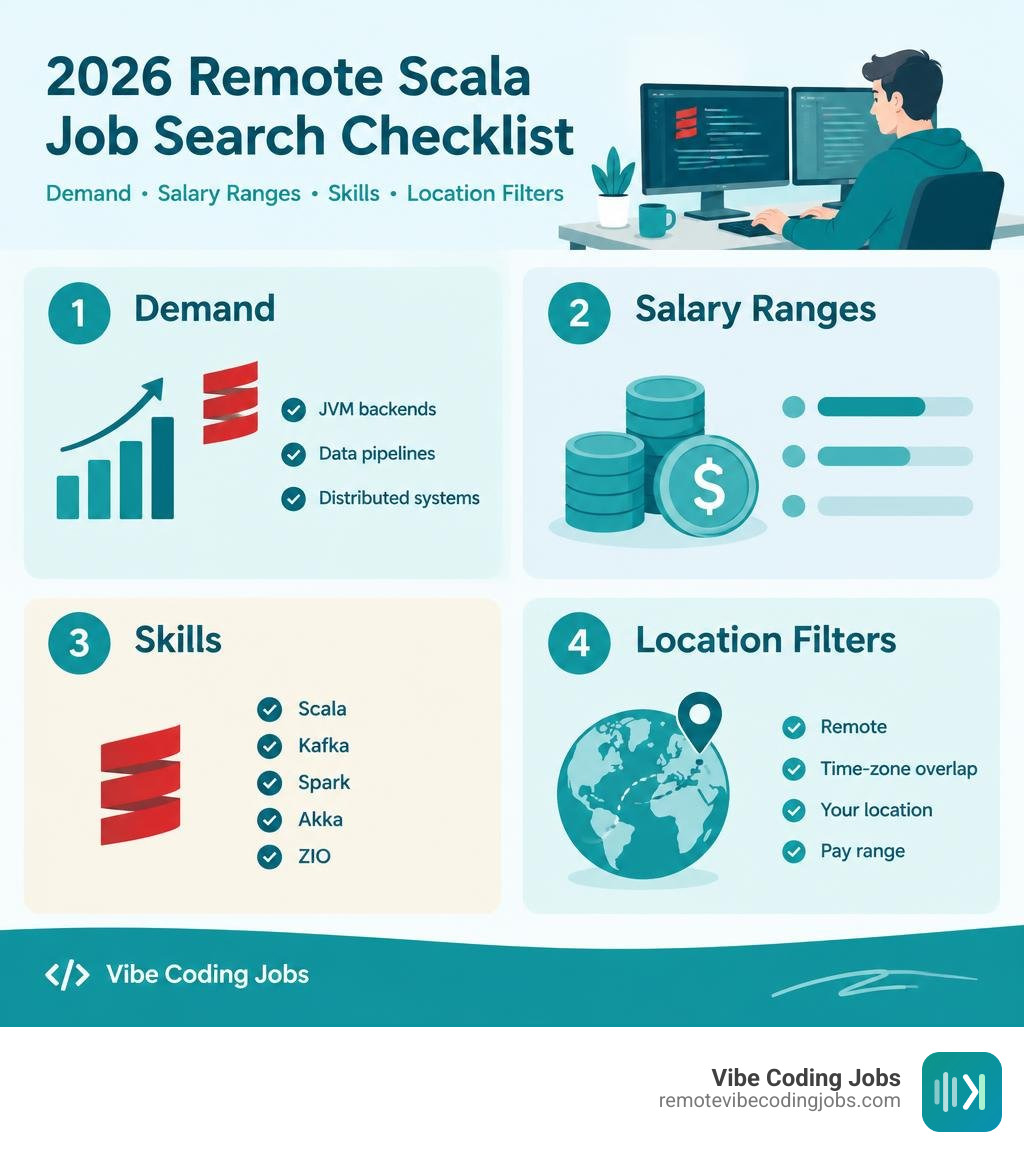
Start with remote job boards and company career pages. Filter for Scala, your location, seniority, and salary range. Search for related skills such as Kafka, Spark, Akka, and ZIO, then set alerts so you can apply while listings are fresh. Tailor each application to the systems you have built, not just the tools you know.
Scala is a niche skill with strong use cases in JVM backends, data pipelines, and distributed systems. That can make experienced developers valuable, but a “remote” listing may still limit where you can work. Check location rules, time-zone overlap, and pay before you apply.
I’m Di Su, a software engineer with over 10 years of experience building scalable, user-focused products. I bring that engineering and search experience to this guide to scala developer remote jobs, starting with where demand and pay stand today.
Easy scala developer remote jobs word list:
The State of Scala Developer Remote Jobs in 2026: Salaries and Market Demand
The market dynamics for Scala engineers in 2026 present a compelling paradox. While general developer surveys show that roughly 2.6% of engineers worldwide write Scala on a daily basis, and 44% of respondents in the State of Scala report perceive the language as stabilizing or narrowing in general popularity, employer competition for experienced engineers remains intense. In fact, 43% of engineering teams report severe difficulties finding competent Scala programmers.
Because Scala combines deep functional programming paradigms with the enterprise-proven Java Virtual Machine (JVM), companies relying on it cannot simply swap in an entry-level engineer. Traditional recruitment agencies often spend 2 to 4 months trying to fill a single senior vacancy. This scarcity keeps compensation in the top tier of backend engineering. When we analyze broader trends across remote developer salaries in 2026, Scala consistently outpaces standard JVM benchmarks. Roughly 38% of all active Scala developers sit in their company’s highest compensation bracket.
In the United States, base salaries for full-time remote roles average between $130,000 and $146,000 annually. Senior engineers, lead architects, and principal distributed systems specialists regularly negotiate packages pushing past $275,000 per year. For contract and B2B arrangements, US and European hourly rates generally span $70 to $150 per hour depending on domain complexity. European markets, particularly across tech hubs offering B2B contracts, frequently list rates between €40 and €50 per hour (or 21,000 to 31,080 PLN monthly in Central Europe).
| Region | Junior / Mid-Level (Annual / Hourly) | Senior Engineer (Annual / Hourly) | Staff / Principal Architect (Annual) |
|---|---|---|---|
| United States | $110,000 – $135,000 ($60 – $80/hr) | $145,000 – $195,000 ($90 – $130/hr) | $200,000 – $275,000+ ($140 – $175+/hr) |
| Western / Northern Europe | €65,000 – €85,000 (€40 – €60/hr) | €90,000 – €130,000 (€70 – €100/hr) | €135,000 – €170,000 (€110 – €140/hr) |
| Central / Eastern Europe (B2B) | €35,000 – €55,000 (€25 – €40/hr) | €60,000 – €95,000 (€45 – €75/hr) | €100,000 – €135,000 (€80 – €110/hr) |
| Latin America | $45,000 – $65,000 ($25 – $40/hr) | $70,000 – $110,000 ($45 – $70/hr) | $115,000 – $150,000 ($75 – $100/hr) |
Many US-based enterprises look for candidates across domestic time zones, while distributed engineering organizations hire across borders using specialized global platforms.
Top High-Paying Industries Hiring for Scala Developer Remote Jobs
Scala is rarely chosen for simple CRUD applications. Instead, it is the weapon of choice for organizations dealing with massive throughput, complex data orchestration, and near-zero tolerance for runtime crashes.
- Fintech and Capital Markets: High-frequency trading firms, post-trade automation platforms, and foreign exchange (FX) settlement providers rely on Scala’s type safety and concurrency models. These architectures process millions of transactions per second where state corruption or race conditions carry massive financial penalties.
- Ad Tech and Real-Time Bidding (RTB): Ad exchanges process billions of daily bid requests within millisecond latency windows. Scala backends handle these heavy streaming loads with predictable memory footprints and robust parallel execution.
- Industrial IoT and Telemetry: Connected industrial hardware generates continuous telemetry that requires immediate aggregation and anomaly detection. Teams use Scala services to ingest device metrics via Kafka and dispatch actions through microservices architectures.
- Big Data Infrastructure and AI Platforms: Companies building foundational analytics pipelines combine Scala with distributed engines like Apache Spark. Engineers exploring backend engineer salary trends will find that Scala data engineers command significant premiums due to the complexity of managing multi-terabyte cluster jobs.
Senior vs. Mid-Level Expectations in Distributed Teams
The expectations placed on a remote senior engineer differ drastically from those for a co-located mid-level developer. In an asynchronous, remote-first environment, technical competence must be paired with self-directed architectural leadership.
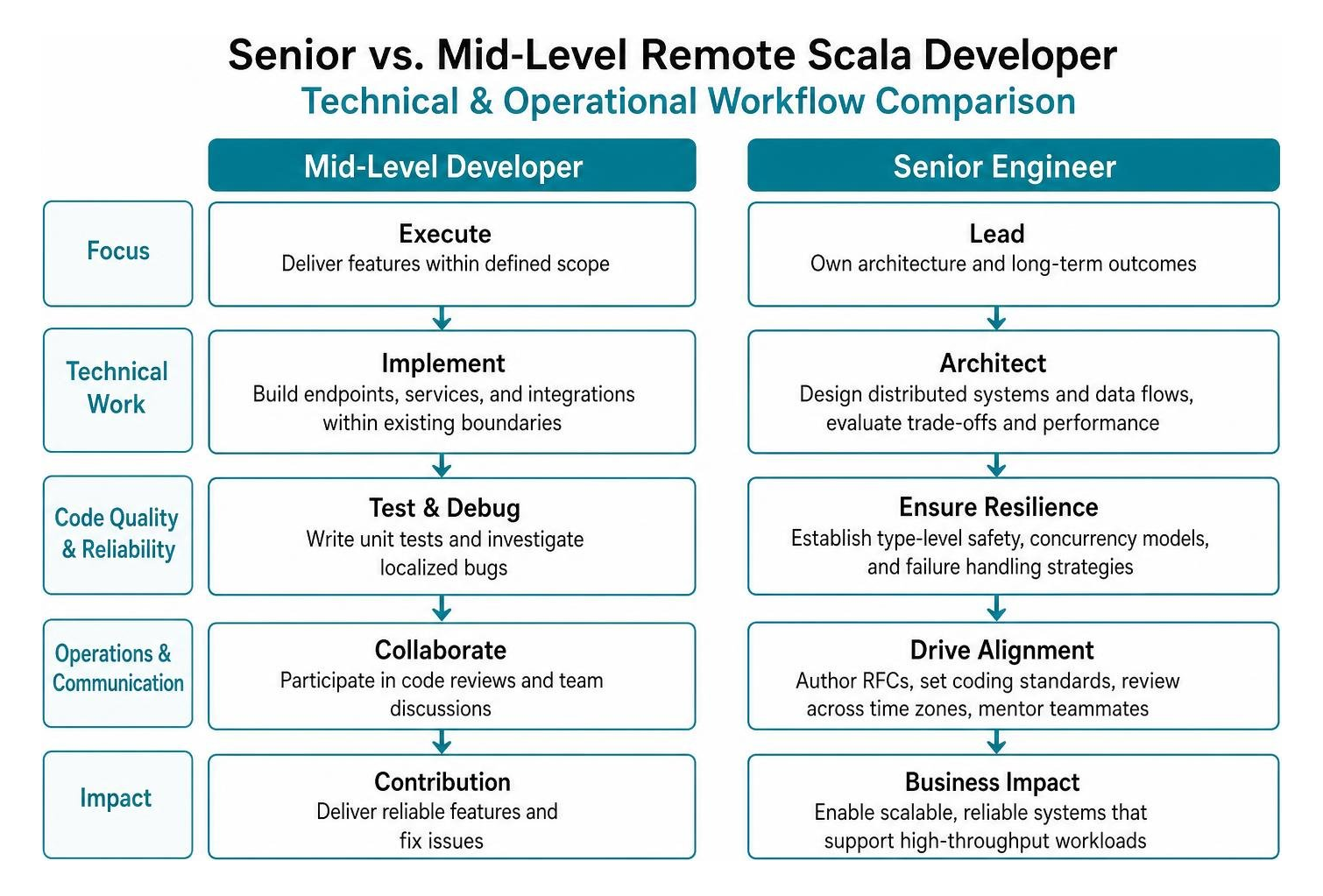
A mid-level developer typically implements well-defined endpoints, writes unit tests, and investigates localized bugs within existing service boundaries. Conversely, senior and staff engineers manage distributed system resilience, evaluate trade-offs between pure functional libraries and imperative performance optimizations, and design type-level safety mechanisms that prevent entire classes of runtime errors across the team.
As highlighted in our remote senior software engineer salary guide, senior developers in remote setups must also excel at asynchronous communication. They author concise Request for Comments (RFC) documents, establish coding standards, review pull requests across time zones without blocking teammates, and mentor junior colleagues through recorded walkthroughs and detailed documentation.
Core Tech Stack and Essential Frameworks for Modern Scala Roles

The modern Scala landscape has matured significantly with the widespread adoption of Scala 3. With its cleaner syntax, revamped macro system, intersection types, and improved contextual abstractions, Scala 3 allows distributed teams to maintain clean codebases with fewer third-party compiler plugins. Staying competitive means mastering both core functional programming paradigms and the JVM runtime mechanics that power high-concurrency systems. When evaluating in-demand remote developer skills, deep JVM tuning and cloud-native patterns remain indispensable.
Reactive and Streaming Frameworks: ZIO, Cats Effect, and Pekko
Modern backend development in Scala has largely converged around two powerful functional effect systems alongside established actor runtimes:
- Cats Effect & http4s: The Typelevel ecosystem remains a gold standard for pure, composable functional programming. Teams utilize Cats Effect 3 for fiber-based concurrency, resource safety via
Resource, and pure I/O handling, pairing it withhttp4sfor type-safe REST APIs andfs2for streaming data. - ZIO: ZIO has seen explosive adoption due to its developer-friendly ergonomics, built-in concurrency primitives, powerful software transactional memory (STM), and out-of-the-box support for metrics and tracing.
- Apache Pekko & Akka: Following Akka’s license transition, Apache Pekko has emerged as a community-driven open-source alternative for actor-based distributed systems. Many established enterprises continue maintaining high-throughput Akka clusters, making knowledge of the actor model, Akka Streams, and event sourcing a major asset.
- Data Access Layers: Production services frequently rely on Doobie, Skunk, or Slick to maintain compile-time query safety when interacting with PostgreSQL and cloud datastores on infrastructure like Amazon Web Services (AWS).
Big Data and High-Throughput Distributed Systems
For data-intensive positions, Scala developers must bridge the gap between application engineering and large-scale data processing.
Apache Spark remains the backbone of enterprise batch and streaming pipelines. Developers build fault-tolerant transformation graphs, optimize memory execution plans, and interact with distributed table formats using Databricks and Delta Lake. Real-time event streaming architectures also depend on Apache Kafka. Remote teams look for engineers who understand partition rebalancing, consumer offset commit strategies, schema registries (Avro, Protobuf), and dead-letter queue patterns. High-impact roles, such as this Senior Scala Developer microservices position, specifically demand engineers capable of pairing Kafka streaming with containerized microservice runtimes.
Proven Strategies to Land High-Paying Remote Scala Roles
Landing a top-tier remote role requires more than sending generic resumes. Because Scala talent pools are specialized, hiring managers look for unambiguous evidence of technical craftsmanship and remote communication habits.
- Build a Public Functional Portfolio: Create a small, clean GitHub project showcasing real-world problem solving. For example, build an asynchronous microservice using ZIO 2 or Cats Effect 3 that streams data from a public API into Kafka, persisting results into PostgreSQL with comprehensive property-based tests (using ScalaCheck).
- Demonstrate JVM Performance Literacy: Highlight practical optimizations in your application materials, such as how you reduced garbage collection overhead, resolved fiber leaks, or optimized Spark shuffle operations.
- Target Curated Marketplaces: Instead of competing against thousands of applicants on general job aggregators, look for verified platforms and direct company listings that specialize in remote Scala opportunities.
- Identify Employer Red Flags: Avoid companies that expect 24/7 synchronous on-call availability without clear rotation policies, teams lacking automated CI/CD pipelines, or postings that conflate entry-level compensation with staff-level architectural demands. Many progressive remote teams now prioritize alternative, no-LeetCode practical assessments that evaluate real-world design rather than abstract puzzles.
How AI Tools and Vibe Coding Are Reshaping Scala Developer Remote Jobs
The rise of generative AI tools like GitHub Copilot, Cursor, and Claude 3.5 Sonnet has introduced new workflows to functional programming. While dynamically typed languages can sometimes suffer from AI hallucinations that silently fail at runtime, Scala’s strict, expressive type system acts as an automated verification layer.

Engineers can leverage natural language prompts to scaffold boilerplate, generate serialization codecs, or write repetitive unit test suites—an approach often termed “vibe coding” when rapidly prototyping functional logic. The Scala compiler immediately catches type mismatches, missing implicit/given instances, or unhandled sum-type branches. As covered in our AI-assisted development career guide and the vibe coding remote job guide, high-performing engineers in 2026 are not replaced by AI; they use AI to accelerate implementation speed while dedicating their human focus to high-level architecture, domain modeling, and data consistency models.
Mastering the Async-First Interview and Trial Process
Remote hiring processes for Scala engineers typically focus on practical execution rather than high-pressure whiteboard sessions.
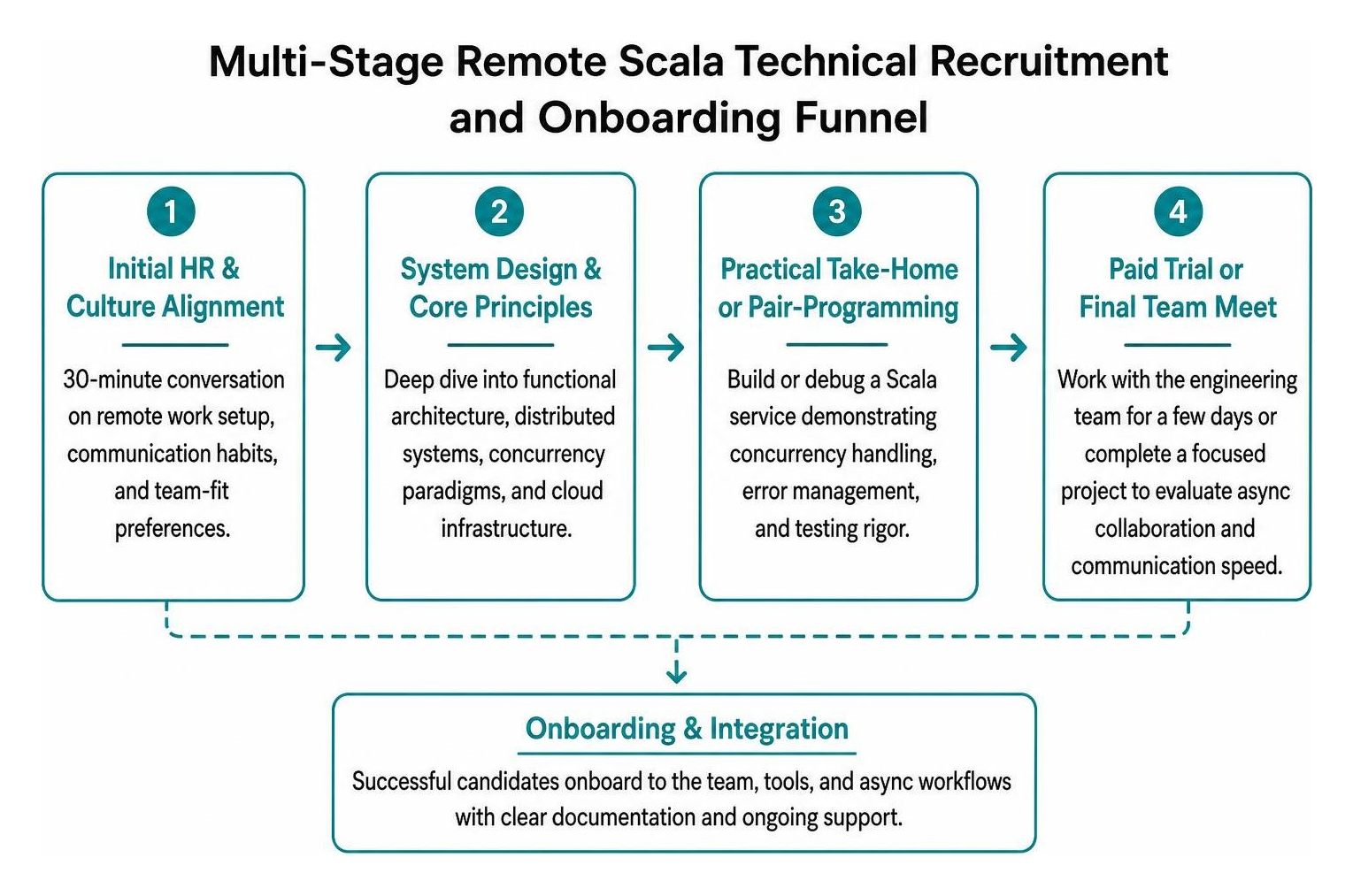
Most hiring pipelines follow a structured four-stage format:
- Initial HR & Culture Alignment: A 30-minute conversation evaluating your remote work setup, communication habits, and team-fit preferences.
- System Design & Core Principles: A deep dive into your experience with functional architecture, distributed systems, concurrency paradigms, and cloud infrastructure.
- Practical Take-Home or Pair-Programming: Building or debugging a small Scala service that demonstrates concurrency handling, error management, and testing rigor.
- Paid Trial or Final Team Meet: Working with the engineering team for a few days (or completing a focused project) to evaluate async collaboration and communication speed.
Adopting a robust async-first communication workflow during your interview stages—such as submitting clear pull-request descriptions, recording short Loom walkthroughs of your design, and proactively managing time-zone expectations—will instantly separate you from the competition.
Frequently Asked Questions About Remote Scala Development
What is the average salary for a remote Scala developer in 2026?
In the US, remote Scala developers earn an average of $130,000 to $146,000 per year, with senior and lead engineers making upwards of $180,000 to $275,000+. In Europe, senior B2B contractors typically earn between €40 and €75 per hour, while full-time salaries average €75,000 to €120,000 depending on location and experience.
Is Scala still in high demand despite declining developer popularity share?
Yes. While general developer surveys show Scala representing around 2.6% of the global developer market, it is heavily entrenched in mission-critical backend systems, global financial exchanges, ad tech platforms, and big data infrastructure. Because 43% of companies report difficulty hiring experienced Scala talent, qualified engineers enjoy high job security and premium compensation.
How do AI-assisted development tools affect remote Scala engineering?
AI coding assistants accelerate scaffolding, repetitive codec creation, and test generation. Because Scala features an advanced static type system, compiler errors immediately catch code hallucinations. This allows remote engineers to prototype rapidly while relying on the compiler to guarantee system correctness and thread safety.
Conclusion
The market for remote Scala developers in 2026 offers immense financial and professional upside for engineers who master functional paradigms, distributed systems, and modern JVM ecosystems. While general industry trends shift, enterprise demand for scalable, fault-tolerant infrastructure ensures that high-performing Scala talent remains among the highest-compensated in software engineering.
To accelerate your search, focus on building verifiable projects using modern Scala 3, Cats Effect, ZIO, or Spark, embrace AI-assisted development workflows to boost your daily output, and target async-first engineering cultures that value deep work. Ready to take the next step in your remote career? Explore thousands of curated listings, salary benchmarks, and AI-native opportunities at Remote Vibe Coding Jobs.