
Scala Freelance Jobs Are Niche — and That’s Exactly Why They Pay Well
Scala freelance jobs are in steady demand across fintech, data engineering, and enterprise backend development — and the niche nature of the language means less competition and stronger rates for skilled developers.
Where to find Scala freelance jobs quickly:
Finding high-quality contracts requires looking beyond generic job boards. Specialized platforms like Vibe Coding Jobs curate remote Scala contract roles specifically for modern, AI-first teams, allowing you to bypass the noise and connect directly with companies that value your specific expertise.
Scala sits at a fascinating crossroads right now. It powers real-time data pipelines at major financial institutions, drives event-driven microservices on Kafka, and underpins some of the world’s most demanding distributed systems — yet it remains niche enough that finding good Scala freelancers is genuinely hard for clients.
That scarcity works in your favor. Many developers note that working locally often meant being pushed toward mainstream technologies — but focusing on global remote opportunities opens up roles where Scala is the core language, not an afterthought.
The freelance Scala market in 2026 is active, global, and heavily skewed toward senior contract work. If you know what you’re doing with Scala, Kafka, Spark, or Akka, there are real, well-paying remote gigs waiting.
I’m RVCJ Editorial, the content team behind Vibe Coding Jobs — we cover remote developer hiring, AI-assisted workflows, and career strategy for engineers navigating the scala freelance jobs market and beyond. We’ve analyzed hundreds of active Scala contract postings across global platforms to bring you the clearest picture of where the work is and how to land it.
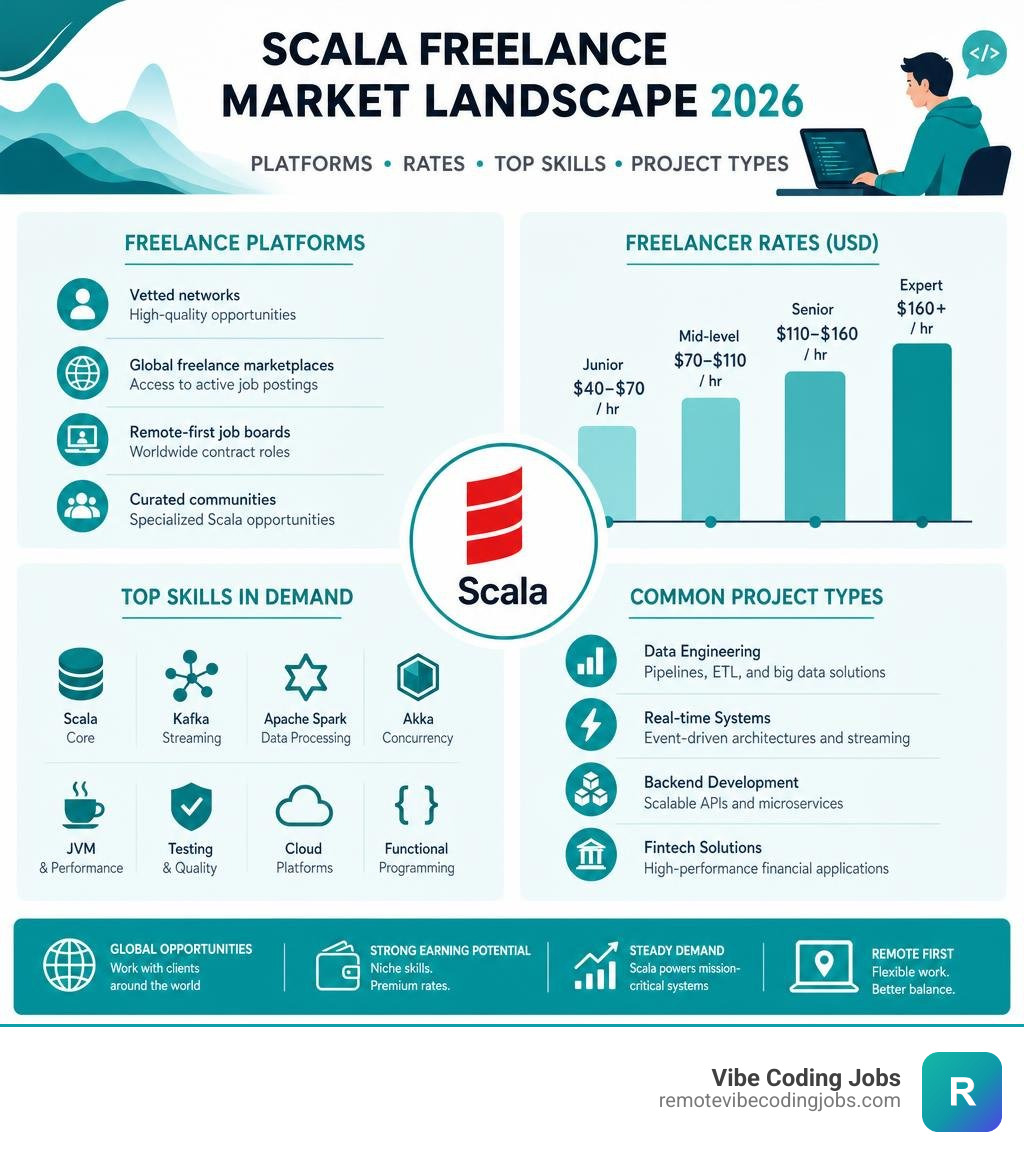
Know your scala freelance jobs terms:
The Landscape of Scala Freelance Jobs

The market for freelance Scala developers is highly specialized. Unlike languages like PHP or JavaScript, where projects can range from simple landing pages to complex web apps, Scala is almost exclusively reserved for high-performance, mission-critical infrastructure.
When companies hire Scala freelancers, they are typically looking to solve problems in three core areas:
- High-Throughput Backend Development: Building resilient, concurrent backend systems that can handle millions of requests. These projects frequently rely on microservices architectures and robust communication protocols.
- Data Engineering and Big Data Pipelines: Processing massive datasets using Apache Spark, Databricks, or Palantir Foundry. Scala’s strong typing and native compatibility with the JVM make it the gold standard for data pipeline automation.
- Event-Driven Streaming: Designing real-time streaming architectures using Kafka Streams and reactive frameworks. This is incredibly common in fintech, where real-time transaction processing, pattern analysis, and risk assessment are vital.
We see these patterns constantly in active project listings. For instance, many projects focus heavily on building state-of-the-art fintech digital marketplaces using Scala, Kafka, and microservices. Similarly, companies in the financial and energy sectors regularly look for contractors to maintain and optimize real-time planning and optimization platforms.
In 2026, we are also seeing a massive rise in “vibe coding”—using AI tools like Cursor and Claude to rapidly draft, refactor, and test Scala code. Because Scala has a notoriously steep learning curve and strict compiler rules, AI-assisted development has become a secret weapon for freelancers. You can let the AI handle the boilerplate structure while you focus on high-level system architecture and functional purity.
Explore remote Scala developer roles on Vibe Coding Jobs to find teams that encourage modern, AI-assisted workflows.
In-Demand Skills for Scala Freelance Jobs
If you want to secure high-paying contracts, simply knowing basic Scala syntax isn’t enough. Clients are looking for developers who understand the broader ecosystem. Here are the technical stacks that dominate the freelance market:
- The Typelevel Stack: Functional programming (FP) purity is highly valued. Expect clients to ask for experience with Cats-Effect and Doobie for pure functional side-effects and database access. Many advanced listings explicitly state they want a “Scala Expert in Functional Programming, not Procedural Programming.”
- The Reactive Stack (Akka/Pekko): Despite licensing shifts, Akka (and its open-source fork, Apache Pekko) remains a staple for actor-based concurrency. Gigs often involve setting up Scala with Akka and messaging systems like IBM MQ.
- Cloud Infrastructure & DevOps: Modern Scala applications don’t run in a vacuum. You will need strong experience with Kubernetes, AWS, and robust CI/CD pipelines. For example, senior contracts often require a minimum of five years of experience with deployment architectures using Kubernetes on AWS alongside Protobuf serialization.
- Version Migrations: One of the most common contract archetypes is the upgrade project. Many enterprises are actively migrating legacy codebases from Scala 2.12 or 2.13 to Scala 3. These projects require deep knowledge of dependency management, macro refactoring, and library compatibility.
Check out active Scala contract requirements to see which of these skills are commanding the highest premiums today.
Typical Project Scopes and Engagement Models
Freelance Scala engagements rarely look like quick, two-week design gigs. Because of the complexity of the systems involved, projects generally fall into one of three buckets:
- Short-Term Migrations and Audits (3 to 6 months): These are highly targeted contracts. A client might hire you for an 80% capacity role (4 days a week) specifically to migrate a system to Scala 3 or optimize a slow-performing Spark streaming pipeline.
- Long-Term Platform Development (6 to 12+ months): Many fintech and enterprise clients hire freelancers on rolling 6-month or 12-month contracts. For example, roles at major financial institutions or consulting firms often run until the end of the calendar year with high chances of extension.
- Retainers and Part-Time Support: Some clients running stable Scala systems don’t need a full-time engineer but require a reliable expert on retainer to debug legacy issues, fix IDE compilation errors, or support data lake operations on Databricks.
Most of these gigs are 100% remote, though some European clients (especially in Germany or Switzerland) occasionally request a monthly on-site alignment meeting.
How Scala Freelance Rates Compare to Other Languages
Because Scala is a niche language with a steep learning curve, its average freelance rates are consistently higher than those of more mainstream languages. Companies are willing to pay a premium because a poorly written Scala application can cause massive infrastructure overhead, while an optimized functional system can save them millions in cloud costs. For additional context on the language and ecosystem, see the official Scala documentation.
| Language | Average Freelance Hourly Rate (USD) | Common Project Focus | Market Demand |
|---|---|---|---|
| Scala | $85 – $150+ | Big Data, Fintech, High-Throughput Microservices | Niche / Very High Value |
| Java | $60 – $105 | Enterprise Web Apps, Legacy Backend Systems | Broad / Highly Competitive |
| Python | $50 – $110 | Data Science, Scripting, AI/ML Integrations | Massive / High Volume |
| Kotlin | $65 – $110 | Android Development, Spring Boot Backend | Growing / Moderate |
Scala developers command premium pricing due to the “functional programming premium.” Writing clean, type-safe, non-blocking concurrent code requires a level of software engineering discipline that is harder to find. Furthermore, because Scala integrates seamlessly with the JVM, enterprises can run high-performance functional code on their existing Java infrastructure, making Scala freelancers highly valuable to large organizations.
Where to Find High-Paying Scala Freelance Jobs

Finding Scala contracts requires a more targeted approach than looking for general web development work. Because of the specialized nature of the tech stack, you should focus your search on platforms that cater to enterprise clients and high-end engineering talent.
- Specialized Job Boards and Aggregators: Instead of wading through entry-level listings, use platforms that aggregate high-quality remote work. Focus on boards that specialize in functional programming or remote-first engineering roles.
- Elite Freelance Networks: Vetted networks allow you to bypass traditional bidding wars. Once you pass their screening, jobs are matched directly to you, ensuring you connect with clients who have the budget for premium Scala talent.
- General Freelance Marketplaces: While general platforms have a reputation for lower-budget work, they still host enterprise contracts. You can find active listings ranging from quick debugging tasks to massive backend integrations if you filter carefully.
- AI-First Job Boards: If you prefer working with modern teams that embrace AI-assisted workflows (vibe coding), we curate daily listings of remote roles where your ability to leverage tools like Cursor and Claude is seen as an asset, not a shortcut.
Browse remote Scala job listings on Vibe Coding Jobs to find forward-thinking companies hiring today.
How to Win Bids and Land Scala Freelance Jobs
Because Scala contracts are lucrative, the competition at the senior level can be fierce. To stand out, you need to prove your technical depth immediately:
- Showcase Migration Case Studies: Don’t just list “Scala” on your resume. Write a short case study on how you migrated a codebase from Scala 2.12 to Scala 3, detailing how you handled macro changes and library deprecations.
- Highlight High-Throughput Achievements: Clients care about performance. Use concrete numbers: “Optimized a Kafka Streams pipeline, reducing latency by 40% and saving $5,000/month in AWS costs.”
- Prepare for Rigorous Vetting: Technical interviews for Scala roles are notoriously thorough. You should expect live coding challenges focusing on functional programming paradigms, recursion, and concurrency. Be ready to explain the difference between Monads and Applicatives if you are applying for Typelevel-heavy roles that require deep Kafka and microservices expertise.
- Leverage Vibe Coding to Build Rapid Proofs of Concept: When pitching a client, use AI tools to quickly scaffold a small proof-of-concept (PoC) demonstrating how you would solve their specific problem (e.g., a mock Akka actor system or a basic Spark streaming job). This shows incredible proactivity and technical capability.
Frequently Asked Questions About Scala Freelancing
Is Scala still in high demand for freelance projects in 2026?
Yes. While Scala is not a “hype” language, it remains an essential pillar for enterprise systems, big data architectures, and real-time financial applications. Its adoption in data lakes (via Spark and Databricks) and microservices ensures a steady stream of highly paid contract opportunities for senior developers who can manage complex distributed systems.
Do I need to know Java to get Scala freelance work?
While you don’t need to be a daily Java developer, a strong understanding of the JVM (Java Virtual Machine) is highly beneficial. Many freelance projects involve integrating Scala applications with legacy Java systems, debugging JVM garbage collection issues, or wrapping existing Java libraries.
What are the most common frameworks used in Scala freelance gigs?
The most common frameworks you will encounter in freelance listings include:
- Apache Spark (for big data and data engineering pipelines)
- Kafka / Kafka Streams (for real-time event streaming)
- Akka / Pekko (for concurrent, actor-based microservices)
- Play Framework / Http4s (for building robust RESTful APIs and web backends)
- Cats / Cats-Effect (for pure functional programming architectures)
Conclusion
Freelancing as a Scala developer offers an incredible path to career freedom, high compensation, and intellectually stimulating work. By focusing on high-value niches like real-time data streaming, functional programming architectures, and version migrations, you can position yourself as an indispensable expert.
As software development evolves, those who combine deep Scala expertise with modern AI-assisted “vibe coding” workflows will find themselves at a massive advantage—delivering complex, type-safe backend systems faster than ever before.
Ready to skip the generic job boards and find remote-first teams that value high-level engineering and modern tooling?
Find your next remote developer role on Vibe Coding Jobs today.