
Why Python AI Coding Remote Jobs Are One of the Hottest Opportunities in Tech Right Now
Python AI coding remote jobs have exploded in 2026 — and if you know Python well, you’re already closer to landing one than you might think.
Here’s a quick snapshot of what’s available right now:
| Role Type | Typical Pay | Commitment |
|---|---|---|
| Freelance AI Trainer | $8–$90+/hr | 5–20 hrs/week |
| RLHF Contract Engineer | $30–$70/hr | 15–40 hrs/week |
| Full-Time AI Engineer | $100K–$250K+/yr | Full-time |
| Senior AI Solutions Engineer | $165K–$249K/yr | Full-time |
The short answer: You don’t need a machine learning degree. You need strong Python skills, sharp code-review instincts, and the ability to explain your reasoning clearly. Companies like Scale AI, Mindrift, and G2I are actively paying developers to review and improve AI-generated code — right now, from anywhere in the world.
The opportunity is real. Imagine spending your day challenging a large language model on its handling of asynchronous Python code, documenting where it fails, and feeding that insight back into its training pipeline. That’s a paying remote job in 2026 — and it’s just one of many.
I’m Dominic Zijlstra, co-founder of Adaptify.ai and a former data scientist and DevOps engineer, and my hands-on experience building automated data systems gives me a grounded view of what it takes to break into python ai coding remote work today. In this guide, I’ll walk you through every layer of this market — from freelance AI training gigs to senior agentic engineering roles — so you can find the right fit fast.
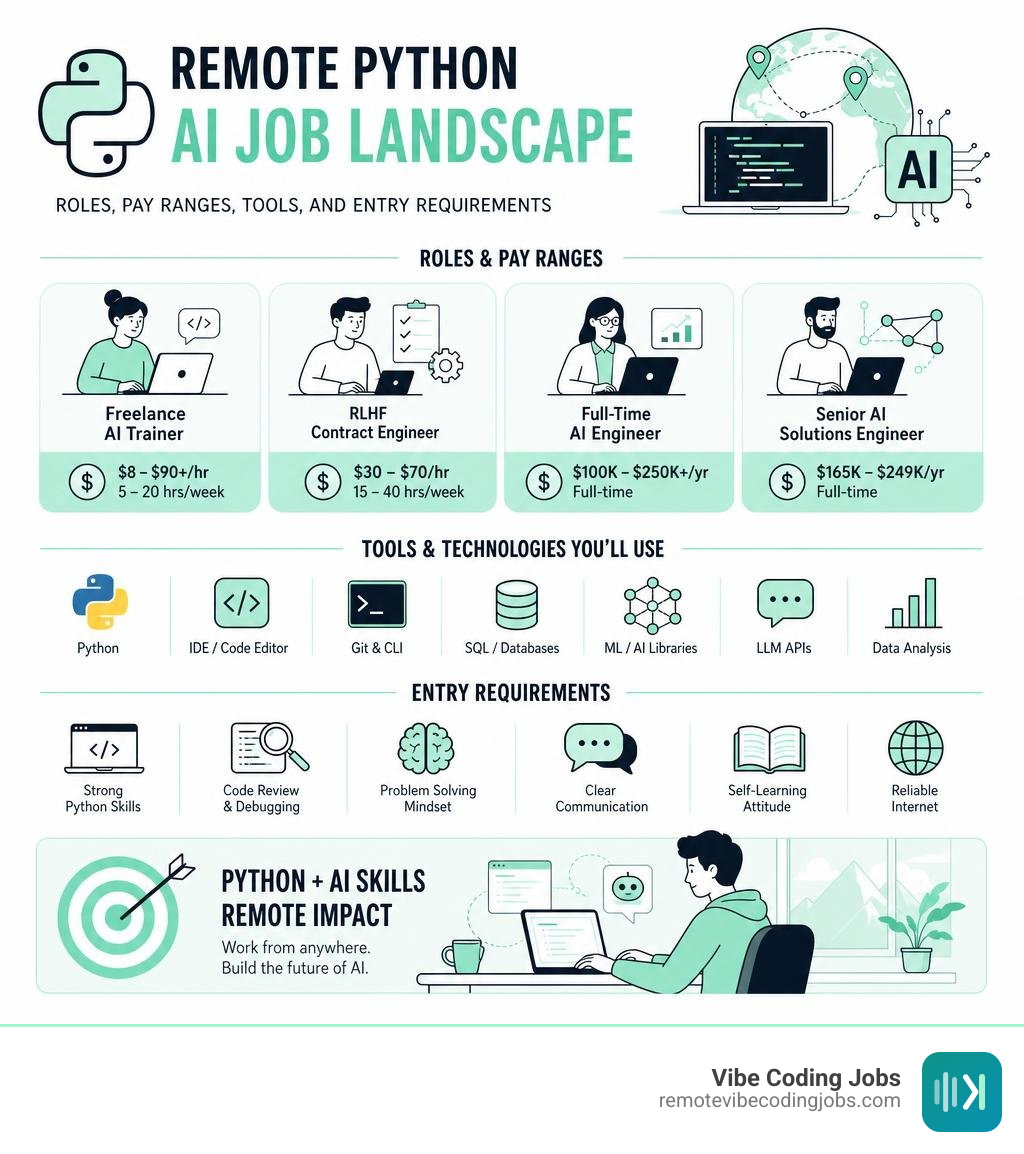
Essential python ai coding remote terms:
The Landscape of Python AI Coding Remote Roles
The market for python ai coding remote positions has matured rapidly. It is no longer a choice between being a traditional academic researcher or a standard backend developer. Today, a spectrum of specialized remote roles exists, each requiring a unique balance of Python expertise, critical analysis, and system architecture skills.
Understanding where you fit on this spectrum is the first step to targeting the right opportunities. Let’s break down the primary roles driving this remote job market:
- AI Trainer / AI Coding Specialist: In this role, you act as an educator for large language models (LLMs). Instead of writing software for end-users, you converse with advanced models on complex programming scenarios. You challenge the model on topics like memory management, object-oriented design, and secure coding practices. Your goal is to evaluate, debug, and harden the model’s code generation capabilities, documenting its failures and suggesting prompt engineering improvements.
- Code Evaluator / RLHF Specialist: Reinforcement Learning from Human Feedback (RLHF) is the engine behind modern generative AI. As a code evaluator, you compare multiple AI-generated implementations of a function, rank them by readability and performance, and write detailed rationales explaining your choices. You might review how an AI-generated function handles overlapping keys and nested structures in a dictionary, identify subtle logical bugs, and rewrite the code to make it production-grade.
- AI Engineer / AI Solutions Engineer: This is a core software engineering role focused on building applications powered by AI. You are responsible for designing and deploying systems that integrate LLMs with enterprise data. This involves building Retrieval-Augmented Generation (RAG) pipelines, managing vector databases, and constructing secure APIs.
- Agentic AI Engineer: The frontier of AI development is moving from passive chatbots to autonomous agents. Agentic AI engineers build multi-agent orchestration layers that coordinate specialized AI workers, manage state, handle complex workflows, and execute real-world business decisions like revenue forecasting or supply chain automation.
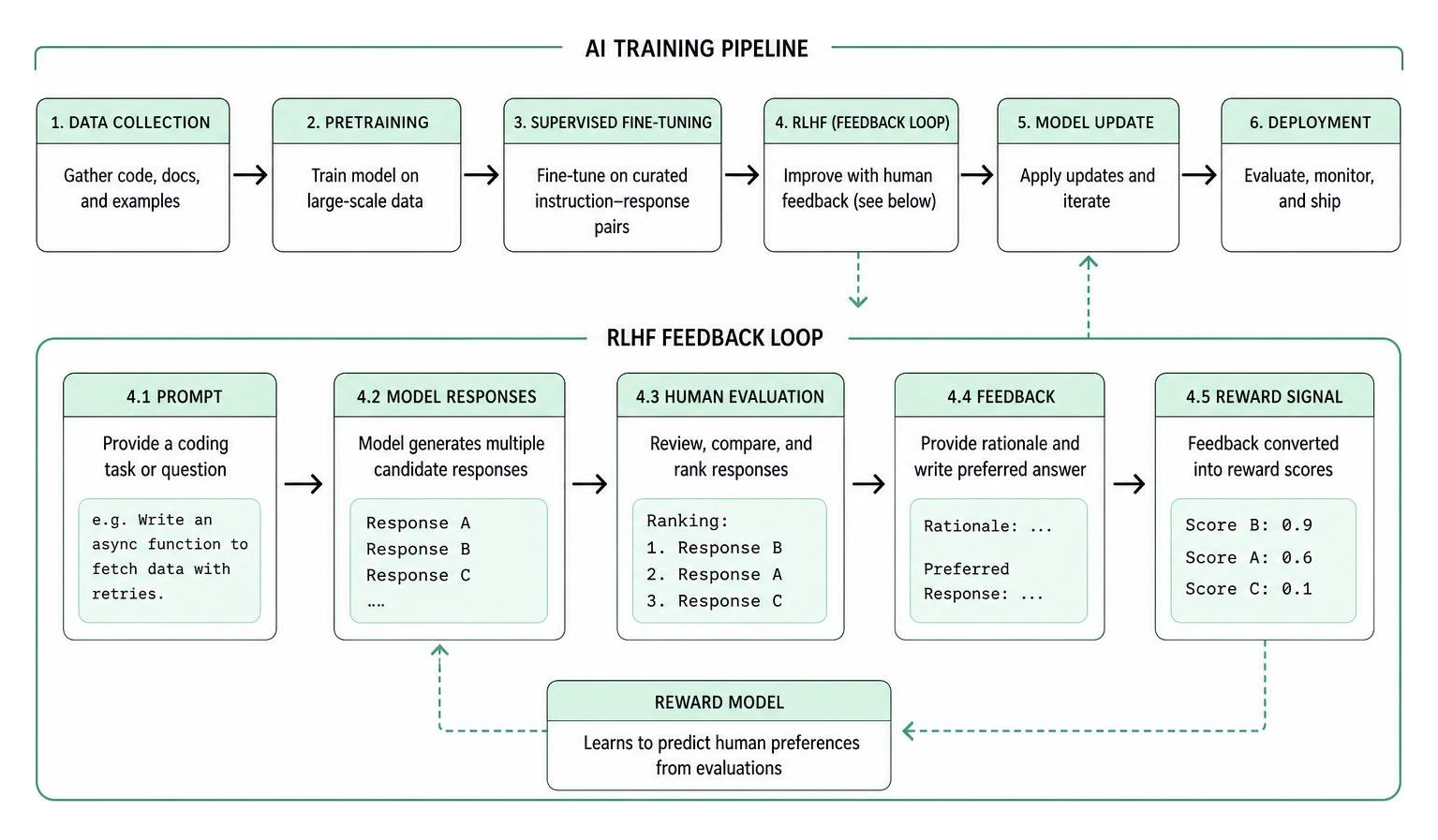
These roles represent a fundamental shift in how software is created. We are moving toward what many call the AI-native Development Lifecycle (AI-DLC), where developers spend less time typing boilerplate syntax and more time acting as systems architects who guide, evaluate, and orchestrate AI systems.
To learn more about how this shifts your day-to-day work, check out our guide on Remote AI Coding Jobs Opportunities.
Freelance AI Trainers vs. Full-Time Engineers
When seeking a python ai coding remote role, you will find a clear divide between flexible freelance training projects and traditional full-time engineering positions. Both paths offer strong career potential, but they serve different lifestyles and professional goals.
Freelance AI training networks (such as Mindrift, Scale AI, and G2I’s contract division) offer incredible flexibility. Most contributors on these platforms work between 5 and 20 hours per week alongside other commitments, making it an ideal side-hustle or a way to monetize your skills while traveling. These platforms operate on an asynchronous, on-demand basis: you log in, claim a task (such as evaluating an AI-generated script or writing a complex coding challenge), complete it, and get paid.
The major trade-offs for freelance roles are the lack of traditional employment benefits (like health insurance or paid time off) and the variable nature of project availability. However, they serve as an exceptional entry point. They allow you to build a portfolio of LLM evaluation experience without needing prior AI/ML credentials.
Full-time remote AI engineering roles, on the other hand, require a standard 40-hour weekly commitment and deep integration with a product team. You will be architecting production systems, managing cloud deployments on AWS, and ensuring data compliance. These roles come with competitive annual salaries, equity, health benefits, and a structured path for career growth.
If you want to see what a highly flexible contract role looks like in practice, you can explore the G2i Software Engineer for Training AI Data (Python) posting on our platform.
The Interview and Evaluation Process
The interview pipeline for remote Python AI roles is highly practical and heavily focused on code quality, communication, and problem-solving. While traditional tech interviews often rely on abstract algorithmic puzzles, AI-focused roles evaluate your ability to analyze, debug, and explain code.
The typical evaluation process consists of several distinct stages:
- Technical Assessments: You will likely be asked to complete a take-home assessment or a practical coding test. Instead of just writing a function from scratch, you might be handed an AI-generated code snippet containing a subtle architectural flaw or a performance bottleneck (such as an unhandled edge case in an asynchronous loop). Your task will be to identify the bug, write comprehensive test cases, and explain the fix.
- AI Video Interviews: Many remote-first platforms utilize automated, AI-driven video screening tools as a first-stage evaluation. You will be presented with technical questions on screen and given a set amount of time to record your answers. Preparing for these requires practicing clear, concise verbal communication of technical concepts.
- Metacognitive Communication Reviews: For AI training and evaluation roles, companies assess how well you “show your work.” Because AI models learn from human reasoning, your written explanations of why a certain block of code is efficient, secure, or logically correct are just as important as the code itself.
- Live Code Reviews: In later stages for full-time roles, you will walk through your take-home project with senior engineers. They will evaluate your design decisions, your understanding of separation of concerns, and how you manage LLM limitations like context windows and non-deterministic outputs.
Compensation Models and Tech Stacks in 2026
Compensation in the remote Python AI space is highly elastic, reflecting the wide range of roles and geographic flexibility. Whether you are looking for a high-paying hourly side-hustle or a stable six-figure salary, the market in 2026 offers competitive rates across all experience levels.
To help you visualize the compensation landscape, we have compiled a comparison of typical rates and salaries across the primary remote Python AI roles:
| Role | Experience Level | Hourly Rate Range | Equivalent Annual Salary |
|---|---|---|---|
| Freelance AI Trainer | Entry to Mid | $25 – $65 / hr | $50,000 – $130,000 |
| Senior RLHF Evaluator | Senior | $60 – $90+ / hr | $120,000 – $180,000+ |
| Mid-Level AI Engineer | Mid (2+ years) | $50 – $100 / hr | $100,000 – $150,000 |
| Lead/Senior AI Architect | Senior (5+ years) | $100 – $150+ / hr | $165,000 – $250,000+ |
Hourly Freelance and Contract Rates
For freelance and contract-based python ai coding remote roles, the compensation model is almost exclusively hourly. These rates vary depending on your evaluated expertise, the complexity of the tasks, and sometimes your geographic location.
- Entry-Level Training: Basic code evaluation and prompt testing roles typically pay between $25 and $34 per hour. These projects usually provide structured guidelines and do not require extensive systems-level backend experience.
- Mid-Level & Specialized Gigs: Platforms like Mindrift and G2I offer projects ranging from $32 to $70+ per hour. At this level, you are expected to review advanced Python concepts, construct complex test suites, and write highly detailed rationales.
- Senior Systems & LLM Evaluation: Top-tier contract positions can pay $90 to $150+ per hour. These roles require deep systems-level programming knowledge (often pairing Python with languages like Rust, C++, or Go) to evaluate LLM outputs for high-performance computing and enterprise security.
Because these hours can be variable, many remote developers treat contract RLHF work as a highly lucrative stream of supplementary income while maintaining other freelance projects or full-time roles.
Essential Skills, Tools, and Frameworks
To stand out in the competitive remote job market, you need to master the specific technologies that modern AI teams use to build and deploy applications. Today’s AI engineering goes far beyond basic API calls; it requires building robust, production-grade architectures.
The most in-demand skills and frameworks for Python AI developers include:
- Orchestration Frameworks: LangChain and LangGraph are essential for wiring tools, planners, and memory together. LangGraph, in particular, is highly sought after for building complex, stateful multi-agent systems.
- Retrieval-Augmented Generation (RAG): You should have hands-on experience building RAG pipelines to connect LLMs to external data sources. This requires understanding embeddings and working with vector databases like Milvus, Weaviate, or pgvector.
- Asynchronous Backend Development: Because LLM API calls are high-latency operations, proficiency with async Python frameworks like FastAPI is critical for building responsive, distributed systems.
- Cloud Infrastructure & DevOps: Knowledge of AWS (including services like AWS Lambda, S3, and Amazon Bedrock), containerization with Docker, and orchestration with Kubernetes is highly valued for deploying GenAI workloads at scale.
- AI-Assisted Development Tools: Enterprise teams are actively looking for developers who use AI-assisted tools like Cursor, Claude Code, and GitHub Copilot as standard practice to accelerate prototyping and code reviews.
If you are looking to join a team that values this modern, AI-forward stack, take a look at the Senior Python Full Stack Developer with AI Skills opportunity listed on our board.
Breaking Into the AI Space as a Traditional Developer
If you are an experienced Python developer but have never built a neural network or trained a model from scratch, do not be discouraged. The vast majority of remote Python AI roles do not require deep mathematical knowledge of machine learning algorithms. Instead, they require strong software engineering judgment.
Transitioning into this field is about reframing your existing skills. When an AI training company asks you to evaluate code, they are not looking for an academic researcher; they are looking for a senior developer who can conduct a rigorous pull request review, spot edge cases, and ensure clean, maintainable code.

To begin your transition, focus on building a portfolio that demonstrates your ability to work with LLMs. You can find active listings to match your current skill level by browsing our curated list of Remote Python Developer Jobs.
How to Land a Python AI Coding Remote Role Without Prior ML Experience
To land your first remote role in this space, you need to show employers that you understand how to build and evaluate AI-driven software. Here is a practical roadmap to get started:
- Master Code Validation: Practice reviewing code written by others (including AI models). Focus on identifying performance traps, security vulnerabilities, and logical errors. Write comprehensive test cases using pytest to validate edge cases, nested data structures, and asynchronous behavior.
- Develop Metacognitive Communication: When you write code or debug an error, practice explaining your thought process step-by-step. Write clear, structured markdown documentation. For AI training roles, your ability to explain why a piece of code is correct is a core hiring metric.
- Build Practical AI Projects: Instead of theoretical tutorials, build real, functional tools. Create a simple RAG application that lets you query a collection of local documents, or build a basic multi-agent workflow using LangGraph. Post these projects on GitHub and write detailed README files explaining your architectural choices.
- Adopt AI-Native Workflows: Integrate tools like Cursor and Claude Code into your daily development routine. Learn how to write precise prompts, manage context files, and use AI as a collaborative partner to speed up your prototyping.
By focusing on these practical engineering skills, you can easily bypass the need for a formal ML degree. For straightforward, direct opportunities that value clean code over academic credentials, explore our curated list of No-BS Remote Python Jobs.
Overcoming Remote Work Challenges in AI
Working remotely in a field like AI brings unique coordination challenges. Because the technology and project requirements change rapidly, maintaining alignment with your team is critical.
- Asynchronous Communication: AI engineering often involves non-deterministic systems where models can behave unexpectedly. When documenting bugs or model failures, clear, written communication is essential. Learn to capture reproducible error traces and write detailed tickets so team members in other time zones can understand the issue without needing a live meeting.
- Time Zone Management: Many remote AI teams are globally distributed. If you are working as a contractor, establish clear boundaries for your working hours while ensuring a few hours of overlap with core team members for collaborative debugging and architecture reviews.
- Maintaining Work-Life Balance: The flexible, task-based nature of freelance AI training can make it tempting to work around the clock. To avoid burnout, set a structured daily schedule, designate a dedicated workspace, and track your active hours diligently.
The Future Outlook of Python AI Coding Remote Specializations
As the AI landscape continues to evolve, several specialized areas are expected to see massive growth, offering lucrative, long-term career paths for remote Python developers:
- Agentic AI & Multi-Agent Systems: The demand for developers who can orchestrate complex, autonomous agent networks using frameworks like LangGraph and CrewAI will continue to skyrocket as enterprises seek to automate end-to-end business workflows.
- LLM Evaluation & Benchmarking: As companies deploy proprietary models, the need for rigorous human-in-the-loop evaluation, automated testing frameworks, and custom benchmarking suites will remain a top priority to ensure model reliability.
- AI Safety & Guardrails: Building defense-grade security layers, monitoring systems, and input/output guardrails to prevent data leaks, prompt injections, and non-compliant model behavior will become a critical engineering discipline.
Frequently Asked Questions about Python AI Jobs
Do I need a PhD in machine learning to work in Python AI?
No, you do not need a PhD or even a background in data science. While academic researchers design the core architectures of foundational models, the industry has a massive, unmet demand for software engineers who can build applications, manage data pipelines, and evaluate model outputs.
If you can write clean Python, design robust system architectures, and conduct thorough code reviews, you have the foundational skills needed for these roles. To build your confidence and learn how to leverage AI assistants effectively in your daily workflow, check out the Python Coding With AI (Learning Path) on Real Python.
What are the best AI-assisted coding tools to learn?
The remote job market highly values developers who are fluent in modern, AI-native development environments. The most frequently cited tools in active job descriptions include:
- Cursor: A powerful, fork-of-VS-Code editor that integrates LLMs directly into your editing workflow, allowing for rapid inline edits, codebase-wide queries, and auto-generation.
- Claude Code: Anthropic’s command-line tool designed for agentic coding tasks, allowing you to run tests, write code, and manage git repositories using natural language.
- GitHub Copilot: The industry-standard autocomplete and chat assistant that helps speed up boilerplate writing and basic debugging.
To understand how these tools are redefining software careers and how you can position yourself as an AI-fluent professional, read our guide on Vibe Coding Jobs with Remote AI Assistants.
How many hours per week do freelance AI trainers work?
Freelance AI training roles are highly flexible, typically requiring a commitment of 5 to 20 hours per week. Because the work is entirely asynchronous, you can choose when and where to complete tasks, making it an excellent option for a side-hustle, transition phase, or flexible remote lifestyle.
Conclusion
The rise of python ai coding remote jobs represents a massive shift in the tech industry, offering developers unprecedented flexibility, competitive compensation, and the opportunity to build the future of software. Whether you want to earn a flexible hourly income as a freelance AI trainer or architect enterprise systems as a full-time agentic engineer, your Python skills are your ticket to this rapidly growing market.
At RemoteVibeCodingJobs, we make finding these opportunities simple. We curate daily remote listings from async-first companies, filtering specifically for tech stacks, culture, and modern AI tools like Cursor and Claude. We skip the generic job board noise to bring you high-quality, practical roles where you can leverage your skills to the fullest.
Ready to take the next step in your career? Find your next remote Python AI job on RemoteVibeCodingJobs today, and download our free playbook to fast-track your application!