
The Async Software Dev Remote Survival Guide
The Async Remote Engineering Job Market in 2026: What You Need to Know Fast
If you’re a software engineer remote async role hunter, here’s the quick answer:
Top async remote engineering facts right now:
| What | Numbers |
|---|---|
| Total async jobs listed worldwide | 3,620 |
| Jobs added in the past month | 2,939 |
| Fully remote positions | 1,648 (45.5%) |
| Mid-senior level roles | 2,619 (72.3%) |
| Full-time positions | 93.5% |
Common salary ranges (2026):
- AI Trainer contracts: $50–$150/hour
- Mid-level software engineer: $79,000–$138,000/year
- Senior engineer: $109,100–$181,800/year
- Principal engineer: $147,000–$237,500 + equity
Where to find async remote roles: Curated platforms like Vibe Coding Jobs aggregate verified listings filtered by async culture and tech stack.
The async-first engineering market is moving fast. Nearly 3,000 new roles appeared in a single month, and companies are no longer treating remote work as a perk — they’re building entire engineering cultures around it. Written updates replace meetings. Pull requests replace hallway conversations. Timezone independence replaces the 9-to-5.
But finding the right async role — one that actually matches your stack, your experience level, and your working style — is harder than it looks. Most job boards don’t filter for async culture. Most listings don’t tell you whether “remote” means “remote but on EST hours” or genuinely async-first.
This guide cuts through that noise.
We’re RVCJ Editorial, the team behind Vibe Coding Jobs — we cover AI-assisted development, async engineering culture, and remote hiring for developers using tools like Cursor, Claude, and Copilot to land software engineer remote async roles at teams that actually ship without meetings. We’ve reviewed hundreds of live job listings, engineer portfolios, and async-first company structures to put this together, so you don’t have to start from scratch.
Glossary for software engineer remote async:
What It Means to Be a Software Engineer Remote Async in 2026

To succeed as a software engineer remote async, you have to throw out the playbook of the traditional office. In 2026, working asynchronously doesn’t just mean “working from home.” It means owning your time completely, managing your own attention blocks, and communicating in a way that respects everyone else’s focus.
The core of async remote work is deep work. Without the constant tap on the shoulder or the “quick Slack call,” developers can enter flow states that last for hours. But this level of autonomy requires a major shift in how you plan your day. When your team is spread across ten different timezones, you can’t rely on real-time feedback to unblock your progress.
Instead, you must become an expert at self-documentation and forward-thinking planning. If you are interested in making this shift, check out our insights on Transitioning to Remote Software Engineering: A Complete Guide to understand how to adapt your mindset.
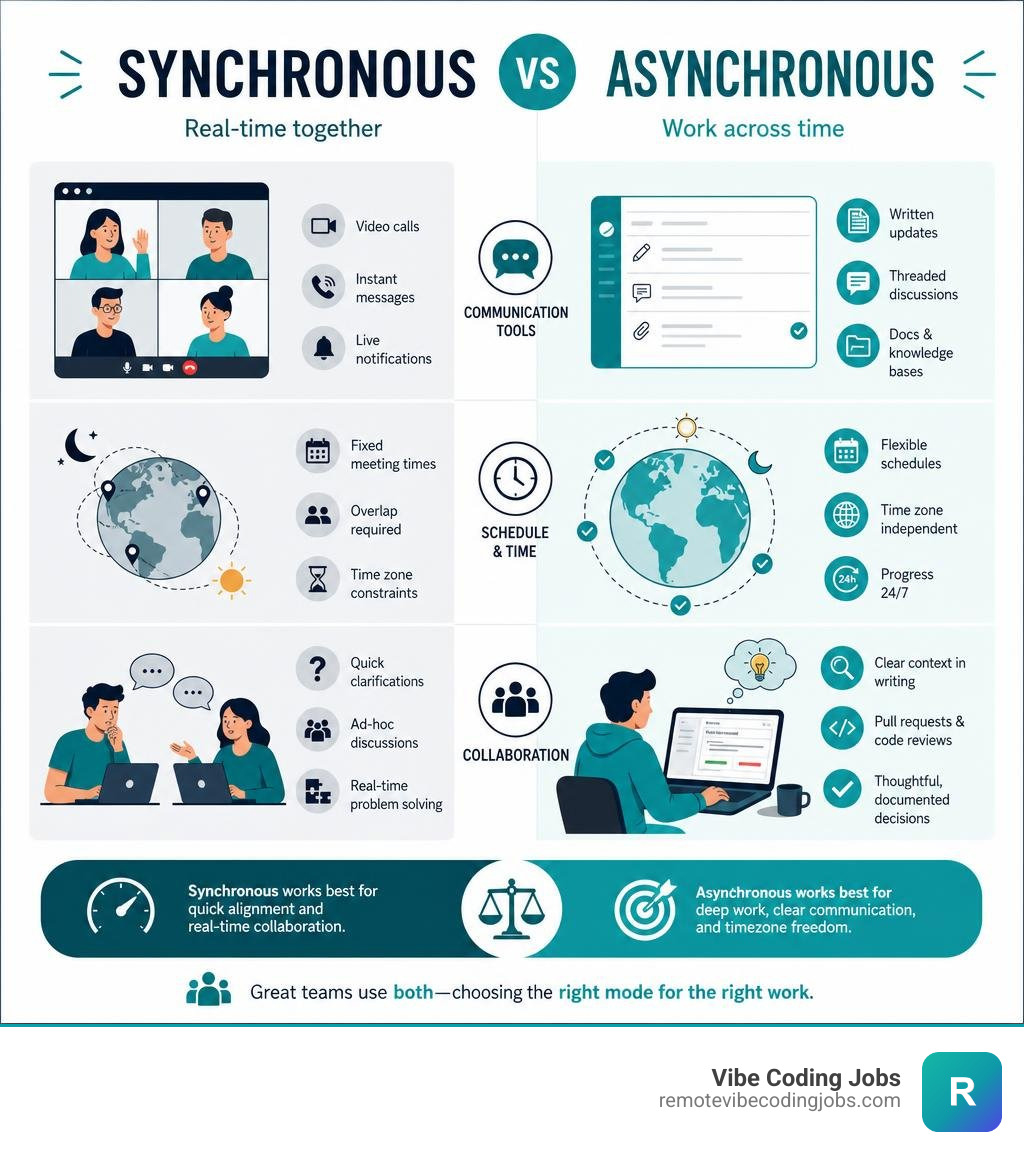
Core Differences: Synchronous vs Asynchronous Work
The differences between synchronous and asynchronous setups come down to how teams value your presence versus your output:
- Synchronous Remote: You are expected to be “online” during core hours (e.g., 9 AM to 5 PM EST). Your Slack status must remain green, and your day is peppered with standups, refinement sessions, and ad-hoc Zoom syncs. Collaboration happens in real-time, which often fragments your schedule and destroys deep focus.
- Asynchronous Remote: You have complete calendar control. Meetings are treated as a last resort, not a default. Communication happens via written updates, detailed PR descriptions, and recorded walkthroughs. You are judged strictly on your technical deliverables and the clarity of your documentation, not on how many hours you sat in a virtual meeting room.
The Daily Routine of a Software Engineer Remote Async
What does a typical day look like when you have ultimate flexibility?
You might start your morning at 7:00 AM with a quiet cup of coffee, reviewing pull requests and checking automated test results while the rest of your local timezone is still asleep. Because there are no morning standups, you can dive straight into a four-hour coding block using AI tools to scaffold a new feature.
By midday, you write a thorough update on your progress, record a quick Loom video demonstrating a UI change, and submit your PR. In the afternoon, you might take a long break to exercise, run errands, or spend time with family. You log back in during the evening to address feedback left by a teammate on the other side of the world.
This lifestyle is incredibly liberating, but it requires relentless self-discipline. If you want to explore teams that support this level of freedom, browse through Async-First Remote Developer Jobs with Flexible Hours.
Essential Skills, Tools, and Workflows for Async Success

To thrive as a software engineer remote async, your technical stack is only half the battle. Your operational stack — how you manage tasks, write code reviews, and handle deployments — is what keeps you from burning out or stalling.
| Operational Area | Traditional Remote Setup | Async-First Setup |
|---|---|---|
| Daily Updates | Live Standup Meetings (Zoom/Teams) | Written status updates (Notion, Slack, Geekbot) |
| Code Feedback | Live pairing or synchronous walkthroughs | Detailed PR templates, recorded Looms, automated CI |
| Knowledge Base | Scattered Google Docs, verbal agreements | Centralized, searchable markdown documentation |
| Task Assignment | Real-time sprint planning sessions | Ticket backlogs with rich context and clear specs |
Communication and Documentation Best Practices
In an async environment, writing is the core product. If you cannot express your technical ideas clearly in writing, your code won’t matter.
- RFCs (Requests for Comments): Before writing a single line of complex code, async engineers draft RFC documents. These outline the problem, proposed architectural solutions, and trade-offs, allowing team members to review and comment on their own schedules.
- Loom & Video Walkthroughs: Instead of scheduling a 15-minute meeting to show a feature, record a 2-minute video. Walk through the code or the UI, highlight the key areas, and share the link.
- Markdown & Notion: Keep documentation close to the code. Maintain updated READMEs, project boards, and architecture logs. For a deeper dive into these strategies, read our comprehensive Async-First Remote Work Guide.
AI-Assisted Development and Vibe Coding in Async Teams
The rise of AI-native workflows has supercharged async teams. “Vibe coding” — using AI assistants like Cursor, Claude, and specialized agents to handle boilerplate, debugging, and rapid prototyping — allows solo developers to ship at the speed of entire teams.
In an async setup, AI acts as your instant peer reviewer and rubber duck. Instead of waiting hours for a teammate in another timezone to answer a syntax question, you can leverage advanced setups to unblock yourself immediately.
For instance, developers are increasingly looking at open-source, local-first environments. You can Explore open-source AI tools like Async IDE to see how developers are building customizable, local-first AI workspaces. To see these principles in action at the highest level, you can also Discover how Ernie leverages AI-native workflows to combine functional programming, domain-driven design, and extensive LLM tooling for rapid shipping.
Async Code Reviews and Collaboration Workflows
Code reviews can easily become the biggest bottleneck in an async team if they aren’t structured correctly. To keep shipping fast, top teams enforce strict automation and clear communication patterns.
Every pull request should have a detailed template explaining what changed, why it changed, and how to test it. Automated testing suites (CI/CD) must run immediately upon pushing code, catching linting errors and broken tests before a human ever looks at the PR.
Platform engineers focus heavily on building these robust foundations so that product developers can ship without friction. For an excellent example of this philosophy, you can See Max Pugh’s platform engineering approach, which emphasizes building stable operational guardrails, background jobs, and observability pipelines that allow async teams to deploy confidently without constant real-time coordination.
Market Landscape: Tech Stacks, Salaries, and Opportunities
The job market for a software engineer remote async in 2026 is highly specialized. While general web development roles remain competitive, specialized niches — particularly in high-performance systems, AI infrastructure, and modern functional languages — are seeing massive demand.
Common Tech Stacks for a Software Engineer Remote Async
The most resilient tech stacks in the async market are those built for performance, concurrency, and reliability.
- Rust: Used heavily for distributed systems, blockchain, and high-performance tooling. To see how Rust is utilized for mission-critical, high-throughput systems, you can Learn about Oleksii Vasylenko’s high-performance Rust systems, which process thousands of transactions per second with sub-millisecond latency.
- Go & Python: The backbone of modern cloud-native applications and AI orchestration pipelines.
- TypeScript & Node.js: Dominating full-stack development, especially when paired with modern AI-assisted engineering tools.
- Specialized Async Tooling: Developers who can build custom developer tooling are highly valued. For example, you can Read about Shanmukeshwar’s async Rust CLI tools to see how modern command-line utilities and WebAssembly (WASM) plugins are designed to automate deployments and manage multi-tenant infrastructures.
Salary Ranges and Benefits in 2026
Async roles offer highly competitive compensation packages, often matching or exceeding traditional on-site roles due to the global talent pool.
- AI Training & Contracting: High-end contract roles for AI training and optimization pay anywhere from $50 to $150 per hour depending on your language expertise (e.g., Python, Rust, C++).
- Mid-to-Senior Full-Time Roles: Companies like Lonely Planet (hiring Elixir devs) and Genki (hiring Kotlin backend devs) offer salaries ranging from $109,100 to $181,800/year, complete with premium benefits like full parental leave, remote work stipends, and tuition reimbursement.
- Principal & Staff Roles: Major tech players like Palo Alto Networks and Grafana Labs offer principal salaries of $147,000 to $237,500/year or more, alongside significant RSU equity packages.
To explore which organizations align with your compensation goals, check out our curated list to Find top companies hiring async-first developers.
How to Find and Land Async Remote Programming Jobs
Finding these roles requires looking beyond traditional, generic job boards. You need platforms that understand the difference between “work-from-home” and “async-first.”
Start by keeping an eye on dedicated resources:
- Search broad directories with targeted filters, like Software Engineer Asynchronous jobs in Remote – Indeed.
- For a curated, daily-updated selection of roles that encourage AI-native development and flexible setups, you can Search remote asynchronous programming jobs on Vibe Coding Jobs.
If you are transitioning from a traditional office environment, make sure to read our step-by-step roadmap: Transitioning to Remote Software Engineering: A Complete Guide.
Standing Out with an AI-Native Portfolio
In 2026, a standard resume listing “React, Node, SQL” isn’t enough. Async employers want to see that you can build, deploy, and maintain production systems independently using modern AI tools.
Your portfolio should highlight:
- Measurable Business Outcomes: Focus on cost optimization, latency reduction, and system reliability.
- AI Integrations: Show how you’ve built real-world AI pipelines, vector search databases, or agentic workflows. To see a great example of this, you can See Parbhat Kapila’s production AI systems portfolio, which demonstrates how to build high-performance semantic search and cost-efficient RAG pipelines with 99.9% uptime.
- Independence: Prove that you can own a project from idea to production deployment without needing hand-holding.
Ready to start applying? Browse async-first remote developer jobs to find teams looking for your exact skillset.
Frequently Asked Questions about Async Remote Engineering
What is the difference between remote and async remote?
Traditional remote work simply changes where you work, but keeps the synchronous when (core hours, constant meetings, instant messaging expectations). Async remote work changes both, allowing you to work from any location and on your own schedule, relying on written documentation and clear deliverables instead of real-time presence.
What are the best programming languages for async roles?
Languages that emphasize strong typing, reliability, and concurrency are highly popular in async teams because they reduce runtime bugs and make code easier to understand without talking to the author. Rust, Go, TypeScript, Kotlin, and Elixir are highly sought after in modern async job listings.
How do async teams handle urgent production bugs?
Async teams use structured on-call rotations (via tools like PagerDuty), automated rollback scripts, and highly detailed runbooks. When a critical bug occurs, the designated on-call engineer is paged to handle it using pre-documented steps, avoiding the need to wake up the entire engineering team for an emergency meeting.
Conclusion
The era of sitting in unproductive meetings just to prove your presence is ending. Becoming a software engineer remote async allows you to reclaim your time, focus on writing high-quality code, and design a lifestyle that works for you. By mastering written communication, adopting AI-assisted development tools, and targeting companies that value output over hours, you can build a highly rewarding, timezone-independent career.
If you are ready to skip the generic job boards and find companies that truly live and breathe async culture, Find your dream remote job on RemoteVibeCodingJobs today. Your calendar will thank you.