
No More Standups: Why Async First Dev Jobs Are the Future
The Rise of Async-First Dev Jobs in 2026
Async-first dev jobs are remote developer roles where written communication, documentation, and recorded updates replace live meetings as the default — and right now, they’re one of the fastest-growing segments in tech hiring.
Quick answer: What are async-first dev jobs?
- Default communication is written — Slack messages, Notion docs, Loom videos, not Zoom calls
- Meetings happen only when truly necessary — no mandatory daily standups
- Decisions are documented so anyone can catch up on their own time
- Timezone flexibility is real — work when you’re most productive
- Deep focus time is protected — developers report 40% more uninterrupted coding time
If you want to browse open roles right now, over 260 async-first developer positions are currently active across major job boards.
The 2026 job market has made one thing clear: developers are done with back-to-back meetings that break their flow. Meeting fatigue is real. So is the demand for flexibility across time zones. Async-first companies solve both problems by making written communication the norm, not the exception.
This isn’t just a lifestyle preference. It’s backed by numbers. Async-first engineering teams report 20% higher productivity metrics, and companies running async cultures see 25% better employee retention than traditional office-based teams. Remote async developer roles have grown 159% since 2020, with dev roles making up 35% of all async-first positions.
I’m RVCJ Editorial, the team behind Remote Vibe Coding Jobs — we cover async work culture, AI-assisted development, and remote hiring trends to help developers find async-first dev jobs that actually match their stack and values. In this guide, we’ll walk you through everything you need to know to find, evaluate, and land the right role.
Explore more about async first dev jobs:
What Are Async First Dev Jobs?
To truly appreciate async first dev jobs, we have to contrast them with traditional, synchronous remote work. Many developers who transitioned to remote work during the early 2020s realized that their physical office meetings had simply been replaced by digital ones. Instead of a tap on the shoulder, they faced a constant barrage of Slack pings demanding immediate replies and calendar invites that fragmented their afternoons.
True asynchronous work turns this model on its head. In an async-first environment, the default assumption is that team members are working on different schedules and in different time zones. Immediate responses are not expected. Instead, communication is deliberate, structured, and deeply documented.
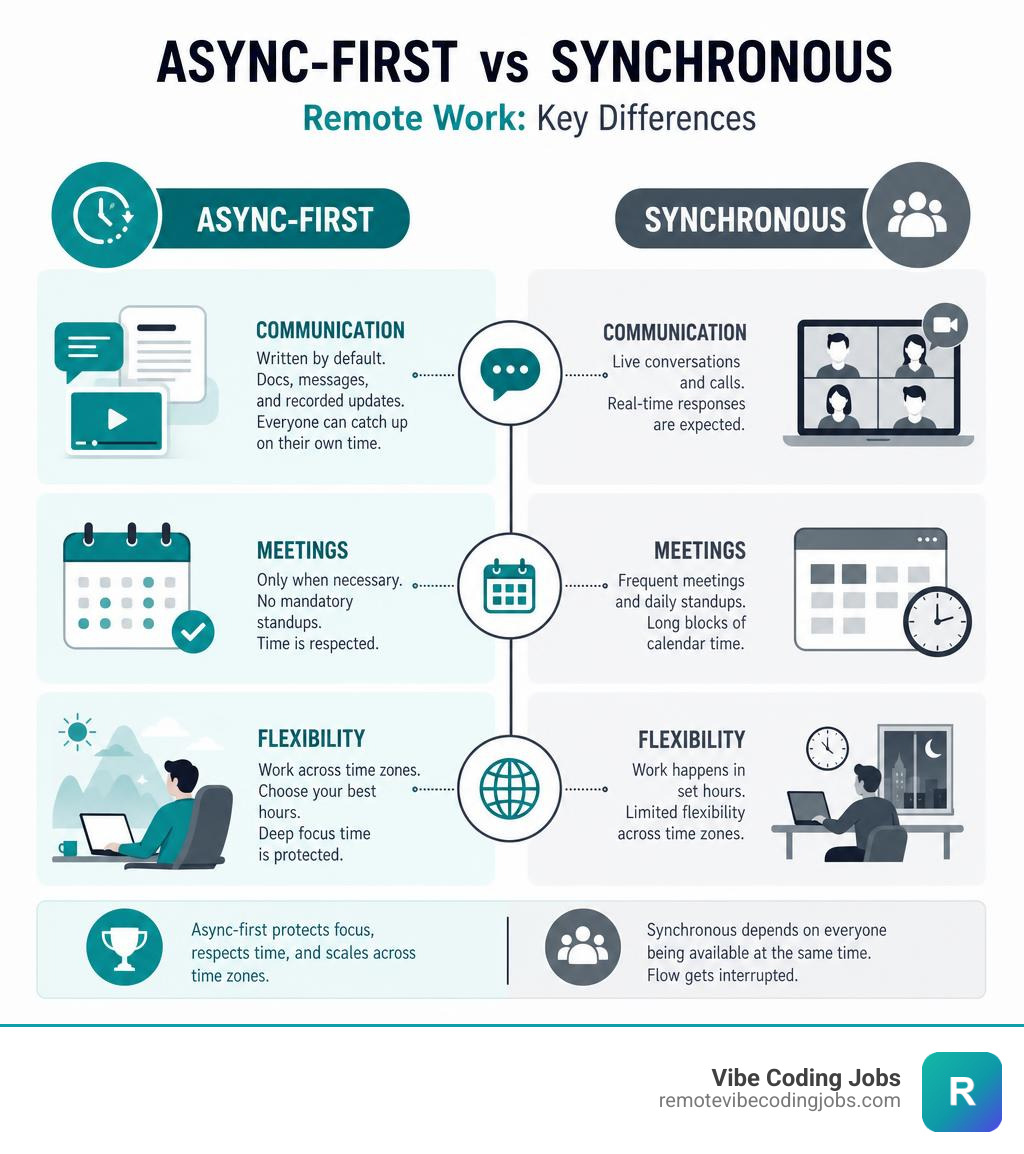
Here is a quick look at how the two models compare side-by-side:
| Feature | Synchronous Remote Work | Async-First Remote Work |
|---|---|---|
| Primary Communication | Live Zoom calls, instant Slack replies | Written documentation, RFCs, recorded Loom updates |
| Daily Structure | Fragmented by scheduled meetings and standups | Large blocks of uninterrupted deep focus time |
| Timezone Expectation | Team must overlap for 6-8 hours daily | Complete timezone independence; work when you want |
| Decision Making | Decided in real-time calls (often undocumented) | Documented in public threads with clear reasoning |
| Core Metric | Hours spent active on Slack/Teams status | Actual output, code shipped, and documentation quality |
By decoupling collaboration from real-time presence, async-first environments allow engineers to regain control over their schedules. Instead of interrupting a complex debugging session to attend a status update meeting, you read a written summary or watch a 2-minute Loom video when you reach a natural breaking point.
If you want to dive deeper into how this structural shift changes the day-to-day life of an engineer, check out our comprehensive guide on async remote developer jobs.
Why Developers Are Rushing to Async-First Roles in 2026
The year 2026 has witnessed a massive shift in developer expectations. With the explosion of AI-assisted development tools like Cursor, Claude, and GitHub Copilot, the speed at which we can prototype and ship software has skyrocketed. In this high-velocity environment, meetings have become the ultimate bottleneck.
When you are in the zone, “vibe coding” with your AI companion, the last thing you want is a calendar alert telling you it is time for a 30-minute status meeting that could have been a single bullet point in a Slack channel.

This friction is driving top engineering talent to actively seek out async first dev jobs. The benefits are highly measurable:
- 40% More Focused Coding Time: Without the constant interruption of synchronized check-ins, developers can sink into deep, uninterrupted state-of-flow work.
- 30% Fewer Meetings Per Week: By replacing status updates with tool-integrated dashboards (like Linear or Notion), teams eliminate the need for synchronous alignment.
- Better Cognitive Health: The constant context-switching required by synchronous communication is a primary driver of developer burnout. Async-first cultures respect your mental bandwidth.
When developers are given the freedom to design their own schedules, their relationship with work changes. They are no longer performing “presence” by keeping their Slack dot green; they are focused entirely on the craft of building. To understand how this impacts engineering output and business velocity, read more about async first remote developer jobs productivity benefits.
Key Benefits of Asynchronous Engineering Cultures
The advantages of an async-first culture extend far beyond individual daily productivity. It reshapes the entire engineering organization, creating a more sustainable, high-performing, and inclusive workplace.
For starters, async-first companies report 25% higher employee retention rates compared to traditional office-based or highly synchronous remote teams. When you trust your engineers to manage their own time, they stick around.
Here are the structural benefits that make these cultures so resilient:
- True Timezone Independence: Whether you want to work from a beach in Portugal, a cabin in Canada, or your home office in Australia, your location doesn’t hinder the team. You do not have to wake up at 11 PM for a sync call with headquarters.
- A Living Knowledge Base: Because async teams must communicate through writing, every architectural decision, bug fix, and product specification is naturally documented. This eliminates the “single point of failure” problem where key system knowledge exists only in one developer’s head.
- Thoughtful Decision Making: In synchronous meetings, the loudest voice in the room often wins. In an async culture, proposals are written down as RFCs (Requests for Comments). This gives introverted or junior team members the time to analyze the problem and write structured, high-quality feedback.
By prioritizing clear writing over fast talking, async teams build a more equitable environment where the quality of your ideas and your code matters more than your presentation skills. Learn more about how this impacts collaboration in our breakdown of async first remote developer jobs benefits, communication, and teamwork.
How to Find True Async First Dev Jobs
As the popularity of async work grows, many companies are trying to “async-wash” their job postings. They might list a role as “flexible remote” but still expect you to be online for a 9 AM EST standup every day. To find truly async-first companies, you have to know what to look for.
Here are the green flags to watch for during your search:
- Written-First Interview Processes: Truly async companies often replace initial screening calls with written questions or short, self-recorded videos.
- Detailed Public Handbooks: Companies like GitLab and other pioneers publish their entire organizational handbook online. If a company can point you to their written operating procedures before you even apply, they are the real deal.
- Explicit Focus on Output over Hours: Look for job descriptions that highlight “self-management,” “written clarity,” and “documented workflows” rather than “, highly collaborative environments” (which is often code for constant meetings).
To skip the guesswork, look for specialized job boards that verify these cultural values before listing roles, ensuring you find employers who actually walk the walk.
Essential Skills to Land Async First Dev Jobs
Landing a role in an async-first company requires a slightly different toolkit than a traditional software engineering job. While your technical skills remain critical, your soft skills — particularly your written communication and self-organization — will be put under a microscope.
Here are the core competencies you need to demonstrate:
- Exceptional Written Clarity: Can you explain a complex technical bug, outline three potential solutions, and list their respective trade-offs in a single, easy-to-read markdown document? If yes, you are highly employable in an async world.
- AI Tool Fluency: In 2026, being “AI-fluent” is a major differentiator. Async-first teams expect developers to leverage tools like Cursor and Claude to write boilerplate code, draft documentation, and debug quickly. Showing that you use AI as a productivity multiplier proves you can work efficiently without constant hand-holding.
- Proactive Self-Management: Without a manager checking in on you daily, you must be the driver of your own tasks. You need to know how to unblock yourself, manage your priorities, and signal when things are going off track.
If you are a junior developer trying to break into the market, navigating this landscape can feel daunting. The traditional entry-level path is shifting rapidly due to AI, requiring a stronger focus on self-direction and building a visible portfolio.
Additionally, many developers have successfully bypassed traditional job boards altogether by building in public. For inspiration, read about how developers are landing roles through organic community engagement:
- How I Got My First Rust Job by Doing Open Source
- The road to my first web development job
- My First Tech Job (Using Rust)
- Entry-Level Developer Guide
How Async Teams Collaborate Without Real-Time Meetings
A common question skeptics ask is: “If you don’t have meetings, how do you actually get anything done together?”
The answer lies in a highly structured tool stack and strict communication norms. Async teams do not work in isolation; they collaborate deeply, but they do it across time rather than in real-time.

The modern async-first tech stack typically revolves around a few key pillars:
- Project Management (Linear / GitHub Issues): Tickets are not just tasks; they are the central source of truth for a feature. All context, design mockups, and technical discussions happen directly inside the ticket.
- Knowledge Management (Notion / Wiki): Every system architecture, API contract, and team policy is documented. If a developer needs to know how to deploy a microservice, they search the wiki instead of asking in Slack.
- Asynchronous Video (Loom): Instead of scheduling a 15-minute meeting to demo a new feature, engineers record a 2-minute Loom walk-through. Team members watch it at 1.5x speed on their own time and leave written feedback.
- Strict Slack Norms: Slack is treated as a low-urgency inbox. Notifications are turned off by default, and channels are structured around specific topics. Threads are mandatory to keep conversations organized.
By using these tools intentionally, async teams build an incredibly clear, searchable paper trail of their work. For a deep dive into the operational workflows of these teams, explore our guide on async first remote developer jobs culture, workflow, and communication.
Mentorship and Growth for Junior Developers in Async Teams
There is a common misconception that async-first environments are bad for junior developers. Skeptics argue that without a senior developer sitting next to them to answer questions, juniors will struggle to learn.
In practice, the opposite is often true. Junior developers in async-first environments take 15% less time to reach mid-level competency.
Why? Because async cultures force senior engineers to write down their knowledge.
In a traditional office, a junior might ask a senior a question, get a verbal answer, and forget it a week later. In an async-first company, that answer is documented in a shared database or a searchable Slack thread. The junior can reference it indefinitely. Furthermore, code reviews in async teams are typically incredibly detailed, providing a permanent, written record of feedback and architectural best practices.
To explore how async companies structure their mentorship programs, career ladders, and salary bands, read our article on async first remote developer jobs culture, tools, and salary.
Frequently Asked Questions about Async-First Work
What is the difference between remote-first and async-first?
Remote-first simply means the company is built to support remote workers as a primary class, but they may still rely heavily on synchronous communication (such as mandatory core hours, constant Zoom meetings, and real-time pairing). Async-first goes a step further by actively designing the company’s workflows to minimize the need for real-time presence, allowing team members to work completely independently across any timezone.
How do async-first teams handle urgent production bugs?
Async does not mean slow. For critical incidents, teams use automated alerting systems (like PagerDuty or incident management bots) linked to clear on-call rotations. When a production server goes down, the designated on-call engineer is paged immediately. They spin up a temporary incident room (often a live Zoom or Slack huddle) to resolve the issue in real-time. Once the fire is out, they transition back to async mode by writing a detailed post-mortem document for the rest of the team.
What tools are essential for async-first development?
The core stack includes Linear for issue tracking, Notion or GitLab Wiki for documentation, Loom for video updates, GitHub for asynchronous code reviews, and AI-native IDEs like Cursor to accelerate individual output.
Conclusion
The era of the mandatory 9 AM standup is coming to an end. As we move through 2026, the developers who build the future are choosing environments that respect their focus, value their output over their screen time, and give them the freedom to work from anywhere on their own schedule.
If you are ready to leave meeting fatigue behind and step into a highly productive, AI-empowered development flow, it is time to look for an async-first role.
At RemoteVibeCodingJobs, we curate daily listings of remote “vibe coding” (AI-assisted development) jobs at companies that value true async culture. We filter roles by culture, tech stack, and your favorite AI tools (like Cursor and Claude) to make your application process as seamless as possible.
Ready to see how the modern way of building software stacks up against legacy methods? Compare vibe coding vs traditional development and find your next role with us today!