
Find and Win Remote Blockchain Developer Jobs in 2026
The fastest way to find remote blockchain developer jobs is to target roles that match your chain and stack, then prove you can ship secure code. Filter for Solidity/EVM, Rust/Solana, DeFi, or full-stack Web3 roles; apply early; and link to deployed contracts, useful GitHub work, and clear test coverage.
In 2026, demand is strongest for mid-to-senior engineers who can work independently across smart contracts, backend services, and dApp front ends. Ethereum and its Layer 2 ecosystem remain major hiring areas, while Solana, DeFi infrastructure, tokenization, security, and blockchain data systems create other strong paths. US job searches show more than 1,000 remote blockchain openings, and dedicated crypto job boards index more than 12,000 roles worldwide.
The catch: a job title alone tells you very little. A “blockchain developer” might build a React and Node.js product connected to an EVM contract. A DeFi engineer may need to understand AMMs, lending pools, oracle risk, gas costs, and attack vectors. The best applications make that difference obvious.
I am Di Su, a software engineer with 10+ years of experience building scalable web products, improving workflows with Svelte and Python, and shipping high-conversion digital experiences. That mix of practical engineering, product thinking, and async-ready delivery is directly useful when evaluating and pursuing remote blockchain developer jobs.
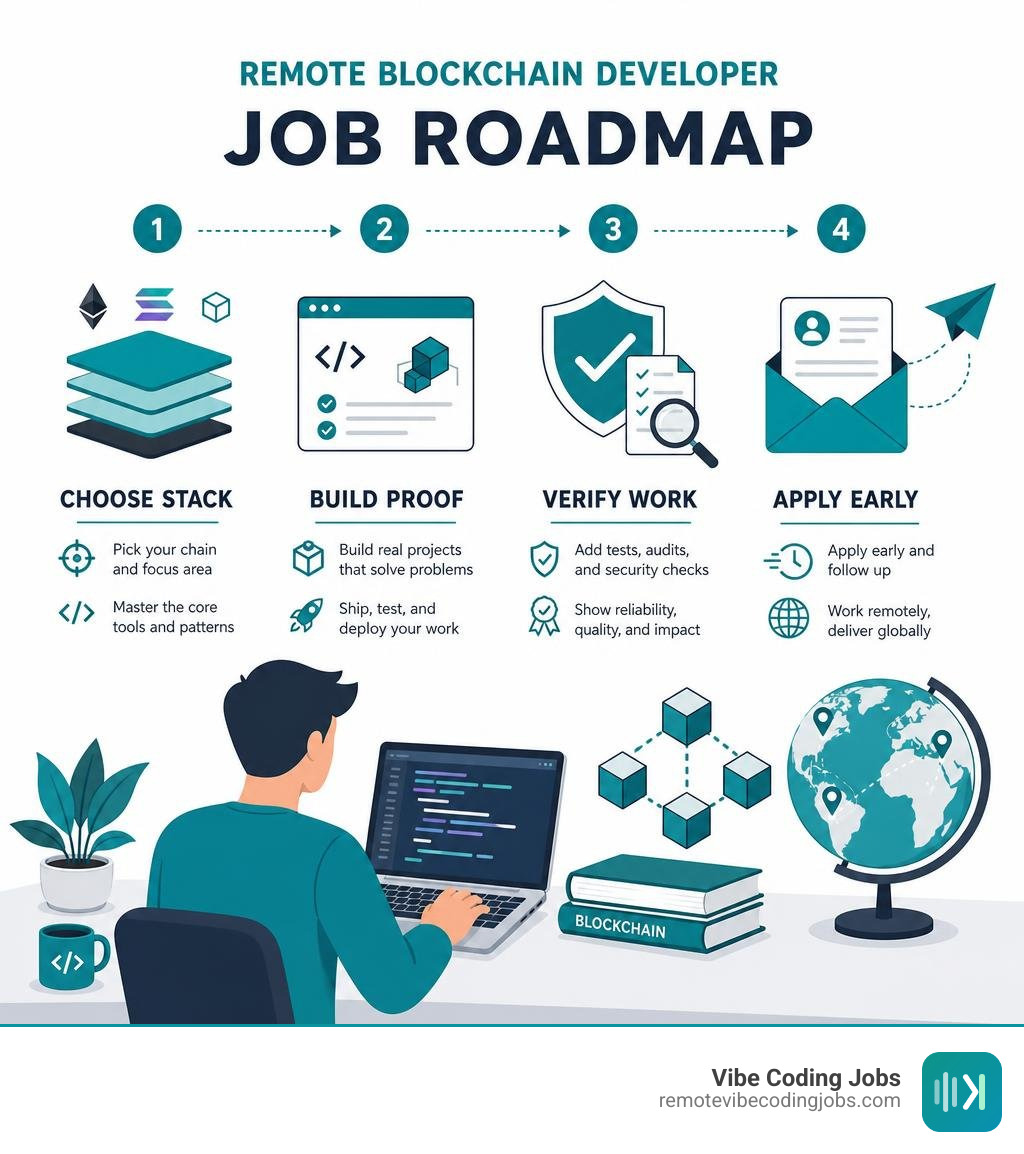
Simple guide to remote blockchain developer jobs terms:
Navigating the Market for Remote Blockchain Developer Jobs in 2026

The landscape for decentralized engineering has matured rapidly. Companies are no longer hiring based on speculative roadmaps or whitepapers; they are hiring engineers who can build battle-tested protocols, scale high-throughput networks, and deploy user-facing distributed applications (dApps).
Recent industry hiring data reveals over 1,000 active remote blockchain developer positions available in the United States alone, with more than 12,370 blockchain-related job listings tracked across global ecosystems on dedicated Web3 directories. More than 70% of open engineering roles in this sector offer fully remote flexibility. However, hiring teams have raised their standards. Over 64% of open listings explicitly seek mid-to-senior level talent who possess solid fundamentals across distributed systems and modern frameworks.
Understanding where the market is expanding is essential for targeting your search:
- EVM Dominance and Layer 2 Networks: Ethereum Virtual Machine (EVM) compatibility remains the core standard for smart contract deployment. Engineering demand is concentrated around Layer 2 scaling protocols, including Arbitrum, Optimism, and Polygon, where lower gas costs and higher transaction throughput power complex decentralized protocols.
- Non-EVM Ecosystems: High-performance ecosystems like Solana continue to drive substantial recruitment for engineers proficient in Rust, particularly for trading systems and real-time execution environments.
- Hybrid Web2 to Web3 Architectures: Distributed teams are seeking developers who can bridge traditional cloud and microservices backends with on-chain protocols.
To evaluate where your profile fits within these broader industry shifts, review the remote developer skills in demand 2026 and verify live trends on our market compensation statistics dashboard.
High-Growth Sectors for Remote Blockchain Developer Jobs
Decentralized engineering encompasses multiple specialized sub-disciplines. Identifying your focus area allows you to tailor your applications directly to hiring managers:
- DeFi Protocol Architecture: Decentralized finance protocols require engineers capable of building composable liquidity systems, automated market makers (AMMs), staking mechanisms, and decentralized lending markets. These roles prioritize deep knowledge of protocol composability across standards like Uniswap and Aave, along with advanced gas optimization.
- Real World Asset (RWA) Tokenization: Institutional demand for tokenizing physical and financial assets—such as real estate, private credit, and treasury debt—has accelerated. Developers in this space design custom token standards, compliant transfer mechanisms, and immutable audit structures.
- Enterprise Blockchain and Master Data Management (MDM): Major financial enterprises integrate decentralized ledgers with legacy data governance systems. These positions often require 5 to 8 years of software engineering experience with 2 to 3 years in blockchain, focusing on zero-knowledge identity, data lineage, and regulatory compliance (GDPR, CCPA).
- Zero-Knowledge (ZK) Rollups and Infrastructure: Infrastructure teams are expanding their focus on cryptographic verification and decentralized sequencers, requiring engineers with strong math and systems-level programming backgrounds.
Remote Compensation, Equity, and Token Grants
Compensation packages in Web3 remain among the most competitive across remote software engineering. Packages frequently combine a high base salary with equity grants, token allocations, or performance-based incentives.
| Seniority Level | Typical Experience Required | Base Salary Range (USD) | Equity / Token Allocation | Common Responsibilities |
|---|---|---|---|---|
| Junior Blockchain Developer | 0–2 Years (Software/Web3) | $70,000 – $110,000 | 0.05% – 0.1% or Early Pool | dApp front-end integration, basic contract testing, unit test writing |
| Mid-Level Blockchain Engineer | 3–4 Years (2+ Years Web3) | $120,000 – $180,000 | 0.1% – 0.5% Token Grants | Smart contract development, API indexing, gas optimization |
| Senior Blockchain Architect | 5+ Years (3+ Years Web3) | $190,000 – $270,000 | 0.5% – 1.0%+ Tokens / Equity | Protocol design, security auditing, multi-chain deployment, tech leadership |
| DeFi / Security Specialist | 5+ Years (Specialized) | $200,000 – $280,000+ | High Carry / Token Pools | Formal verification, invariant testing, economic exploit prevention |
Recent industry job posts reflect these high compensation tiers. For example, remote Senior Blockchain Developer positions for US-preferred candidates regularly feature salary bands between $260,000 and $270,000 per year, while specialized cloud and infrastructure roles range from $114,600 to $252,100.
For international remote contractors, monthly rates typically range between $2,500 and $6,000+ depending on the funding stage and geographical tier. For a full breakdown of base compensation trends, check our remote developer salary guide 2026.
Core Tech Stacks and Frameworks Required for Distributed Web3 Teams
Working on a distributed blockchain team requires proficiency across smart contract execution layers and traditional application infrastructure.
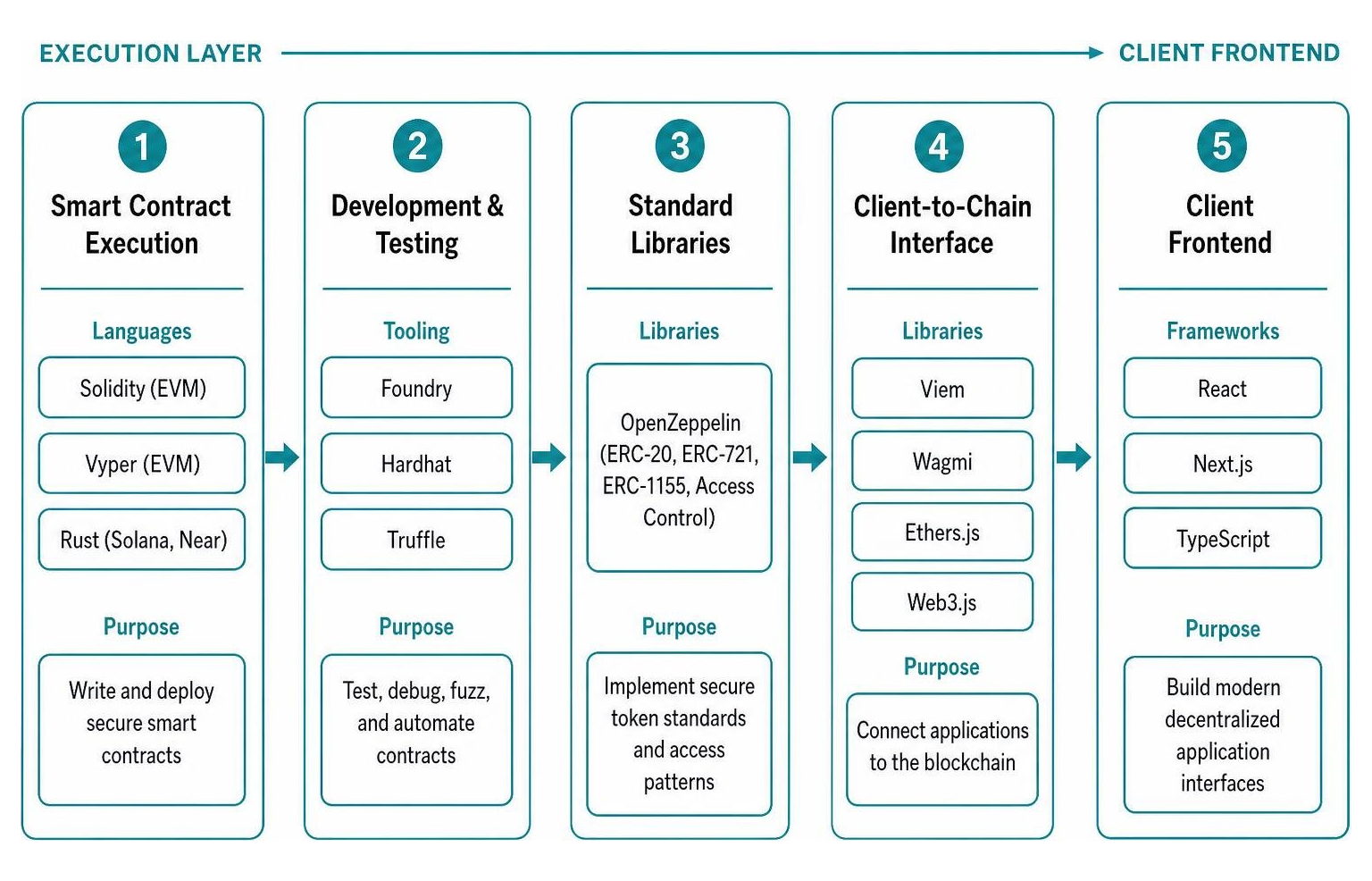
- Smart Contract Languages: Solidity remains the foundational language for the EVM ecosystem. Vyper is widely used for secure DeFi protocols due to its simplicity and security-first design, while Rust powers high-speed execution environments on Solana and Near.
- Testing and Development Environments: Modern development teams rely heavily on Foundry for fast, Solidity-native testing, fuzzing, and debugging. Hardhat and Truffle remain widespread across enterprise environments for script-based contract orchestration and automated continuous integration.
- Standard Contract Libraries: Knowledge of OpenZeppelin smart contract libraries is a universal prerequisite for implementing secure ERC-20, ERC-721, and ERC-1155 token standards and access control patterns.
- Client-to-Chain Interface Libraries: Developers must know how to connect front ends to the blockchain using modern libraries like Viem, Wagmi, Ethers.js, and Web3.js.
- Frontend and Full-Stack Engineering: Decentralized applications depend on modern interfaces built with React, Next.js, and TypeScript. To review expectations for UI integration roles, see our remote TypeScript developer jobs guide.
- Backend Microservices and Indexing: Scalable dApps rely on indexing layers like The Graph, combined with backend services written in Go, Node.js, or Python, backed by Redis and PostgreSQL.
AI-Assisted Development in Modern Blockchain Engineering
In 2026, high-velocity engineering teams increasingly incorporate AI-assisted workflows—often called “vibe coding”—into their daily routines. AI coding assistants like Cursor, GitHub Copilot, and Claude are transforming how smart contracts and dApp interfaces are produced.
Modern developers use AI assistants to:
- Generate standardized Solidity boilerplate and OpenZeppelin contract scaffolding in seconds.
- Formulate comprehensive test suites in Foundry, automatically producing edge-case unit tests and invariant mocks.
- Review code for preliminary gas inefficiencies and identify basic vulnerabilities before human peer reviews.
- Rapidly build and style React and Next.js interfaces that integrate Web3 wallet connectors.
You can learn more about building end-to-end applications with AI by following our vibe coding full stack dApp tutorial or reviewing the best AI coding tools in 2026.
Security Standards, Auditing, and Verification Protocols
In smart contract development, deployed code is immutable and handles millions of dollars in total value locked (TVL). Because vulnerabilities can result in irreversible financial losses, remote teams implement strict security validation pipelines:
- Static Analysis and Linting: Automated tools like Slither and Mythril are integrated directly into CI/CD pipelines to catch standard reentrancy bugs, integer issues, and unhandled exceptions.
- Fuzzing and Invariant Testing: Teams expect engineers to run stateful fuzzing campaigns via Foundry or Echidna to test that contract properties hold true under unexpected user interactions.
- External Audits and Bug Bounties: Before mainnet deployment, protocols undergo multiple security reviews by external firms and host competitive bounty programs on platforms like Immunefi.
- Candidate Verification and Sybil Resistance: To maintain security across fully remote, pseudonymous development environments, Web3 protocols increasingly integrate decentralized identity tools like World ID to confirm human-verified developer profiles during recruitment.
Step-by-Step Blueprint to Fast-Track Your Web3 Application

Landing a remote blockchain role requires tangible proof of technical competence. Traditional resumes carry far less weight in Web3 than verifiable on-chain deployments and public contributions.
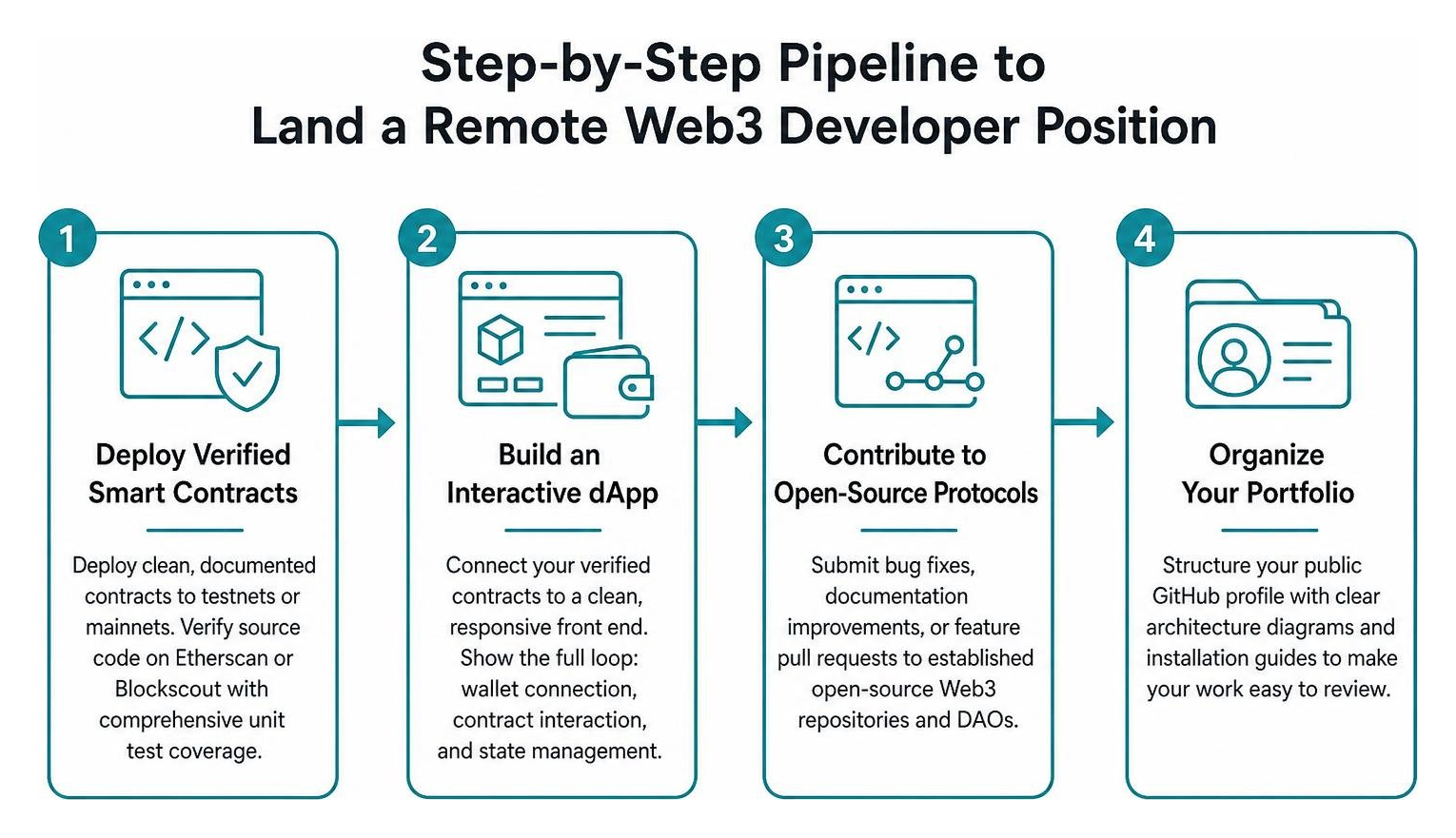
- Deploy Verified Smart Contracts: Deploy clean, fully documented contracts to testnets (Sepolia, Base Sepolia) or mainnets. Ensure the source code is verified on Etherscan or Blockscout with comprehensive unit test coverage.
- Build an Interactive dApp: Connect your verified contracts to a clean, responsive front end hosted on platforms like Vercel. Hiring managers value seeing the full loop: wallet connection, contract interaction, and state management.
- Contribute to Open-Source Protocols: Submit bug fixes, documentation improvements, or feature pull requests to established open-source Web3 repositories and DAOs.
- Organize Your Portfolio: Structure your public GitHub profile with clear architecture diagrams and installation guides. For tips on curating your work, see our remote coding jobs portfolio guide.
How to Stand Out When Applying for Remote Blockchain Developer Jobs
- Highlight Gas Optimization: Include clear benchmarks demonstrating how your contract refactoring lowered gas consumption on state-changing transactions.
- Showcase Protocol Composability: Demonstrate that you know how your contracts interact with existing automated market makers, lending protocols, or decentralized oracles (like Chainlink).
- Target the Right Employment Model: Decide whether you are seeking a full-time W2 role, an international contractor setup, or a project-based DAO grant. If you are comparing contract vs salaried pathways, review our breakdown on contract vs full-time remote developer options.
- Apply Early: The earliest applicants to newly published remote positions receive significantly higher engagement from engineering hiring managers.
Mastering Async Communication for Distributed Protocols
Because blockchain organizations operate across global time zones, async-first collaboration is a core requirement for distributed engineering teams:
- Comprehensive Pull Request Context: Write thorough pull request descriptions outlining architectural decisions, gas trade-offs, testing commands, and security considerations.
- Time Zone Overlap: Many US-based decentralized protocols require candidates to maintain a dedicated 3 to 4-hour working overlap with Pacific Time (PT) or Eastern Time (ET) for weekly sprint syncs.
- Structured Async Standups: Distributed teams replace daily synchronous status meetings with asynchronous check-ins on Slack, Discord, or Notion to maintain continuous development momentum.
To understand how high-performing remote teams operate asynchronously, explore our deep dive into async-first remote work culture.
Frequently Asked Questions
What is the average salary for a remote blockchain developer in 2026?
Remote blockchain developer compensation ranges from $120,000 to $180,000 for mid-level engineers, while senior blockchain developers frequently secure salaries between $190,000 and $270,000 per year. Specialized roles in DeFi protocol development, trading infrastructure, and smart contract auditing can exceed $280,000 in base pay, often supplemented with token grants or equity. Exact compensation varies based on company funding stage, geography, and chain specialization. You can run detailed compensation scenarios using dedicated salary calculator tools.
Do I need prior DeFi experience to land a smart contract developer role?
While specialized DeFi roles (such as AMM or lending protocol engineering) require deep knowledge of protocol composability and economic attack vectors, general smart contract developer positions do not always demand prior DeFi experience. Experienced Web2 backend and full-stack software engineers can transition into Web3 by mastering Solidity, understanding EVM internals, and building a portfolio of tested, deployed smart contracts. For a structured roadmap on leveling up your engineering career, check our remote developer career path guide.
Which programming languages should I learn first for remote Web3 development?
Solidity is the primary language to learn first due to the widespread dominance of EVM-compatible chains (Ethereum, Arbitrum, Optimism, Polygon, and Base). If you are targeting high-performance non-EVM ecosystems like Solana or Near, learning Rust is essential. Additionally, mastering TypeScript for front-end integration and Go or Python for backend indexing and node-level services will make you a well-rounded candidate for distributed engineering teams. If you are interested in backend protocol engineering, take a look at our listings for remote Golang developer roles.
Conclusion
The market for remote decentralized development provides exceptional compensation, flexible async-first workflows, and the opportunity to build foundational open-source financial infrastructure. By mastering modern smart contract frameworks like Foundry, integrating AI coding assistants like Cursor and Claude to accelerate your development output, and providing verifiable on-chain proof of your engineering skills, you can secure high-impact remote positions without unnecessary hiring friction.
At RemoteVibeCodingJobs, we curate daily remote engineering openings across async-first Web3 protocols and AI-forward tech startups. Ready to find your next opportunity? Explore verified remote blockchain developer jobs on RemoteVibeCodingJobs today.