
How to Cash In on the New Wave of Vibe Coding Freelance Jobs
The Fastest-Growing Freelance Opportunity in Tech Right Now
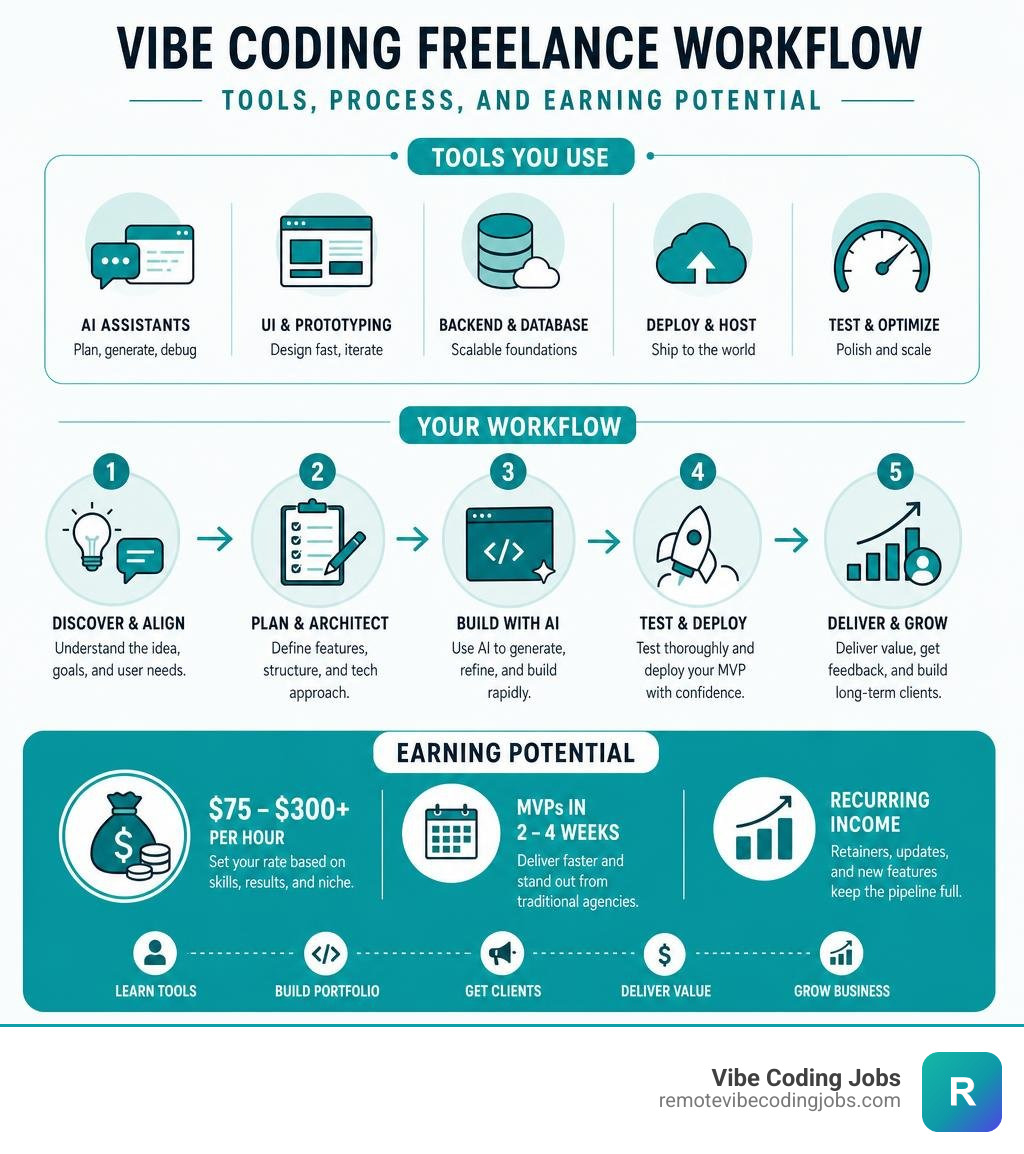
Vibe coding freelance work is one of the most in-demand ways to earn money as a developer in 2026. Here’s what you need to know at a glance:
Quick Answer: How to Land Vibe Coding Freelance Gigs
- Learn the core tools — Cursor, Claude Code, Bolt.new, Lovable, or Windsurf
- Build 2-3 portfolio projects — MVPs, SaaS tools, or internal tools work best
- Post your services on freelance platforms or dedicated job boards like Remote Vibe Coding Jobs
- Set your rate — freelance vibe coders typically charge $75-$300/hour
- Deliver fast — MVPs in 2-4 weeks is your key selling point over traditional agencies
The gap between “having an idea” and “having a working product” used to take months and cost tens of thousands of dollars. Not anymore.
AI-assisted development has flipped that equation. Skilled vibe coders are now delivering production-ready MVPs in weeks — at up to 70% lower cost than traditional dev agencies. That speed advantage is exactly why clients are actively seeking freelancers who know how to use these tools.
Andrej Karpathy, who coined the term “vibe coding” in early 2025, described it simply: instead of writing every line of code by hand, you describe what you want in natural language and let AI handle the heavy lifting. You stay focused on architecture, judgment, and outcomes.
The result? A new class of freelancer who ships faster, charges less than agencies, and keeps clients coming back.
I’m RVCJ Editorial, the team behind Remote Vibe Coding Jobs — we cover AI-assisted development, remote work trends, and practical career guidance for developers building with tools like Cursor, Claude, and Copilot, including the growing world of vibe coding freelance work. Read on for everything you need to start landing gigs, setting rates, and building a sustainable freelance practice with AI tools.
Quick vibe coding freelance definitions:
What is Vibe Coding vs. Traditional Development?
To succeed as a vibe coding freelance specialist, you must first understand how this paradigm shifts your daily work. Traditional coding is syntax-heavy. Developers spend hours writing boilerplate code, configuring environments, searching for obscure library bugs, and manually writing test suites.
Vibe coding, or AI-assisted development, shifts the developer’s role from a “code typist” to a software architect and product director. Instead of writing every line manually, you use natural language prompts to guide AI models to write, refactor, and optimize the code for you. You don’t ignore the code; rather, you direct its flow, review its output, and piece together complex systems.
However, vibe coding is not just about typing “make me a Facebook clone” into a prompt box. Real vibe coding requires strong prompt engineering, an understanding of system architecture, and the ability to spot where an AI’s logic is breaking down.
While no-code tools lock you into a visual interface with strict platform limitations, vibe coding gives you raw, production-grade code that you fully own.
| Feature | Traditional Coding | No-Code Tools | Vibe Coding |
|---|---|---|---|
| Development Speed | Slow (Months) | Fast (Days) | Ultra-Fast (Days to Weeks) |
| Development Cost | Very High | Low to Medium | Low (Runs on ~$45/month) |
| Customization Ceiling | Infinite | Limited by Platform | Infinite (Full Code Access) |
| Vendor Lock-in | None | High | None |
| Skill Barrier | High (Years of Study) | Low | Medium (Architectural Focus) |
Learn more about the vibe coding career path to see how this transition is redefining technical roles across the industry.
Speed, Cost, and Code Ownership
For a solopreneur or a freelance builder, the business metrics of vibe coding are unbeatable. When you work with traditional codebases, you are paying for time. When you work with no-code tools, you are paying high monthly platform fees (often $100 to $500 per month) and are locked into their hosting ecosystem.
Vibe coding allows you to run an entire development stack for roughly $45 a month in AI API fees, while retaining 100% ownership of the source code. This means you can host your clients’ applications on free or low-cost hosting tiers like Cloudflare Workers, Supabase, or Vercel, completely escaping tool lock-in.
Clients love this because they aren’t tied to a proprietary visual editor. If they want to hire a traditional developer later, they can hand over a clean, standard GitHub repository.
To see how professional builders organize these projects for maximum efficiency, you can read the ultimate vibe coding guide on GitHub.
For clients looking to bypass expensive software agencies entirely, adopting a vibe coding approach shows just how disruptive this model has become.
Launching Your Vibe Coding Freelance Career in 2026
The freelance market in June 2026 is experiencing an unprecedented gold rush for AI-fluent builders. Freelancers who embrace vibe coding report massive productivity gains, often seeing 2x to 5x increases in their output within the first month of consistent practice. Because you can build in days what used to take weeks, your earning potential increases dramatically.

Instead of billing strictly by the hour—which penalizes you for working fast—successful vibe coders price their projects based on value. Delivering an MVP in 2 weeks instead of 2 months is worth thousands of dollars to a startup founder.
By charging flat project rates, entry-level vibe coders with 1-2 years of experience are earning between $70,000 and $100,000 annually, while mid-level and senior AI-first developers easily command $100,000 to over $250,000 per year.
To understand how these numbers translate to different freelance and remote roles, Check out the vibe coding salary guide.
Building a Vibe Coding Freelance Portfolio
If you want to land high-paying gigs, you cannot rely on a resume. Clients want to see working software. Your portfolio should feature 2 to 3 fully functional applications that solve real-world problems.
Excellent portfolio projects include:
- SaaS MVPs: A subscription-based micro-tool with user authentication and payment processing (e.g., Stripe integration).
- Internal Business Tools: A custom database interface, a programmatic lead generator, or an automated reporting system.
- Interactive Web Utilities: AI-powered search engines, custom API integrations, or niche dashboards.
If you are wondering how fast you can build these, read our guide on How to build your first SaaS in a weekend. Once you have completed a couple of builds, make sure to document your process and Explore vibe coding portfolio projects to see how to present your work to prospective clients.
Finding High-Paying Vibe Coding Freelance Gigs
To land your first clients, you must position yourself as an “AI-First Developer” or “Rapid MVP Builder” rather than just a general programmer. Clients who are stuck in “prompt hell”—meaning they tried to build an app themselves using AI but got stuck when the code broke—are highly lucrative targets.
You can find active contracts and client opportunities across several platforms:
- Freelance Marketplaces: General freelance platforms are filled with clients looking for quick turnaround times on web apps, scraping scripts, and bug fixes.
- Curated Job Boards: To skip the bidding wars, you can Browse remote vibe coding jobs directly to find async-first companies hiring long-term contractors.
- Direct Outreach: Look for founders on social media complaining about slow development agencies, and offer to build their prototype in under 3 weeks.
If you want a step-by-step blueprint on positioning your skills, read our comprehensive guide on How to get a vibe coding job.
When positioning your services, highlight the types of projects that are currently in high demand:
- Minimum Viable Products (MVPs): Helping early-stage startups launch and test ideas with real users in 2 to 4 weeks.
- Database and Scraping Utilities: Swapping manual data entry for automated workflows, such as custom scraping tools that extract and organize web data automatically.
- AI Integrations: Adding LLMs, vector search, or automated agents into existing business systems.
The Essential Toolkit and Skills for AI-First Builders
To make a living doing vibe coding freelance work, you need to master the specialized tools of the trade. While ChatGPT and Claude’s web interfaces are great for simple questions, professional vibe coders use deep-integration tools that sit directly inside their development environments.
The core tools of a modern vibe coder include:
- Cursor: A fork of VS Code built entirely around AI, allowing you to reference your entire codebase, edit multiple files simultaneously, and auto-apply code changes.
- Claude Code / Codex CLI: Terminal-based tools that allow AI agents to execute terminal commands, run tests, and write code directly from your command line.
- Bolt.new & Lovable: In-browser builders that let you generate, preview, and deploy full-stack web applications from simple text descriptions.
To set up your environment like a professional, Discover the essential vibe coding tools and read our specialized breakdown in the Read our complete guide for vibe coding solopreneurs.
Technical Skills Beyond Prompting
Many beginners think that vibe coding means they do not need to learn any real technical skills. This is a trap. If you do not understand software fundamentals, you will quickly find yourself stuck in endless prompt loops, unable to fix simple deployment bugs.
To command high freelance rates, you need to study:
- Systems Architecture: Knowing how frontend, backend, databases, and APIs connect.
- UI/UX Design: Building interfaces that look clean and professional, using modern CSS libraries like Tailwind.
- Database Design: Understanding how to structure relational databases (like PostgreSQL) and write basic SQL queries.
- API Integration: Connecting third-party services like Stripe, SendGrid, or OpenAI.
Understanding these concepts is exactly Learn what clients look for in vibe coders when they want to hire a freelancer who can actually deliver a secure, production-grade product.
Overcoming Challenges: From AI Prompts to Production-Ready Code
The biggest risk in vibe coding freelance work is code quality. Unchecked AI-generated code can easily become bloated, hard to maintain, and riddled with security vulnerabilities. In fact, research indicates that up to 45% of unaudited AI-generated code contains security flaws.
To prevent your projects from becoming an unmanageable mess, you must establish a strict development workflow:
- Never let the AI plan autonomously: Always require the AI to write an implementation plan before it writes any code.
- Use a “Memory Bank” system: Keep structured files in your project directory (like
architecture.md,tech-stack.md, andprogress.md) so the AI always has up-to-date context on how the application works. - Commit changes frequently: Use Git to commit your code after every successful feature. If the AI breaks something in the next step, you can easily roll back.
By keeping your code modular and separating your business logic from your display logic, you ensure that your projects remain easy to debug and scale.
To master this structured approach, read our Master the vibe coding workflow.
If you are looking for real-world inspiration, you can look at how independent professionals like the Software Developer Cincinnati | Freelance MVP Developer | Fred | Vibe Coding With Fred rescue broken, prompt-heavy codebases and turn them into clean, production-ready applications.
Managing Client Expectations and Maintenance
When you deliver an application 5x faster than a traditional agency, clients might assume that future changes or bug fixes are instant. You must manage these expectations from day one.
- Set Clear Project Scopes: Define exactly what features are included in the initial build.
- Include a Bug-Fix Period: Offer a standard 30-day window of free bug fixes post-launch to give clients peace of mind.
- Sell Maintenance Contracts: Offer monthly retainer packages (e.g., $100 to $500/month) to handle server monitoring, security updates, and minor feature adjustments.
To build a healthy, sustainable freelance business, make sure to check out our guides on how to Master freelance MVP development and How to manage client expectations in vibe coding.
Frequently Asked Questions about Vibe Coding Freelance Work
How much can I earn as a freelance vibe coder?
Freelance vibe coders charge between $75 and $300 per hour depending on their expertise, system design skills, and the complexity of the projects they build. Because vibe coding increases your delivery speed, charging flat project rates (e.g., $3,000 to $8,000 for a 3-week MVP) often results in an effective hourly rate of over $150/hour.
To see how these freelance rates compare to full-time remote contracts, Read about vibe coding salary remote positions.
Do I need a computer science degree to start vibe coding?
No! Clients in the freelance market care about working products, not credentials. A strong portfolio showing functional, live web applications is worth far more than a formal degree. However, you do need to understand programming basics like variables, data structures, and APIs to guide the AI effectively.
If you want to quickly build these practical skills, we highly recommend you Take the vibe coding 30 day challenge.
What are the best tools for freelance vibe coding?
The industry-standard setup for freelance vibe coders in 2026 relies on Cursor or Windsurf as the primary code editor, Claude Code for terminal-based tasks, and platforms like Bolt.new or Lovable for rapid prototyping and deployment. Using these tools in combination allows you to maintain high code quality while shipping at lightning speed.
To see how these tools are changing the remote work landscape, Understand the benefits of vibe coding remote jobs.
Conclusion
The future of software development belongs to those who can build at the speed of thought. As AI agents evolve from writing simple snippets to autonomously managing entire deployments, the value of a developer will be measured by their creativity, systems thinking, and execution speed.
By mastering vibe coding freelance workflows today, you position yourself at the forefront of this shift. You can build faster, charge competitive prices, and deliver incredible value to your clients.
Ready to start landing high-paying AI-assisted development gigs? Sign up for Remote Vibe Coding Jobs to get daily curated remote listings, free playbooks, and direct access to async-first companies looking for builders who know how to ship code with AI. You can also Compare vibe coding vs traditional development to see how our platform helps you stay ahead of the curve.