
Find NYC Remote Async Jobs That Fit How You Build
NYC remote async work means a remote role where progress happens mainly through written updates, shared documentation, recorded video, tickets, and pull requests instead of constant meetings. For developers seeking AI-assisted coding work, the best options are usually fully async engineering, data, design, and product roles, though many NYC-linked jobs are partially async and require set Eastern Time overlap.
| What to look for | Quick meaning |
|---|---|
| Fully async | Few meetings, no fixed core hours, and work that does not depend on being online at the same time |
| Partially async | Regular team syncs or 2-4+ hours of required overlap, often in Eastern Time |
| Strong job signals | Written-first culture, clear response-time norms, Notion or docs, Loom, Slack threads, GitHub, and outcome-based evaluation |
| NYC compensation | Pay varies widely by role and seniority; senior technical jobs often disclose NYC-specific salary bands under local transparency rules |
NYC is a major tech market, with 549,200 tech workers and strong startup investment. That creates real remote opportunities, but it also creates noise: a listing can say “remote” while still expecting daily standups, fast Slack replies, or several office days each week.
The difference matters because async is not simply working from home. It is a work system designed to protect deep focus, make decisions visible, and let people contribute across schedules. A good async job gives you autonomy and clear written expectations. A poor one can leave you dealing with the quiet pressure of wondering whether delayed replies or invisible work will hurt your standing.
I’m Di Su, a software engineer with more than 10 years of experience building web products, improving workflows, and connecting technical execution with growth. My background in Svelte, Python, conversion work, and scalable product delivery shapes this guide to finding practical nyc remote async roles and recognizing the culture behind the job description.
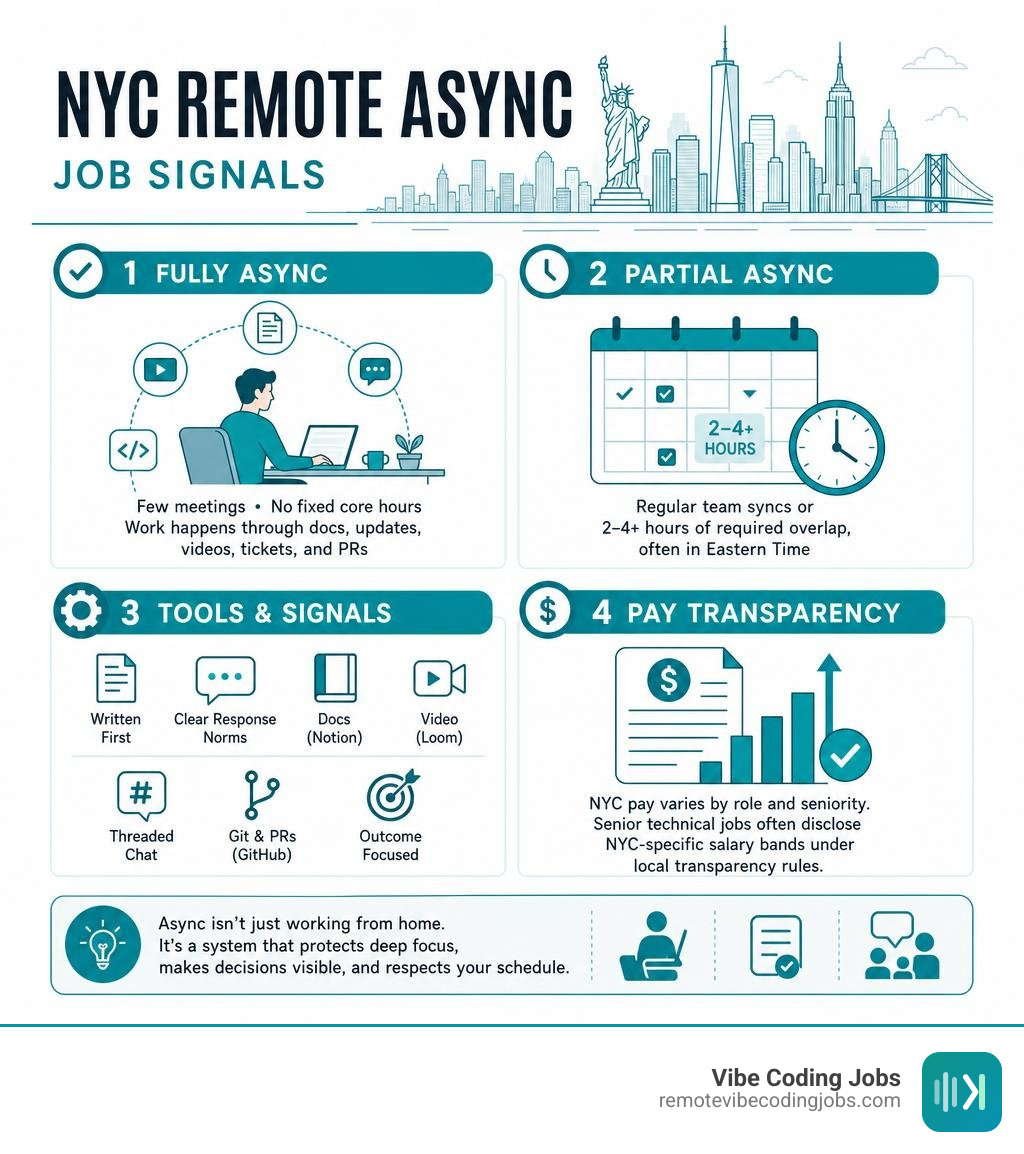
Quick nyc remote async definitions:
Understanding the NYC Remote Async Landscape: Fully vs. Partially Async Roles
When navigating the market for a nyc remote async position, candidate confusion often stems from how companies define asynchronous work. Job boards and company career pages routinely market jobs as “async” whenever employees operate outside a traditional office. However, established criteria like The Async Policy Rubric — What Earns the Label show that asynchronous work exists along a spectrum ranging from Fully Async to Partially Async.
To evaluate opportunities effectively, developers must look past generic recruitment language and examine concrete operational requirements: meeting frequency, required timezone overlap, and schedule autonomy. Detailed breakdowns in our analysis of Async-First Remote Developer Jobs: Productivity & Benefits highlight how true async environments measure engineering output rather than hours spent logged into Slack.
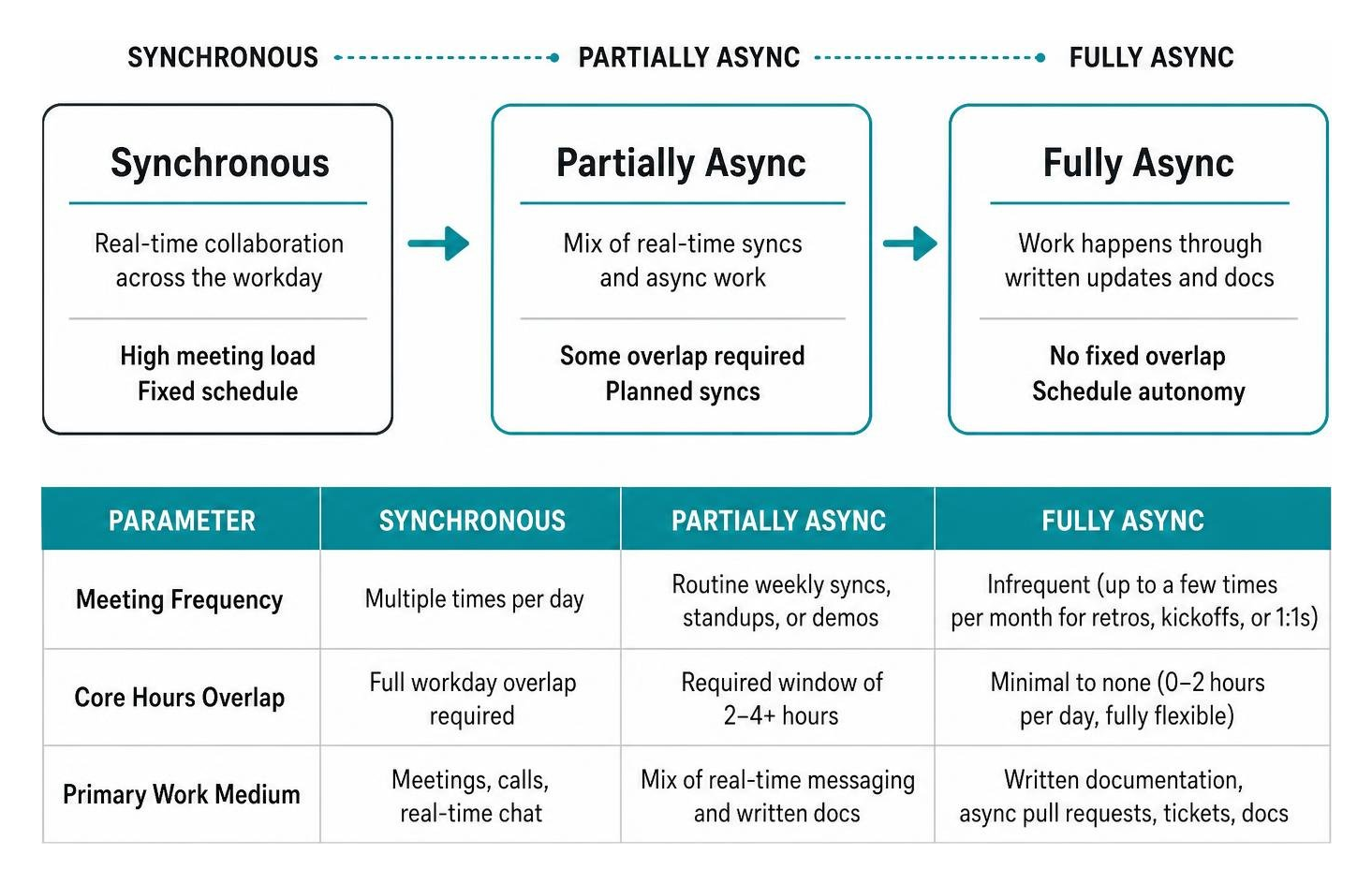
| Parameter | Fully Async Roles | Partially Async Roles |
|---|---|---|
| Meeting Frequency | Infrequent (up to a few times per month for retros, kickoffs, or 1:1s) | Routine weekly syncs, recurring team standups, or customer demos |
| Core Hours Overlap | Minimal to none (0–2 hours per day, fully flexible) | Required window of 2–4+ hours of concurrent team overlap |
| Primary Work Medium | Written documentation, architecture deciders, async pull requests | Mix of real-time messaging (Slack/Teams) and written docs |
| Schedule Autonomy | Total control over local working hours | Partial flexibility structured around mandatory team availability |
| Performance Metric | Written artifacts, code shipped, and outcome completion | Combination of shipped output and real-time team availability |
Core Hours and Timezone Overlap Expectations
In the New York tech ecosystem, timezone dynamics heavily influence async policies. Many companies headquartered in Manhattan or Brooklyn manage distributed teams spanning North America, South America, and Europe. Roles labeled as partially async often enforce a mandatory 2-to-4-hour overlap window, typically between 10:00 AM and 2:00 PM Eastern Time (ET). This overlap facilitates rapid architecture alignment, critical incident triage, or client-facing discussions while leaving the remainder of the working day clear for uninterrupted execution.
Conversely, fully async roles dispense with core hours entirely. Engineers operating in fully async teams have complete control over their schedules, provided they maintain thorough asynchronous communication through pull request descriptions, technical design documents, and structured thread updates.
Evaluating NYC Remote Async Developer Roles
The degree of asynchronous flexibility a position affords depends significantly on the role function:
- Maker Roles (Software Engineers, Data Engineers, System Architects): These positions benefit most from fully async models. Software developers produce discrete artifacts—such as written code, database migrations, and system documentation—making their progress easily verifiable without real-time surveillance.
- Customer-Facing and Facilitation Roles (Sales Engineers, Technical Account Managers, Product Managers): Because these roles require direct client demos, live discovery calls, or real-time cross-department orchestration, they almost universally operate on a partially async basis.
Understanding this functional distinction helps job seekers set realistic expectations when evaluating nyc remote async job descriptions.
NYC Employers Hiring for Remote Async Roles and Salary Benchmarks
New York City’s tech sector remains a powerhouse for high-paying engineering opportunities. Backed by $25.5 billion in venture capital funding and a massive talent base, NYC companies offer attractive compensation tiers for remote software talent.

A broad review of New York remote listings across general job platforms reveals base salaries spanning $40,000 for entry-level administrative positions to $500,000 for executive and legal roles. High-level technical roles typically fall between $150,000 and $300,000. As detailed in our guide to Remote Developer Salaries in 2026: What to Expect, senior software engineers, platform architects, and AI developers command premium compensation bands when tied to NYC-based entities.
Active Roles and Technical Infrastructure Requirements
Several prominent employers hiring in the NYC ecosystem actively recruit for async-focused roles:
- Gusto: Offers specialized engineering positions such as Staff Software Engineer, Developer Productivity Async. This role focuses explicitly on building and scaling asynchronous background infrastructure—utilizing tools like Sidekiq, Kafka, and Karafka—to support distributed product development.
- Ocrolus: A NYC-headquartered fintech company automating financial document analysis. Positions like Director of Product – Platform illustrate how modern teams mandate async workflows paired with AI-driven rapid prototyping (or “vibe coding”) to build platform services.
Modern platforms continuously track these listings, highlighting how tech organizations are shifting toward asynchronous infrastructure development.
Geographic Compensation Tiers and NYC Location Premiums
Pay transparency legislation under N.Y.C. Admin. Code §§ 8-102 and 8-107(32) requires companies hiring in connection with New York City offices to disclose clear compensation ranges. Employers often structure pay according to geographic tiers:
- NYC / SF Bay Area Tier: Commands a significant premium to match regional cost-of-living standards. For instance, Gusto’s Staff Software Engineer (Developer Productivity Async) position lists a targeted cash compensation range of $220,000 to $250,000 for NYC and San Francisco residents.
- General Remote Tier: The exact same role for candidates located in Denver or standard US remote locations offers a band of $189,000 to $210,000.
This structure represents a location-based premium of $31,000 to $40,000 for engineers residing in the New York metropolitan area. Furthermore, senior positions frequently include equity grants and performance bonuses, making overall compensation highly competitive.
How to Demonstrate Async Communication Skills on Your Resume
In a competitive remote hiring market, possessing strong technical skills is only half the equation. Engineering leaders routinely reject qualified candidates whose application materials signal a heavy reliance on synchronous meetings, verbal alignment, or constant real-time supervision.
To stand out for a nyc remote async position, your resume must actively demonstrate asynchronous communication proficiency. We recommend leveraging the established C.L.E.A.R. framework outlined in industry literature like Async Communication: The Complete Guide for Remote Professionals | RemoteResume.ai. Aligning your application with Remote Developer Skills in Demand 2026: Future-Proof Your Career ensures your materials showcase modern distributed workflows.

Navigating NYC Remote Async Hiring Expectations
Remote hiring managers filter applications for explicit async signals. Key expectations include:
- Context-First Written Communication: The ability to front-load technical specifications, background decisions, and reproduction steps in pull requests or ticket descriptions so team members can move forward without back-and-forth messaging.
- Asynchronous Video Demonstration: Over 40% of modern remote engineering job descriptions explicitly reference video tools like Loom. Demonstrating proficiency in recording structured walkthroughs for code reviews or technical RFCs is a strong hiring signal.
- Self-Service Documentation: Proving that you build internal knowledge assets—such as team wikis, Standard Operating Procedures (SOPs), and architectural decision records (ADRs)—that enable self-serve onboarding and unblock colleagues across timezones.
High-Signal Phrasing and the Async Proof Formula
To convey async competency, avoid generic phrases like “communicated effectively” or “led daily standups.” Instead, apply the Async Proof Formula:
[Async Tool / Medium] + [Context / Initiative] + [Measurable Outcome]
Resume Phrasing Transformations
- Weak (Synchronous Focus): “Held daily standup meetings with engineers to track project status and address blockers.”
- Strong (Async Signal): “Replaced 5 weekly status meetings by introducing structured Notion update templates and Loom walkthroughs, saving the team 12 engineering hours per week.”
- Weak (Documentation): “Wrote technical documentation for internal systems.”
- Strong (Async Signal): “Authored 14 self-service architecture guides and OpenAPI specifications, reducing developer onboarding time from 3 weeks to 4 days across 3 timezones.”
By emphasizing outcome-driven written documentation, candidates signal that they are ready to thrive in high-autonomy environments.
Workplace Culture and Pitfalls in NYC Remote Async Environments
While asynchronous work offers high schedule flexibility and deep focus, it also presents distinct cultural challenges that engineers must navigate.
When managed improperly, async cultures can degenerate into environments driven by invisible pressure. A primary metric highlights why developers seek async cultures in the first place: research shows it takes an average of 23 minutes to regain focus after a single work interruption. Frequent Slack notifications, unplanned huddles, and status requests destroy engineering throughput.
However, moving entirely to async requires deliberate cultural guardrails, as discussed in our guide to Remote Work & Deep Focus Productivity.
The Hidden Psychological Challenges of Asynchronous Work
- “Quiet Pressure” and Response Latency Anxiety: Without explicit guidelines defining healthy response windows, remote workers often feel compelled to check Slack or email constantly outside of working hours. This creates an environment of artificial urgency, undermining the core benefits of async flexibility.
- Context Switching and Fragmented Threads: Participating in dozen-long Slack threads without structured resolution mechanisms leads to cognitive fatigue.
- Asynchronous Isolation: Highly autonomous written-first environments can leave engineers feeling disconnected from their teammates if companies neglect social connection channels or clear feedback loops.
Critical Asynchronous Communication Mistakes to Avoid
Candidate performance in async roles often suffers due to avoidable communication habits:
- Meeting Dependency: Defaulting to a calendar invite whenever a minor question arises rather than crafting a detailed written query.
- Over-Communication Theater: Producing massive walls of text or excessive status updates strictly to project visibility, rather than delivering concise, actionable context.
- Lack of Upfront Context: Sending partial, vague messages (e.g., “Hey, do you have a minute?”) that require multiple back-and-forth cycles across timezones, dragging out simple interactions over days.
- Synchronous Validation Seeking: Waiting for real-time approval on trivial execution details rather than leveraging autonomy to ship work and solicit feedback asynchronously.
Modern Developer Tools and AI Integration in NYC Async Teams
The evolution of asynchronous engineering in New York is tightly tied to the adoption of modern developer tooling and modern AI coding assistants.
Engineering teams leverage asynchronous platforms like async-labs/async to decouple urgent real-time alerts from structured long-form discussions, minimizing deep work interruptions. On a technical protocol level, open-source utilities like iceprosurface/remote-async highlight how software architectures mirror asynchronous paradigms, enabling promise-based RPC messaging over isolated Web Workers, WebSockets, and iframe protocols.
Simultaneously, the rise of AI-assisted development—frequently termed vibe coding—is transforming how async teams build software. As detailed in Remote Developer Jobs: AI Tools, Productivity, Collaboration, integrating tools like Cursor, Claude, and Github Copilot enables software engineers to transform written prompts into production-ready software artifacts.
Integrating AI Workflows for Asynchronous Developer Productivity
In high-performing nyc remote async engineering teams, AI tools enhance productivity through several key workflows:
- AI-Assisted Rapid Prototyping (“Vibe Coding”): Engineers write high-level architectural specifications and prompt AI tools (such as Cursor or Claude) to generate foundational boilerplate, API integration code, and unit tests asynchronously.
- Automated Pull Request Descriptions: AI tools parse code diffs to automatically generate context-rich pull request summaries, explaining architectural changes to reviewers working in different timezones.
- Continuous Integration and AI Code Reviews: Automated code review agents inspect PRs, flag potential security bugs, and enforce code style rules asynchronously before human reviewers enter the thread.
This combination of asynchronous team policies and AI-driven code generation allows lean engineering teams to ship features rapidly without requiring synchronous coordination.
Frequently Asked Questions about NYC Remote Async
What distinguishes Fully Async from Partially Async positions in NYC?
Fully Async roles require minimal to no real-time meetings (typically only a few monthly retros or 1:1s) and enforce zero core overlap hours, granting total schedule autonomy. Partially Async roles involve routine weekly syncs, standups, or client calls, requiring a mandatory overlap window (typically 2 to 4+ hours, usually centered on Eastern Time).
How does New York City’s pay transparency law apply to remote async jobs?
Under N.Y.C. Admin. Code §§ 8-102 and 8-107(32), any employer hiring for a role connected to a New York City office or facility must state the minimum and maximum salary range in the job posting. This law applies to remote positions if the candidate could potentially be managed by or associated with an NYC hub.
Which communication tools are most valued by NYC async employers?
Employers prioritize candidates proficient in structured documentation and asynchronous video tools. Key applications include Notion and GitHub for written documentation, Loom for asynchronous video updates, Slack (specifically organized, threaded conversations), and AI development environments like Cursor and Claude.
Conclusion
The market for nyc remote async positions represents a major shift in how tech talent builds software. By moving away from meeting-heavy schedules and real-time availability, asynchronous frameworks let developers reclaim their deep focus, maintain schedule autonomy, and build software on their own terms. Coupled with NYC’s strong venture capital landscape and competitive compensation bands, async engineering roles offer ideal conditions for tech professionals.
At Vibe Coding Jobs, we specialize in tracking and aggregating curated remote engineering positions tailored for modern developers. Whether you are looking for a fully async platform engineering role or an AI-assisted vibe coding position, our platform filters jobs by culture, stack requirements, and toolsets like Cursor and Claude.
Ready to find a remote role that respects your focus and autonomy? Find NYC Remote Async Opportunities on Vibe Coding Jobs today.