
What Is the Market Value for Hourly Web Development in 2026?
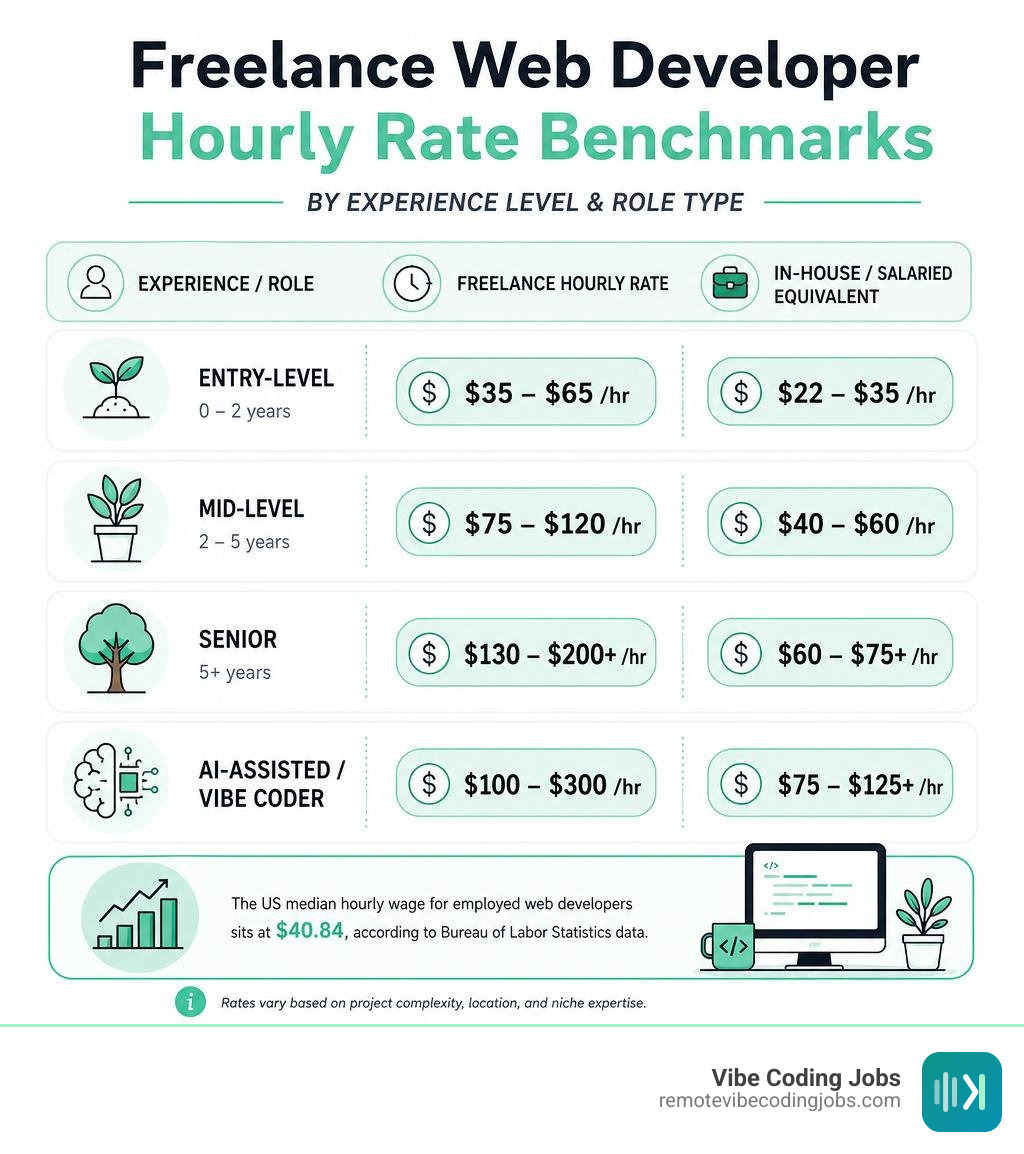
Understanding the market value hourly web development rates command right now can be the difference between leaving money on the table and pricing yourself competitively. Here’s a quick snapshot:
| Experience Level | Freelance Hourly Rate | In-House / Salaried Equivalent |
|---|---|---|
| Entry-level (0-2 years) | $35 – $65/hr | $22 – $35/hr |
| Mid-level (2-5 years) | $75 – $120/hr | $40 – $60/hr |
| Senior (5+ years) | $130 – $200+/hr | $60 – $75+/hr |
| AI-assisted / Vibe Coder | $100 – $300/hr | $75 – $125+/hr |
The US median hourly wage for employed web developers sits at $40.84, according to Bureau of Labor Statistics data. But freelance rates tell a different story — most independent developers charge significantly more to cover taxes, overhead, and unpaid hours.
The gap between what you could charge and what you actually charge often comes down to one thing: not knowing your real floor rate.
Most developers underprice by roughly 20%. They forget to account for the hours spent on admin, proposals, and client calls — time that doesn’t show up on any invoice.
This guide walks you through exactly how to fix that.
I’m Di Su, a software engineer with over 10 years of experience building web products and landing pages that have driven millions of visits — work that required a sharp understanding of market value hourly web development rates across both agency and freelance contexts. That background shapes everything in this guide, so you’re getting practical benchmarks, not theoretical ones.
Essential market value hourly web development terms:
Understanding the Market Value Hourly Web Development Benchmarks
Setting your freelance rate isn’t about plucking a number out of thin air. It requires a deep understanding of the broader economy, industry standards, and the fundamental differences between employment models. In web development, “market value” is highly fluid. It changes depending on whether you are working as a full-time salaried employee, an independent freelancer, or as part of a specialized development agency.
To understand where you fit, we must first look at the baseline data. According to the US Bureau of Labor Statistics, the median hourly wage for an employed web developer is $40.84, which translates to a median annual salary of approximately $85,000 to $95,570. At the top end of the traditional employment spectrum, the 90th percentile of salaried web developers earns upwards of $75.61 per hour.
However, freelance benchmarks operate on an entirely different plane. Because freelance developers do not receive corporate benefits, paid time off, or employer-sponsored healthcare, their hourly rates must be higher to achieve the same standard of living. An entry-level freelancer might start at $50 to $75 per hour, while seasoned pros regularly command $100 to $300 per hour.
When we look at custom software development firms and agencies, the pricing scales up even further. Mid-market custom software development firms typically charge clients between $120 and $250 per hour. Elite, enterprise-class agencies can easily charge $400 to $900 per hour for high-end consulting and complex system architecture.

To help you visualize these differences, we have compiled a comprehensive comparison table of the hourly rates across different employment types in 2026:
| Developer Tier | In-House Salaried (Hourly Equivalent) | Freelance / Contractor Hourly Rate | Agency Billing Hourly Rate |
|---|---|---|---|
| Junior / Entry-Level | $22.53 – $30.00/hr | $35.00 – $75.00/hr | $90.00 – $160.00/hr |
| Mid-Level Developer | $30.00 – $50.00/hr | $75.00 – $120.00/hr | $120.00 – $250.00/hr |
| Senior Developer / Architect | $50.00 – $75.61+/hr | $130.00 – $300.00+/hr | $250.00 – $400.00+/hr |
| AI-First / Vibe Coder | $45.00 – $90.00/hr | $100.00 – $300.00/hr | $150.00 – $350.00/hr |
Entry-Level and 1-Year Experience Market Value Hourly Web Development Rates
If you are a junior developer with around 1 year of professional experience, navigating the market can feel incredibly daunting. You might ask yourself: “How much should I charge without pricing myself out of a job or, conversely, letting clients take advantage of me?”
According to real-world market discussions, such as those analyzed on How much to pay a 1-year experience developer, the consensus for a developer with one year of professional experience sits between $35 and $50 per hour for freelance contracts.
There is a distinct difference between a true entry-level developer (0-1 years of experience) and a junior developer who has crossed the 1-year mark. A brand-new developer is still learning the ropes, often requiring significant hand-holding, which keeps their baseline market rate closer to $20 to $30 per hour in traditional employment, or $35 to $45 in freelancing. Once you have a full year of professional experience under your belt, you have proven that you can ship functional code, work within a team, and handle basic project lifecycles independently. This pushes your competitive freelance rate closer to $50 to $75 per hour.
For those looking at salaried remote tracks, our research on remote developer salary expectations by experience level indicates that junior remote developers with 1-2 years of experience can expect starting salaries of $46,850 to $70,000 per year, which equates to an hourly equivalent of roughly $22 to $34 per hour.
Mid-Level and Senior Market Value Hourly Web Development Rates
As you transition from a junior developer to a mid-level (2-5 years of experience) or a senior professional (5+ years of experience), your market value rises exponentially. At this stage, clients are no longer just paying for your syntax-typing speed; they are paying for your architectural decisions, problem-solving capabilities, and strategic consulting.
For mid-level developers, a competitive freelance hourly rate typically ranges from $75 to $120 per hour. In this bracket, you are expected to take a project from concept to deployment with minimal supervision, write clean, maintainable code, and integrate complex third-party APIs seamlessly.
For senior developers and “seasoned pros,” the sky is the limit. Senior freelance rates start at $130 per hour and frequently exceed $200 to $300 per hour for highly specialized work. These experts are often brought in to solve critical performance bottlenecks, architect enterprise-scale cloud applications, or lead cross-functional development teams.
To gain a clearer understanding of how these senior rates translate into everyday client proposals, you can explore our breakdown of web developer hourly rate pricing. This resource highlights how elite independent contractors structure their rates to match the high-stakes value they deliver to enterprise clients. Furthermore, our comprehensive guide on remote developer salaries in 2026 shows that senior remote developers regularly secure base salaries ranging from $120,000 to over $180,000 annually, proving that high hourly rates are backed by strong global salary benchmarks. For more context on what top independent experts charge across the United States, you can also reference the data compiled in US freelance web developer rates.
Key Factors Influencing Your Hourly Rate
Your hourly rate is not a static number written in stone. It is influenced by a dynamic mix of variables that you can actively optimize to increase your earning potential.

The most significant factors that influence your market value hourly web development rate include:
- Specialization and Tech Stack: Generalists who build simple template websites command far lower rates than developers who specialize in modern, high-demand frameworks.
- Project Complexity: Simple informational landing pages require less risk and effort than complex, multi-tenant SaaS dashboards with real-time database syncing and strict compliance requirements.
- Geographic Location of the Client: A client based in a high-cost-of-living tech hub like San Francisco or New York will have a significantly higher budget than a local small business in a rural area.
- Your Development Workflow: Developers who leverage advanced AI-assisted tools can complete projects much faster, allowing them to charge premium hourly rates while still delivering incredible value.
Specialization and Tech Stack Premiums
What you build matters just as much as how well you build it. The hourly rate averages across standard specializations show clear tiering:
- Front-End Developers: Average around $34 per hour. They focus on user interface, accessibility, and client-side performance.
- Back-End Developers: Average around $36 per hour. They handle database architecture, API design, server-side logic, and security.
- Full-Stack Developers: Average around $39 per hour (with senior full-stack specialists easily commanding $120+ per hour). They bridge the gap between front-end and back-end, offering complete end-to-end solutions.
If you specialize in commoditized platforms like basic WordPress or Shopify theme installations, you will find yourself competing in a highly crowded market where rates hover around $35 to $50 per hour. However, if you upskill into custom application development using modern frameworks like React, Next.js, TypeScript, or Node.js, you can immediately command a 20% to 40% premium.
To see how these tech stack differences affect real project quotes, take a look at the web developer pricing guide. It details how a 10-page basic WordPress site might be priced at a flat $4,500, while a custom React-based SaaS dashboard commands upwards of $25,000 for a similar time investment due to the specialized skillset required.
Geographic Location and Cost of Living Impact
Geography continues to play a massive role in determining web development rates, even in our highly remote world.
For example, the average hourly wage for a web developer in San Francisco is a staggering $71.55, reflecting the intense concentration of venture-backed tech startups and the extremely high local cost of living. In New York City, the average hourly rate sits at a strong $45.78. Meanwhile, in lower-cost-of-living cities like Austin, Texas, or Atlanta, Georgia, average developer rates range from $27 to $32 per hour.
This geographic disparity opens up a massive opportunity known as geographic arbitrage. As a remote freelance developer, you can live in a low-cost-of-living area (where your personal expenses are minimal) while targeting clients located in high-cost tech hubs like San Francisco, New York, or Seattle. By doing this, you can easily secure rates that are 25% to 35% higher than your local market average, dramatically boosting your savings.
To understand how remote work trends and geographic shifts are shaping developer compensation, check out our analysis of vibe coding salary remote work location growth. It explains how modern developers are leveraging remote flexibility to maximize their real-world purchasing power.
How to Calculate Your Competitive Hourly Rate
Now that you know the market benchmarks, it is time to calculate your own competitive hourly rate. Many new freelancers make the mistake of simply dividing their target salaried income by 2,080 (the standard number of working hours in a traditional 40-hour workweek year).
This is a fast track to financial struggle. As a freelancer, you do not bill 40 hours a week. A large portion of your week is spent on non-billable tasks: writing proposals, chasing invoices, marketing your services, communicating with prospective clients, and keeping your technical skills up to date.
Step-by-Step Rate Calculation Formula
To calculate a sustainable, profitable hourly rate, you must factor in your target take-home pay, business overhead, self-employment taxes, and your actual expected billable hours. Follow this step-by-step formula:
- Determine Your Target Annual Net Income: This is the actual amount of money you want to take home after taxes to cover your rent, food, savings, and lifestyle. Let’s assume a target of $90,000.
- Calculate Your Annual Business Expenses: Add up all your overhead costs. This includes your computer hardware, software subscriptions (IDEs, design tools, hosting, AI assistants), health insurance, marketing costs, and office space. Let’s estimate this at $4,000 per year ($333/month).
- Factor in Self-Employment Taxes: In the US, freelancers must pay a 15.3% self-employment tax in addition to standard federal and state income taxes. To safely cover this, you should apply a self-employment tax multiplier of roughly 1.153 to your target income.
- Calculate Your Total Required Gross Revenue: Add your target net income (adjusted for taxes) to your annual business expenses.
- Formula: (Target Net Income × 1.153) + Business Expenses = Required Gross Revenue.
- Example: ($90,000 × 1.153) + $4,000 = $107,770.
- Estimate Your Actual Annual Billable Hours: Most full-time freelancers only bill 20 to 25 hours per week, which equals roughly 960 to 1,200 billable hours per year (accounting for 48 weeks of work and 4 weeks of vacation/sick leave). Let’s use a realistic baseline of 1,000 billable hours per year.
- Divide Gross Revenue by Billable Hours: Divide your total required gross revenue by your expected annual billable hours to find your baseline hourly floor rate.
- Formula: Required Gross Revenue / Annual Billable Hours = Baseline Hourly Rate.
- Example: $107,770 / 1,000 hours = $107.77 per hour (rounded to $108/hr).
To play around with these numbers based on your unique financial situation, you can use the average web developer hourly rate calculator. It will help you visualize exactly how adjusting your billable hours or expenses impacts your take-home pay. Once you have established your target rate, you must also learn how to present and defend it during client negotiations. Check out our guide on how to negotiate remote salary to master the art of value-based positioning.
To make the administrative side of freelancing even easier, modern developers use specialized tools to automate their quoting and proposal processes. Tools like Qotify for Web Developers help you generate accurate, professional project quotes in minutes, saving you hours of non-billable administrative time. You can also benchmark your rates against real-time freelance data using the Upwork Rate Calculator to see where your target rate lands compared to active job posts.
AI and Vibe Coding Productivity Adjustments
We cannot talk about web development in 2026 without addressing the massive elephant in the room: artificial intelligence. The rise of advanced AI-native development environments and tools like Cursor, Claude, WindSurf, and Bolt.new has birthed a new paradigm known as vibe coding.
Vibe coding is the practice of leveraging AI-powered tools to handle the heavy lifting of syntax generation, boilerplate writing, and routine debugging, while the human developer focuses on high-level system architecture, strategic prompting, user experience, and business logic.
This shift has created a massive productivity multiplier. Experienced vibe coders report being 2x to 5x more productive than traditional developers. A project that used to take a traditional agency 4 to 6 weeks to complete can now be built, tested, and deployed live in a matter of days (or even 48 hours, as demonstrated by rapid-build platforms like 48hr.dev).
This productivity boom completely changes how you should think about your hourly rate. If you can build a web application three times faster than your competitor, charging the same hourly rate actually penalizes you for your efficiency.
To maintain high margins, freelance vibe coders command premium hourly rates of $100 to $300 per hour. Because they deliver functional products in a fraction of the time, their total project cost is often lower or equal to traditional developers, making them incredibly attractive to forward-thinking clients.
To explore the earning potential of this exciting new career track, take a look at our vibe coding salary guide. It breaks down how AI-fluent professionals are securing premium compensation. To calculate your own modern market value in the AI era, you can also utilize our interactive developer market value tool.
Frequently Asked Questions about Web Development Rates
What is the average hourly rate for a web developer with 1 year of experience?
For a junior web developer with 1 year of professional experience, the average freelance hourly rate in the US typically ranges from $35 to $50 per hour.
At this stage, you have moved past the absolute entry-level phase (where rates hover around $20 to $30 per hour) and can build functional features, integrate basic APIs, and debug standard frontend or backend issues independently. If you have strong skills in modern frameworks like React or Node.js, you can confidently position yourself at the higher end of this bracket ($50/hr).
How do freelance rates compare to agency rates?
Freelance rates are generally much lower than custom software agency rates, but they offer significantly more flexibility and direct communication for the client.
While a highly competent freelance web developer might charge between $50 and $300 per hour depending on their experience, a mid-market custom software development agency will typically charge $120 to $250 per hour for the exact same project. Enterprise-class agencies can charge upwards of $400 to $900 per hour. Agencies charge more because they have massive overhead costs, including project managers, sales teams, physical offices, and multi-layered quality assurance processes.
To see how freelance rates compare directly to platform benchmarks, you can review the real-world data on Upwork web developer hourly rates.
Should I charge hourly or project-based for web development?
The best pricing model depends entirely on the clarity of the project scope:
- Hourly Billing: This is the safest model for ongoing maintenance, debugging, consulting, or projects with a highly fluid, evolving scope. It ensures you are paid for every single minute of work and protects you from “scope creep.”
- Project-Based (Fixed-Price) Billing: This is highly profitable for well-defined projects where the scope, features, and deliverables are locked in upfront. It aligns incentives around efficiency — if you complete the project ahead of schedule (especially by using AI tools), your effective hourly rate increases dramatically.
Many experienced freelancers use a hybrid approach: they calculate their “hourly floor rate” behind the scenes to estimate the total effort, and then present the client with a flat-fee project quote that includes a safety buffer for unexpected revisions.
Conclusion
Finding and setting your competitive hourly rate is a continuous process of market research, self-evaluation, and strategic positioning. Whether you are a junior developer with 1 year of experience stepping into the freelance world, or a seasoned senior developer transitioning into high-end consulting, understanding your true market value hourly web development commands is the key to building a sustainable, highly profitable career.
As the industry rapidly evolves, the developers who command the highest premiums will be those who combine traditional engineering principles with cutting-edge AI tools to deliver unmatched speed and quality.
If you are ready to take your development career to the next level and work with forward-thinking, async-first companies that value high-efficiency development, we invite you to Explore remote developer salaries and browse our curated, daily-updated job listings at Vibe Coding Jobs today!