
Find Verified Remote iOS Developer Jobs Faster
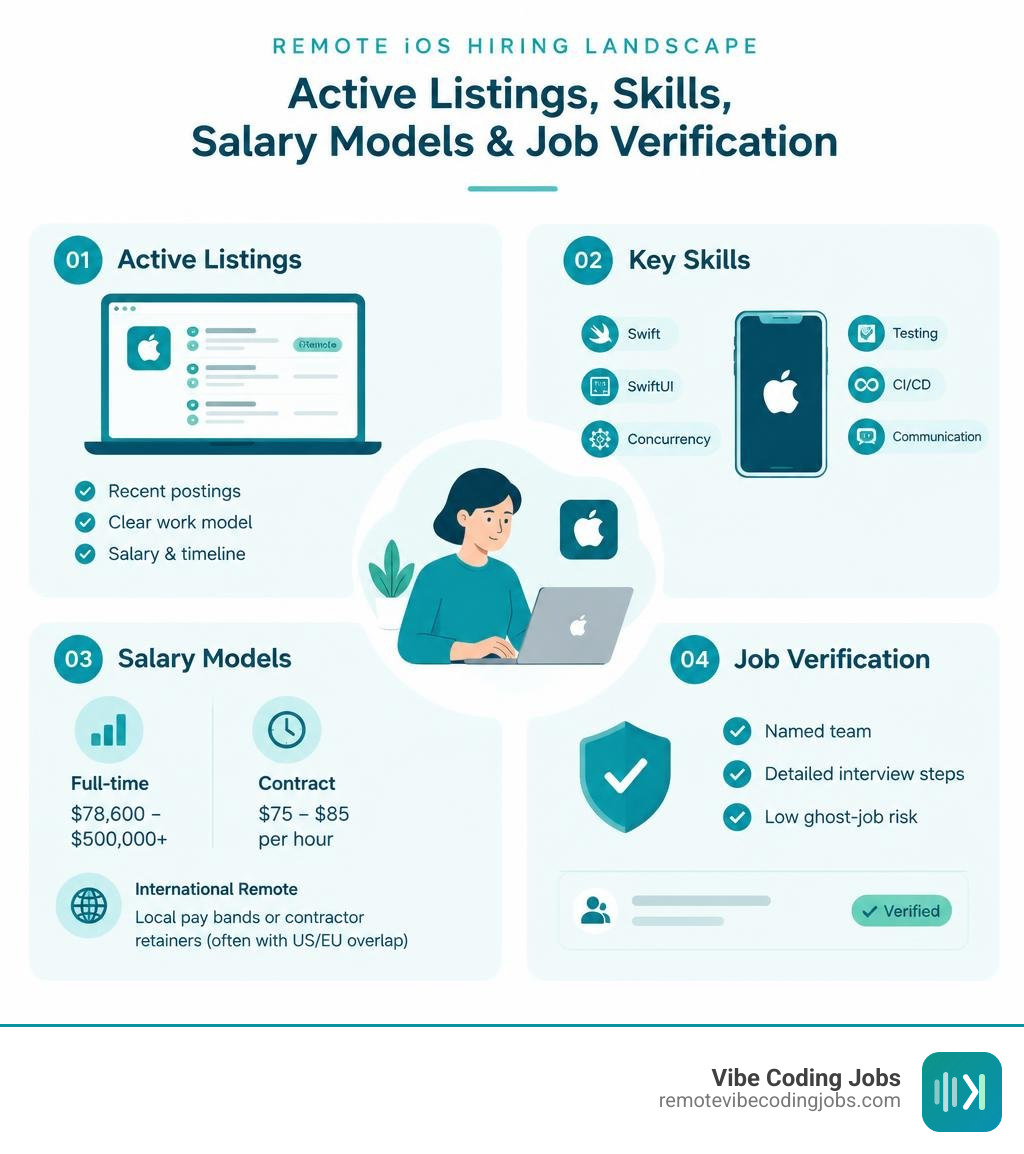
To find iOS developer jobs remote, focus on niche remote job boards, direct company career pages, and listings that clearly state the work model, location eligibility, salary, and hiring timeline. Prioritize roles posted recently, match your Swift and SwiftUI experience to the requirements, and look for signs of an active process, such as a named team, detailed interview steps, or a low ghost-job risk score.
Remote iOS hiring spans fintech, healthcare, SaaS, media, consulting, and enterprise software. Most openings target mid-level and senior engineers, while the strongest candidates can show more than UIKit experience: modern Swift, SwiftUI, concurrency, testing, CI/CD, and clear async communication all matter.
Pay varies sharply by employer and location. US full-time roles can range from roughly $78,600 to more than $500,000 at the highest-paying companies, while contract work often lists rates around $75 to $85 per hour. International remote roles may use local pay bands or contractor retainers, often with required overlap in US or European working hours.
This guide cuts through the noisy feeds. You will learn where to find active Swift roles, which skills hiring teams request most, and how to avoid stale postings before you spend time applying.
I’m Di Su, a software engineer with 10+ years of experience building scalable digital products and improving user-focused workflows. My background in engineering, growth, and high-converting product experiences helps me evaluate ios developer jobs remote through both the technical and practical lens job seekers need.
Similar topics to ios developer jobs remote:
For broader context on how remote hiring is evolving, see Remote work and its impact on distributed engineering teams.
1. Top High-Paying Industries and Salaries for iOS Developer Jobs Remote
Compensation for remote Apple platform engineers varies drastically based on market sector, architectural complexity, and individual experience levels. Senior engineering talent commanding top-of-market compensation typically gravitates toward sectors that demand uncompromising reliability, rigorous security compliance, and high-volume real-time performance.
In the fintech and digital banking sectors, engineers build low-latency interfaces, real-time transaction streams, and secure cryptographic storage layers, with base salaries routinely ranging from $170,000 to $240,000 annually. Digital health and healthtech products present another lucrative niche; companies in this space prioritize offline-first local persistence, HIPAA compliance, and background sensor integrations. In consumer SaaS, streaming media, and high-growth productivity apps, companies pay premium packages for engineers capable of delivering fluid 120Hz frame rates and responsive animations.
For broader market context, reviewing our comprehensive Remote Developer Salary Guide 2026 provides deep insight into compensation modeling. Furthermore, evaluating remote full-stack and mobile earnings highlights how native Apple ecosystem specialists compare to multi-platform engineering roles across distributed teams.
| Seniority / Role Type | Typical US Annual Base Salary | Hourly / Contractor Benchmark | Primary Focus Areas |
|---|---|---|---|
| Junior / Associate iOS Engineer | $78,000 – $120,000 | $40 – $60 / hr | Bug fixes, UI updates, UIKit-to-SwiftUI migration |
| Mid-Level iOS Engineer | $120,000 – $165,000 | $60 – $80 / hr | Core feature development, Swift concurrency, unit testing |
| Senior iOS Engineer | $165,000 – $267,000 | $75 – $110 / hr | App architecture, StoreKit 2, performance profiling, CI/CD |
| Staff / Principal / Specialist | $250,000 – $558,000+ | $120 – $175+ / hr | Enterprise infrastructure, offline-first sync, CoreML, visionOS |
| International Remote (Americas / LatAm) | $60,000 – $95,000 | $35 – $55 / hr | Full-stack mobile features, Pacific Time zone overlap |
Full-Time Salaried Roles vs Hourly Contracts in iOS Developer Jobs Remote
When evaluating remote opportunities, understanding the financial and structural differences between direct salaried employment (W2) and independent contractor agreements (1099 or international B2B) is critical.
- Full-Time Salaried (W2): Provides stable income, employer-sponsored healthcare, 401(k) matching, and recurring equity grants (RSUs or stock options). High-scale technology companies frequently augment cash compensation with significant annual equity refreshes.
- Hourly & Retainer Contracts (1099/B2B): Independent contractors often trade traditional corporate perks for higher immediate cash flow and geographic flexibility. Contract positions commonly bill at $75 to $85 per hour, while dedicated monthly retainers for senior developers in Latin America and Europe average between $5,000 and $5,500 per month.
- Tax and Tooling Deductions: Contract roles require self-managed tax withholdings, hardware procurement, and private healthcare funding, making gross rate calculations essential when comparing offers.
Choosing between contract flexibility and salaried stability also depends on your technical versatility; understanding the top programming languages for distributed teams helps guide long-term career positioning across contract and permanent tracks.
2. Essential Modern Tech Stack and AI-Assisted Workflows

The modern iOS landscape has shifted rapidly away from legacy patterns toward reactive, type-safe, and declarative engineering. While maintaining legacy Objective-C and imperative UIKit codebases remains necessary for enterprise modernization efforts, high-performing remote teams prioritize modern Swift 6 language paradigms.
Core technical expectations for top-tier remote openings include:
- Declarative User Interfaces: Deep architectural fluency with SwiftUI alongside an understanding of UIHostingController integration points for hybrid codebases.
- Modern Architecture Patterns: Practical experience implementing Clean Architecture, MVVM-C (Model-View-ViewModel-Coordinator), and The Composable Architecture (TCA) for modular state management.
- Reactive Data Streams: Leveraging Combine and native Swift Concurrency (async/await, Actors, TaskGroups) to eliminate data races and prevent main-thread UI hitches.
- Monetization & API Communication: End-to-end integration of StoreKit 2 for native subscription lifecycle management, paired with GraphQL and REST networking layers.
Beyond traditional native frameworks, top distributed teams expect developers to leverage modern AI developer productivity tools to streamline code scaffolding and unit test coverage. Mastering these modern AI-assisted development stacks separates developers who write code linearly from those who architect applications at scale.
The Rise of AI Tools and CI/CD Pipelines in iOS Developer Jobs Remote
Remote iOS teams rely heavily on automated continuous integration and continuous deployment (CI/CD) pipelines to ship weekly TestFlight builds and App Store releases without synchronous oversight. Engineering candidates must demonstrate hands-on familiarity with tools such as Xcode Cloud, Fastlane automation scripts, and GitHub Actions.
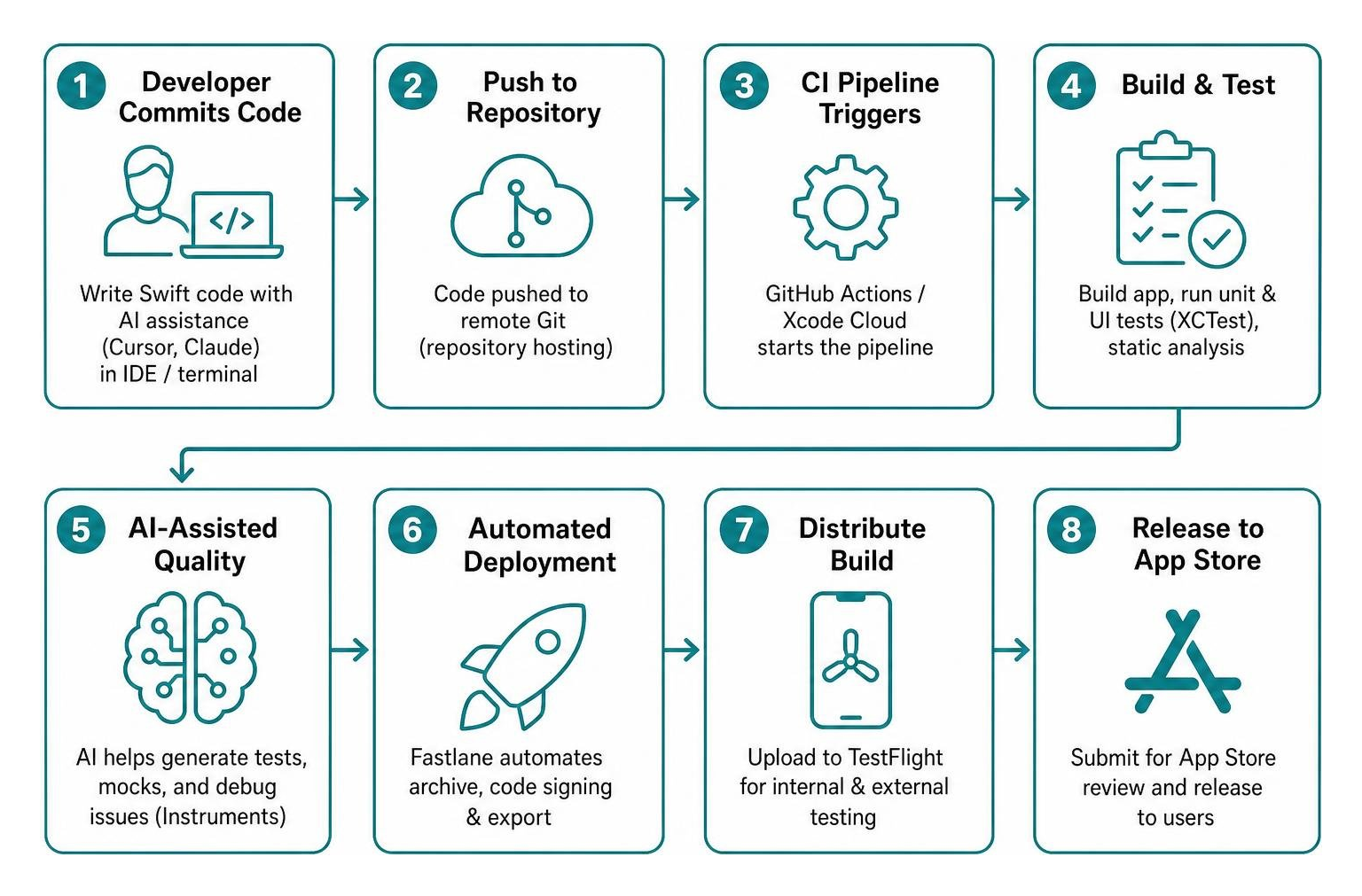
Integrating AI coding assistants directly into daily terminal and IDE workflows—using tools like Cursor and Claude—enables engineers to auto-generate complex mock schemas, write exhaustive XCTest suites, and isolate obscure memory leaks with Instruments. Distributed teams actively test candidates on their ability to execute debugging and automated workflows with AI, accelerating release cadences while maintaining high App Store stability scores.
3. How to Spot and Avoid Ghost Postings in the Remote Market

One of the greatest frustrations in searching for distributed engineering roles is navigating “ghost jobs”—openings that companies leave listed indefinitely to build passive talent pipelines, test market compensation, or project company growth without active hiring budgets.
To protect your time and energy, apply strict filtering criteria before submitting an application:
- Evaluate Listing Age: Focus heavily on positions published within the past 14 days. Postings older than 45 days without clear updates often reflect stalled hiring loops.
- Review Ghost Score Metrics: Modern curated aggregators calculate a “ghost score” based on hiring manager responsiveness, recent interview activity, and direct confirmation signals. A ghost score of 0% to 15% indicates an actively hiring team.
- Inspect the Hiring Funnel: Legitimate remote listings detail exact hiring stages (e.g., initial technical screen, take-home paid exercise, architecture review, culture discussion) rather than generic, open-ended intake forms.
- Identify Named Engineering Teams: Verified listings frequently specify the exact product team (e.g., Core Monetization, Mobile Platform, Design Systems) and list reporting structures.
Taking the time to research landing a legitimate remote developer position will refine your targeting strategy. Many tech firms adopt practical remote technical hiring processes that bypass arbitrary whiteboard exams in favor of pragmatic codebase reviews and paid asynchronous trial projects.
4. Where to Find Vetted Remote Swift and iOS Positions
Finding high-quality, verified remote positions requires looking beyond broad, uncurated job portals overflowing with duplicate postings. Specialized developer communities and targeted aggregators provide significantly higher signal-to-noise ratios.
- Curated Remote Aggregators: Platforms like RemoteVibeCodingJobs filter daily postings by tech stack, asynchronous culture, and AI workflow integration, ensuring direct access to teams actively building distributed engineering teams.
- Async-First Job Boards: Many tech leaders explicitly prioritize distributed operations. Exploring async-first software companies hiring developers allows you to target companies built around autonomy, structured documentation, and flexible hours.
- Niche Mobile Feeds: Bookmark direct feeds for remote mobile engineering listings to catch cross-platform and native engineering openings the day they go live.
- Direct Tech Portals and Open Repositories: Monitoring open-source Swift repositories and developer advocacy groups frequently surfaces unlisted founding mobile engineer roles before they reach mainstream employment platforms.
When applying, ensure your GitHub portfolio features working TestFlight links, clean modular architectures, and clear documentation demonstrating your ability to build and deploy apps independently.
5. Overcoming Key Challenges for Remote iOS Engineers
Remote mobile engineering presents unique logistical challenges compared to traditional backend or web development. Managing physical hardware, handling remote provisioning profiles, and debugging performance bottlenecks across device generations requires deliberate operational discipline.
Physical Device Testing and Hardware Labs
Relying solely on Xcode Simulators introduces blind spots around memory pressure, thermal throttling, Bluetooth peripherals, camera pipelines, and battery drain. Distributed iOS developers should maintain a personal testing rack of at least two physical test devices running beta and production iOS versions. Top remote employers routinely provide hardware stipends or ship managed device fleets directly to your workspace.
Asynchronous Collaboration and Time Zone Overlap
Working effectively across distributed teams requires mastering asynchronous communication. Instead of scheduling frequent meetings, high-performing developers use detailed pull request descriptions, annotated screen recordings of UI interactions, and structured architecture decision records (ADRs). Even fully distributed teams often request a 3- to 4-hour working overlap with primary business hubs (such as US Pacific Time or Central European Time) to facilitate code reviews and cross-functional planning.
Implementing structured developer productivity optimization strategies ensures you maintain steady engineering momentum while enjoying the flexibility of remote work.
Frequently Asked Questions about Remote iOS Jobs
What is the average salary range for remote iOS developers in the US?
Compensation for remote iOS developers in the United States ranges widely based on experience, company scale, and equity components:
- Junior / Early Career: $78,000 to $120,000 base salary.
- Mid-Level (3–5 years): $120,000 to $165,000 base salary.
- Senior (5+ years): $165,000 to $267,000 base salary.
- Staff / Principal / FAANG-tier: $250,000 to $558,000+ total compensation (base salary plus equity and performance bonuses).
Contractor roles typically range from $75 to $85 per hour for mid-to-senior engineers, with specialized contractors commanding $110 to $150+ per hour.
How do I transition to remote iOS development without prior remote experience?
Transitioning into distributed engineering requires providing clear evidence of self-direction, technical ownership, and written communication skills:
- Publish Live App Store Projects: Demonstrate complete development ownership by launching an independent app utilizing SwiftUI, Swift Concurrency, and StoreKit 2.
- Build Public Async Proof: Contribute to open-source Swift libraries, document architecture choices on a technical blog, and participate in public pull-request reviews.
- Highlight Remote Tooling Competence: Emphasize your experience with CI/CD automation (Fastlane, Xcode Cloud), asynchronous task tracking (Linear, Jira), and AI-assisted workflows in your application materials.
For additional strategies on entering distributed engineering roles, read our guide on breaking into remote development without prior remote roles.
Are international developers eligible for US-based remote iOS positions?
Yes, many US tech organizations hire international engineers, typically employing one of three models:
- Employer of Record (EOR): Companies use global employment platforms to hire international developers as full-time local employees with statutory benefits.
- Direct B2B Contractor Retainers: International engineers invoice the US entity directly through a registered business entity, with typical senior retainers ranging from $5,000 to $6,500 USD per month.
- Time Zone Alignment: Most US-based employers require international contractors to provide 3 to 4 hours of daily working overlap with US Pacific or Eastern standard business hours.
Conclusion
The market for remote Apple platform engineers remains robust and rewarding for developers who combine native Swift and SwiftUI expertise with modern async workflows and AI-assisted tooling. By focusing on verified job listings, steering clear of stale postings, and actively demonstrating your architectural and testing skills, you can land a high-paying remote role tailored to your lifestyle.
At RemoteVibeCodingJobs, we curate daily, high-signal developer openings at forward-thinking, async-first organizations. Explore our verified listings today to find the latest remote Swift developer jobs and take the next step in your distributed engineering career.