
Hire NYC Remote Talent Without Paying for Empty Desks
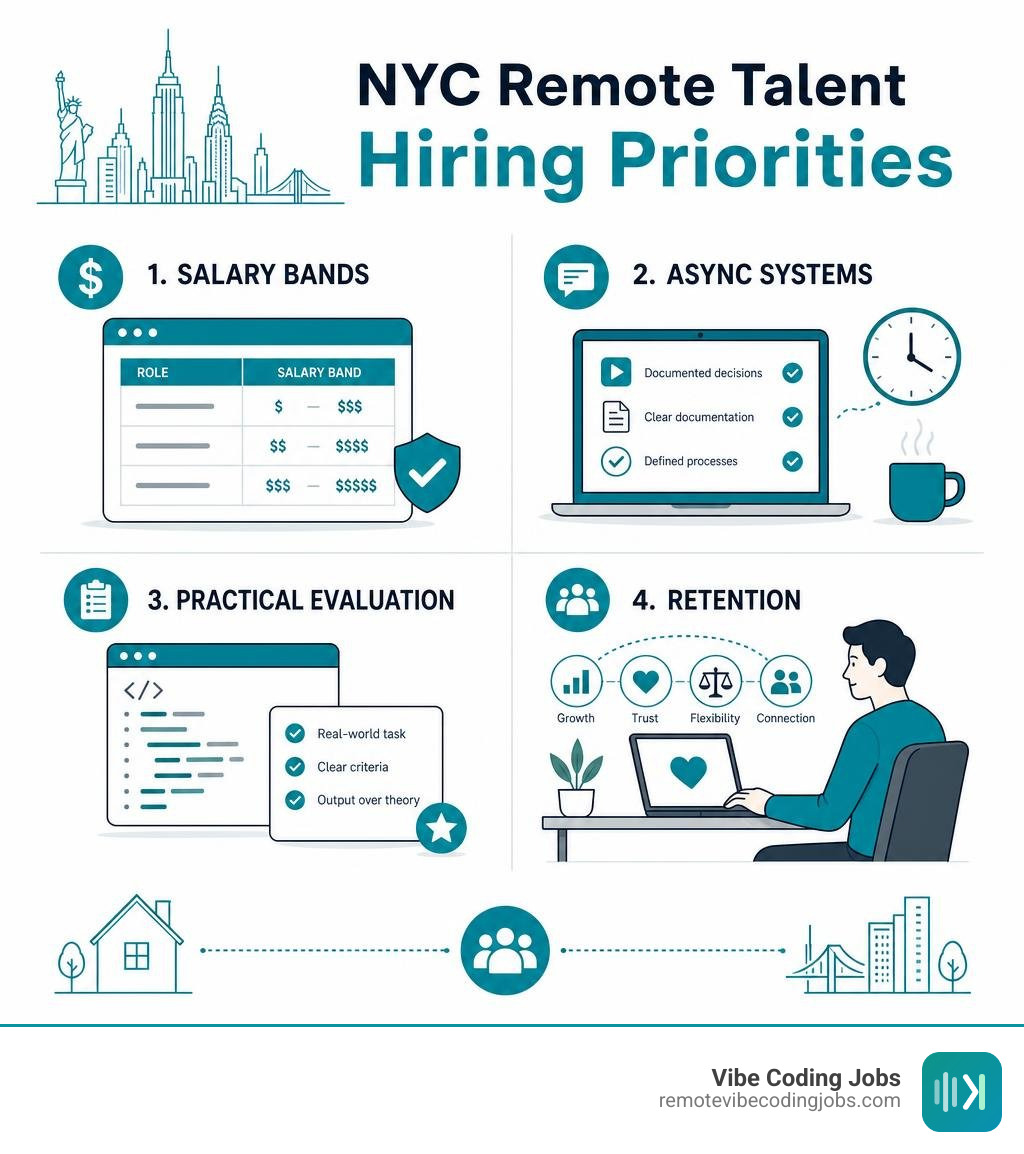
To hire and retain strong NYC remote talent, focus on three things: clear salary bands, async-friendly work systems, and practical skill assessment. Hire for proven output rather than office presence, give candidates a fast and transparent process, and use occasional in-person time only when it adds real value.
New York remains a deep talent market for tech, people operations, recruiting, media, and startups. A recent LinkedIn snapshot showed 87 remote talent management openings in New York, with 46 aimed at mid-senior professionals and 76 listed as full-time. That is a useful signal: companies want experienced people who can build hiring systems, manage distributed teams, and operate with less supervision.
For employers, remote hiring can reduce Midtown office costs while expanding access beyond commuting distance. For developers and talent professionals, it can mean access to NYC-based companies without trading every workday for a crowded commute. The best teams make that trade work through documented decisions, sensible overlap hours, structured interviews, and benefits that support remote work.
I am Dominic Zijlstra, a technologist and entrepreneur who has built automated systems, data infrastructure, and AI-enabled products across startups and engineering teams. My work in DevOps, data science, and automation informs this guide to NYC remote talent and the systems that help distributed teams hire, ship, and stay effective.
Nyc remote talent terms explained:
The Shifting Landscape of NYC Remote Talent in 2026
The New York tech ecosystem in August 2026 is no longer defined by physical floor space on Park Avenue or renovated warehouses in DUMBO. The city boasts a tech workforce of over 549,200 workers—representing roughly 6% of the city’s total employment base. Backed by a historic $25.5 billion in annual venture capital funding flowing into local tech companies, the metropolitan area serves as an economic powerhouse. However, how these companies allocate capital has fundamentally shifted.
Rather than committing millions of dollars to long-term commercial leases, modern startups, especially Series A through Series C scaleups, are embracing distributed operating models. They tap into elite local talent while extending their networks to source top-tier technical and operational operators regardless of their physical zip code.

Mid-Senior Roles and In-Demand Specializations
When analyzing active job data across New York, mid-senior level specialists dominate the market. More than half of all listed remote talent and people operations roles target professionals who can take ownership immediately without extensive hand-holding:
- Talent Operations & Automation Leads: Operators who configure applicant tracking systems, design automated candidate workflows, and eliminate manual recruitment bottlenecks.
- Executive Search & GTM Recruiters: Specialists capable of conducting outbound market mapping to attract high-earning Go-To-Market (GTM) leaders and foundational engineers.
- People & Culture Partners: Senior generalists who build scalable onboarding tracks, manage distributed performance cycles, and sustain company culture across time zones.
As organizations scale, foundational hiring relies on high-touch sourcing rather than brute-force volume. Specialized boutique recruiting practices help early-stage founders secure key engineering and design hires without diluting candidate experience.
NYC vs Other Major Tech Metros
While Silicon Valley and Seattle remain dominant software engineering capitals, New York holds distinct advantages for distributed teams:
- East Coast Timezone Hub: NYC’s Eastern Standard Time allows simultaneous, seamless collaboration with Western Europe, Latin America, and West Coast branches.
- Academic & Research Pipelines: Elite institutions including Columbia University, NYU, Cornell Tech, the AI Now Institute, and the Flatiron Institute continuously supply elite engineering and data science graduates.
- Industry Diversity: NYC blends deep domain expertise across fintech, healthcare, media, digital commerce, and artificial intelligence, giving local operators strong commercial acumen alongside technical mastery.
Compensation Models and Remote Operational Structures
Attracting top operators requires structured, transparent compensation. In a market where candidates can explore hundreds of open positions across the tech landscape, competitive pay bands and clear benefits packages dictate hiring success.
| Role Type | Typical Base Compensation | Variable / Bonus / Equity | Common Benefits & Remote Perks |
|---|---|---|---|
| Head of Talent / VP People | $175,000 – $214,000 | Substantial Equity + 15–25% Performance Bonus | $1,000 WFH setup, $100/mo wellness, 12 weeks paid parental leave |
| Talent Operations / Program Mgr | $110,000 – $150,000 | Equity Options + Annual Merit Bonus | Home office stipend, async tech toolkit, learning credits |
| Senior Technical / GTM Recruiter | $90,000 – $135,000 | 10–20% Placement Bonuses or Equity | Comprehensive healthcare, unlimited PTO, annual retreats |
| Specialized Commission Recruiter | Commission-Only ($0 Base) | Estimated $70,000 – $180,000 (20–50% per deal) | High autonomy, flexible hours, production performance bonuses |
| Municipal / Public Talent Manager | $62,868 – $80,000 | Public Service Loan Forgiveness (PSLF) eligible | Hybrid Flexible Work (up to 2 days remote/week), city pension |
In entertainment and media, specialized representation roles often offer commission-heavy structures, allowing agents who bring their own client rosters to retain up to 80% commission splits.
Structuring Competitive Compensation for NYC Remote Talent
To retain senior contributors without overinflating operational burn, progressive companies combine healthy base compensation with localized remote perks. For engineering leaders evaluating market benchmarks, reviewing Remote Developer Salaries In 2026 What To Expect provides baseline context on how technical compensation is evolving across distributed teams.

When benchmarking software engineering roles against traditional on-site compensation, examining the Vibe Coding Salary Remote Vs Onsite Growth guide reveals how output-driven compensation models balance out geographic cost-of-living adjustments. Top companies supplement base salaries with:
- Initial remote workspace setup grants ($1,000+)
- Monthly high-speed internet and wellness stipends ($100–$200/month)
- Company-wide quarterly asynchronous recharge weeks
- Transparent equity vesting frameworks
Traditional In-House HR vs Distributed Talent Operations
Traditional in-house HR departments historically focused on physical office administration, paper onboarding, and local compliance. In contrast, modern distributed talent operations teams function like software engineering pods.
Using integrated platforms like Ashby ATS, talent operations program managers track funnel conversion metrics, automate interview scheduling across time zones, and calibrate interviewers using standardized scoring rubrics. By building automated capacity models, a lean internal team can manage hiring volume that previously required a department twice its size.
Modern Sourcing, Vibe Coding, and AI Automation
The recruitment process itself is undergoing a generational shift driven by artificial intelligence. Sourcing is no longer a manual task of browsing profiles one by one; it combines programmatic outbound market mapping, automated pipeline nurturing, and predictive candidate scoring.
Emerging engineering talent like Talia Nyasia exemplifies this shift, combining core software development skills with specialized credentials in agentic AI frameworks, Claude architecture, and automated cloud workflows.
The Tech Stack and AI Tools Driving NYC Remote Talent
Forward-thinking organizations have integrated AI-assisted software development into everyday operations. Engineers build scalable systems using Next.js App Router, NestJS, Prisma, and PostgreSQL, accelerated by AI development environments like Cursor and Claude Code.
These AI-first methodologies allow developers to ship clean microservices and complex multi-tenant architectures in fractions of the traditional development cycle. Understanding these compensation models is easier when you review the Vibe Coding Salary Remote Ai Roles breakdown, which explores the compensation upside for engineers who master AI-assisted workflows.
Postings by technical recruiters like Laura Gutiérrez explicitly recruit AI-first full-stack developers skilled in prompt engineering, sub-agents, and LLM orchestration tools like LangChain or CrewAI.
Evaluating Practical Skills Over LeetCode Puzzles
Outdated algorithmic interviews fail to measure a candidate’s actual ability to build and maintain distributed systems. Progressive engineering teams evaluate candidates through practical take-home projects, pull-request reviews, and real-world system design challenges.
Teams adopting modern technical vetting strategies frequently reference Remote Coding Jobs No Leetcode Practical Skills to design practical assessments that evaluate how effectively candidates leverage modern IDEs, agentic coding tools, and cloud deployment pipelines.
Scaling Distributed Teams: Compliance, Nearshore Hiring, and Retention
Building a high-performing distributed organization requires looking beyond city limits while maintaining cohesive operational standards. Many NYC-headquartered companies combine core local leadership with nearshore engineering teams in Latin America (LATAM) and Europe.

Recruiting specialists like Thalia Bitencourt specialize in sourcing international engineering talent across Latin America for US-based startups. These nearshore arrangements allow teams to collaborate during matching working hours while accessing specialized engineering talent. Listings highlighted by recruiters like Martina Vai show high demand for full-stack engineers skilled in React, Node.js, and cloud architectures who can integrate directly into US startup workflows.
Navigating Municipal Regulations and Cross-Border Sourcing
Hiring across jurisdictions requires careful attention to compliance:
- NYC Municipal Regulations: Public sector agencies operating under programs like the Department of Consumer and Worker Protection Flexible Work Pilot Program often allow up to 2 days per week of remote work, though municipal roles typically require city residency within 90 days.
- Cross-Border & Nearshore Talent: When engaging international contractors or full-time remote employees in LATAM or Europe, companies use Employer of Record (EOR) platforms to ensure compliance with local labor laws, tax withholdings, and statutory benefits.
Building Asynchronous Culture and Long-Term Retention
Retaining high-performing remote employees requires intentional cultural design. Top talent stays at organizations that respect deep work, document key decisions, and provide meaningful paths for advancement.
- Documentation-First Workflows: Replace unnecessary status meetings with structured Notion or GitHub RFCs where team members provide asynchronous feedback.
- Anti-Silo Initiatives: Encourage cross-departmental collaboration, open project channels, and structured mentorship programs.
- Comprehensive Family & Mental Health Benefits: Progressive employers offer mental health subscriptions, paid parental leave, fertility planning, and flexible dependent-care options to foster long-term career longevity.
- Periodic In-Person Retreats: Host semi-annual or quarterly offsites where distributed teams gather for strategic alignment, team bonding, and collaborative roadmapping.
Frequently Asked Questions About NYC Remote Hiring
What salary ranges can candidates expect for NYC remote talent roles?
Compensation for remote talent roles connected to the NYC market varies widely by seniority, domain, and scope:
- Entry to Associate Roles: $50,000 – $75,000 base salary.
- Mid-to-Senior Talent Acquisition & People Ops: $90,000 – $145,000 base salary plus bonus structures.
- Director and Head of Talent Positions: $175,000 – $215,000+ base salary, supplemented by meaningful equity grants.
- Independent / Agency Commission Roles: $70,000 – $180,000+ depending directly on closed placements.
How do NYC municipal hybrid policies differ from private remote roles?
NYC public sector roles operate under civil service guidelines and specific municipal initiatives like the Flexible Work Pilot Program. These programs typically permit eligible employees to work remotely up to 2 days per week. Furthermore, municipal roles generally require employees to establish NYC residency within 90 days of appointment (or within designated surrounding counties after two continuous years of service), whereas private remote companies hire across national and international jurisdictions without local residency mandates.
Which AI and coding skills are most in-demand for remote developers?
Modern remote engineering teams look for developers proficient in:
- Modern Full-Stack Frameworks: Next.js (App Router), TypeScript, NestJS, and Prisma.
- AI Development Tools: Cursor IDE, Claude Code, and agentic prompt engineering workflows.
- LLM Orchestration: LangChain, CrewAI, and custom sub-agent architectures.
- Cloud & Infrastructure: AWS Lambda, SageMaker, Docker containerization, and modern CI/CD automation pipelines.
Conclusion
Scaling a company in 2026 no longer requires paying exorbitant commercial rents in Midtown Manhattan. By shifting focus toward asynchronous communication, transparent compensation structures, and practical technical vetting, modern founders and leaders can attract world-class talent while maintaining lean operational overhead.
Whether you are scaling foundational engineering teams or modernizing your people operations stack, embracing AI-assisted workflows and distributed hiring models allows you to build an agile, high-impact organization.
Ready to find top-tier engineering talent and AI-first developers? Explore open NYC remote talent roles on RemoteVibeCodingJobs to build your distributed team today.