
Find Innovative Remote NYC Companies Hiring in 2026
The best remote NYC companies to watch in 2026 are tech-forward startups and larger employers that hire across the United States for AI, engineering, product, and customer-facing roles. Start by filtering for fully remote roles if you want no office requirement, then check for time-zone rules, salary bands, and whether the job is truly remote or merely remote-eligible.
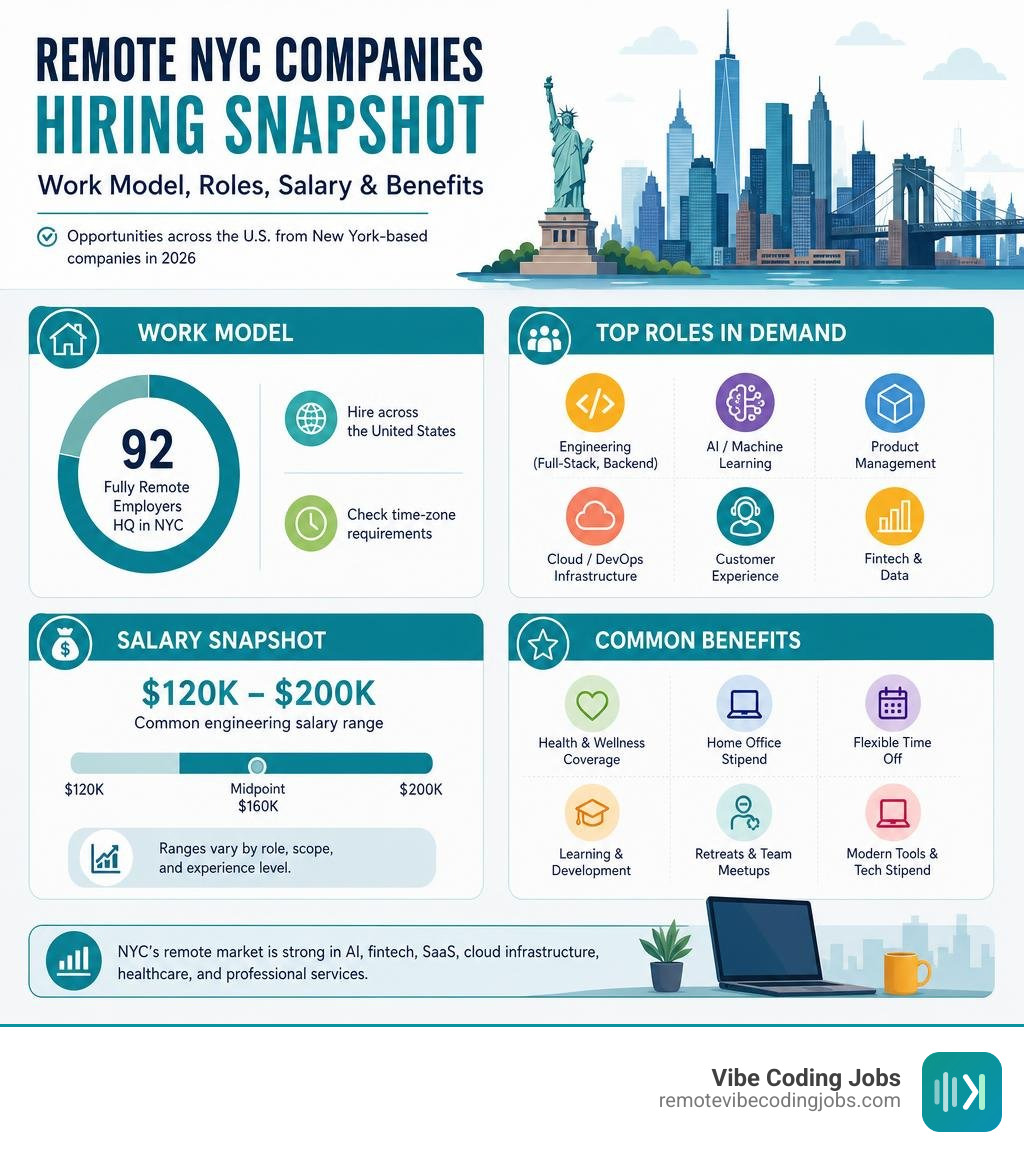
NYC’s remote market is broad, with thousands of organizations hiring remote workers and dozens of fully remote employers headquartered across New York. The strongest opportunities tend to be in AI, fintech, SaaS, cloud infrastructure, healthcare, and professional services.
For developers, the most promising openings often involve full-stack engineering, backend integrations, AI systems, developer tools, and forward-deployed engineering. Many startup listings lean mid-to-senior, offering substantial autonomy and modern developer tooling. Pay can also be competitive, with published engineering ranges in this market commonly reaching roughly $120,000 to $200,000, depending on scope and experience.
I am Hansjan Kamerling, cofounder of Adaptify SEO and a product design leader with more than a decade in tech. I have worked on digital products and technology-driven teams, and this guide helps developers assess remote NYC companies for real flexibility, strong tooling, and practical AI-assisted coding work.
Basic remote nyc companies glossary:
The Best Remote NYC Companies Hiring in 2026

New York City’s technology landscape has evolved from crowded Manhattan coworking spaces into a powerhouse ecosystem of distributed and hybrid teams. Whether you are seeking venture-backed startups scaling AI tooling or established SaaS operations offering high autonomy, several standout organizations headquartered or rooted in NYC are actively expanding their engineering talent pools.
| Company | Sector | Primary Tech Stack | Standout Perks & Benefits |
|---|---|---|---|
| Circle | Community SaaS | Ruby on Rails, React, LLMs | $3,000 setup stipend, bi-annual international retreats |
| Brigit | FinTech | React Native, Java, GraphQL | AI tooling stipends, comprehensive wellness coverage |
| Kilvin | AI-Native Services | TypeScript monorepo, Node.js, Prisma | QSEHRA health reimbursements, flexible gear budget |
| Hatch | Voice AI | Python, Elixir, Go, n8n | Soho hub access + US remote, parental leave |
| Byteboard | HR Tech / EdTech | React, Cloud Native, Async APIs | Unlimited PTO, synchronized summer & winter shutdowns |
| Supermove | Vertical SaaS / Logistics | Python Flask, GraphQL, AWS | a16z backing, rapid project ownership |
Circle: Async Community SaaS Scaling AI Core Systems
Sid Yadav and his founding team launched Circle to empower creators and enterprises with customizable community platforms. Today, their team spans hundreds of builders across dozens of countries working in an async-first culture.
Circle is heavily investing in large language model (LLM) agents, retrieval-augmented generation (RAG), and intelligent community workflows. Openings such as the Senior Full-Stack Software Engineer (AI Core) role bridge traditional Ruby on Rails and React infrastructure with cutting-edge LLM pipelines. Circle offers transparent compensation benchmarks typically ranging between $130,000 and $140,000 alongside a $3,000 home office setup stipend and bi-annual international team retreats.
Brigit: Holistic Fintech Scaling Financial Health
Based in Manhattan’s Flatiron District, Brigit builds financial health tools designed to alleviate overdraft fees and build consumer credit. While maintaining an NYC footprint, Brigit hires developers across the country under East Coast (EST) or Central (CT) operational schedules.
According to open engineering roles at Brigit, the engineering department builds using React Native, TypeScript, Java microservices on Google Cloud, and GraphQL. The company explicitly looks for builders who leverage modern AI tools to accelerate code generation, offering base salaries between $155,000 and $170,000 for mid-level engineers and up to $190,000 for senior engineers.
Kilvin: AI-Native Custom Internal Tooling
Kilvin operates as an agile, AI-native software agency delivering bespoke internal tools for non-technical enterprise teams. Rather than relying on legacy enterprise software suites, Kilvin builds functional prototypes within days using rapid AI workflows.
Positions like the Forward-Deployed Engineer opening combine direct client discovery with full-stack implementation across TypeScript monorepos, Node.js, Express, Prisma, and PostgreSQL. With base compensation ranging from $120,000 to $180,000, Kilvin provides tax-free QSEHRA health benefit reimbursements and high autonomy for developers who ship fast.
Hatch: Voice AI Infrastructure and Integrations
Hatch focuses on conversational AI, combining real-time voice orchestration with automated business logic. While maintaining a physical presence in Soho, the team provides full US remote flexibility for technical talent.
Their technical integration layer requires robust architectures using Python, Elixir, Go, and workflow engines. For candidates looking at applied AI integrations, the Forward Deployed Engineer @ Hatch role bridges client implementations directly into production R&D codebases, with compensation packages ranging from $144,000 to $200,000.
Byteboard: Equitable Technical Interview Platform
Spun out of Area 120 and backed by a $5M seed round, Byteboard redesigns the technical interview landscape by replacing high-stress algorithmic puzzles with practical, real-world development tasks.
As highlighted on the Careers at Byteboard portal, the company operates as a fully remote team spanning US and Canadian time zones. Byteboard stands out for its human-centric benefits, including 100% employer-covered health premiums, unlimited PTO, and two synchronized, week-long company-wide shutdowns during the summer and winter.
Supermove: Cloud SaaS for Moving and Logistics
Supermove is modernizing the analog moving and logistics industry through end-to-end cloud infrastructure backed by Andreessen Horowitz (a16z). Headquartered with a presence in Williamsburg, Brooklyn, Supermove recruits engineers nationwide.
Open roles such as Software Engineer, Backend & Integrations utilize Python, Flask, GraphQL, and AWS cloud microservices. Engineering salary tiers span $90,000 to $140,000 for level I and $120,000 to $170,000 for level II, offering end-to-end feature ownership within a developer’s first 90 days.
Workplace Models and Compensation Trends in Distributed Teams

The transition toward distributed teams has reshaped how organizations structure their internal operations and compensation models. Remote teams in New York have developed distinct operational cadences to balance flexibility with execution speed.
Why High-Growth Startups and Remote NYC Companies Embrace Async Culture
Modern distributed startups avoid endless video calls by adopting asynchronous-first collaboration standards. Rather than holding daily status meetings, teams rely on written documentation and structured project tracking tools:
- Clear Specifications: Product managers write actionable project scopes in Notion or Linear before sprint kickoffs.
- AI-Assisted Prototyping: Engineers build initial feature branches quickly using tools like Cursor and Claude.
- Async Code Reviews: Pull requests are reviewed on GitHub with automated CI/CD checks and preview deployments.
- Feature Flag Rollouts: Changes are deployed behind feature flags, allowing incremental production releases without scheduled downtime.
By establishing core collaboration windows (commonly 11:00 AM to 4:00 PM EST), distributed organizations maintain alignment across time zones while protecting uninterrupted blocks for deep coding work.
Key Roles and Salaries Across Remote NYC Companies
Under New York City’s wage transparency legislation, companies posting roles that can be performed remotely from NYC must publish realistic compensation ranges.
Remote tech salaries from NYC-headquartered firms generally offer national parity, allowing engineers living outside the metro area to access Tier-1 compensation bands:
- Mid-Level Full-Stack Engineers: $130,000 – $170,000 base salary
- Senior Backend & AI Infrastructure Engineers: $160,000 – $200,000+ base salary
- Forward-Deployed Engineers: $120,000 – $180,000 base salary
- AI Product Managers & Technical Leads: $150,000 – $220,000 base salary
In addition to base compensation, venture-backed startups regularly provide equity option grants, granting employees upside in long-term enterprise growth.
Essential Perks and Benefits Offered by Remote New York Employers
To attract top-tier engineering talent, distributed NYC firms offer comprehensive benefit packages designed to support remote professionals:
- Comprehensive Health Coverage: Many firms cover 100% of employee medical, dental, and vision insurance premiums, while smaller agencies utilize Qualified Small Employer Health Reimbursement Arrangements (QSEHRA) to provide tax-free healthcare allowances.
- Home Office Setup Stipends: One-time equipment allowances ranging from $1,000 to $3,000 ensure remote engineers have high-performance monitors, ergonomic seating, and modern computing hardware.
- Synchronized Company Shutdowns: To prevent remote burnout, forward-thinking employers implement collective summer and winter rest weeks so teams can fully disconnect without returning to an overflowing inbox.
- Learning and Development Budgets: Annual stipends (typically $500 to $2,000) for developer tooling subscriptions, AI model API credits, books, and technical certifications.
- In-Person Hub Gatherings: Bi-annual company offsites held in major cities or retreat destinations to cultivate interpersonal trust outside of daily Slack channels.
How to Land a Role at a Remote NYC Tech Firm
Securing an engineering position with a distributed NYC company requires demonstrating both technical competence and strong remote communication habits:
- Demonstrate AI Tooling Efficiency: Show how you incorporate AI coding assistants like Cursor, Claude, or GitHub Copilot into your daily development cycle to compress feature turnaround times.
- Build a Public Async Portfolio: Highlight production repositories, technical blog posts, or interactive demos that illustrate your ability to write clear documentation and clean code.
- Master Practical Take-Home Challenges: Many modern startups replace algorithmic whiteboarding with scoped take-home tasks (such as building a functional React component or an integration API) to evaluate real-world problem-solving.
- Confirm Time Zone Compatibility: Clearly communicate your working hours, ensuring you can overlap with the core EST/CT schedule required for team planning.
Frequently Asked Questions about Remote NYC Companies
What defines a remote NYC company versus a traditional local employer?
A remote NYC company is typically headquartered in New York City or maintains an executive hub there while allowing its workforce to work from home across the United States. Unlike traditional employers that mandate in-office attendance, remote-friendly NYC firms manage operations asynchronously and adhere to New York pay transparency regulations on their job postings.
Which technical skills and roles have the highest remote demand in NYC?
The highest volume of remote technical openings centers around full-stack development (TypeScript, React, Node.js), backend systems (Python, Java, Go, GraphQL), and AI engineering (LLM integration, RAG systems, and AI agent orchestration). Forward-deployed engineering roles that blend customer implementation with production coding are also seeing substantial demand.
How do remote NYC compensation packages compare to national averages?
Remote compensation from New York companies typically sits at or near Tier-1 national market rates. Many venture-backed NYC startups do not discount pay based on an employee’s local cost of living, providing base salaries ranging from $120,000 to over $200,000 for software development roles alongside equity participation.
Conclusion
The remote hiring market across New York City continues to expand, driven by agile startups and tech-enabled organizations adopting distributed models. As software delivery increasingly incorporates rapid prototyping, modern tooling, and AI-assisted workflows, companies are looking for builders who thrive in autonomous, documentation-first cultures.
If you are ready to find your next flexible role, explore our curated remote nyc jobs directory at Vibe Coding Jobs to discover active openings with high-growth teams.