
Coding from Couch: The Best Remote Developer Jobs in NYC
NYC Remote Developers: What You Need to Know in 2026
NYC remote developers are in high demand right now — and the numbers back it up.
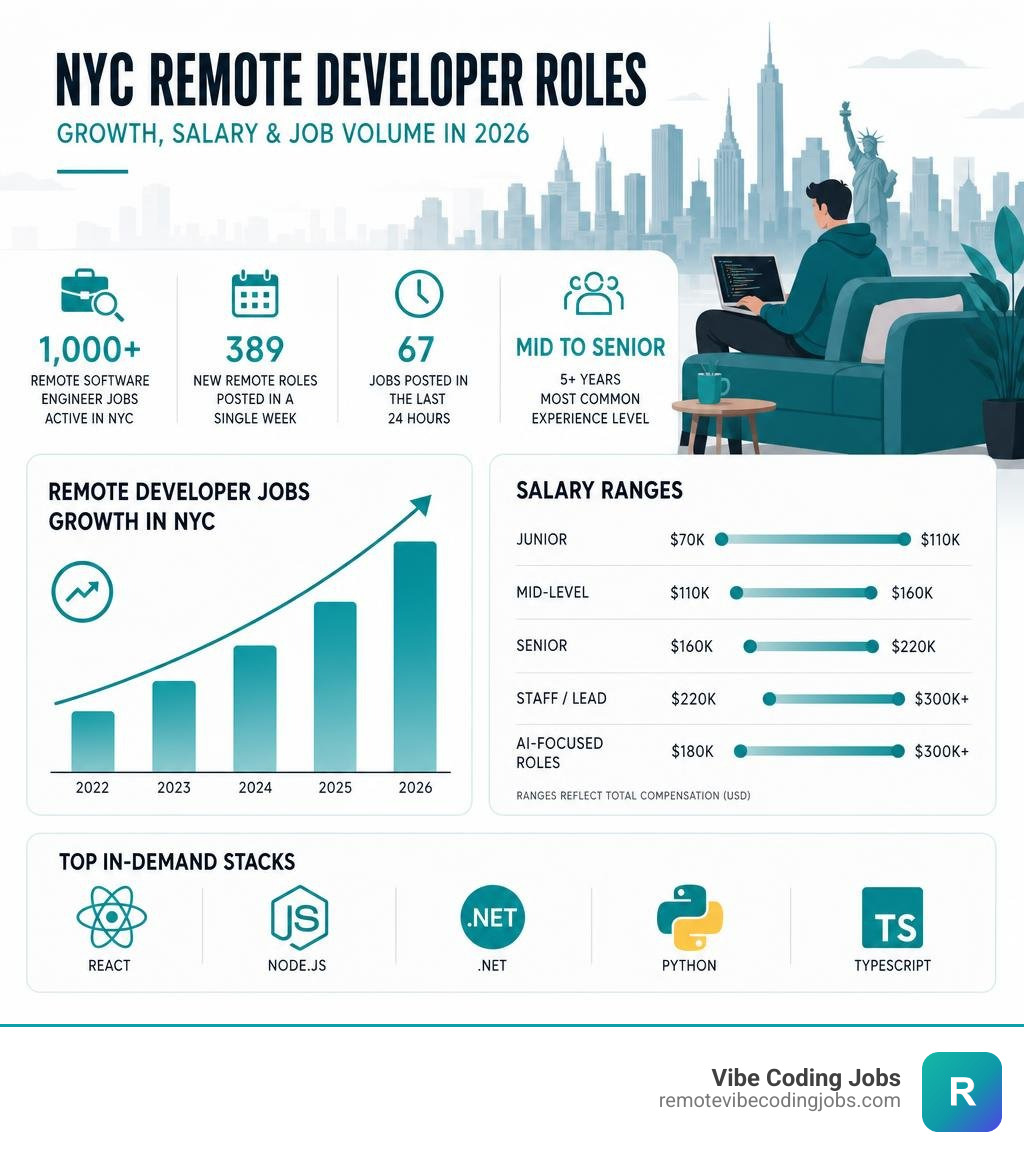
Here’s a quick snapshot of the current market:
- 1,000+ remote software engineer jobs are actively listed in New York
- 389 new remote roles were posted in a single week
- 67 jobs appeared in just the last 24 hours
- Salaries range from $70K for junior roles up to $300K+ for senior and AI-focused positions
- The most common experience level is mid-to-senior (5+ years)
- Top in-demand stacks include React, Node.js, .NET, Python, and TypeScript
The market is active, competitive, and moving fast.
New York has always been a powerhouse for finance, media, and tech. But something shifted over the past few years. Remote work went from a perk to a default for many NYC companies. Today, you don’t need to commute to Midtown to land a top-tier engineering role at a New York-based company — or to work for one from anywhere in the world.
What’s also changed: the kinds of roles being posted. Alongside traditional full-stack and backend positions, a new wave of AI-native and vibe coding roles is emerging — jobs that explicitly value tools like Cursor, Claude Code, and Copilot as core skills, not just nice-to-haves.
The opportunity is real. But the market is noisy, and finding the right role takes knowing where to look.
We’re RVCJ Editorial, the team behind Remote Vibe Coding Jobs — we cover AI-assisted development, async work culture, and remote hiring trends, with a sharp focus on helping developers find verified NYC remote developer roles that match their stack and work style. Let’s break down exactly what the market looks like and where you should focus your energy.
Quick nyc remote developers definitions:
The State of the Market for NYC Remote Developers in 2026
The tech landscape in New York City is incredibly dynamic. As of June 2026, the job market displays a fascinating split. Out of approximately 1,424 total software engineering job results tracked in New York, we see a relatively even three-way split between work arrangements: 473 are fully remote, 457 are traditional on-site roles, and 265 are hybrid.
This means that nearly a third of all engineering jobs originating in the NYC metro area are now fully remote. For nyc remote developers, this represents a massive pool of opportunities.
However, this shift has also changed how companies hire and operate. Rather than forcing developers into expensive Manhattan office spaces, forward-thinking NYC firms are adopting async-first cultures. They are leaning heavily on Slack, Notion, and automated CI/CD pipelines to keep distributed teams aligned.
Of course, this setup comes with its own set of challenges. NYC employers frequently struggle with timezone alignment when hiring globally, navigating complex state-by-state tax compliance, and verifying the practical skills of applicants in an era where anyone can copy-paste code. To address this, many companies are shifting away from dry, algorithmic whiteboard tests. Instead, they are evaluating real-world project portfolios, system architecture skills, and how effectively a developer collaborates with AI tooling.
Why NYC Remote Developers Command Premium Salaries
Even when working from the comfort of a couch, developers hired by New York-based companies continue to command premium compensation packages. Why? Because NYC companies are competing for top-tier talent on a global stage, and they carry the capital of a major financial capital.
In 2026, the salary bands for remote software developers in NYC generally look like this:
- Entry-Level / Junior (0-2 years): $70,000 – $110,000
- Mid-Level (2-5 years): $110,000 – $160,000
- Senior (5+ years): $160,000 – $250,000+
- Staff / Principal / AI Specialist: $250,000 – $350,000+ (often accompanied by significant equity packages)
Startups backed by prominent venture firms in NYC frequently sweeten these offers with equity packages ranging from 0.1% to 1.5% for early engineering hires. To get a broader look at how these rates stack up globally, check out our comprehensive guide on Remote Developer Salaries in 2026.
Remote vs. On-Site and Hybrid Compensation in New York
There is a common misconception that choosing a fully remote role means accepting a massive pay cut. In NYC’s highly competitive tech sector, the “remote discount” has largely vanished for mid-to-senior roles. While some traditional firms still attempt to adjust salaries downward based on a candidate’s local cost of living, top-tier tech companies pay for impact, not desk presence.
Here is how the three main work arrangements compare across NYC tech roles:
| Feature | Fully Remote | Hybrid | On-Site |
|---|---|---|---|
| Average Salary Range | $120,000 – $240,000 | $130,000 – $250,000 | $135,000 – $260,000 |
| Equity Opportunities | High (mostly startup-focused) | Standard | Standard |
| Core Perks & Benefits | Home office stipends, flexible hours, async-first culture | Commuter benefits, catered lunches (on office days) | Gym memberships, modern office spaces, free meals |
| Work-Life Balance | High flexibility, zero commute | Moderate flexibility, partial commute | Low flexibility, daily commute |
While on-site roles might occasionally offer a slightly higher nominal base salary to offset the brutal cost of a Manhattan commute, fully remote positions often save developers thousands of dollars annually in transit, dry cleaning, and city lunches—all while offering unmatched lifestyle flexibility.
Top Tech Stacks and Experience Levels in Demand
If you want to land a premier remote role, your tech stack needs to align with what NYC companies are actively building. Right now, the demand is heavily skewed toward senior-level engineers who can operate autonomously.
Cloud platforms have become absolutely non-negotiable. Whether a company is building in fintech, healthtech, or SaaS, they expect remote developers to be highly proficient in AWS, Azure, or GCP. To see a detailed breakdown of the exact skills that will make your resume stand out this year, read our analysis of Remote Developer Skills in Demand.

The Rise of AI-Native and Vibe Coding Roles
The most exciting trend in 2026 is the explosive growth of vibe coding and AI-native developer roles.
What is vibe coding? It is a modern development approach where you use natural language prompts with AI-powered tools—like Cursor, Claude Code, Windsurf, Bolt.new, and v0—to generate clean, functional code at lightning speed. Instead of spending hours writing boilerplate code, vibe coders act as software architects. They describe the “vibe” and functional requirements of what they want, and the AI builds it.
This shift has created entirely new career paths, such as AI-First Developers, Product Engineers, and AI Systems Architects. Far from replacing developers, companies are actively seeking professionals who know how to combine human creativity with AI speed. For instance, tech companies are listing roles like AI Engineer with salary ranges of $150,000 to $300,000 plus equity, specifically looking for engineers who can design agentic architectures and prompt-to-code infrastructure.
If you want to explore these cutting-edge positions, look through our curated list of the Best Remote Developer Jobs in 2026.
Traditional Stacks: From .NET to Full-Stack JavaScript
While AI-native roles are surging, traditional enterprise and product stacks remain incredibly robust in New York.
For enterprise, healthtech, and fintech companies, the Microsoft ecosystem is still a dominant force. If you are a back-end expert, you can find excellent opportunities focusing on .NET. These roles frequently pay between $120,000 and $230,000, requiring deep knowledge of C#, .NET Core, and cloud integrations.
On the product and startup side, full-stack JavaScript/TypeScript reigns supreme. Companies are constantly hunting for developers who can seamlessly navigate React, Next.js, and Node.js. If frontend engineering is your specialty, you can find tailored listings across various specialized tech platforms.
To see what successful NYC-based developers are building in the wild, you can look at the portfolios of local engineers. For example:
- Andrew Epprecht — Full-Stack Developer in NYC builds beautifully designed web experiences using Next.js, React, and Tailwind CSS.
- Ujjal Zaman | Full-Stack Developer crafts fast web and mobile applications with React Native and Node.js.
- Irving Duran | Software Engineer & Creative Technologist showcases a journey from creative arts to building robust applications at American Express.
- Terence Richardson – Full-Stack Developer highlights how Navy-trained discipline translates into building AI-native productivity tools.
- Evan Huang — Software Engineer & Solo Dev focuses on building complex real-time agile systems and LLM-driven simulations.
- Muhammad Malook — Senior Full-Stack Developer | SaaS, AI & Automation demonstrates how incorporating AI-driven workflows can reduce manual operational effort by 40% for clients.
How NYC Compares to Other Major Tech Hubs
When looking for remote work, it helps to understand how the New York market compares to other heavyweights like San Francisco (Silicon Valley) and Austin.

- San Francisco / Silicon Valley: SF still boasts the absolute highest concentration of venture capital and slightly higher salary ceilings. However, the cost of living remains notoriously high, and many Bay Area companies still prefer hybrid setups. NYC remote roles offer comparable compensation with a distinct East Coast work ethic—, highly professional, and direct.
- Austin: Austin has grown rapidly as a tech hub, offering a lower cost of living and no state income tax. However, Austin’s local salary bands are generally 15% to 25% lower than those offered by New York-based companies.
- The Timezone Advantage: For remote developers, working for an NYC-based company offers a major logistical benefit. Eastern Standard Time (EST) is the perfect “middle ground” timezone. It allows for easy real-time collaboration with European team members in the morning, and comfortable overlap with West Coast teams in the afternoon.
Best Platforms and Strategies to Land Your Next Role
Sifting through generic job boards can feel like a full-time job in itself. To find high-quality remote software engineering roles in New York, you need a targeted strategy.
Start by looking at dedicated job listings that focus specifically on remote-first and async-friendly companies.
However, if you want to avoid the sea of thousands of applicants on massive public boards, using specialized platforms is key. To see which platforms offer the best filters for salary transparency, work culture, and tech stacks, check out our guide to Compare Remote Job Boards.
How to Stand Out as NYC Remote Developers in the AI Era
In 2026, simply listing “React” and “Node.js” on your resume isn’t enough to stand out. To capture the attention of top NYC startups and enterprise firms, you need to prove you can leverage modern workflows.
Here are three actionable strategies to elevate your application:
- Showcase Your AI Tooling Fluency: Don’t hide the fact that you use AI. Explicitly state in your resume or portfolio how you use tools like Cursor, Claude, or GitHub Copilot to accelerate your development cycles, write unit tests, or refactor legacy systems.
- Build an Impact-First Portfolio: Instead of generic school projects, build and deploy real-world SaaS applications or open-source tools. Highlight concrete metrics—such as reducing page load times by 20% or automating a workflow to save hours of manual labor.
- Master Async Communication: In your interviews, emphasize your ability to write clear documentation, open detailed pull requests, and communicate effectively without needing constant real-time supervision.
For a step-by-step walkthrough on navigating this process successfully, read our detailed playbook on How to Land Your First Remote Job as a Developer.
Frequently Asked Questions about NYC Remote Developer Jobs
Navigating the remote job market can bring up plenty of questions. Here are some of the most common queries we hear from developers looking to break into the NYC tech scene.
What is the average salary for a remote software engineer in New York?
The average salary for a remote software engineer in New York sits right around $145,000 to $165,000 per year. However, this varies widely based on your experience. Junior developers typically start around $70,000 to $100,000, while experienced senior developers easily command between $170,000 and $250,000. Staff engineers and specialized AI developers can see base salaries climbing over $300,000, often paired with lucrative equity packages.
Which NYC companies are actively hiring remote developers?
A diverse mix of companies in New York are actively hiring. This includes fast-growing fintech startups, healthcare innovators (healthtech), digital media giants, and SaaS providers. Many seed-stage and Series A startups backed by top-tier NYC venture capital firms are fully committed to remote-first or async-first work models to source the best talent across the country.
Do I need a computer science degree to get a remote developer job in NYC?
No, you do not. While some legacy financial institutions in New York still list a bachelor’s degree in Computer Science as a requirement, the vast majority of modern startups and tech companies care infinitely more about your practical skills, your portfolio, and your ability to solve real-world problems. Having a strong portfolio of shipped projects, active open-source contributions, or a proven track record of using AI tools to build software quickly is highly valued over a traditional diploma.
Conclusion
The market for nyc remote developers in 2026 is full of potential. Whether you are a seasoned .NET engineer, a full-stack JavaScript specialist, or an AI-fluent “vibe coder” pushing the boundaries of what prompt-to-code tools can do, New York-based companies have a desk-free spot waiting for you.
To bypass the noise of generic boards and find roles that explicitly value modern, AI-assisted workflows and async-first cultures, check out our dedicated listings at Remote Vibe Coding Jobs NYC. Let’s build the future of software development together—right from the comfort of our couches!