
Are You a Prompt Engineer or Just Vibe Coding Your Way to Production?
The Real Difference Between Prompt Engineering and Vibe Coding (And Why It Matters for Your Career)
Prompt engineering vibe coding sits at the center of one of the biggest debates in software development right now: are you directing AI with skill and intention, or just hoping for the best?
Here’s the quick answer:
| Vibe Coding | Prompt Engineering | |
|---|---|---|
| Approach | Casual, natural language prompts | Structured, context-rich instructions |
| Control | Low — AI leads | High — developer leads |
| Best for | Prototypes, side projects, MVPs | Production systems, complex apps |
| Risk level | Higher (security gaps, tech debt) | Lower (explicit constraints baked in) |
| Skill required | Minimal to start | System thinking + clear communication |
| Output quality | Variable | More consistent and reliable |
The short version: vibe coding gets you moving fast. Prompt engineering gets you somewhere worth going.
When Andrej Karpathy coined the term “vibe coding” in February 2025, he described a style of development where you fully give in to the vibes — letting AI write the code while you focus on outcomes. Merriam-Webster added it to their dictionary the very next month. That’s how fast this shifted from niche experiment to mainstream practice.
But speed without structure has a cost. More than 70% of developers now use or plan to use AI coding tools — and the ones getting the best results aren’t just vibing. They’re applying deliberate prompt engineering to get cleaner, safer, and more maintainable code out of their AI tools.
This guide breaks down exactly where the line is, and how to use both approaches to your advantage.
As the RVCJ Editorial team at Remote Vibe Coding Jobs, we cover AI-assisted development and developer careers daily — including the evolving craft of prompt engineering vibe coding across tools like Cursor, Claude, Copilot, and Windsurf. We’ll walk you through the practical differences so you can ship smarter, not just faster.
Prompt engineering vibe coding vocab to learn:
The Spectrum of Prompt Engineering Vibe Coding: From Casual Chat to Production Specs

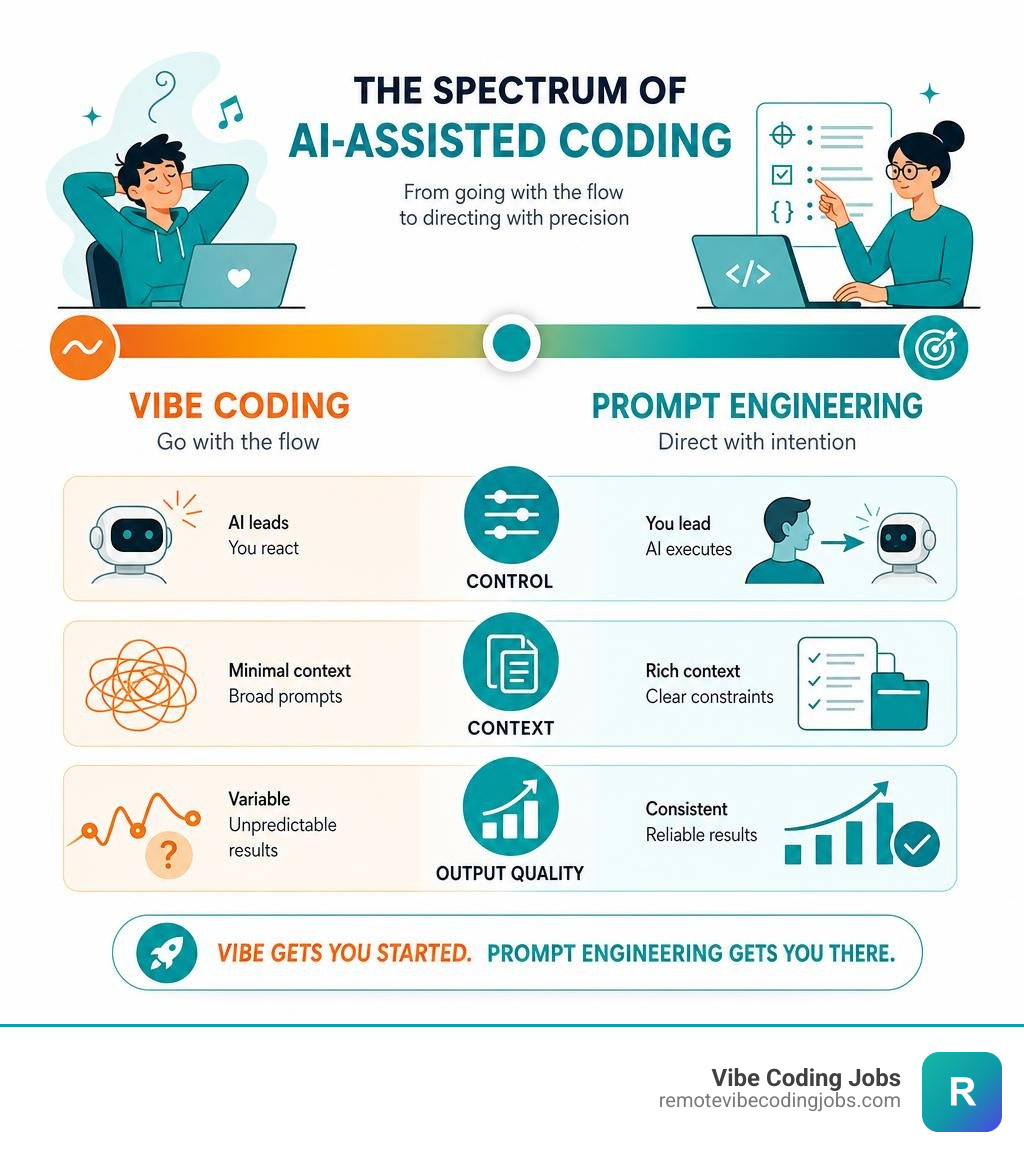
When we look at how professionals build software in 2026, we do not see a binary split between “old school” manual typing and “new school” magic generation. Instead, we see a spectrum. On one end, you have pure vibe coding—typing a loose sentence into an LLM and hitting run. On the other end, you have highly structured prompt engineering, which resembles software architecture and technical specifications.
As highlighted in the Vibe Coding vs Prompt Engineering: Future of AI Interaction – Rocket breakdown, the core differentiators are control and context.
When you vibe code, you delegate context-gathering to the AI model. You provide a minimal starting point and let the model make assumptions about dependencies, state management, and error routing. When you engineer your prompts, you explicitly define those boundaries upfront.
Understanding this spectrum is critical if you want to know Is Vibe Coding Legitimate? The Future of Software Development. It is absolutely legitimate, but only when you know when to slide from “vibe” to “spec.”
What is Vibe Coding and How Does It Differ From Traditional Development?
In traditional software development, the developer’s primary bottleneck is syntax, logic translation, and API integration. You write every line of code, run it, hit an error, read the stack trace, and manually refactor.
In a vibe coding workflow, the developer shifts from being the writer to the reviewer. You describe your functional intent in natural language, and the AI agent (whether it is Cursor Composer, Claude Code, or Windsurf) does the heavy lifting. As detailed in the essay on Vibe Coding as a software engineer, vibe coding means your unit of work is the behavior rather than the function. You accept changes based on execution (“does it work?”) rather than line-by-line review.
While this allows a single builder to ship features at unprecedented speeds, it fundamentally changes how we think about code ownership. If you do not understand the underlying architecture because you “vibed” it into existence, you are accumulating technical debt at a rate traditional tools could never match.
Why Prompt Engineering Vibe Coding Requires a Conductor Mindset
To bridge the gap between fast prototyping and production-ready applications, we must adopt what we call the Conductor Mindset. You are no longer the violinist; you are leading the orchestra.
According to the Prompt Engineering for Vibe Coding – Blockchain Council, this mindset requires you to step into five distinct roles:
- Vision Holder: You must clearly understand what the software needs to accomplish and how it should feel to the end user.
- Intent Communicator: You translate user experience and business logic into precise instructions.
- Quality Guardian: You verify that the generated code is secure, clean, and performant.
- Context Provider: You supply the AI with the right files, system rules, and API documentation.
- Iterative Refiner: You guide the AI through step-by-step improvements rather than asking for massive, all-at-once code dumps.
Structuring the Perfect Prompt for Production-Ready Code

If you treat an AI model like a magic wand, you will get unpredictable results. If you treat it like an incredibly fast, slightly forgetful junior developer, you will get production-ready code. The secret lies in how you structure your prompts.
Instead of writing a vague request like “build me a dashboard,” we recommend structuring your prompts like a creative brief. This approach is highly emphasized in From Vibe Coding to Engineering: Building a Production-Ready …. When you provide explicit constraints, the AI does not have to hallucinate solutions.
For those just starting, our Vibe Coding with AI: A Beginner’s Practical Guide (2026) outlines how to gradually build up from casual prompts to structured templates.
The Core Components of an Effective Code Generation Prompt
According to the comprehensive vibecoding/prompt-engineering-guide.md at main – GitHub, an effective production-grade prompt should include:
- Context Setting: Define the tech stack, library versions (e.g., Next.js 15, Tailwind CSS v4), and existing files.
- Role & Persona Assignment: Tell the AI who it is (e.g., “You are a senior security engineer auditing a Node.js API”).
- Objective Statement: A clear, concise description of what the code must accomplish.
- Constraint Specification: Explicit rules on what not to do (e.g., “Do not use ‘any’ types,” “Do not hardcode API keys,” “Do not import external UI libraries”).
- Negative Examples: Show patterns you want to avoid, such as inline styling or unsafe SQL queries.
- Visual & Quality Expectations: Specify accessibility requirements (ARIA attributes) and responsive design breakpoints.
The Role of Context Setting and Memory Banks in AI Development
AI models do not have long-term memory across independent chat sessions. If you do not manage your context window, your project will suffer from “prompt drift”—where the AI starts forgetting previously established rules, leading to broken layouts and duplicate functions.
To solve this, we rely on a Memory Bank system. As detailed in the README.md at main · EnzeD/vibe-coding framework, you should maintain a dedicated folder (such as .memory-bank/ or .clinerules) containing markdown files that document:
tech-stack.md: Explicit versions of all libraries in use.system-architecture.md: How different parts of the application communicate.progress.md: What features are completed, in progress, or planned.active-context.md: What you are working on right now.
By feeding these files to your AI agent at the start of every session, you keep the context pristine and prevent the agent from making destructive architectural changes.
The Iterative Prompt Cycle and Debugging Workflows
Building software with AI is not a one-shot transaction. It is an ongoing dialogue. If you try to generate a complete application in a single prompt, the model will likely hit its token limit, omit crucial logic, or hallucinate APIs.
We break this down into a structured cycle in The Ultimate Vibe Coding Workflow Guide. By working in small, testable loops, you can maintain perfect control over your codebase. If you are new to this iterative loop, we suggest walking through our Learn Vibe Coding: A Step-by-Step Tutorial to practice real-time refinement.
How the Iterative Prompt Cycle Works in Practice
To keep your codebase clean, adopt the prompt patterns outlined in Vibe Coding: The Complete Guide (2026) | SurePrompts:
- Set the Autonomy Ceiling: Before the AI writes code, tell it what files it is allowed to modify. (e.g., “Only modify components in
/components/ui/. Do not touch backend routes.”) - Ask for a Plan Before Code: For any change affecting more than two files, demand a written plan first. Review the plan, make adjustments, and only then give the green light to write code.
- Demand the Minimum Diff: Instruct the model to only output the exact lines of code that need to change. This prevents the AI from rewriting perfectly fine surrounding code and introducing accidental bugs.
- Request a Rollback Path: Always ask: “If this change breaks our build, what git commands or file reverts should I run?”
Best Practices for Debugging and Refining AI-Generated Code
When an AI-generated script throws an error, the instinct for many vibe coders is to simply paste the error and type “fix this.” This is a recipe for endless loops of broken code.
Instead, follow the advice from Vibe Code Like You Mean It – Michael J. Jabbour:
- Use Dual Tabs: Keep one AI session open for high-level planning and architectural advice, and a separate session (or terminal agent) for direct code execution.
- Provide the Full Stack Trace: Don’t just paste the error message. Provide the terminal command, the full error stack, and the relevant file context.
- Ask for Explanations: Before accepting a bug fix, ask the AI: “Why did this error happen, and how does your proposed fix solve it?” This keeps you in the driver’s seat and prevents “code blindness.”
Mitigating Risks: Pitfalls of Pure Vibe Coding
Vibe coding is incredibly fun. It feels like magic when a complex feature appears on your screen in seconds. But shipping unverified AI code directly to production is incredibly risky.
As analyzed in Vibe Coding Risks: 5 Hidden Threats in AI-Built Apps (2026), pure vibe coding without prompt engineering boundaries leads to structural rot. Because the AI has no “mental ownership” of the application, it will solve individual prompts in isolation, often creating duplicate functions, introducing outdated dependencies, and ignoring basic security protocols.
Balancing Prompt Engineering Vibe Coding Across Different Project Types
How you balance these two approaches depends entirely on what you are building:
- Throwaway Scripts & API Exploration: Lean heavily into vibe coding. If you just need a quick Python script to parse a CSV or test a third-party API, let the AI run wild. There is no need for deep architectural planning.
- Internal Tooling & MVPs: Use a hybrid approach. Vibe the UI components using tools like v0 or Lovable, but use structured prompts to define data storage and state management.
- Production Systems, Auth, and PII: Lean 100% into prompt engineering. When dealing with user passwords, database connections, or financial transactions, you must write highly constrained prompts, review every single diff, and run comprehensive manual tests.
How Prompt Engineering Prevents Code Blindness and Security Flaws
Code blindness occurs when a developer accepts large AI-generated pull requests without actually understanding what the code does. This is how major vulnerabilities slip into production.
To protect your applications, use prompt engineering to enforce these guardrails:
- Ban Hardcoded Secrets: Include a rule in your system prompts: “Never write raw API keys or database credentials. Always use environment variables and reference a
.env.examplefile.” - Prevent SQL Injection: Force the AI to use parameterized queries or trusted ORMs.
- Mandate Authentication Checks: Ensure every API route prompt explicitly requires verification of JWTs or session cookies before processing data.
- Run Dependency Audits: Periodically run
npm auditorpip-auditto ensure the AI hasn’t imported package versions with known security exploits.
Frequently Asked Questions about Prompt Engineering and Vibe Coding
Is vibe coding safe to use for production applications?
Only if it is accompanied by strict prompt engineering, developer code reviews, and automated testing. Pure vibe coding—where you accept and deploy AI code without looking at the diffs—frequently introduces security vulnerabilities (like SQL injections and hardcoded secrets) and massive technical debt. Treat AI-generated code as a draft that requires expert sign-off before hitting production.
Do I need to know how to code to be a successful vibe coder?
While you do not need to be a master of syntax, having a solid grasp of programming fundamentals (how databases work, what an API is, basic frontend state) makes you infinitely more effective. The better you understand software architecture, the better prompts you can write, and the easier it is to spot when the AI is hallucinating or writing insecure code.
What are the best tools for vibe coding in 2026?
The landscape is split into three main categories:
- Agentic IDEs: Cursor and Windsurf are top choices for developers who want full code ownership and deep terminal integration.
- App-Generation Platforms: Platforms like Lovable, Bolt.new, and Vercel v0 are excellent for rapid prototyping and non-technical builders.
- Command Line Agents: Terminal-based tools like Claude Code and Codex CLI offer incredible speed and precise context control for multi-file edits.
Conclusion: Elevate Your Career in the AI Era
The transition from writing syntax to directing AI is not a threat to software engineers—it is an incredible career evolution. Companies are no longer looking for developers who simply type code; they are looking for AI-fluent professionals who can architect systems, design robust prompts, and guide autonomous agents to build secure, scalable software.
At Remote Vibe Coding Jobs, we curate daily remote opportunities at forward-thinking, async-first companies that actively encourage the use of advanced AI tools. Whether you excel at high-level system design or structured prompt engineering, your skills are in higher demand than ever.
Ready to take the next step in your career?
- Read our guide on How to Get a Vibe Coding Job to stand out to top remote employers.
- Compare how your skills stack up against traditional roles by exploring our resource on how to Explore Vibe Coding vs Traditional Careers.