
AI Enhanced Coding Careers Are Rewriting the Rules of Software Development
AI enhanced coding careers are one of the fastest-growing segments in tech right now — and the opportunity looks very different from what software development looked like even two years ago.
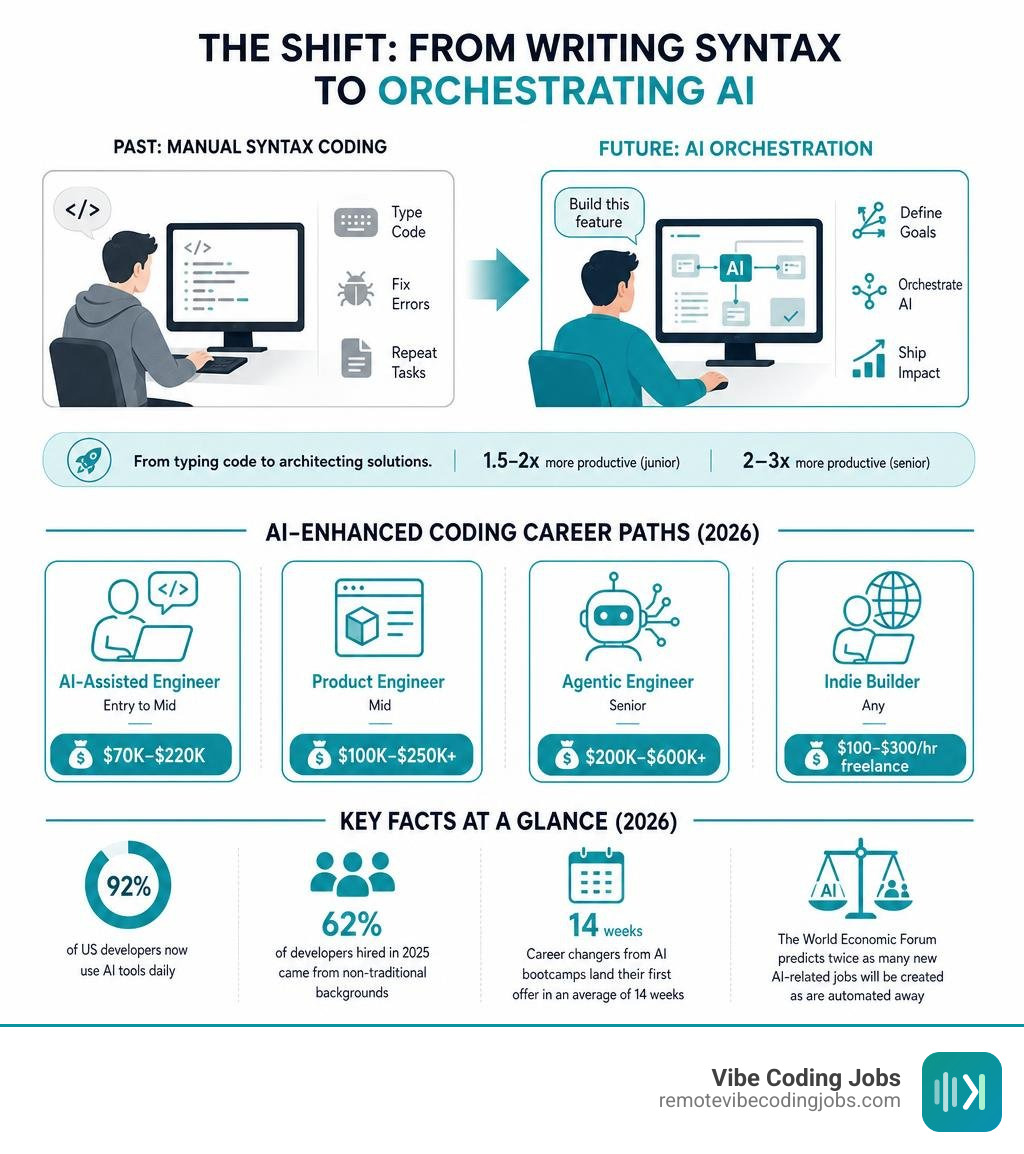
Here’s a quick snapshot of what you need to know:
| Career Path | Experience Level | Salary Range |
|---|---|---|
| AI-Assisted Engineer | Entry to Mid | $70K–$220K |
| Product Engineer | Mid | $100K–$250K+ |
| Agentic Engineer | Senior | $200K–$600K+ |
| Indie Builder | Any | $100–$300/hr freelance |
Key facts at a glance:
- 92% of US developers now use AI tools daily (as of 2026)
- 62% of developers hired in 2025 came from non-traditional backgrounds
- Career changers from AI bootcamps land their first offer in an average of 14 weeks
- The World Economic Forum predicts twice as many new AI-related jobs will be created as are automated away
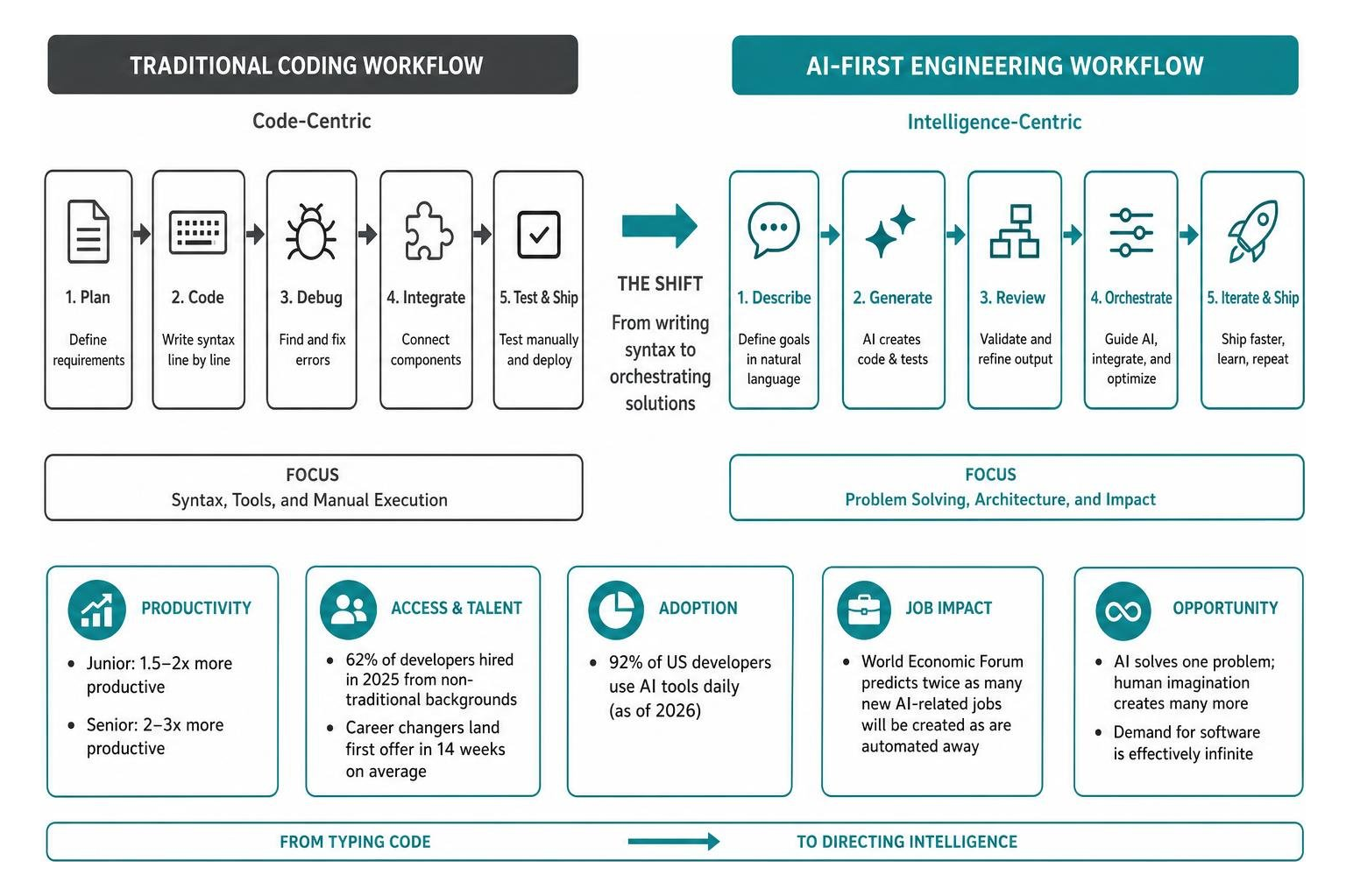
The shift isn’t subtle. AI tools like Cursor, Claude Code, and Bolt.new have moved the developer’s core job from writing syntax to directing AI — from typing code to architecting solutions. A junior developer with strong AI tooling is now 1.5 to 2x more productive than one without it. A senior developer with the same tools is 2 to 3x more productive.
As Stack Overflow puts it, this is less a threat and more a platform shift — similar in scale to the arrival of the internet or mobile computing. Every time AI solves one problem, human imagination conceives several new ones. The demand for software is, in that sense, effectively infinite.
This guide maps out every major AI-enhanced career path, what each one pays, and exactly how to break in — whether you’re a seasoned engineer or switching careers entirely.
I’m Di Su, a software engineer with over 10 years of experience across web development, conversion optimization, and scalable product building — and I’ve watched AI enhanced coding careers evolve from a niche concept into the dominant hiring trend in tech. My background bridging engineering and growth gives me a practical lens on what these career paths actually demand day-to-day.
AI enhanced coding careers terms to learn:
The Paradigm Shift: How AI is Reshaping Software Engineering
The software engineering landscape is going through a massive platform shift. Historically, we have seen similar monumental transitions: the emergence of the commercial internet in the 1990s, the mobile application boom in the late 2000s, and the migration to cloud computing. Each of these shifts caused initial panic about job security, yet each ultimately unlocked a massive wave of developer productivity and created millions of new jobs.
Today, AI is the new abstraction layer for developer knowledge. Just as compilers saved us from writing raw machine assembly language and search engines replaced bulky physical manuals, AI coding assistants are abstracting away the tedious, repetitive “grunt work” of manual syntax typing. By leveraging these tools, we are seeing a massive acceleration in product delivery times. For instance, building a REST API endpoint that used to require about 28 minutes of manual syntax lookup and boilerplate writing can now be specified, generated, and verified in just 12 minutes—a 57% reduction in development time.
However, this transition requires us to rethink our entire approach to building software. Rather than using AI as a simple passive auto-complete helper, the most successful engineers are designing their entire development workflow around AI from the start. This evolution is unlocking massive AI-Assisted Development Career Opportunities and Benefits for those who learn to work alongside these systems rather than resisting them.
The Rise of AI Enhanced Coding Careers
As natural language interfaces become the primary way we interact with code, the concept of “vibe coding” has transitioned from a social media meme into a legitimate, formalized development approach. Vibe coding refers to using generative AI tools to describe the desired outcome or “vibe” of a program in plain natural language, letting the AI handle the heavy lifting of code generation while the human developer orchestrates the system.
This has opened up highly diverse Top Careers That Use AI-Assisted Coding – Campus.edu , democratizing software creation across fields that were previously locked behind steep technical barriers. We are now seeing “Vibe Coder” appear as an official, remote-friendly job title on modern job boards. Because these tools handle boilerplate code, database setups, and minor integrations effortlessly, professionals in non-technical roles—such as product designers, legal engineers, supply chain managers, and marketing leads—are using tools like Claude Code and Cursor to build their own internal automated tools, design interactive prototypes, and manage data pipelines without needing a formal computer science background.
How Industry Leaders View the AI Developer Demand
There is a common misconception that because AI can write code faster, companies will need fewer developers. However, industry data and thought leaders point to a phenomenon known as the “infinite demand for code.” Human ambition is rarely satiated; as soon as a technology solves one set of problems, our imagination conceives multiple new ones.
For example, organizations like CodeAI are actively expanding access to computer science education because they view AI and CS as foundational lenses for participating in a digital society, rather than just raw career prep. When looking at hiring, progressive organizations are adapting their policies to welcome candidates who use AI tools responsibly during recruitment. According to the Careers at CodeAI guidelines, employers are shifting toward evaluating an applicant’s honesty, integrity, and high-level problem-solving abilities over their ability to write memorized syntax under pressure. Human developers remain absolutely essential for defining the problems, setting strategic directions, ensuring security, and making high-level architectural decisions that AI simply cannot navigate.
The Four Career Paths in the Age of Vibe Coding
The traditional linear engineering career ladder—which strictly ran from junior developer to mid-level, senior, and eventually staff engineer—has collapsed. Historically, the senior engineer bottleneck existed because it took years of syntax memorization to write reliable, production-ready code. Today, AI tools compress this learning curve, allowing junior developers to achieve massive productivity gains.
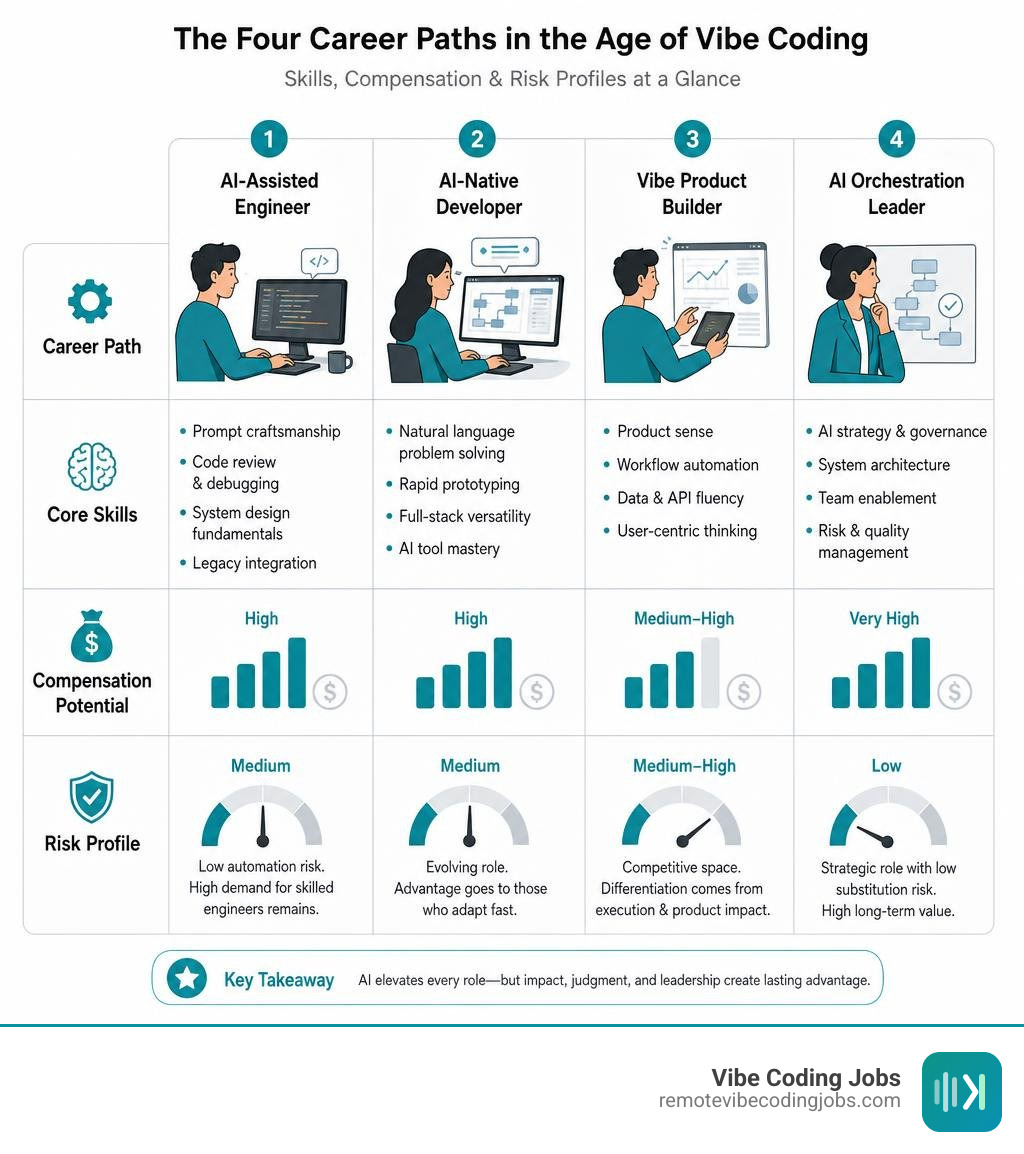
To navigate this new landscape, we must understand the four distinct career paths that have emerged in 2026. Each path carries a different risk profile, compensation potential, and skill requirement. For a detailed breakdown of how these tracks are reshaping modern tech, you can read more about the Career Paths in the Age of Vibe Coding and AI Tools 2026 – How AI coding tools are reshaping the engineering career ladder, and the four paths that emerged when the senior bottleneck disappeared — Vibe Coder Blog .
The AI-Assisted Engineer
The AI-Assisted Engineer represents the evolution of the traditional software developer. These are professionals who work within established engineering teams, using AI tools daily to accelerate their output and improve code quality.
- Role & Workflow: They focus on writing clean prompts, reviewing AI-generated pull requests with high scrutiny, and integrating AI capabilities into existing legacy codebases.
- Productivity: A junior on this path is 1.5x to 2x more productive, while a senior is 2x to 3x more productive.
- Compensation: In 2026, mid-level AI-assisted engineers command salaries between $130,000 and $220,000, while senior engineers earn between $220,000 and $380,000.
- Opportunities: If you are looking for roles that offer high stability and strong remote benefits, check out AI-Assisted Development Careers: Remote Opportunities to find companies hiring for these exact skill sets.
The Product Engineer
Product Engineers are highly user-centric builders who sit at the intersection of product management, design, and software engineering. Because AI handles the heavy lifting of backend boilerplate, these developers spend their time focusing on product logic, user experience, and rapid prototyping.
- Role & Workflow: They use design-to-code platforms and automated workflow tools to turn a product concept into a fully functional, deployed web application in days instead of months.
- Skills: They prioritize empathy for the user, critical design judgment, and rapid iteration.
- Compensation: Typically earning between $100,000 and $250,000+, they are highly sought after by fast-moving startups.
- Market Trends: To understand how the market is shifting toward these hybrid, product-focused roles, explore our guide on Vibe Coding Careers: Remote Job Market, Skills, and Growth.
The Agentic Engineer
Agentic Engineers represent the cutting edge of AI-first development. Instead of just using AI to help them write code, they build complex systems where autonomous AI agents collaborate to execute tasks, run tests, and deploy software with minimal human intervention.
- Role & Workflow: They design agentic architectures, manage multi-agent orchestration frameworks (such as LangGraph), and implement strict safety and verification logic to keep autonomous agents from going off the rails.
- Compensation: This is one of the highest-paying tracks in tech, with compensation ranging from $200,000 to $600,000+ at frontier labs and top-tier tech companies.
- Transitioning: If you want to move from traditional software engineering to managing autonomous systems, read our deep dive on going From Writing Code to Managing Agents: A New Developer Career Path.
The Indie Builder
The Indie Builder path represents the ultimate expression of developer autonomy. With AI tools handling everything from frontend design to database scaling, a single developer can now operate with the output capacity of an entire traditional startup team.
- Role & Workflow: These are solo founders and freelancers who build, launch, and monetize software-as-a-service (SaaS) MVPs, Chrome extensions, and custom business tools completely on their own.
- Freelance Rates: Freelance vibe coders on this path frequently charge $100 to $300 per hour due to their ability to deliver working software up to 10x faster than traditional development agencies.
- Risk & Reward: While it carries the highest risk and lacks a guaranteed corporate salary, the upside of owning 100% of a profitable, AI-built product is unmatched.
Is a Computer Science Degree Still Worth It in 2026?
With generative AI writing functional code from simple English prompts, many students and aspiring developers are asking a tough question: Is it still worth studying computer science?
The short answer is yes—but the way we must study and apply computer science has changed forever.
Historically, computer science enrollments have gone through cyclical dips, particularly after major economic downturns like the dot-com bust or the Great Recession, only to rebound stronger as new technologies emerged. Today, computing remains the absolute foundation for AI and all emerging technologies. However, a recent Study: AI is already erasing entry-level coding jobs highlights that traditional, routine programming jobs—where a junior developer is hired simply to write repetitive boilerplate code or basic CRUD APIs—are rapidly disappearing.
Employers no longer want to pay for raw syntax typing. Instead, they are looking for graduates who combine deep academic foundations with the ability to orchestrate AI tools effectively.
Navigating the Junior Developer Dilemma
This shift has created what we call the “Junior Developer Dilemma.” If AI handles all the entry-level, routine coding tasks, how do junior developers build the foundational skills needed to become senior engineers?
The key is shifting the focus of learning from syntax memorization to technical judgment. In the AI era, junior developers do not need to spend weeks memorizing the exact syntax of a programming language. Instead, they can use AI as a patient, always-available 1-on-1 tutor that explains complex concepts, catches errors, and guides them step-by-step.
To build true technical judgment, juniors must focus on:
- Code Reading: Reading and critically analyzing AI-generated code rather than blindly accepting it.
- System Architecture: Learning how different databases, APIs, and services connect and scale.
- Debugging and Testing: Understanding how to write comprehensive test suites to verify that the AI’s output is secure and performant.
Will Entry-Level Programming Jobs Disappear?
While the U.S. Bureau of Labor Statistics anticipates a slight drop in traditional “computer programmer” titles—predicting a decline from 139,000 to 126,000 jobs over the next decade due to automation—overall demand for software developers is actually exploding. The BLS expects more than 140,000 open software developer roles to be created over the next 10 years.
The jobs are not disappearing; they are simply evolving. An entry-level developer who refuses to use AI will struggle to find work. However, an entry-level developer who masters AI-native IDEs and prompt engineering is 1.5 to 2x more productive than a traditional junior, making them incredibly valuable to modern engineering teams.
High-Paying AI Enhanced Coding Careers and Essential Skills
For those who develop deep expertise in AI-assisted development, the financial rewards in 2026 are substantial. The market has established clear, premium compensation ranges for specialized AI engineering roles:
- Artificial Intelligence Engineer: Median entry-level salary starts at $123,000, with top performers earning up to $192,000.
- Machine Learning Engineer: Entry-level starting salary averages $123,000, with the top 10% commanding $204,000+.
- Deep Learning Engineer: Entry-level compensation starts at $149,000, with the top 10% reaching $253,000+.
To command these top-of-market salaries, we must transition our daily workflows away from traditional manual coding practices. As outlined in the guide AI-First Development — Rethinking How You Build Software | Kemal Codes , this transition is not about using AI as a simple helper; it is about designing our entire system architecture and testing strategies around AI capabilities.
Core Skills for AI Enhanced Coding Careers
When AI is writing the raw code, our value as human developers shifts to higher-order cognitive and engineering skills. The essential skill stack for an AI-first developer includes:
- Context Engineering: Knowing how to structure and feed the right context (such as writing specialized
.cursorrulesorCLAUDE.mdfiles) to an AI model. Providing high-quality context can swing an AI’s code generation success rate from a mediocre 42% to an impressive 78%. - Prompt Decomposition: The ability to break down a large, complex software requirement into small, logical, and prompt-friendly steps that an AI can execute without generating “spaghetti code.”
- Critical Code Review: Reviewing AI-generated pull requests with a highly skeptical eye, specifically checking for security vulnerabilities, repeated incorrect patterns, and performance bottlenecks.
- System Architecture & Integration: Understanding how to connect different open-source models, databases, and APIs using modern standards like the Model Context Protocol (MCP).
- Testing and Validation: Implementing robust automated testing frameworks to ensure that the code generated by AI is reliable before it is ever shipped to production.
How Career Changers Can Break Into AI-First Development
One of the most exciting aspects of the AI revolution is that it has leveled the playing field. In 2025, 62% of all newly hired developers came from non-traditional backgrounds—including self-taught builders and career changers who did not possess a formal computer science degree.
If you have zero prior coding experience, AI tools act as a powerful accelerator. Instead of spending years struggling to understand complex syntax, you can enroll in specialized programs like the Career Change to AI Developer — No Experience Needed | CodeLeap | CodeLeap AI Bootcamp to learn how to orchestrate AI tools, build production-ready SaaS MVPs, and manage autonomous agent systems in a fraction of the traditional time.

From Non-Technical to AI Developer: Timeline and Salary Potential
The transition from a non-technical background to a job-ready AI developer is remarkably fast when leveraging AI-native workflows:
- Transition Timeline: Beginners typically take 3 to 6 months to become proficient, while some intensive bootcamps can get dedicated students job-ready in as little as 8 to 12 weeks.
- Job Search Speed: The average time for an AI bootcamp graduate to receive their first formal developer job offer is just 14 weeks.
- Starting Salary: The median starting salary for career changers who completed an AI-focused coding bootcamp in 2025 was $85,000.
To accelerate this transition, career changers can leverage interactive, terminal-based career coaching tools. For example, the ayush488-glitch/ai-career-planner-skill is a custom Claude Code skill that runs an interactive 15-question intake process to generate a brutally honest, personalized 6-month roadmap to land a $100K AI-enhanced role. This framework emphasizes building high-value architectural skills, establishing a personal brand on LinkedIn, and executing targeted outreach campaigns to land high-paying roles.
Frequently Asked Questions about AI Coding Careers
Is vibe coding only for beginners, or can experienced developers benefit too?
Vibe coding and AI-assisted tools are incredibly powerful for developers at all skill levels. In fact, experienced developers benefit more than beginners. A senior developer’s deep understanding of system design, database indexing, security practices, and software architecture acts as a massive multiplier. While a beginner might use AI to generate simple scripts, an experienced engineer can use AI to automate boilerplate, write tests, and refactor legacy systems, achieving a 2x to 5x boost in productivity within their first month.
What are the best AI coding tools for getting started in 2026?
The modern AI coding ecosystem is rich and specialized. The most popular tools used by professional vibe coders in 2026 include:
- Cursor: A highly popular, context-aware code editor built on top of VS Code.
- Claude Code: A powerful command-line AI assistant that can read, write, and execute code directly in your terminal.
- Bolt.new & Lovable: Elite web-based tools designed for rapid, design-to-code prototyping and launching full-stack SaaS MVPs in minutes.
- Windsurf: A highly collaborative AI-native development environment.
Do I need to know how to code to become a vibe coder?
While AI tools lower the barrier to entry, having a basic grasp of programming fundamentals (such as variables, functions, loops, and data structures) is a massive advantage. Knowing these concepts allows you to write much more precise prompts, understand what the AI-generated code is doing, and effectively debug the system when the AI inevitably makes a mistake or “hallucinates.”
Conclusion
The rise of AI enhanced coding careers is not a threat to human developers—it is an invitation to dream bigger, build faster, and transition from a “code typist” into a true software architect.
At RemoteVibeCodingJobs, we curate and aggregate remote “vibe coding” (AI-assisted development) jobs at async-first companies that actively embrace this future. We filter listings by engineering culture, specific tech stacks, and the exact AI tools (like Cursor and Claude) that teams use daily. If you are ready to future-proof your career, you can explore the Remote Developer Jobs: AI Tools, Career Growth, and Companies that are actively hiring.
Whether you want to work as an AI-assisted engineer, a product engineer, or manage autonomous agents, the first step is to start building. Explore our curated directory of Vibe Coding Jobs and Remote AI Assistant Careers and grab our free playbook to kickstart your journey.
Ready to find your next remote role? Explore remote vibe coding opportunities on RemoteVibeCodingJobs today!