Find Better Remote Web Developer Jobs by Changing Where You Apply
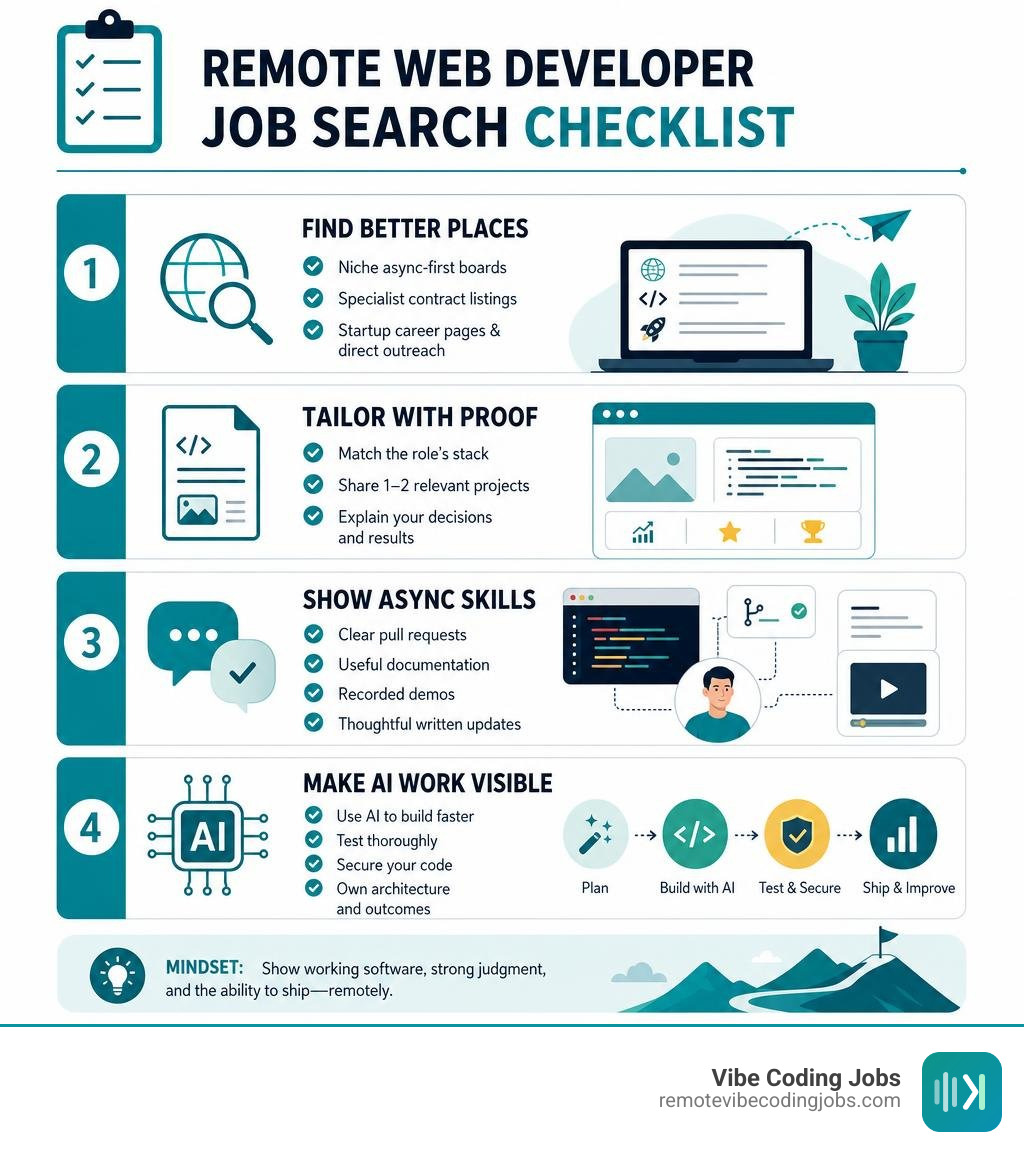
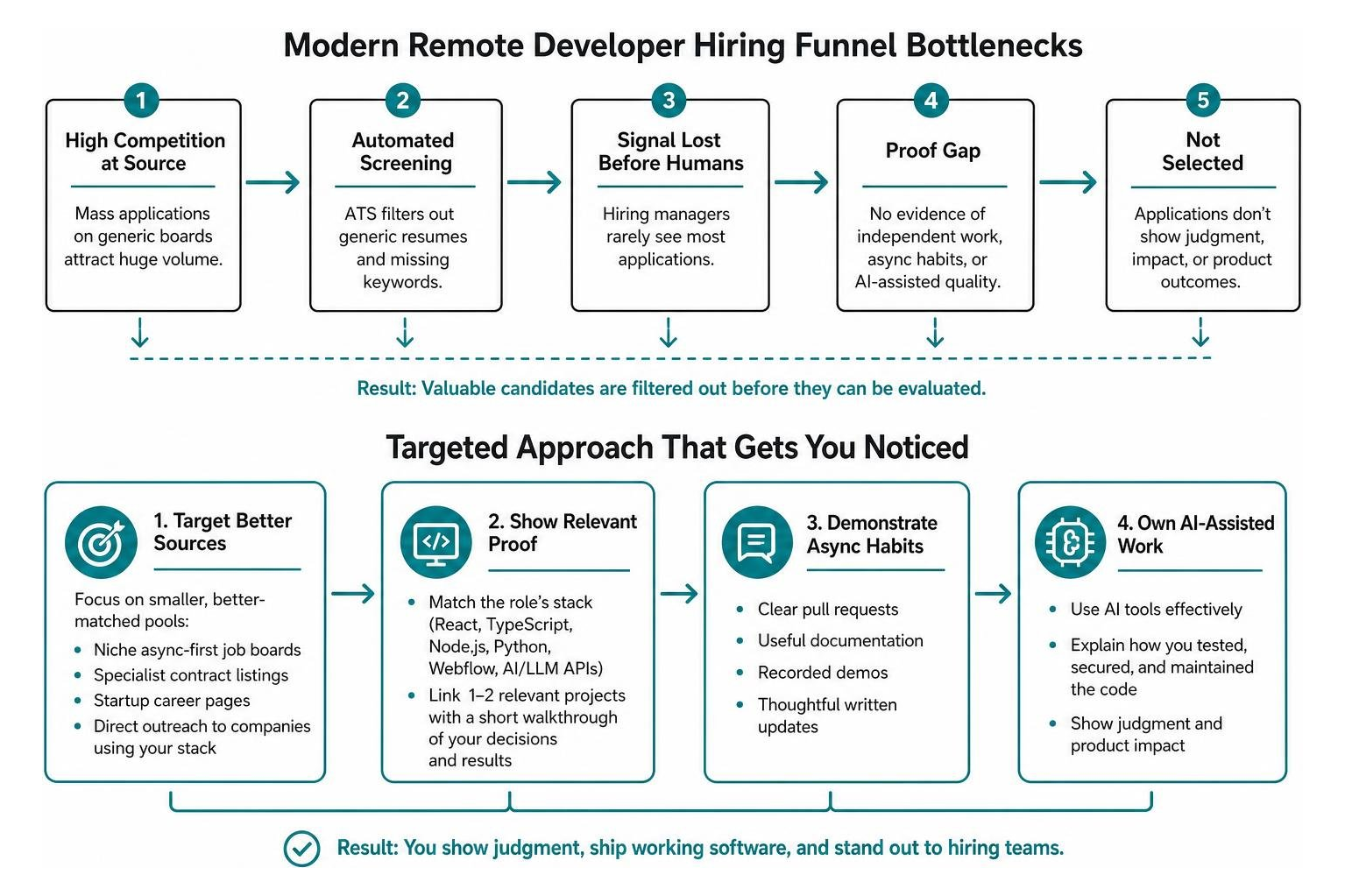
When remote web developer applications keep failing, do not send more of the same application. Target smaller, better-matched pools: niche async-first job boards, specialist contract listings, startup career pages, and direct outreach to companies using your stack.
Focus each application on proof that you can work independently:
- Match the role’s stack, such as React, TypeScript, Node.js, Python, Webflow, or AI/LLM APIs.
- Link to one or two relevant projects, with a short walkthrough of your decisions and results.
- Show async habits: clear pull requests, useful documentation, recorded demos, and thoughtful written updates.
- Make AI-assisted work visible, but explain how you tested, secured, and maintained the code.
The market is crowded, and automated screening can reject generic resumes before a hiring manager sees them. At the same time, many remote web developer jobs now expect developers to use tools like AI coding assistants while owning architecture, quality, and product outcomes. The good news: that creates a real advantage for candidates who can show working software and strong judgment, not just a long skills list.
I am Di Su, a software engineer with 10+ years of experience in web development, scalable product work, conversion optimization, and e-commerce growth. I have built high-traffic landing pages and production workflows, so I know what makes remote web developer jobs applications look credible to teams that need people who can ship.
Simple remote web developer jobs glossary:
Why Traditional Applications Fail in the Modern Hiring Landscape
Sending hundreds of standard resumes into generic job portals has become an exercise in futility. With remote web developer listings on major platforms climbing rapidly, application volume has exploded. A single posting on general boards can attract over a thousand submissions within 48 hours.
When you apply through high-traffic aggregators with a generic PDF, your application enters an automated Applicant Tracking System (ATS) designed to eliminate candidates rather than discover them. Algorithms discard resumes for missing minor keyword variants, while hiring teams become exhausted by boilerplate applications generated in bulk.
Understanding how to navigate modern remote career paths means recognizing that standard portfolios—like basic to-do apps or clone sites—no longer work. In 2026, engineering leads look for evidence of autonomous execution, live production experience, and clear communication.
The Shift from Ticket-Takers to Problem Solvers
Engineering teams no longer hire remote developers just to close tickets. With modern automation handling routine boilerplate, distributed teams need autonomous problem solvers who understand product objectives and system architecture.
Hiring managers want to see that you can take ambiguous requirements, design modular solutions, and ship without constant supervision. Exploring emerging vibe coding career trends shows how the modern remote developer’s value has shifted toward higher-level architecture ownership, technical SEO rigor, and direct business impact.
ATS Fatigue and the Rise of Proof-of-Work Screening
Because automated screening tools have saturated hiring pipelines with false positives, forward-thinking engineering leads now rely on proof-of-work screening:
- Interactive Walkthroughs: Short, 3-minute recorded videos explaining why you structured an API or component tree a certain way.
- Production Codebases: Clean, publicly accessible repositories containing robust automated testing suites, continuous integration setups, and descriptive commit histories.
- Working Deployments: Live, accessible web applications solving real business use cases, such as custom CMS setups or multi-tenant architectures.
The Best Channels to Uncover Hidden Remote Web Developer Jobs

If applying on massive platforms leads to automated rejection emails, changing your acquisition channel changes your results. You can review broad market aggregations to benchmark requirements, but landing offers quickly requires targeting high-intent, specialized sources.
Niche Async Boards and Communities for Remote Web Developer Jobs
Async-first companies prioritize clear written communication and documented workflows over rigid office hours. They hire globally and pay based on impact rather than physical desk location.
For instance, international startups often post high-impact roles directly on dedicated career pages, such as lead web engineering opportunities offering up to 10,000 EUR per month with equity participation. Similarly, distributed teams regularly list competitive roles offering $75,000 to $85,000 annually for full-stack developers. These listings value proven self-direction and clean async communication.
Specialized Contract Platforms and AI-Native Remote Web Developer Jobs
Specialized agencies and scaling digital brands frequently hire high-rate contract developers who possess specialized skills in performance marketing, dynamic CMS management, and AI tooling.
A clear example is this Webflow Developer at Ffg contract role paying $60 to $90 per hour. Roles like this require developers who can take Figma files, construct localized CMS architectures, integrate Cloudflare Workers, and use AI coding tools to script repetitive tasks. For engineers building full-stack products, roles like Remote Web App Developer – Build Impactful Digital Solutions demonstrate that organizations are ready to pay solid annual salaries (averaging $91,318) for developers who manage feature lifecycles end-to-end.
Startup Ecosystems and Direct Founder Pitching
Early-stage startups backed by venture capital or growing through customer revenue often bypass standard job boards entirely. Founders frequently look for agile builders who can wear multiple hats.
By analyzing future-proof developer opportunities, you can identify startups actively expanding their tech stack. Reaching out directly to engineering leads with a tailored Loom review of their product’s performance or a prototype solving an open problem routinely cuts through the hiring queue.
Skills That Turn Rejected Applications into Offers

Landing interviews in today’s remote environment requires balancing foundational software engineering with modern acceleration tools.
Employers looking for developers prioritize strong fundamentals:
- TypeScript Fluency: Writing end-to-end type-safe code that reduces runtime exceptions across distributed codebases.
- Component Architecture: Building modular, reusable design systems that cross-functional teams can safely consume.
- State Management & APIs: Designing resilient REST and GraphQL integrations with robust error boundaries, caching layers, and optimistic UI updates.
Staying ahead means tracking high-demand React ecosystem roles that emphasize server components, performance optimization, and clean data fetching patterns.
Leveraging AI Workflows and Vibe Coding Tools
AI-assisted coding is now standard practice across remote teams. Postings regularly specify daily use of tools like Cursor, Claude Code, and GitHub Copilot to accelerate delivery.
Mastering AI-driven vibe coding allows you to prototype applications quickly, automate data migrations, and script complex tasks. The differentiator is your engineering judgment: verifying security boundaries, writing comprehensive test suites, and refactoring AI-generated code to prevent technical debt.
Async Communication and Written Documentation
In an async-first company, your writing is your presence. Distributed engineering managers value clear documentation as much as clean code:
- Descriptive Pull Requests: Explaining the why behind architectural choices, linking relevant issue trackers, and attaching visual proofs of UI changes.
- RFC Proposals: Drafting concise Requests for Comments (RFCs) that outline system trade-offs before writing a single line of backend logic.
- Disciplined Asynchronous Updates: Using tools like ClickUp, Slack, and Jira to provide actionable status reports across time zones without requiring real-time meetings.
Remote Web Developer Compensation and Contract Benchmarks
Remote compensation models vary based on engagement type, specialization, and engineering level. Reviewing comprehensive senior engineer salary benchmarks helps you evaluate opportunities accurately across the market.
| Role Type | Typical Rate / Salary Range | Primary Work Focus | Key Requirements |
|---|---|---|---|
| Part-Time / Retainer Developer | $2,000 – $5,000 / month | Specialized tool refactoring, feature maintenance | JavaScript/TypeScript, computational logic, independent delivery |
| Specialized CMS / Webflow Developer | $60 – $90 / hour | Multi-market builds, localization, technical SEO | Figma-to-Webflow mastery, custom scripting, API hooks |
| Full-Time Remote Web App Developer | $75,000 – $110,000 / year | End-to-end product features, CI/CD, UI/UX optimization | Modern JS/TS frameworks, cloud integrations, async workflow |
| Lead / Senior Product Engineer | $120,000 – $180,000+ / year (or up to €10k/mo) | Architecture direction, platform infrastructure, team guidance | System architecture, monorepos, AI tooling workflows |
| AI Data Trainer & Annotation Specialist | $50 – $100 / hour | Evaluating LLM code generation, reviewing complex logic | Full-stack debugging, multi-language fluency, testing rigor |
Full-Time vs. Freelance and AI Training Roles
Contract and freelance positions offer high hourly flexibility, with specialized roles reaching $60 to $90 per hour. For developers seeking flexible schedules, AI training roles evaluating code generated by Large Language Models pay between $50 and $100 per hour. Full-time remote web application developer roles offer stable annual salaries averaging $91,318 to over $150,000 for senior positions, often paired with equity participation, flexible schedules, and hardware stipends.
Frequently Asked Questions About Remote Web Development
Why are my remote web development applications getting rejected without an interview?
Most rejections happen when applications lack tailored proof of impact. Submitting standard resumes to high-volume job boards exposes you to aggressive ATS filters. To improve response rates, include links to live production codebases, write clear project walkthroughs, and highlight your experience with async collaboration and AI-assisted workflows.
What tech stacks are most in demand for remote web developers in 2026?
TypeScript combined with modern React frameworks (such as Next.js and Astro) remains dominant. Backend proficiency with Node.js, Python (FastAPI), serverless architectures, and SQL/NoSQL databases is highly valued. Additionally, developers who integrate AI/LLM APIs and utilize agentic development tools are seeing higher interview conversion rates.
How do I demonstrate async-first communication skills to remote employers?
Highlight async habits in your portfolio and cover notes. Share links to public repositories featuring detailed pull request descriptions, clear README files, and documented architecture decisions. Demonstrating how you organize tasks in tools like ClickUp, Notion, and Jira proves you can ship independently across time zones.
Conclusion
Application fatigue ends when you stop competing in crowded, generic hiring queues. By moving toward specialized async job boards, pitching directly to founders, and showcasing AI-augmented workflows, you set yourself apart from the standard applicant pool.
At RemoteVibeCodingJobs, we curate daily listings from async-first companies that value AI-native development, clean architecture, and independent problem-solving. Explore our curated remote job platform to find your next remote role.