
The Ultimate Guide to Finding Web Developer Remote Part-Time Gigs
More Remote Part-Time Web Developer Roles Are Available Than You Think
If you’ve been searching for a remote part time web developer role that fits around your life — not the other way around — the good news is the market is bigger than it looks.
Quick answer: Where to find part-time remote web developer jobs right now
| Platform | What You’ll Find | Best For |
|---|---|---|
| 3,000+ remote web dev listings, 22 part-time filtered | Salaried/contract roles | |
| Vibe Coding Jobs | AI-native and async-first remote roles | AI-assisted dev gigs |
| Direct Company Sites | Niche stack roles, .NET, Shopify, full-stack | Direct applications |
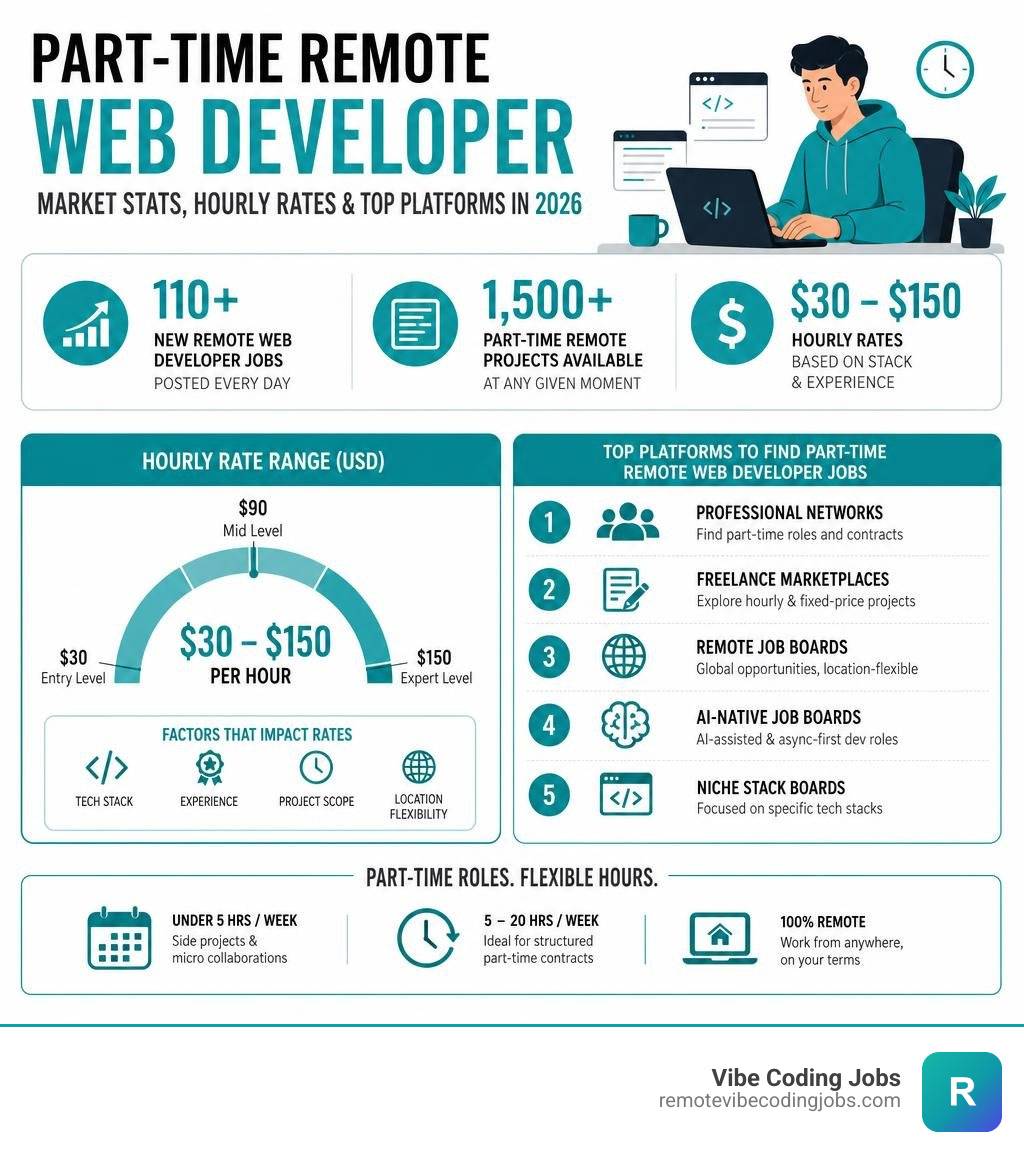
The market in June 2026 is active. Over 110 new remote web developer jobs are posted every single day, and platforms list more than 1,500 part-time remote projects at any given moment. Part-time arrangements range from under 5 hours per week for side collaborations all the way to 20-25 hours per week for structured contract roles — with hourly rates spanning $30 to $150/hr depending on your stack and experience.
Whether you want to supplement a full-time income, ease into freelancing, or simply protect your time while staying sharp on modern tools, part-time remote development is a legitimate and growing path in 2026.
I’m RVCJ Editorial, the team behind Vibe Coding Jobs — we track AI-assisted development hiring, async-first remote teams, and the tools and trends shaping how developers find remote part time web developer work globally. Below, we break down exactly how to find, land, and thrive in these roles.
Remote part time web developer vocabulary:
- remote ruby on rails jobs part time
- ruby on rails jobs freelancer
- remote node js developer jobs
The Landscape of Remote Part Time Web Developer Roles in 2026

The remote part-time web development landscape has shifted dramatically over the last few years. Companies are moving away from rigid, full-time-only hiring models. Instead, they are embracing flexible, specialized talent to handle specific product features, maintenance tasks, or rapid prototyping cycles.
As a remote part time web developer, you can choose to specialize in several distinct areas depending on your expertise and interests:
- Frontend Development: Focusing on user interfaces, accessibility, and interactive features. This is perfect if you love polished UI/UX and want to work with modern web ecosystems. There is a high volume of part-time roles for specialists in Remote React Developer Jobs and Remote TypeScript Developer Jobs.
- Backend Development: Managing servers, databases, and core application logic. Backend-heavy frameworks and languages remain highly sought after for database optimizations and API development, creating constant demand within Remote Python Developer Jobs.
- Full-Stack Development: Combining frontend and backend skills to build and maintain end-to-end features. Many startups look for part-time full-stack generalists who can jump in and solve issues across the entire stack without needing a massive full-time team.
In-Demand Skills for a Remote Part Time Web Developer
To land a high-paying part-time role, you need to align your skill set with what companies are actively hiring for. In 2026, several key areas dominate the job listings:
- E-Commerce Platforms (Liquid & Shopify): E-commerce brands frequently hire part-time developers to customize themes, build custom integrations, and optimize page load speeds. For instance, many e-commerce teams actively recruit part-time Shopify developers, highlighting how critical skills in Liquid, HTML, CSS, and JavaScript are for their success. You can find similar listings via Remote Shopify Developer Jobs.
- Enterprise and SaaS Ecosystems (.NET & Java): Startups in HR, finance, and logistics often build their platforms on robust backends. A great example of this is the demand for remote .NET developers, where companies require professional experience to build, test, and deploy robust .NET applications. Check out Remote .NET Developer Jobs for more opportunities.
- API Integrations and Backend Architecture: Many part-time roles focus purely on connecting services, writing REST or GraphQL APIs, and managing databases. Whether you write Node.js, Python, or Ruby, knowing how to securely handle data flow and authentication is a massive competitive advantage.
How to Position Yourself as a Remote Part Time Web Developer
In a part-time hiring process, employers want to see that you can hit the ground running with minimal hand-holding. They don’t have time for extensive onboarding, so your positioning must scream efficiency.
- Curate a Highly Relevant Portfolio: Instead of a generic resume, showcase real-world web applications you have shipped. If you specialize in interactive single-page applications, highlight your work in Remote Vue Developer Jobs or display full-stack MVPs you’ve built from scratch.
- Highlight AI-Assisted Builds (Vibe Coding): Modern companies love developers who know how to build fast. If you use AI coding assistants like Cursor, Claude Code, GitHub Copilot, or Windsurf to accelerate your boilerplate generation and debugging, make it known! Showing that you can deliver 2x the output in half the time makes you an incredibly attractive part-time hire. You can find many of these roles under Remote Fullstack Developer Jobs.
- Provide Clean GitHub Repositories: Employers look at your code structure, commit history, and documentation. Include brief
README.mdfiles that explain how to run your projects locally. This shows professionalism and structured thinking.
Compensation, Hours, and Contract Types for Part-Time Gigs
One of the biggest advantages of working as a remote part time web developer is the sheer variety of ways you can structure your working relationship. Depending on your personal goals and availability, you might find yourself in one of three main contract types:
| Contract Type | Typical Weekly Hours | Average Pay Structure | Best For |
|---|---|---|---|
| Freelance Gig | 5 to 15 hours (project-based) | Fixed-price or hourly ($30 – $100/hr) | Developers seeking maximum autonomy and project variety |
| Part-Time Contract | 10 to 25 hours (ongoing) | Hourly retainer ($50 – $150/hr) | Developers looking for stable income without full-time commitment |
| Part-Time Employee | 15 to 25 hours (structured) | Pro-rated salary ($75K+ pro-rated equivalent) | Developers wanting corporate stability, PTO, or wellness benefits |
Hourly Rates and Salary Expectations
Your earning potential as a part-time remote web developer depends heavily on your experience level, tech stack, and location.
- Entry-Level Developers: Typically earn between $30 and $50 per hour. These roles often focus on HTML/CSS updates, basic Shopify theme tweaks, or simple WordPress maintenance.
- Mid-Level Developers: Usually command $50 to $90 per hour. Developers in this tier are expected to handle complex frontend frameworks, API integrations, and robust database queries independently.
- Senior Developers & AI-Fluent Builders: Can charge $100 to $150+ per hour (and sometimes up to $300/hr for highly specialized consulting). Senior developers who leverage advanced AI-assisted workflows can build entire applications at lightning speed, making their high hourly rates incredibly cost-effective for employers.
To learn more about how to value your skills and negotiate the best rates, read our Vibe Coding Salary Guide Remote and explore our Remote Developer Salary Negotiation Tips Get Paid What You Are Worth. You can also compare active rates across different frameworks in the Remote Fullstack Developer Jobs category.
Typical Working Hours and Flexibility Expectations
Part-time remote roles are rarely standard 9-to-5 desk jobs. Instead, they are structured to respect your time and allow you to work around other commitments.
- Low-Commitment Side Collaborations: Some platforms offer micro-contracts requiring less than 5 to 10 hours per week. For example, side collaborations often offer an expected 10 hours per week of side work, with agencies handling client acquisition and scoping on your behalf.
- Structured Part-Time Roles: Many startups hire for 20 to 25 hours per week. These roles give you the freedom to set your own schedule, provided you meet sprint deadlines and attend occasional team syncs.
- The Power of Async Communication: The best part-time remote employers operate on an “async-first” philosophy. Instead of requiring you to be online at specific times, they evaluate your output and rely on tools like Slack, Notion, and GitHub issues to keep everyone aligned. To find companies that work this way, check out our guide on Async First Remote Developer Jobs Roles Teams and browse open listings on Remote Web Developer Jobs.
Pros, Cons, and Balance: Managing Part-Time Remote Work

While the flexibility of being a remote part time web developer is incredibly attractive, it also comes with its own unique set of challenges. Understanding both sides of the coin will help you decide if this path is right for you.
The Pros:
- Unmatched Flexibility: Work from anywhere, design your own schedule, and make time for family, travel, or personal projects.
- Diversified Income Streams: By working multiple smaller contracts, you avoid putting all your financial eggs in one basket.
- Accelerated Skill Growth: Working with different clients exposes you to a wide variety of tech stacks, deployment pipelines, and team cultures.
The Cons:
- Context Switching: Jumping between different codebases and client communication channels can be mentally draining.
- Variable Income: Freelance and contract gigs can sometimes experience “feast or famine” cycles if you don’t keep a steady pipeline of work.
- Fewer Traditional Benefits: Unless you are hired as a structured part-time employee, you will usually need to manage your own health insurance, retirement contributions, and taxes.
To stay productive and avoid burnout while balancing these challenges, check out our Remote Work Productivity Tips. If you are planning your long-term career trajectory, our Remote Developer Career Path Junior to Senior Guide 2026 offers a step-by-step roadmap for growing your income and influence.
Best Platforms to Find Legitimate Part-Time Remote Gigs
Finding high-quality, legitimate part-time remote developer jobs requires looking in the right places. Generic job boards are often flooded with full-time corporate roles or low-quality listings. Here are the best platforms to streamline your search:
- Vibe Coding Jobs: Our platform, Vibe Coding Jobs, is specifically built for modern developers who leverage AI tools (like Cursor, Claude, and Copilot) to build faster. We aggregate and curate remote developer jobs at async-first companies, making it easy to filter roles by culture, tech stack, and your favorite AI tools. Explore our dedicated Part-Time Remote Developer Jobs section to find your next gig.
- Professional Networking Sites: LinkedIn remains a powerhouse for finding corporate contract work. By searching 1000+ Remote Web Developer jobs in United States and filtering by “part-time” or “contract,” you can connect directly with hiring managers and internal recruiters.
- Direct Company Career Pages: Many forward-thinking startups and established tech companies list part-time contract roles directly on their own websites. Keeping a curated list of target companies in your niche and checking their careers pages weekly is an excellent way to find unadvertised opportunities.
Frequently Asked Questions about Part-Time Remote Web Development
What are the tax implications for part-time remote developers?
If you work as an independent contractor (often referred to as a 1099 contractor in the United States), you are responsible for managing your own taxes. Unlike traditional W2 employees, taxes are not automatically withheld from your paycheck.
We highly recommend setting aside 25% to 30% of every payment you receive to cover self-employment and income taxes. On the bright side, you can often write off business-related expenses, such as a portion of your internet bill, software subscriptions (like your IDE or AI developer tools), and home office equipment. Always consult a certified tax professional in your region to make sure you are fully compliant.
Can I transition a part-time remote role into a full-time position?
Absolutely! Many companies use part-time contracts as a low-risk “test drive” to evaluate a developer’s technical skills, communication, and cultural fit. If you consistently write clean code, communicate proactively, and deliver features on time, there is a very high probability that the company will offer to expand your hours or transition you into a full-time role as their budget grows.
Do I need a computer science degree to get hired part-time?
No, you do not. While some traditional enterprise companies still list degrees as a requirement, the vast majority of modern remote startups care about only two things: your portfolio and your ability to ship working software.
If you can show a solid track record of built projects, clean GitHub repositories, and familiarity with modern development workflows (including AI-assisted coding), you will have no trouble landing interviews.
Conclusion
Finding a remote part time web developer role in June 2026 is all about aligning your skills with modern, flexible hiring trends. Whether you are building custom e-commerce stores, writing APIs for SaaS startups, or leveraging cutting-edge AI tools to build products at breakneck speed, there is an abundance of opportunities waiting for you.
Ready to skip the endless scrolling and find curated, high-quality roles that fit your lifestyle? Visit Vibe Coding Jobs today to explore daily updated listings at async-first, forward-thinking companies!