
Kotlin Multiplatform Jobs Are Growing Beyond Android
Kotlin Multiplatform jobs are still a specialist market, but they offer strong opportunities for experienced Android, iOS, SDK, and full-stack Kotlin engineers. The fastest route in is to pair solid Kotlin and Android skills with shared-code experience: build a small KMP project, learn iOS interop basics, and show that you can manage Gradle, testing, and multi-target CI/CD.
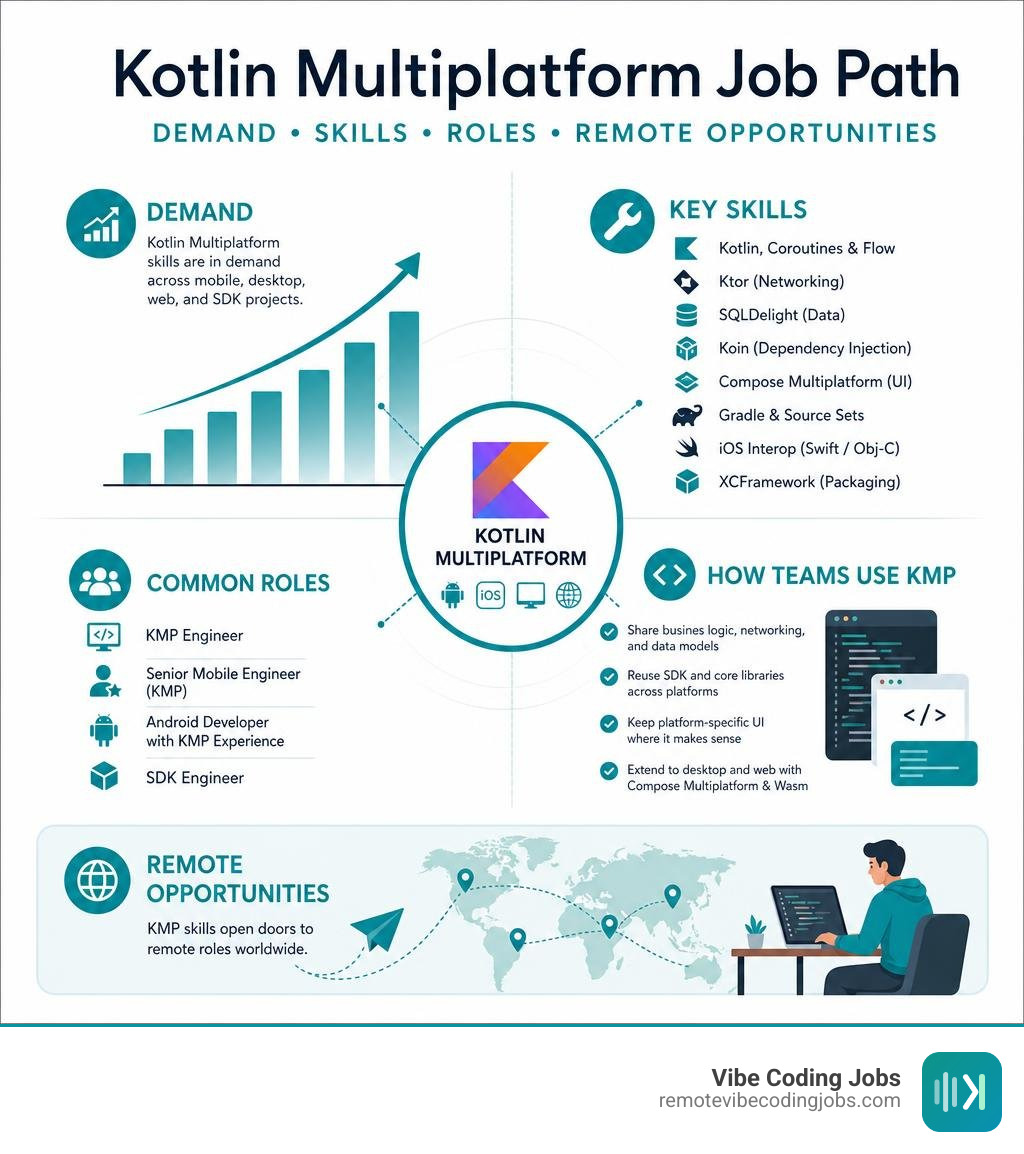
The broader Kotlin market is active, with more than 7,000 Android Kotlin roles listed worldwide in recent job-board data. Dedicated KMP openings are fewer, but they often target mid-to-senior engineers. Employers commonly hire for titles such as KMP Engineer, Senior Mobile Engineer, Android Developer with KMP experience, and SDK Engineer.
What makes these roles different is the work itself. Teams are using KMP to share business logic, networking, data models, and SDK code across Android and iOS, while keeping platform-specific UI where it makes sense. Some are also extending that shared code to desktop and web through Compose Multiplatform and Kotlin/Wasm.
For candidates, the signal is clear: Kotlin alone is not enough. The most useful skills include Coroutines and Flow, Ktor, SQLDelight, Koin, Compose Multiplatform, Gradle source sets, Swift or Objective-C bridging, and XCFramework packaging. You do not always need to be an iOS expert, but you should understand how shared Kotlin code reaches a Swift app.
I am Dominic Zijlstra, a technologist and entrepreneur with experience in data infrastructure, DevOps, automated systems, and software products. That background shapes this practical look at Kotlin Multiplatform jobs: what teams need, how they hire, and how developers can show they are ready for real cross-platform work.
Basic kotlin multiplatform jobs terms:
Market Demand and Salaries for Kotlin Multiplatform Jobs
The mobile development landscape has shifted away from fragmented native codebases toward unified core logic. Companies across fintech, healthcare, IoT security, digital streaming, and on-device machine learning want to write their core state machines, networking layers, and validation rules once without compromising on native user experience.
Because Kotlin Multiplatform (KMP) allows native platform integration rather than forcing a heavy, one-size-fits-all runtime engine, hiring demand is concentrated among engineering teams that care deeply about app responsiveness, raw execution speed, and granular system access.
| Role Level / Specialization | Base Salary Range (USD) | Additional Compensation & Perks | Key Experience Benchmarks |
|---|---|---|---|
| Senior Software Engineer (Java/Kotlin) | $130,900 – $166,600 | 401(k) matching, health coverage, annual bonuses | 5+ years software engineering, JVM/Android mastery |
| Kotlin Multiplatform Engineer (Senior-Staff) | $180,000 – $230,000 | Meaningful startup equity, $500/mo lifestyle stipends, 42 days PTO | 8+ years experience, KMP/Wasm production design |
| Mid-to-Senior KMP Developer (Global / Distributed) | Market Competitive / Contract | Flexible scheduling, remote stipends, project bonuses | 5+ years development with 1.5–2+ years dedicated KMP |
| Multiplatform Desktop / SDK Lead | $150,000 – $210,000 | Stock options, dedicated learning budgets, conference sponsorship | Deep Kotlin Native, gRPC, Protobuf, architecture design |
Compensation packages for cross-platform Kotlin engineers reflect the hybrid nature of the role. Because a single developer with multiplatform expertise can bridge the divide between two platform teams, employers offer high base salaries and substantial equity grants to secure top talent.
Global Hiring Trends in Kotlin Multiplatform Jobs
Global hiring data reveals a distinct skew toward higher seniority levels. Mid-to-senior level openings represent over 67% of all active listings, while purely entry-level openings account for a much smaller fraction.
Workplace models in this segment have adapted quickly to distributed engineering:
- Roughly 25% of all active Kotlin multiplatform postings are listed as fully remote.
- Another 23% are structured as hybrid setups, giving local teams collaborative sprint planning days while leaving execution flexible.
- The remaining openings remain tied to on-site labs, often within hardware security, automotive displays, medical diagnostics, or high-security fintech environments.
Contract pools and specialized mobile consultancies have also grown rapidly. When enterprise teams decide to migrate existing Android and iOS applications into a unified shared core, they frequently hire specialized contract engineers to set up the Gradle architecture, write foundational source sets, and upskill internal developers.
Seniority Expectations and Salary Tiers
Entry into mid-level positions generally requires strong fluency in modern native Android development or JVM software architecture, paired with demonstrated enthusiasm for cross-platform source code sharing. For senior and staff positions, hiring bars rise sharply.
Companies hiring for Senior and Staff Kotlin Multiplatform Engineers look for professionals with 5 to 8+ years of total software engineering experience, including at least 1.5 to 2 years building multi-target production apps. Staff-level developers are expected to own the cross-compilation pipeline, define public-facing SDK boundaries, design internal concurrency architectures, and evaluate multi-target performance trade-offs.

Essential Technical Stack and Skills Employers Demand

Production multiplatform jobs require a specialized collection of libraries and frameworks designed to run reliably across different execution targets without relying on platform-specific runtimes.
The modern production KMP toolset includes:
- Concurrency: Kotlin Coroutines and asynchronous Flow for structured concurrency.
- Networking: Ktor client for cross-platform HTTP requests, serialization, and WebSockets.
- Data Persistence: SQLDelight or multiplatform DataStore for offline-first local databases and settings.
- Dependency Injection: Koin Multiplatform or compile-time DI solutions like Metro.
- Data Formats: kotlinx.serialization, Protobuf, and GraphQL schema generators.
- Build Infrastructure: Gradle multiplatform plugins, Kotlin Multiplatform source sets, and configuration scripts.
A practical example of how these libraries assemble into a cohesive multiplatform architecture can be seen in open-source reference implementations like MohannedSohail/FursatiCMP_CI-CD, which showcases clean layer separation across Android, iOS, and desktop targets.
Shared Business Logic vs Compose Multiplatform UI
When companies evaluate candidate profiles, they frequently distinguish between two primary multiplatform architectures:
- Shared Core Logic Only: In this architectural pattern, the shared KMP module contains network handling, local database operations, repository layers, state machines, and business rules. Android utilizes Jetpack Compose, while iOS engineers consume the shared core through standard SwiftUI views.
- Full-Stack Compose Multiplatform: Here, teams share both the underlying logic and the user interface using Compose Multiplatform. This approach has gained significant momentum across desktop applications (macOS, Windows, Linux), web environments via Kotlin/Wasm, and mobile interfaces.
Desktop-focused job listings often do not require Android SDK expertise at all. Instead, they require deep knowledge of JVM tuning, Compose Multiplatform desktop rendering, Protobuf, gRPC, and Domain-Driven Design (DDD). On the web frontier, forward-thinking startups are targeting Kotlin/Wasm to execute high-performance browser modules directly from the same Kotlin codebase powering their mobile apps.
Native Interoperability and iOS Integration
A recurring hurdle for Android developers stepping into cross-platform roles is understanding the mechanics of iOS compilation. Employers do not expect you to write Swift like a ten-year veteran, but you must know how Kotlin code compiles and integrates into the Apple ecosystem.
Key iOS interop topics tested in technical interviews include:
- Generating and distributing Apple-compatible binaries via XCFramework packages.
- Understanding how Kotlin Coroutines and suspend functions translate across Objective-C and Swift language boundaries.
- Working with the modern Kotlin/Native memory manager to avoid leaks and maintain smooth UI performance.
- Designing platform abstractions using the
expect/actualdeclaration pattern to access native APIs such as secure keychains, device sensors, or Bluetooth stacks.
Key Challenges and Engineering Best Practices
Building for multiple platforms from one codebase introduces distinct technical hurdles that pure single-platform engineers rarely encounter.
Engineering teams focus heavily on these architectural and operational practices:
Navigating Platform Boundaries and SDK Architecture
The most effective KMP shared modules maintain strict, platform-clean boundaries. A common pitfall is leaking platform-specific imports (such as Android context or UIKit objects) into the shared common source set.
Top engineering teams mandate that:
- The shared domain module exposes only immutable, plain data classes and clean suspend functions at the public boundary.
- State machines decouple internal side effects from the user interface, returning structured state streams via Kotlin Flow.
- Dependency injection graphs cleanly separate common dependencies (like HTTP clients) from platform implementations (such as platform-specific database drivers).
- Internal test suites run lightweight validation companion applications (often built with Jetpack Compose) to benchmark core logic before cutting cross-platform framework releases.
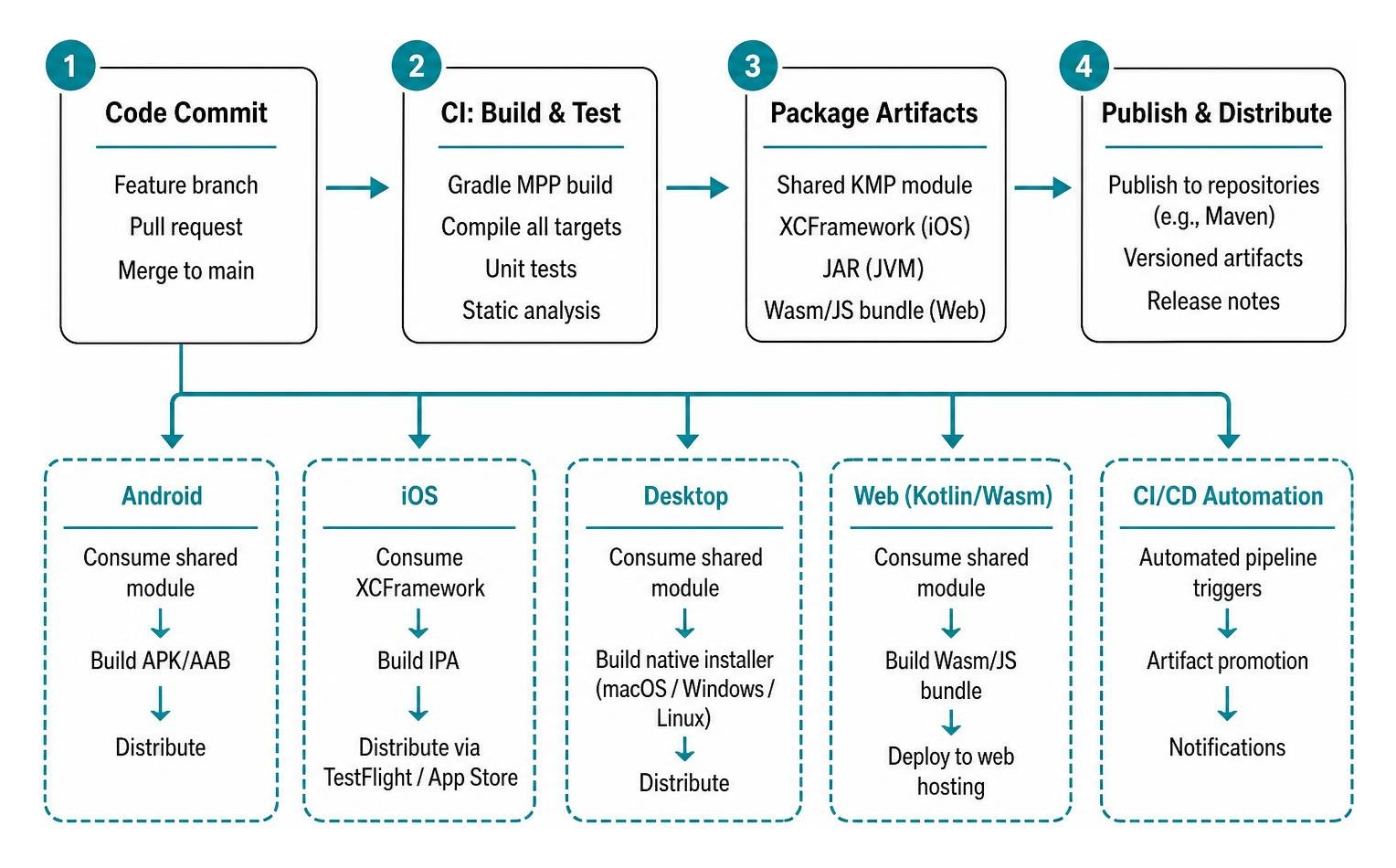
CI/CD Pipelines and Multi-Target Build Automation
Automating cross-platform builds requires orchestrated DevOps workflows. Unlike standard single-platform apps, KMP repositories compile against Linux runners for Android and JVM, while requiring macOS runners to compile Apple-targeted XCFrameworks.
Common CI/CD requirements found in modern KMP job postings include:
- Managing automated build matrices with GitHub Actions and Fastlane.
- Resolving cross-environment bundler lock issues across disparate OS architectures (e.g.,
x86_64-linuxandarm64-darwin). - Automating internal test releases via services like Firebase App Distribution.
- Ensuring static code analysis, formatting checks, and unit test suites execute seamlessly across all target source sets on every pull request.
How Modern Hiring Evaluates KMP Engineers

The interview process for multiplatform roles has moved away from abstract algorithmic puzzle-solving toward practical, architecture-driven evaluations.
Employers typically structure their evaluation pipeline across three distinct stages:
- Practical Screening: A take-home exercise or live architectural review assessing clean architecture, Coroutines usage, and modular project design.
- Deep-Dive Technical Interview: A collaborative session exploring cross-platform memory management, dependency injection, and iOS/Android interop trade-offs.
- Culture and Async Collaboration: Evaluating communication clarity, documentation habits, and self-directed problem-solving.
Engineers seeking remote opportunities can explore Kotlin async-first jobs to connect with companies that prioritize written documentation, independent time-zone management, and thoughtful code review over constant meetings.
Differentiating Pure Android Roles from Kotlin Multiplatform Jobs
While native Android roles focus heavily on Android Jetpack components, view lifecycles, and platform UI guidelines, dedicated KMP positions require a systems-level mindset.
Employers look for candidates who understand:
- How to structure source sets (
commonMain,androidMain,iosMain,jvmMain) without code duplication. - The differences in garbage collection and memory lifecycles between the JVM and Kotlin/Native runtimes.
- How to write agnostic networking layers using Ktor rather than Android-bound Retrofit setups.
- Full-stack integration connecting client modules with containerized backend services running Java or Kotlin microservices.
AI-Assisted Workflows and Modern Development Dynamics
Engineering teams are embracing AI-assisted development tools to speed up multiplatform migrations. Tools like Cursor, Claude, and intelligent code generators help developers scaffold repetitive multi-target boilerplate, write Swift-to-Kotlin wrapper layers, and generate cross-platform test fixtures.
Teams hiring for Kotlin vibe coding jobs value engineers who can guide AI tools intelligently—leveraging modern generative assistants to draft repetitive expect/actual boilerplate while applying human discernment to overall system architecture, memory safety, and public API design.
Frequently Asked Questions about Kotlin Multiplatform Careers
Do I need extensive iOS experience to apply for KMP jobs?
No, you do not need to be a senior iOS developer. Most teams expect strong Kotlin fundamentals and a solid understanding of how shared Kotlin code is packaged (via XCFrameworks) and consumed inside Xcode with Swift. Being able to read basic Swift code and understand SwiftUI state management will place you ahead of the majority of applicants.
How do KMP salaries compare to traditional native mobile roles?
KMP positions generally offer a 10% to 20% salary premium over single-platform mobile roles at equivalent seniority levels. Because a multiplatform engineer can build and maintain features across Android, iOS, desktop, and web targets simultaneously, organizations achieve higher operational leverage and compensate experienced KMP developers accordingly.
What portfolio projects best demonstrate production-ready KMP skills?
The strongest portfolio project is a multi-target application (Android, iOS, and Desktop or Wasm) that shares business logic, networking (Ktor), persistence (SQLDelight), and dependency injection (Koin). Including an automated GitHub Actions CI/CD workflow that tests and builds artifacts for all targets will immediately validate your production readiness to hiring managers.
Conclusion
Kotlin Multiplatform has transitioned from an experimental framework into a reliable cross-platform solution for enterprise applications, on-device AI tooling, and high-performance mobile SDKs. By combining deep Kotlin fluency with multi-target build orchestration, Swift interop basics, and clean architectural boundaries, engineers can access high-paying, high-impact roles worldwide.
If you are ready to apply your cross-platform and backend skills in forward-thinking, async-first environments, find remote backend and multiplatform roles and discover companies building the future of software development today.