
The Real State of Android Kotlin Developer Jobs in 2026
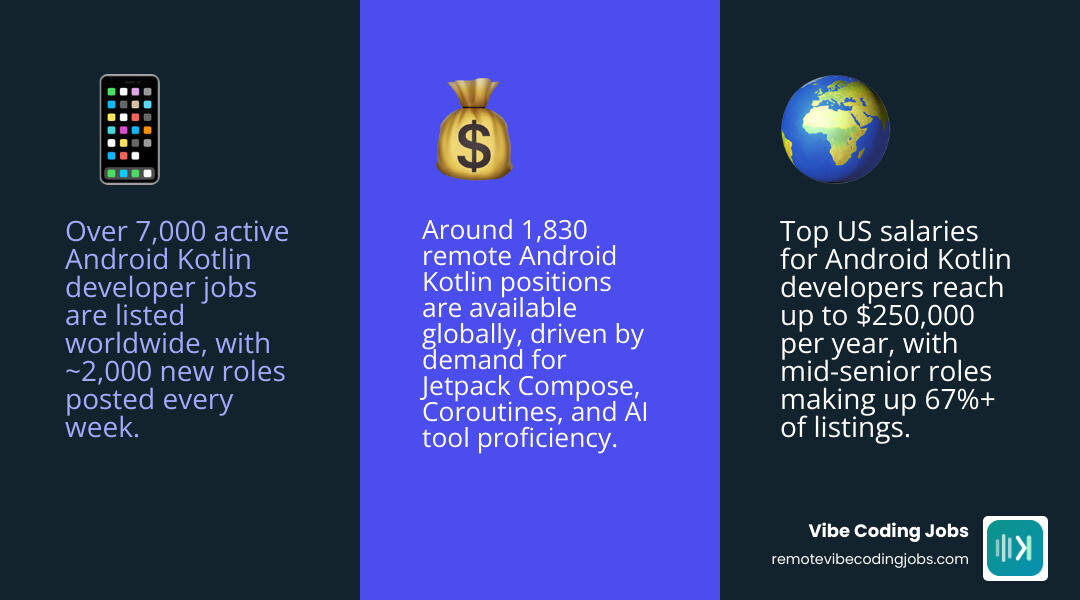
Android Kotlin developer jobs are one of the most active hiring categories in tech right now — with over 7,000 positions listed worldwide and more than 2,000 new roles posted every week.
Here’s a quick snapshot of what the market looks like today:
| Factor | Current State (2026) |
|---|---|
| Global job volume | 7,000+ active listings |
| New jobs per week | ~2,000 |
| Most in-demand level | Mid-Senior (67%+ of listings) |
| Top salary (US) | Up to $250,000/year |
| Remote roles available | ~1,830 globally |
| Must-have skills | Kotlin, Jetpack Compose, Coroutines |
| Rising differentiator | Kotlin Multiplatform (KMP) |
| Emerging requirement | AI coding tools (Cursor, Copilot, Claude) |
The demand is real. But the bar has also risen. Employers in 2026 aren’t just looking for someone who knows Kotlin. They want developers who can ship with Jetpack Compose, think in Clean Architecture, and increasingly — use AI-assisted tools as part of their daily workflow.
Whether you’re eyeing a fintech startup in Europe, a healthtech company in the US, or a fully remote role anywhere in between, this guide breaks down exactly what’s hiring, what’s paying, and what skills will get you to the offer stage fastest.
I’m Di Su, a software engineer with over 10 years of experience building scalable, user-centric products — and I’ve spent considerable time analyzing what actually moves the needle when developers search for android kotlin developer jobs in competitive markets. My background spans technical engineering and growth strategy, which means I’ll cut through the noise and show you only what’s actionable.
The 2026 Landscape of Android Kotlin Developer Jobs

The job market for mobile engineers in 2026 has settled into a fascinating rhythm. While some enterprise giants have pushed hard for hybrid office mandates, the demand for highly specialized native developers means remote work remains incredibly strong. Out of more than 7,000 active global listings, roughly 1,830 are fully remote, and another 1,712 are hybrid.
When searching for the Best Programming Languages for Remote Work in 2026, Kotlin consistently ranks at the top for mobile. Modern teams are eager to hire native Android specialists because mobile apps are no longer just “add-ons” to web products—they are often the primary touchpoint for millions of users.
However, the hiring landscape has shifted toward the higher end of the experience spectrum. Over 67% of all active job postings target mid-to-senior developers. Companies are looking for engineers who can jump in, understand complex modularized codebases, and optimize app performance immediately.
Key Industries Hiring for Android Kotlin Developer Jobs
If you are looking for your next role, we recommend targeting these four hyper-active sectors:
- Fintech & Mobile Banking: High-scale apps requiring flawless security practices, real-time transaction processing, and complex state management. Companies like Finom and major digital banking platforms are constantly hiring to build out features like multi-account cash flow and AI-driven accounting.
- Healthtech & Wearables: This sector is booming. Companies like Eko build AI-powered digital tools to detect heart and lung diseases, requiring engineers who understand background execution, Bluetooth Low Energy (BLE) integration, and medical device communication.
- Robotics & Autonomous Systems: A unique and highly lucrative niche. Companies like AION Robotics build real-time vehicle control interfaces (similar to drone flight software) where low-latency Kotlin development is key.
- E-Commerce & E-Pharmacy: Giant platforms like Redcare Pharmacy Careers require deep native Android expertise to scale shopping carts, handle sensitive health-related user data, and optimize image-heavy rendering.
Salary Ranges and Compensation for Android Kotlin Developer Jobs
Compensation in 2026 remains highly competitive, especially for engineers who can operate at a senior level. Let’s look at the numbers we are seeing in recent job listings across different regions.
According to our Vibe Coding Salary Guide 2026, here is how the compensation breaks down:
| Experience Level | Region / Type | Annual Salary Range / Rate |
|---|---|---|
| Senior Mobile App Developer | United States (Robotics/AI) | $100,000 – $250,000 |
| Senior Android Engineer | United States (Digital Health) | $160,000 – $179,000 |
| Senior Android Developer | Europe (Germany/E-Pharmacy) | €75,000 – €102,000 |
| Senior Android Developer | Canada (Remote/Logistics) | $108,000 – $135,000 (CAD) |
| Mid-Level Android Developer | United States (General) | $100,000 – $174,000 |
| Mid-Level Contractor | Remote / B2B | ~$40 – $65 / hour |
Beyond base salary, modern tech companies offer highly attractive benefits packages, including stock incentives, 401(k) matching, comprehensive mental health support, and flexible travel perks (such as working up to 20 days a year from anywhere in the EU).
Essential Technical Skills and Frameworks in 2026
If you are browsing through Android Developer Jobs, you will notice that the core tech stack has become highly standardized. Knowing Java is still useful for maintaining legacy enterprise codebases, but modern feature development is 100% Kotlin.
The baseline expectation for any mid-to-senior role includes:
- Jetpack Compose: This is no longer a “nice-to-have.” Declarative UI is the absolute standard in 2026. If you aren’t comfortable building complex, modular UI components with Compose, you will struggle to pass initial technical screenings.
- Asynchronous Programming: Strong mastery of Kotlin Coroutines and Flow is mandatory for handling asynchronous data streams, network requests, and database operations.
- Local Storage & Networking: Experience with Room Database for offline caching and Retrofit or Ktor for API communication.
- Dependency Injection: You must be fluent in Hilt or Koin to manage dependencies in a scalable, testable way.
- Architecture Patterns: Companies expect you to design applications using MVVM or MVI patterns coupled with Clean Architecture principles.
Native Android vs. Cross-Platform Mobile Roles
One of the biggest architectural debates in 2026 is the choice between purely native development and cross-platform frameworks. While Flutter and React Native still have their place, Kotlin Multiplatform (KMP)—formerly known as KMM—has transitioned from a niche experiment to a major industry differentiator.
KMP allows developers to write business logic, networking, and data storage once in Kotlin, sharing it seamlessly between iOS and Android, while still building native user interfaces (using Jetpack Compose for Android and SwiftUI for iOS).
Companies like Senior Android Engineer at Eko actively hire Senior Android Engineers with KMP expertise to streamline cross-platform development. Even traditional native roles now list KMP as a highly valued skill that can give you a significant competitive edge in the job market.
The Rise of AI-Assisted “Vibe Coding” in Android Development
The day-to-day workflow of an Android developer has changed dramatically. We have entered the era of vibe coding—where engineers act more like product builders and architects, leveraging powerful AI assistants to generate boilerplate, write tests, and debug complex UI layouts.
Top-tier engineering teams are actively formalizing AI tool usage into their workflows. For instance, modern job postings like the Senior Android Developer at Neatspark explicitly look for developers who are proficient with AI-powered IDEs and agents like Cursor, Windsurf, Claude Code, and GitHub Copilot.
To thrive as a vibe coder in 2026, you need to master:
- Prompt Engineering: Learning how to write clear, context-rich prompts to generate high-quality Kotlin code.
- Context Window Management: Knowing how to configure rules files (like
.cursorrules) so your AI assistant understands your codebase architecture, linting rules, and dependency injection patterns. - Verification and Testing: Because AI can hallucinate, a great developer focuses heavily on writing unit tests (using JUnit and MockK) and UI tests (using Espresso or Compose UI Test) to verify AI-generated output.
For a deeper dive into how this works, check out our guide on Vibe Coding with AI A Beginner’s Practical Guide 2026.
How to Land Your Next Android Kotlin Role
With the market leaning heavily toward experienced developers, getting noticed requires a strategic approach. If you are a self-taught developer or transitioning into mobile, you might read about Why Junior Developers Struggling Find Jobs 2026. The key to breaking through is demonstrating real-world, production-ready skills.
Here are our top recommendations for standing out:
- Build a Modern Portfolio: Don’t just show simple “To-Do” apps. Create a multi-module Android project that implements Jetpack Compose, Clean Architecture, Hilt, and offline caching with Room. You can accelerate this process by reading our guide on how to Build a Developer Portfolio with AI Tools 2026 Guide.
- Contribute to Open Source: Contributing to active Kotlin Multiplatform libraries or well-known Android projects is a massive green flag for recruiters.
- Publish an App: Actually shipping an app to the Google Play Store shows you understand the entire lifecycle, including Gradle configurations (Kotlin DSL), Fastlane, and Play Console release management.
Navigating the Modern Interview Process
The interview process for android kotlin developer jobs has evolved. While you will still face system design rounds, the traditional “LeetCode whiteboard” style is increasingly being replaced by practical, real-world assessments.
Many forward-thinking companies now run AI-assisted coding interviews. Instead of banning AI, they expect you to use tools like Cursor or Copilot to solve a complex coding challenge live. They will evaluate your ability to direct the AI, structure prompt rules, spot logic errors or hallucinations, and quickly write automated tests to verify the code.
Additionally, prepare to discuss mobile system design topics, such as:
- How to design a robust offline-first synchronization mechanism.
- How to optimize UI rendering performance (e.g., aiming for 60/120fps using Baseline Profiles).
- How to handle secure storage and obfuscation in fintech or healthcare environments.
Frequently Asked Questions about Android Kotlin Careers
What is the average salary for a Senior Android Kotlin Developer in 2026?
In the United States, a Senior Android Engineer can expect to earn between $122,000 and $250,000 per year, depending on the industry and level of hardware integration (such as medical devices or robotics). In Europe, senior salaries typically range from €75,000 to €102,000, often accompanied by excellent remote flexibility and stock options.
Is Kotlin Multiplatform (KMP) required for native Android jobs?
No, it is rarely a strict requirement, but it has become an incredibly powerful skill differentiator. Having KMP on your resume shows employers that you can help bridge the gap between their iOS and Android teams, allowing them to share core business logic and save hundreds of engineering hours.
How are AI tools changing the day-to-day work of Android developers?
AI tools like Cursor and Claude Code allow developers to skip the tedious boilerplate code and focus on architecture, performance tuning, and product logic. Instead of writing basic network clients or database schemas by hand, developers can “vibe code” the foundation in seconds and spend their energy solving complex problems like low-latency Bluetooth connectivity or high-security data encryption.
Conclusion
The market for android kotlin developer jobs in 2026 is full of high-impact, high-reward opportunities for developers who stay ahead of the technical curve. By mastering Jetpack Compose, understanding Kotlin Multiplatform, and embracing AI-assisted development tools, you position yourself as a highly valuable product builder rather than just a traditional coder.
At RemoteVibeCodingJobs, we specialize in connecting talented mobile developers with forward-thinking, async-first companies that value deep work, modern tech stacks, and AI efficiency.
If you are ready to find your next remote role where you can vibe code in a supportive environment, explore our curated Remote Backend Developer Jobs and mobile listings, download our free playbook, and fast-track your application today!